
 By TechOriginHub Editorial Team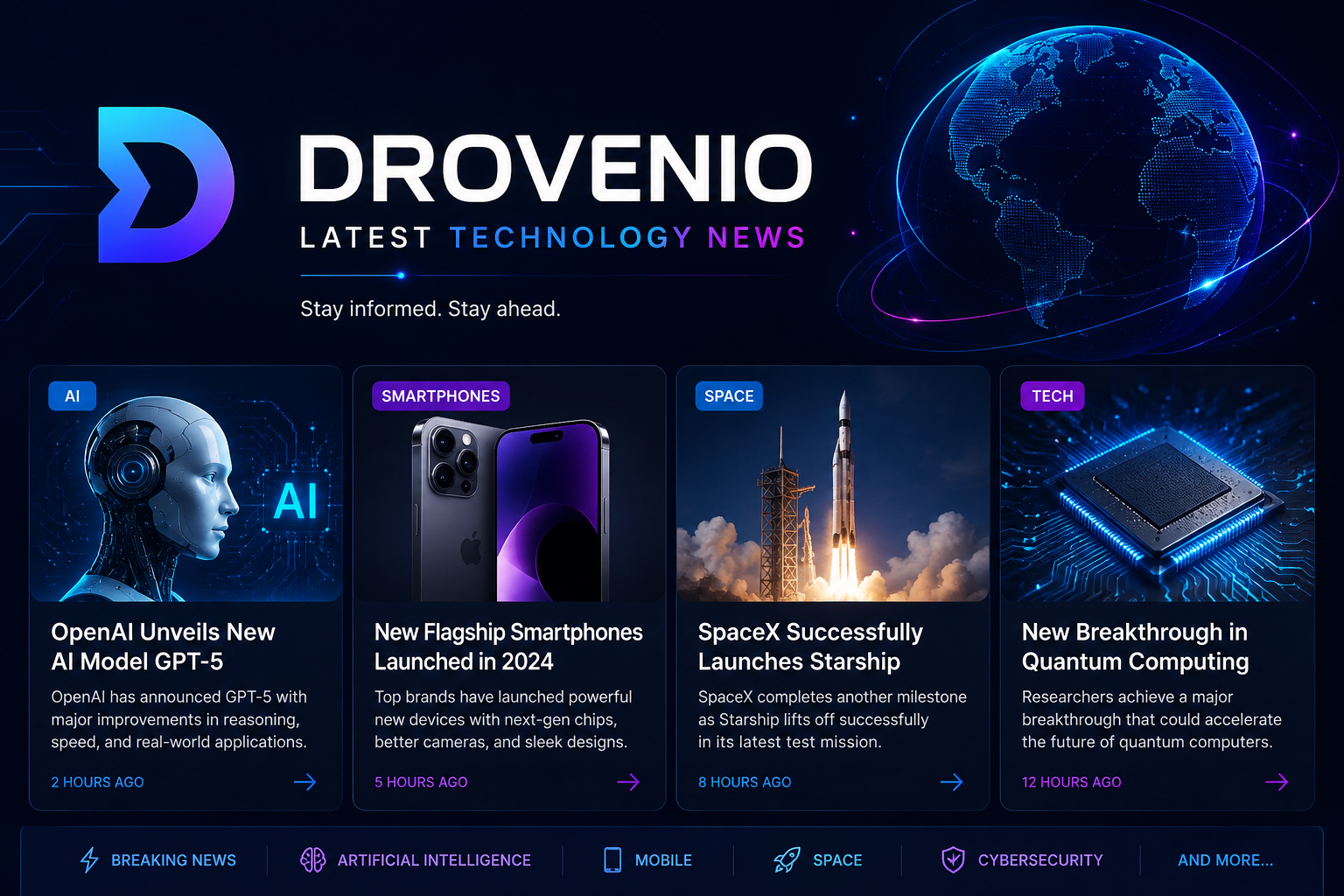
Introduction
Technology moves quickly, and staying informed requires knowing where to look and how to evaluate what you find. Searches for drovenio latest technology news reflect a growing interest in technology content that covers artificial intelligence, cybersecurity, cloud computing, software development, and the broader wave of digital transformation reshaping industries worldwide.
This article explains what the Drovenio technology news keyword refers to, what technology topics are most commonly associated with it, and what the major technology trends of 2026 look like across these areas. It also provides practical guidance on how to verify technology information and how to identify reliable sources in an environment where technology news can become outdated very quickly.
Whether you are a developer, a business professional, a student, or someone who simply wants to understand what is happening in the technology world, this guide provides the context and orientation you need.
What Is Drovenio Latest Technology News?
Drovenio latest technology news refers to technology content and updates published under the Drovenio name, covering topics such as artificial intelligence, automation, cybersecurity, cloud computing, software development, and emerging digital technologies. When people search for this term, they are generally looking for current developments in these areas, seeking either updates specific to the Drovenio platform or using the term to discover broader technology news associated with it.
The search intent behind this keyword is primarily informational. Readers want to understand what is happening in technology, what trends are emerging, and how new developments might affect them as professionals, students, or technology users.
What Is Drovenio?
Based on publicly available information, Drovenio appears to be a technology-focused content platform or publication that covers topics related to artificial intelligence, emerging technologies, digital innovation, and related fields. It is associated with educational and news-style technology content intended for a broad audience including technology enthusiasts, developers, business professionals, and students.
It is important to be clear about what can and cannot be verified regarding Drovenio. This article does not claim that Drovenio develops, owns, or operates any specific technology product or software. Drovenio is treated here as a technology content entity rather than a technology developer. Readers interested in Drovenio’s current status, ownership, editorial team, or official positions should consult the Drovenio website or official communications directly.
What is clear from the search landscape is that Drovenio is associated with technology news content spanning several of the most actively discussed areas in contemporary technology. The topics it covers align closely with the major trends driving the technology industry in 2025 and 2026.
Why Are People Searching for Drovenio Latest Technology News?
The search volume around drovenio latest technology news reflects several overlapping motivations.
Many readers are looking for accessible explanations of fast-moving technology topics. Artificial intelligence in particular has generated enormous public interest, and people are actively seeking sources that explain what is actually happening beneath the hype.
Others are specifically following technology updates in areas that affect their work, such as cybersecurity threats, cloud infrastructure changes, or new development tools. Staying current in these areas is a professional necessity for many IT and software roles.
Students and learners use technology news publications to supplement formal education with real-world context, understanding how the concepts they study connect to current industry developments.
Business owners and decision-makers follow technology news to identify tools, platforms, and practices that could improve their operations or create competitive advantage.
Each of these groups finds value in a technology news source that covers multiple areas under one platform, which is part of what makes aggregated technology content like Drovenio’s attractive to readers.
Technology Topics Covered by Drovenio
Artificial Intelligence
Artificial intelligence is one of the defining technology stories of this decade. The development of large language models, image generation systems, AI-powered search, and AI-integrated business software has accelerated rapidly. Drovenio technology content addresses AI both in terms of its technical development and its practical applications across industries.
AI is no longer confined to research laboratories or specialist applications. It is being integrated into productivity software, customer service systems, medical diagnostics, financial analysis, and creative tools. Understanding what AI can genuinely do, as opposed to what it is claimed to do, requires following developments from primary sources including official research publications and company announcements.
Generative AI
Generative AI refers to systems capable of producing new content, including text, images, audio, video, and code, based on patterns learned from training data. This category of AI has attracted significant attention because of its practical applicability across many domains.
In software development, generative AI tools assist developers by suggesting code, identifying bugs, and automating repetitive tasks. In content production, these tools support writers, designers, and marketers. In business contexts, they are being used to automate document processing, customer communication, and data summarization. The technology is developing rapidly, and specific capabilities and limitations change frequently as models are updated.
Automation
Automation in the technology context refers to using software, scripts, AI systems, and tools to perform tasks that previously required manual human effort. This spans a wide range from simple file management scripts to complex robotic process automation in enterprise environments.
The intersection of AI and automation is particularly significant. AI systems can now handle more variable and judgment-dependent tasks than earlier rule-based automation, expanding the range of work that can be automated and raising important questions about workflow design and workforce adaptation.
Cybersecurity
Cybersecurity remains one of the most urgent and fast-moving areas in technology. The threat landscape changes continuously as attackers develop new techniques and defenders develop countermeasures. Technology news in this area covers new vulnerabilities, attack trends, security product developments, regulatory changes, and best practices for organizations and individuals.
The TechOriginHub guide to what is cybersecurity provides foundational context for readers who want to understand the core concepts before following current cybersecurity news.
Cloud Computing
Cloud computing has moved from an emerging trend to the dominant infrastructure model for most organizations. Technology news in this area covers new services and pricing from major cloud providers, architectural trends such as serverless and edge computing, and the integration of AI capabilities into cloud platforms.
The TechOriginHub guides to what is cloud computing and how does cloud computing work provide useful background for understanding cloud-related technology developments.
Software Development
Software development is an area where technology news covers programming language developments, new frameworks and tools, changes to development workflows, and the increasing role of automation and AI assistance in writing code. For developers, staying current with tooling changes and emerging best practices is a professional necessity.
Digital Transformation
Digital transformation describes the process by which organizations integrate digital technology into their operations, changing how they work and deliver value. Technology news in this area covers enterprise software adoption, cloud migration, AI integration, and the organizational changes that accompany technology adoption.
Emerging Technology
Emerging technology encompasses areas that are developing rapidly and may reshape industries significantly in the coming years. Quantum computing, augmented reality, advanced robotics, and next-generation networking technologies are all areas where technology news organizations track progress, breakthroughs, and realistic timelines for practical adoption.
Latest Technology Trends to Watch in 2026
The following areas represent the most actively developing and widely discussed technology trends as of 2026. Readers should note that specific product announcements and capability claims in technology news should always be checked against official sources and publication dates.
Generative AI maturation is moving from the initial wave of novelty and experimentation toward more structured enterprise adoption. Organizations are building internal policies, evaluation frameworks, and integration strategies for generative AI tools rather than simply experimenting with them.
AI agents and agentic systems represent a significant development beyond simple generative AI. Rather than responding to a single prompt, AI agents can pursue multi-step goals, use tools, access external information, and take actions in digital environments. This capability is being explored in software development automation, business process automation, and research assistance.
AI security has become a priority as security researchers and organizations identify ways that AI systems can be manipulated, deceived, or exploited. Prompt injection, data poisoning, and model inversion attacks are areas of active research and concern. Security teams are developing frameworks for evaluating and monitoring AI systems deployed in production environments.
Edge computing is growing as organizations recognize the limitations of routing all data processing through centralized cloud data centers. Processing data closer to where it is generated reduces latency, improves reliability in environments with limited connectivity, and can reduce data transmission costs. This trend is particularly relevant for manufacturing, logistics, and connected devices.
Cybersecurity regulatory changes are accelerating globally. Governments and regulatory bodies are introducing new requirements for organizations to disclose security incidents, implement specific security controls, and demonstrate compliance with data protection standards. Technology news in this area is closely followed by compliance and security professionals.
Developer tooling evolution continues to accelerate with AI-assisted development environments becoming mainstream. The nature of what software developers spend their time on is shifting as tools handle more of the routine implementation work, with greater focus on architecture, system design, and quality evaluation.
Quantum computing progress continues in research environments, though practical, commercially viable quantum computers capable of outperforming classical computers on real business problems remain further away than some headlines suggest. Technology news in this area benefits from careful reading of primary research sources rather than secondary summaries.
Smart devices and connected infrastructure continue to proliferate, bringing both productivity benefits and security challenges. The management and security of large numbers of connected devices is a growing concern for IT departments and security teams.
AI and Drovenio Technology News
Artificial intelligence is the technology area attracting the most attention in the current technology news cycle, and it is a central topic in the type of content associated with drovenio latest technology news searches.
Software development is being significantly affected by AI assistance tools. Developers use AI-powered tools to generate code suggestions, identify potential bugs, write documentation, and review code. These tools do not eliminate the need for skilled developers but change the nature of their work, with more time spent on design, architecture, and quality evaluation. The TechOriginHub guide to what is programming provides foundational context for understanding how software development works before exploring AI’s impact on it.
Business automation is expanding as AI systems become capable of handling more varied and less predictable tasks than earlier automation approaches. Customer service, document processing, data extraction, and report generation are areas where organizations are deploying AI automation actively.
Data analysis is being transformed by AI tools that can identify patterns in large datasets, generate natural language summaries of analytical findings, and suggest follow-up questions or analyses. This makes sophisticated data work more accessible to people without specialized data science backgrounds.
Cybersecurity is both benefiting from and being challenged by AI. Defenders use AI to detect anomalies, identify threats faster, and automate responses to common attack patterns. Attackers use AI to generate more convincing phishing content, identify vulnerabilities more efficiently, and scale their operations. The security community is actively tracking this adversarial dynamic.
Search and information discovery are changing as AI-powered search features change how people find information online. This has significant implications for technology publishers, developers building information products, and users evaluating the reliability of the information they receive.
It is important to approach AI news with appropriate calibration. Not every claimed AI capability is fully realized, and the gap between research demonstrations and production-ready systems is often significant. Reliable technology journalism distinguishes between research results, product announcements, and verified production deployments.
Cybersecurity Trends
Cybersecurity is one of the most rapidly changing areas in technology, and staying informed requires following developments across several interconnected areas.
AI-powered cyber threats are an escalating concern. Attackers are using AI tools to craft more convincing phishing messages, personalize social engineering attacks at scale, and identify vulnerabilities in systems more efficiently. The volume and sophistication of attacks has increased, and organizations that previously relied on static rule-based defenses are under greater pressure.
Ransomware continues to affect organizations of all sizes. Attackers encrypt organizational data and demand payment for decryption keys, sometimes also threatening to publish stolen data. The most effective defenses include robust backup systems, network segmentation, and rapid detection and response capabilities.
Identity security has become increasingly central to cybersecurity strategy. As organizations move infrastructure to cloud environments, the identity and access management layer becomes one of the most critical attack surfaces. Multi-factor authentication, privileged access management, and identity threat detection are active areas of investment.
Zero Trust architecture represents a shift in security philosophy from perimeter-based security toward a model that requires continuous verification of every user, device, and connection, regardless of whether they are inside or outside the organizational network. This approach is particularly relevant as remote work and cloud adoption have eroded the traditional network perimeter.
Cloud security is a growing specialization as more organizational workloads move to cloud environments. Misconfigured cloud storage, over-permissive access controls, and insufficient monitoring of cloud workloads are among the most common sources of cloud security incidents.
For readers who want to build a foundational understanding of cybersecurity concepts, the TechOriginHub guide to what is a firewall and the guide to what is antivirus software provide useful starting points. Understanding network security fundamentals is also valuable context, covered in the TechOriginHub article on network security.
Practical advice for individuals and organizations includes keeping all software and operating systems updated, using multi-factor authentication on all important accounts, being critical of unsolicited communications requesting action or information, and maintaining offline backups of important data.
Cloud Computing and Digital Transformation
Cloud computing has moved from an emerging capability to the default infrastructure choice for most new technology projects and an increasing proportion of enterprise workloads.
Cloud infrastructure provided by major providers including AWS, Microsoft Azure, and Google Cloud offers organizations access to computing resources, storage, networking, and a growing range of specialized services on a pay-as-you-use basis. This eliminates or reduces the need for organizations to maintain on-premises hardware for many workloads.
Software as a Service (SaaS) has become the dominant model for delivering business software. Rather than purchasing software licenses and running software on internal servers, organizations subscribe to cloud-hosted software that is managed and updated by the provider. This model covers productivity tools, CRM systems, accounting software, collaboration platforms, and many other categories.
Serverless computing allows developers to deploy application code without managing the underlying server infrastructure. The cloud provider handles scaling, availability, and maintenance automatically, allowing developers to focus on application logic. This approach is particularly suited to event-driven workloads and applications with variable traffic patterns.
Edge computing complements cloud computing by processing data closer to where it is generated rather than routing it to centralized data centers. This is valuable for applications where latency is critical, connectivity to central infrastructure is unreliable, or data volume makes central processing impractical.
AI cloud services have become a significant part of what major cloud providers offer. Pre-built AI models available through APIs, tools for training and deploying custom models, and AI-integrated analytics services allow organizations to use AI capabilities without building them from scratch.
Understanding how cloud services are delivered and what types of cloud deployment exist is valuable background for following cloud technology news.
The TechOriginHub guide to what are the types of cloud computing covers the distinctions between public, private, and hybrid cloud models.
Software Development Trends
Software development is changing rapidly, driven by AI assistance tools, evolving infrastructure models, and the growing complexity of the systems being built.
AI-assisted coding tools have become widely used among professional developers. These tools analyze code context and suggest completions, generate code from natural language descriptions, identify potential bugs, and help developers understand unfamiliar codebases. They change the pace and nature of development work without eliminating the need for developer judgment and expertise.
Programming language evolution continues with established languages like JavaScript, Python, and TypeScript remaining central to web and application development while newer languages like Rust and Go continue to grow in adoption for systems programming and infrastructure. The TechOriginHub guides to what is JavaScript and what is Python programming provide foundational understanding of two of the most widely used languages in current development.
APIs (Application Programming Interfaces) are fundamental to how modern software systems communicate and share functionality. The growth of AI services, cloud platforms, and SaaS tools has made API integration a central skill in software development.
Git and version control remain essential practices for all software development workflows. Collaboration through platforms built on Git has become standard, and version control discipline is one of the most important professional habits for developers.
Cloud-native development practices, including containerization with Docker, orchestration with Kubernetes, and infrastructure as code, have become standard in professional development environments. These practices allow software to be deployed reliably across different environments and scaled efficiently.
Web development continues to evolve with new frameworks, build tools, and standards. Understanding the foundational technologies of HTML, CSS, and JavaScript remains essential. The TechOriginHub guides to what is HTML and what is CSS provide useful context for readers who want to understand how the web is built.
Development tools including code editors, terminal environments, debugging tools, and testing frameworks continue to improve.
The TechOriginHub guide to what is Visual Studio Code covers one of the most widely used development environments.
How to Verify Technology News
Technology news can be exciting, but it can also be inaccurate, exaggerated, or out of date. The following checklist helps readers evaluate technology information before acting on it.
Check the publication date. Technology information becomes outdated quickly. An article about a software feature, security vulnerability, or AI capability from six months ago may no longer accurately reflect the current state. Always note when an article was published and whether it has been updated.
Find the original announcement. When a technology news article describes a new product, feature, or research result, the most reliable information is in the original company announcement, research paper, or official documentation. Follow links back to primary sources rather than relying on secondary summaries.
Check the official company website. For claims about a specific company’s products or services, the company’s official website, documentation, and newsroom are the most authoritative sources.
Read technical documentation. For claims about how a technology works, official technical documentation is more reliable than opinion articles or promotional content.
Compare multiple reputable sources. If a technology claim appears in only one place and cannot be found in coverage from other reputable publications, approach it with caution.
Separate product announcements from independent reviews. Companies have legitimate reasons to present their products favorably. Independent testing and review by credible third parties provides a different and valuable perspective.
Watch for exaggerated claims. Language suggesting a technology “will change everything,” “is completely revolutionary,” or “will replace all human workers” is a signal to read more carefully and check primary sources.
Check whether a feature is actually available. Technology is sometimes announced or demonstrated well before it is available to users. Confirm whether something is in development, in limited preview, or generally available before making decisions based on it.
Drovenio Technology News vs Official Technology Sources
Different types of technology sources serve different purposes, and understanding these differences helps readers use each type appropriately.
| Source Type | Primary Purpose | Reliability for Specific Claims |
|---|---|---|
| Technology publication (e.g., Drovenio) | Aggregated news, analysis, educational content | Moderate; depends on sourcing and editorial standards |
| Company newsroom | Official announcements about products and services | High for official positions; promotional perspective |
| Official documentation | Technical specification and how-to guidance | High for how a product currently works |
| Government agency (e.g., NIST, CISA) | Standards, advisories, regulatory guidance | High for security and compliance information |
| Research paper (peer-reviewed) | Academic and technical research findings | High within scope; may not reflect commercial products |
| Independent technology publication | News, analysis, and reviews | Varies; check editorial standards and sourcing |
| Social media post | Rapid sharing of information | Low; requires independent verification |
Technology publications like Drovenio serve a valuable role by making complex technical topics accessible to broad audiences, aggregating developments across multiple areas, and providing context and analysis that primary sources do not. Their reliability depends on their editorial practices, the quality of their sourcing, and how clearly they distinguish between verified information and analysis.
For decisions with significant consequences, such as adopting a security tool, migrating infrastructure, or evaluating a technology investment, primary sources including official documentation, company technical resources, and government advisories should always be consulted directly.
Why Technology News Becomes Outdated
Technology information has a shorter shelf life than information in many other fields. Understanding why this happens helps readers approach technology content with appropriate awareness.
Software updates can change functionality, remove features, or introduce new capabilities on timelines measured in weeks or months. A tutorial or review written about software version 3.1 may be significantly inaccurate for version 3.5.
AI model changes happen frequently and substantially affect capability claims. A description of what an AI system can or cannot do may be outdated within months as the underlying model is updated.
Security vulnerabilities are disclosed continuously. A product described as secure in an older article may have known vulnerabilities that were discovered after the article was written. Always check current security advisories and patch status.
Product launches and discontinuations change the technology landscape. Products that were leading options in a category may be superseded, discontinued, or significantly changed.
Regulatory changes affect how technology can be used, what compliance requirements apply, and what obligations organizations have. Legal and regulatory technology guidance requires current sources.
Cloud services change pricing, features, availability, and terms of service. Information about cloud service capabilities or costs from a year ago may not accurately reflect current offerings.
Operating system updates change system behavior, security posture, and compatibility. Technology guidance tied to a specific OS version may not apply to current versions.
Checking the publication date of any technology article and verifying key claims against current primary sources is a habit that significantly improves the reliability of technology information you act on. The TechOriginHub guide to what is the internet provides useful background on how the infrastructure of the web itself continues to evolve.
How to Stay Updated With Technology News
Staying genuinely informed about technology developments requires a deliberate approach rather than passive consumption of whatever appears in feeds or search results.
Follow official company newsrooms for the technology products and platforms relevant to your work. Major technology companies publish announcements, documentation updates, and security advisories through official channels that are more reliable than second-hand summaries.
Read technical documentation for tools you use. Documentation is updated when products change and reflects current capabilities and limitations more accurately than articles written about earlier versions.
Follow reputable technology publications that have established editorial standards, cite primary sources, and correct errors when they occur. Reading multiple publications across a topic provides a more complete and balanced picture than relying on a single source.
Monitor security advisories from organizations such as CISA (Cybersecurity and Infrastructure Security Agency) and NIST if cybersecurity is relevant to your work. These organizations publish timely and authoritative information about vulnerabilities and recommended responses.
Follow developer documentation and changelogs for programming languages, frameworks, and tools you use professionally. Official changelogs provide precise information about what changed and when.
Compare perspectives by reading coverage of significant technology developments from multiple sources before forming conclusions. Different publications emphasize different aspects of the same developments, and comparison reveals a more complete picture.
Is Drovenio a Reliable Source for Technology News?
Whether any technology publication is reliable depends on the specific article and its editorial practices rather than on the publication’s name alone. The same principle applies to Drovenio. Readers evaluating any technology content, including content from Drovenio, should apply the following criteria.
Author information: Does the article identify its author? Is there information about the author’s background or expertise? Anonymous technology content is harder to evaluate than content with a named, credentialed author.
Publication dates: Are articles dated? Are significant updates noted when content changes? Undated or poorly dated technology content is a red flag for reliability.
Source citations: Does the article link to or cite primary sources for specific claims? Technology content that makes specific factual claims without citing verifiable sources requires more skepticism.
Original reporting vs aggregation: Does the publication do original reporting, or does it primarily summarize other sources? Both can be valuable, but the distinction affects how you should evaluate specific claims.
Editorial transparency: Is there clear information about the publication’s editorial process, correction policy, and organizational background? Transparent publications are generally more trustworthy than those with no stated standards.
Links to primary sources: High-quality technology journalism links readers to original research, official announcements, and documentation so readers can verify claims independently.
Accuracy of claims: Do specific claims in Drovenio content match what primary sources say? Checking a few specific claims against official sources quickly reveals whether a publication’s content is accurate.
The appropriate conclusion is not that Drovenio is definitively reliable or unreliable as a category, but that individual articles should be evaluated on their sourcing, accuracy, and transparency. This is good practice for all technology content, regardless of the source.
Key Takeaways
The keyword drovenio latest technology news refers to technology content published under the Drovenio brand, covering artificial intelligence, cybersecurity, cloud computing, software development, and related emerging technology areas.
Drovenio appears to be a technology content platform aimed at making complex technology topics accessible to a broad audience. Its exact organizational status and editorial standards should be evaluated directly from its official presence.
Major technology areas in current news coverage include generative AI and AI agents, cybersecurity threats and defenses, cloud computing and digital transformation, software development tooling, and emerging technologies including edge computing and quantum computing.
Readers search for this keyword because they want accessible technology news and updates that cover multiple areas under one source, and because they are following specific technology developments relevant to their work or interests.
Verifying technology information requires checking publication dates, finding primary sources, comparing multiple reputable outlets, and distinguishing between announcements and independently verified information.
Technology news becomes outdated quickly because software, AI systems, security threats, cloud services, and regulatory requirements all change continuously. Date-checking is an essential habit when using technology information for decisions.
Frequently Asked Questions
What is Drovenio latest technology news?
Drovenio latest technology news refers to technology content and updates published under the Drovenio name, covering areas including artificial intelligence, cybersecurity, cloud computing, software development, and emerging technologies. Readers search this term to find technology updates and analysis associated with the Drovenio platform.
What is Drovenio?
Based on publicly available information, Drovenio appears to be a technology-focused content platform or publication. Its exact organizational structure, ownership, and editorial practices should be verified directly from its official channels. This article does not claim Drovenio develops or operates technology products.
What technology topics does Drovenio cover?
Drovenio technology content is associated with topics including artificial intelligence, generative AI, automation, cybersecurity, cloud computing, software development, digital transformation, and emerging technologies such as robotics and quantum computing.
Is Drovenio a technology news website?
Drovenio appears to operate as a technology content platform covering news, trends, and educational content in technology areas. Readers should evaluate its specific articles on the basis of sourcing, author information, and accuracy rather than assuming all content meets the same standard.
Where can I find the latest technology news?
Reliable sources for technology news include official company newsrooms, technical documentation from major technology organizations, government cybersecurity agencies such as CISA, and established technology publications with clear editorial standards. Comparing multiple sources on important topics provides a more accurate picture than relying on a single outlet.
What are the latest technology trends in 2026?
Key technology trends in 2026 include the maturation of generative AI and AI agents in enterprise environments, expanding AI security concerns, edge computing growth, cybersecurity regulatory changes, AI-assisted software development, and continued cloud infrastructure expansion. Readers should verify specific product and capability claims against official sources and recent dates.
Does Drovenio cover AI news?
Based on the search patterns and content associated with Drovenio, artificial intelligence including generative AI, AI tools, and AI-powered automation is a significant topic in its technology coverage.
Does Drovenio cover cybersecurity?
Cybersecurity is among the technology topics associated with Drovenio content, including coverage of threats, security practices, and technology security developments.
Is Drovenio a reliable technology news source?
Reliability depends on specific articles and their sourcing rather than the platform name alone. Readers should evaluate Drovenio content by checking source citations, publication dates, author information, and accuracy against primary sources, as they should with any technology publication.
How can I verify technology news?
Verify technology news by checking publication dates, finding original announcements from official sources, consulting official technical documentation, comparing coverage across multiple reputable publications, and being skeptical of unsourced specific claims or exaggerated capability descriptions.
What are the biggest technology trends in 2026?
The biggest technology trends in 2026 include enterprise AI adoption and AI agents, cybersecurity threats powered by AI, edge computing, cloud-native development practices, developer tooling transformation through AI assistance, and regulatory changes affecting technology deployment.
Why does technology news become outdated?
Technology news becomes outdated because software updates change functionality, AI models are revised frequently, security vulnerabilities are discovered continuously, products launch and are discontinued, regulations change, and cloud services evolve. Publication dates should always be checked when using technology information for any significant decision.
Final Thoughts
The interest in drovenio latest technology news reflects a genuine need for accessible, organized coverage of technology developments that are increasingly relevant to professional and personal life. Artificial intelligence, cybersecurity, cloud computing, and software development are not niche technical concerns. They shape the tools people use at work, the security of their data, and the infrastructure of the services they depend on every day.
Following technology news from any source, including Drovenio, is most valuable when readers bring a critical and informed perspective. That means checking dates, finding primary sources for important claims, evaluating author credentials and editorial transparency, and recognizing that technology information has a limited shelf life in fast-moving areas.
The best approach to technology literacy combines following accessible technology publications with consulting official documentation for specific technical questions, monitoring security advisories for relevant threats, and continuously building foundational knowledge in the areas most relevant to your work or interests. The TechOriginHub library of foundational technology guides, covering programming, web development, cloud computing, cybersecurity, and software concepts, provides useful starting points for building that foundational knowledge across key areas.