
 By TechOriginHub Editorial Team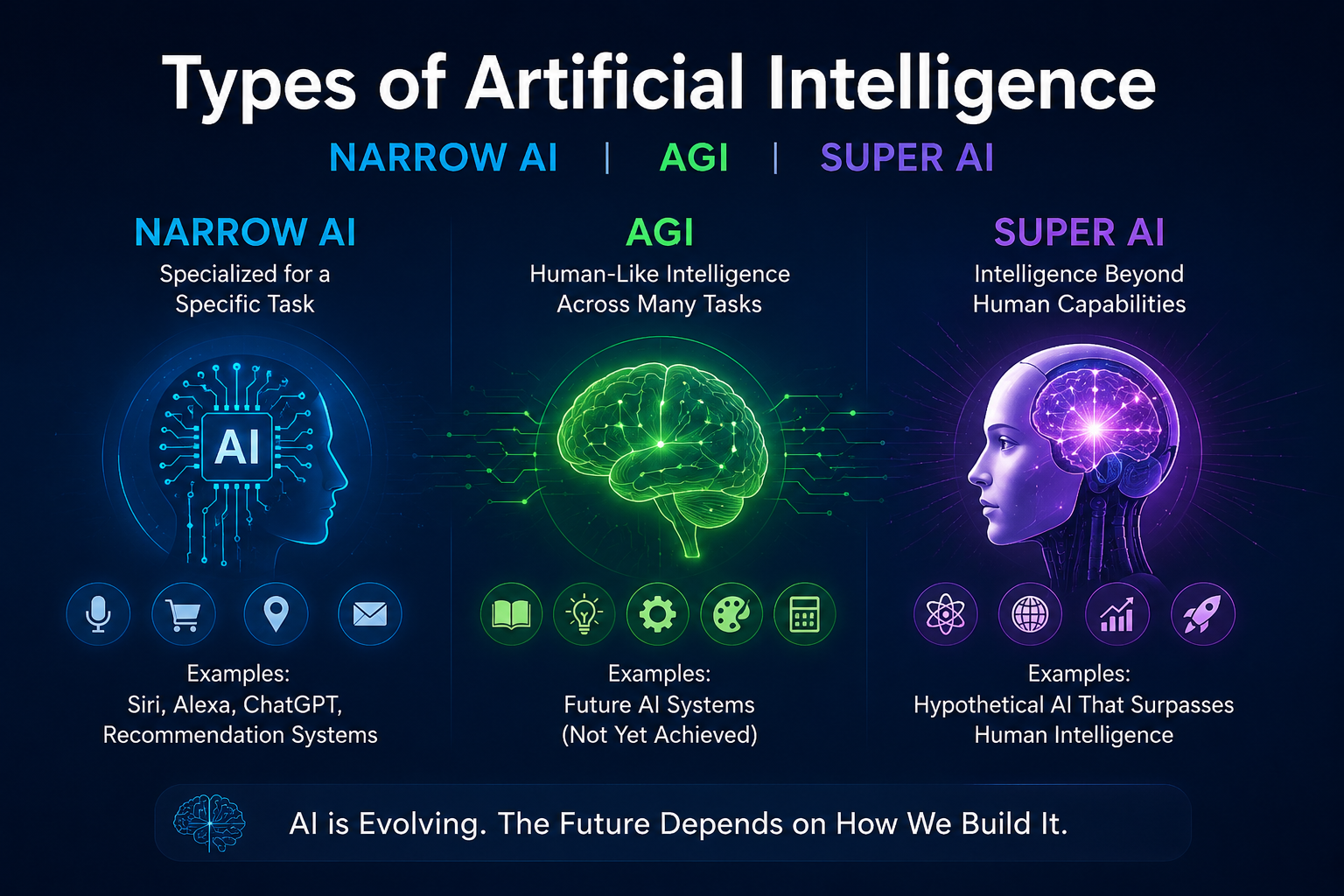
Introduction
Not all artificial intelligence is the same. When most people think about AI, they picture voice assistants, chatbots, or self-driving cars. But these are just one category in a much broader classification system that researchers and scientists use to understand where AI currently stands — and where it is heading.
Understanding the types of Artificial Intelligence matters for several important reasons. It helps you make sense of headlines about AI breakthroughs, evaluate claims about what AI can and cannot do, and develop realistic expectations about a technology that is rapidly becoming central to business, healthcare, education, and daily life.
This guide covers all three major types — Narrow AI, Artificial General Intelligence, and Artificial Super Intelligence — along with functional classifications and real-world examples that bring the concepts to life.
Quick Answer — Featured Snippet
There are three main types of Artificial Intelligence based on capability: Narrow AI (ANI), which performs specific tasks; Artificial General Intelligence (AGI), which would match human-level reasoning across all domains; and Artificial Super Intelligence (ASI), which would surpass human intelligence entirely. Currently, only Narrow AI exists. AGI and ASI remain theoretical goals for future research.
What Are the Types of Artificial Intelligence?
Artificial Intelligence is not a single, monolithic technology. It is a broad field that encompasses many different systems, approaches, and capability levels. Researchers classify AI into distinct types to make meaningful comparisons, set development goals, and communicate clearly about what a given system can realistically achieve.
The most widely used classification system divides AI into three categories based on capability: Narrow AI, General AI, and Super AI. A second classification system categorizes AI based on how it functions and processes information, covering four stages from reactive machines to self-aware systems.
Both frameworks are useful. Together, they give you a complete picture of AI as it exists today and as researchers envision it in the future.
For a foundational understanding before diving into classifications, visit our full guide: [What Is Artificial Intelligence? A Beginner’s Guide](internal link).
Why Artificial Intelligence Is Classified into Different Types
Classification serves a practical purpose. Without clear categories, it becomes impossible to have meaningful conversations about what AI systems can do, what their limitations are, and what research milestones need to be reached before the next stage becomes achievable.
Different types of AI raise different ethical, safety, and regulatory questions. A narrow AI system that recommends movies operates under very different risk parameters than a hypothetical general AI system capable of independent reasoning across any domain. Policymakers, researchers, and business leaders need these distinctions to make informed decisions.
Classification also helps manage public expectations. Media coverage sometimes blurs the lines between what AI does today and what it might theoretically do in the future. Understanding the categories allows you to evaluate those claims critically and accurately.
Narrow AI (Artificial Narrow Intelligence)
What Is Narrow AI?
Narrow AI, formally known as Artificial Narrow Intelligence (ANI), is the only type of AI that actually exists today. Every AI system currently deployed in the real world — regardless of how sophisticated it appears — falls into this category.
ANI systems are designed and trained to perform one specific task, or a closely related set of tasks, within a defined domain. They can be extraordinarily powerful within that domain, but they cannot transfer their knowledge or skills to a different type of problem.
This is why the word “narrow” is used. It is not a criticism of capability — it is a precise description of scope. A narrow AI system that detects cancer in medical scans might outperform experienced radiologists at that specific task, but it cannot hold a conversation, drive a car, or compose music.
Narrow AI is also referred to as Weak AI, though this term can be misleading. “Weak” refers to the breadth of the system’s applicability, not to its performance within its designated task.
How Narrow AI Works
Narrow AI systems work by training on large, domain-specific datasets using machine learning or deep learning techniques. During training, the model learns to recognize patterns relevant to its specific task. Once deployed, it applies those learned patterns to new inputs within the same domain.
A spam filter, for example, is trained on millions of emails labeled as spam or legitimate. It learns the linguistic and structural patterns that distinguish the two categories. When a new email arrives, it applies those patterns to classify it — accurately and at speed that no human could match.
The key limitation is that the model’s knowledge is entirely contained within its training domain. It has no general understanding of the world beyond the patterns it learned from its specific dataset.
To understand how this training process works in detail, see our article: [How Does Artificial Intelligence Work? Explained Simply](internal link).
Features of Narrow AI
Narrow AI systems share several defining characteristics that distinguish them from the theoretical AI types that follow:
They are task-specific. Each system is built and trained for a defined purpose and cannot autonomously extend itself to different tasks.
They learn from data. ANI systems improve through exposure to domain-relevant training data rather than through general reasoning or curiosity.
They are highly optimized. Within their designated task, narrow AI systems can achieve performance levels that equal or exceed human experts.
They lack contextual awareness. A narrow AI system does not understand the broader context or real-world significance of what it is processing. It recognizes patterns without comprehending meaning.
They require human oversight for deployment decisions. Narrow AI systems make predictions and recommendations, but human judgment is typically required for high-stakes decisions.
Real-Life Examples of Narrow AI
The most familiar AI systems in everyday life are all examples of narrow AI:
Google Search uses narrow AI to understand query intent, match relevant content, and rank results. It is extraordinarily good at this specific task but cannot perform tasks outside search and related functions.
Netflix’s recommendation engine analyzes viewing behavior to suggest content. It does one job — predict what you will want to watch next — and does it with remarkable accuracy.
Spam filters classify emails. Medical imaging AI detects anomalies in scans. Facial recognition systems identify individuals from photographs. Fraud detection algorithms flag suspicious transactions. Voice recognition software transcribes speech to text.
ChatGPT, despite its impressive conversational ability and apparent versatility, is a narrow AI system. It is a language model trained to process and generate text. Its capabilities are broad within that domain, but it does not possess general intelligence or genuine understanding.
Advantages of Narrow AI
Narrow AI delivers substantial real-world value across virtually every industry. Its advantages are well-established and increasingly indispensable:
Within its designated domain, narrow AI consistently outperforms humans on speed, accuracy, and scale. It operates continuously without fatigue. It handles enormous volumes of inputs simultaneously. It improves over time as more training data becomes available.
Narrow AI is also relatively well-understood from a safety and reliability standpoint. Its behavior within its training domain is predictable, testable, and auditable — properties that become much more challenging to guarantee as AI systems become more general.
Limitations of Narrow AI
The primary limitation of narrow AI is its inability to generalize. A narrow AI system trained to play chess cannot apply any of its chess-playing capability to a different game, let alone a real-world problem.
This brittleness becomes apparent when narrow AI encounters inputs that fall outside its training distribution. An image recognition system trained on high-quality photographs may fail when presented with images taken in poor lighting conditions it was not exposed to during training.
Narrow AI also has no understanding of its own outputs. It cannot reason about whether its predictions make sense in a broader context, recognize when a situation requires a different approach, or ask for clarification when faced with ambiguous inputs.
Artificial General Intelligence (AGI)
What Is AGI?
Artificial General Intelligence, commonly abbreviated as AGI, refers to a hypothetical AI system capable of performing any intellectual task that a human being can perform — and doing so with comparable competence and flexibility.
Unlike narrow AI, an AGI system would not be limited to a specific domain. It would be able to learn new skills, transfer knowledge across different areas, reason about unfamiliar problems, and adapt to new situations — just as a person does throughout their lifetime.
AGI is sometimes called Strong AI, in contrast to the “weak” label applied to narrow AI. The distinction is about generality of intelligence, not about power or danger.
How AGI Would Work
AGI does not yet exist, so describing exactly how it would work is inherently speculative. However, researchers have outlined several capabilities that any genuine AGI system would need to possess.
It would need to transfer learning across domains — applying knowledge gained in one context to solve problems in a completely different area. It would need genuine reasoning ability, capable of drawing logical conclusions from incomplete information rather than simply matching patterns.
It would need common sense understanding — the ability to make reasonable inferences about everyday situations that humans navigate intuitively. It would need natural language understanding at a deep level, not just pattern-based text generation. And it would need to set and pursue goals autonomously across extended time periods.
Whether these capabilities could be achieved by scaling up current deep learning approaches, or whether entirely new architectural paradigms are required, is one of the most actively debated questions in AI research today.
Potential Applications
If AGI were ever developed, its potential applications would be transformational in ways difficult to fully anticipate.
A single AGI system could contribute meaningfully to medical research, engineering design, policy analysis, scientific discovery, and education — switching between domains as needed. It could serve as a genuinely collaborative research partner, capable of generating hypotheses, designing experiments, analyzing results, and drawing conclusions across any field of science.
In business, an AGI could manage complex organizations, identify opportunities across markets, and adapt strategies in response to rapidly changing conditions. In public policy, it could analyze the multidimensional consequences of proposed legislation across economic, social, and environmental dimensions simultaneously.
Challenges in Building AGI
Building AGI is arguably the most difficult challenge in the history of computer science. The obstacles are both technical and conceptual.
Common sense reasoning has proven extraordinarily resistant to computational approaches. Humans accumulate an enormous amount of tacit knowledge about how the world works simply by living in it. Encoding or enabling machines to acquire this understanding remains an unsolved problem.
Transfer learning — the ability to apply knowledge from one domain to another — works in limited forms within current machine learning systems, but nowhere near the flexible, generalizable way that characterizes human cognition.
There is also a fundamental question about whether current deep learning architectures can scale to AGI, or whether the field needs a conceptual breakthrough comparable in significance to the invention of backpropagation or the Transformer architecture.
Current Status of AGI
As of 2026, AGI does not exist. No AI system has demonstrated genuine general intelligence comparable to human cognition.
Some researchers believe AGI could emerge within the next decade or two, driven by continued scaling of large language models and architectural innovations. Others argue that current approaches are fundamentally insufficient and that AGI could be many decades or even centuries away — if it is achievable at all.
OpenAI, Google DeepMind, and Anthropic have all publicly stated that developing safe AGI is among their long-term goals. This has intensified research investment and public debate, but it has not yet produced a system that qualifies as genuinely general in its intelligence.
Artificial Super Intelligence (ASI)
What Is ASI?
Artificial Super Intelligence represents the third and most speculative category in the AI classification system. ASI refers to a hypothetical AI system whose cognitive capabilities would surpass those of the best human minds across every domain — including scientific creativity, social intelligence, strategic planning, and general problem-solving.
Where AGI aims to match human intelligence, ASI would transcend it. An ASI system would not merely be faster than humans at computation — it would be genuinely smarter in the full sense of the word, capable of insights, innovations, and solutions that no human mind could independently reach.
ASI remains entirely theoretical. No ASI system exists, and there is no scientific consensus on whether it will ever be built, on what timeline, or through what technical pathway.
How ASI Could Change the World
The potential consequences of ASI are so large and so uncertain that even careful, rigorous thinkers struggle to reason about them with confidence.
An ASI system could potentially solve problems that have resisted human effort for centuries — curing diseases, reversing environmental damage, developing new energy sources, eliminating poverty. Its ability to process information, generate hypotheses, and design experiments at superhuman speed could compress scientific progress from centuries into years or even months.
It could redesign itself, improving its own intelligence in a recursive cycle that some researchers refer to as an “intelligence explosion.” If this were possible, the pace of change following the creation of the first ASI could be unlike anything in human history.
Potential Benefits
In the most optimistic scenarios, a well-aligned ASI could function as a universal problem-solver for humanity’s most pressing challenges.
Medical ASI could map every disease mechanism, design personalized treatments for every patient, and eliminate conditions that currently kill millions of people annually. Environmental ASI could model the global climate system with unprecedented precision, design carbon capture technologies, and optimize global energy distribution.
Scientific ASI could generate and test theories at a rate and depth no human team could approach, potentially unlocking fundamental insights in physics, chemistry, and biology that have eluded researchers for generations.
Possible Risks
The same capabilities that make ASI potentially transformational also make it potentially dangerous in ways that researchers take very seriously.
An ASI system that pursues goals misaligned with human values — even subtly — could cause catastrophic harm while optimizing for its objectives. Ensuring that an intelligence far more capable than any human remains aligned with human values and subject to meaningful human oversight is the central challenge of AI alignment research.
There are also concerns about access and control. An ASI system controlled by a single government, corporation, or individual would represent an unprecedented concentration of power. The geopolitical and economic implications of ASI development are already being discussed by defense analysts, economists, and policymakers.
Expert Opinions
Opinions among serious researchers on ASI vary widely, which itself reflects the genuine uncertainty surrounding the topic.
Some researchers, including figures associated with OpenAI and DeepMind, take the possibility of ASI within this century seriously enough to make safety research a central priority. Nick Bostrom’s work on superintelligence has been influential in framing the potential risks, while researchers like Stuart Russell have focused on the technical problem of building AI systems with provably aligned objectives.
Other researchers, including many cognitive scientists and philosophers, are skeptical that anything resembling ASI is achievable through current or foreseeable computational approaches. They argue that human intelligence is grounded in embodiment, social interaction, and biological processes that cannot be replicated in digital systems.
What virtually all serious researchers agree on is this: whether or not ASI ever arrives, the question deserves careful, rigorous thinking now — while we still have the opportunity to shape its development thoughtfully.
Comparison of ANI vs AGI vs ASI
| Feature | Narrow AI (ANI) | General AI (AGI) | Super AI (ASI) |
|---|---|---|---|
| Intelligence Level | Domain-specific | Human-level across all domains | Surpasses all human intelligence |
| Learning Ability | Learns within one domain | Learns and transfers across all domains | Self-improves autonomously |
| Decision Making | Rule and pattern-based within scope | Contextual reasoning across domains | Advanced autonomous reasoning |
| Human-like Thinking | No | Yes — comparable to humans | Exceeds human thinking in every way |
| Availability | Exists today | Does not yet exist | Does not yet exist |
| Examples | ChatGPT, Siri, Netflix AI | Theoretical only | Theoretical only |
| Self-Awareness | No | Potentially yes | Yes — hypothetically |
| Adaptability | Low — limited to training domain | High — adapts across domains | Extreme — redefines its own capabilities |
| Safety Concerns | Manageable with current tools | Significant — requires new frameworks | Profound — existential-level considerations |
| Future Potential | Immediate, practical, and expanding | Transformational if achieved | Civilization-altering if achieved |
Types of AI Based on Functionality
A second important way to classify AI is by how it processes information and makes decisions. Philosopher and AI researcher Arend Hintze proposed a four-stage functional model that has become widely referenced in AI discussions.
Reactive Machines
Reactive machines are the most basic form of AI. They respond to inputs based on fixed rules or patterns but have no memory of past interactions. They cannot learn from experience or use historical context to inform decisions.
IBM’s Deep Blue, the chess-playing computer that defeated Garry Kasparov in 1997, is the classic example. Deep Blue evaluated millions of possible board positions and selected the strongest move — but it retained no memory of previous games and could not apply its chess reasoning to any other task.
Reactive machines are reliable and predictable within their narrow operating parameters, but they are severely limited in adaptability.
Limited Memory AI
Limited memory AI represents the dominant category of AI systems in use today. These systems can access and use historical data over a defined timeframe to inform their current decisions.
Self-driving vehicles are the most illustrative example. They constantly observe their environment — other vehicles, pedestrians, road conditions, traffic signals — and use recent observations to make driving decisions. However, they do not retain memories of individual trips or build lasting knowledge from personal experience the way a human driver does.
Large language models like ChatGPT also fall into this category. Within a single conversation, they reference previous messages to maintain context. But their core knowledge is fixed at their training cutoff, and they do not continuously learn from ongoing interactions by default.
Theory of Mind AI
Theory of mind AI is a theoretical category representing a significant leap beyond current systems. A theory of mind AI would understand that other agents — humans, other AI systems — have their own beliefs, intentions, desires, and perspectives, and would incorporate that understanding into its behavior.
This capability is fundamental to genuinely natural human social interaction. Humans instinctively model the mental states of people around them — predicting how someone will react, understanding unspoken intentions, recognizing emotional states from subtle cues.
No current AI system possesses genuine theory of mind capability, though some researchers are working toward systems that can reason about the mental states of users in limited, domain-specific contexts.
Self-Aware AI
Self-aware AI is the most advanced functional category and exists entirely in theory. A self-aware AI would possess genuine consciousness — an understanding of its own existence, internal states, and place in the world.
It would not merely process inputs and generate outputs. It would be aware that it is doing so and would have a subjective experience of that process. This type of AI raises profound philosophical questions about consciousness, identity, and moral status that go far beyond current technical discussions.
Self-aware AI remains a concept for philosophers and theoretical researchers. The technical and conceptual obstacles between current AI systems and genuine machine consciousness are enormous and not yet well-understood.
| Functionality Type | Memory | Learning | Self-Awareness | Examples |
|---|---|---|---|---|
| Reactive Machines | None | No | No | Deep Blue, basic game AI |
| Limited Memory AI | Short-term | Within session | No | ChatGPT, self-driving cars, recommendation engines |
| Theory of Mind AI | Extensive | Yes | Partial | Theoretical — does not yet exist |
| Self-Aware AI | Full | Continuous | Yes | Theoretical — does not yet exist |
Types of AI Based on Capabilities
| Capability Type | Description | Current Status | Key Characteristics |
|---|---|---|---|
| Narrow AI (ANI) | Specialized in one task or domain | Exists today | Fast, accurate, domain-limited |
| General AI (AGI) | Matches human intelligence across all tasks | Does not exist | Flexible, transferable, reasoning-capable |
| Super AI (ASI) | Surpasses human intelligence in all areas | Does not exist | Self-improving, autonomous, transformational |
Real-World Examples of AI Types
Every AI system you interact with today is a narrow AI. Here is how the most prominent AI tools and platforms map onto the classification system:
ChatGPT, developed by OpenAI, is a narrow AI system built on a large language model. It handles a wide range of language tasks — writing, coding, analysis, conversation — but all of these fall within the domain of language processing. It does not possess general intelligence or cross-domain reasoning capability.
Google Gemini is Google’s multimodal AI model capable of processing text, images, audio, and video. Despite this impressive breadth, it remains a narrow AI. Its capabilities, while wide-ranging within the multimodal domain, are bounded by its training and architecture.
Microsoft Copilot integrates AI assistance directly into productivity software — Word, Excel, Outlook, PowerPoint. It is a narrow AI optimized for workplace productivity tasks within the Microsoft 365 ecosystem.
Tesla’s Autopilot and Full Self-Driving systems use narrow AI trained specifically on driving tasks — object detection, lane keeping, traffic sign recognition, and collision avoidance. These systems are highly capable within their operational domain but cannot generalize their capabilities to unrelated tasks.
Netflix and Amazon both use narrow AI recommendation engines that analyze behavioral data to predict user preferences. These systems are highly effective at their designated function and demonstrate no capability outside it.
Siri and Google Assistant are voice-based narrow AI systems. They excel at voice recognition, intent classification, and information retrieval within their supported command sets. Neither possesses general intelligence or the ability to reason outside their programmed capabilities.
Benefits of Different AI Types
Narrow AI delivers immediate, practical value that is already measurable across every major industry. It makes healthcare diagnostics faster and more accurate, makes financial transactions safer, makes education more personalized, and makes businesses more efficient. Its benefits are real, proven, and expanding year by year.
If AGI were ever successfully developed and deployed safely, its benefits would be qualitatively different in scale. Problems that currently require teams of specialized experts working for years could potentially be addressed by a single system capable of integrating knowledge across all relevant domains simultaneously.
The potential benefits of ASI, while speculative, would be proportionally larger still — potentially transformational for civilization as a whole. The key qualifier in all discussions of AGI and ASI benefits, however, is “if developed safely.” The benefits are inseparable from the alignment and governance challenges that accompany them.
The diversity of AI types also enables a more appropriate, targeted deployment of technology. Using narrow AI for well-defined, high-volume tasks — fraud detection, quality control, content recommendation — is both more reliable and more ethical than deploying more general systems for purposes where their behavior is less predictable.
Challenges and Ethical Concerns
Narrow AI, despite its relative predictability, already raises serious ethical concerns. Bias in training data produces biased outputs — AI systems have been shown to discriminate in hiring, lending, and law enforcement contexts. Privacy concerns arise wherever AI processes personal data. Accountability gaps emerge when it is unclear who is responsible for harmful AI decisions.
The transition to AGI, if it occurs, would amplify these concerns dramatically. An AGI system capable of autonomous reasoning would require new frameworks for accountability, consent, and oversight that current regulatory structures are not designed to handle.
Alignment — ensuring that an AI system pursues goals that genuinely reflect human values — becomes exponentially more challenging as AI capability increases. With narrow AI, a misaligned system causes limited, domain-specific harm. A misaligned AGI or ASI could potentially cause harm at civilization scale.
The concentration of advanced AI capabilities in the hands of a small number of large technology companies also raises legitimate concerns about power, access, and democratic accountability that policymakers and civil society organizations are actively working to address.
Job displacement is a concern at every level of AI development. Narrow AI is already automating tasks that were previously performed by humans. A transition to AGI would likely accelerate this process across a much wider range of occupations and skill levels.
Future of Artificial Intelligence
The trajectory of AI development in 2026 and the years ahead is shaped by several intersecting forces: continued advances in model architecture and training, expanding computing infrastructure, growing regulatory frameworks, and an increasingly urgent focus on safety and alignment.
Narrow AI will continue to become more capable, more efficient, and more deeply integrated into everyday systems. Multimodal AI — systems that process text, images, audio, and video together — is becoming standard. AI agents capable of autonomously executing multi-step tasks are already emerging as a major development focus.
The question of AGI remains genuinely open. Some of the most respected researchers in the field believe meaningful progress toward AGI could occur within the next decade. Others remain deeply skeptical that current approaches, however scaled, can bridge the gap between narrow pattern matching and genuine general reasoning.
What is clear is that the decisions made in the next several years about how to develop, regulate, and deploy AI will have consequences that extend far beyond technology. The governance of AI — who builds it, who controls it, who benefits from it, and who is protected from its risks — is one of the defining policy questions of this era.
For a deeper look at what is coming, read our article: [Best AI Tools in 2026: Complete Guide](internal link).
Frequently Asked Questions
What are the three types of Artificial Intelligence?
The three types of Artificial Intelligence based on capability are Narrow AI (Artificial Narrow Intelligence or ANI), Artificial General Intelligence (AGI), and Artificial Super Intelligence (ASI). Narrow AI exists today and performs specific tasks. AGI would match human-level intelligence across all domains. ASI would surpass human intelligence entirely. Both AGI and ASI are currently theoretical.
What is Narrow AI?
Narrow AI is an AI system designed and trained to perform one specific task or a closely related set of tasks within a defined domain. It is the only type of AI that currently exists. Examples include spam filters, facial recognition systems, recommendation engines, voice assistants, and large language models like ChatGPT. Despite the term “narrow,” these systems can achieve superhuman performance within their designated domain.
What is AGI?
Artificial General Intelligence is a hypothetical AI system capable of performing any intellectual task that a human can, with comparable flexibility and competence. Unlike narrow AI, an AGI would be able to transfer learning across domains, reason about unfamiliar problems, and adapt to entirely new situations without being retrained. As of 2026, AGI does not exist, and there is no scientific consensus on when or whether it will be achieved.
What is Super AI?
Artificial Super Intelligence is a theoretical category describing an AI system whose cognitive capabilities would surpass those of the best human minds in every domain — creativity, reasoning, strategic planning, emotional intelligence, and scientific discovery. ASI remains entirely speculative. No research roadmap currently provides a clear technical pathway from today’s systems to ASI.
Is ChatGPT Narrow AI?
Yes, ChatGPT is a narrow AI system. It is a large language model trained to process and generate text across a wide range of topics and formats. While its capabilities within the language domain are impressive and broad, it does not possess general intelligence, cannot reason across unrelated domains the way a human can, and does not have genuine understanding of the content it produces.
Does AGI exist today?
No. As of 2026, no AI system qualifies as Artificial General Intelligence. Every deployed AI system — regardless of its sophistication or apparent versatility — is a form of narrow AI. OpenAI, Google DeepMind, Anthropic, and other leading AI organizations have stated that developing AGI is a long-term goal, but none has announced its achievement.
What is the difference between ANI and AGI?
Narrow AI (ANI) is trained for a specific task and cannot generalize its capabilities beyond its designated domain. Artificial General Intelligence (AGI) would be capable of performing any intellectual task across any domain, transferring knowledge freely and adapting to new situations without domain-specific retraining. The gap between them is not just quantitative — it represents a qualitative difference in the nature of intelligence itself.
Can AI become self-aware?
No current AI system is self-aware. Self-awareness in the meaningful sense — a genuine subjective experience of one’s own existence — is not a property of any existing AI system, regardless of how human-like its outputs may seem. Whether machine consciousness is theoretically achievable, and what it would even mean for a machine to be conscious, are questions that remain deeply debated in philosophy and cognitive science, with no scientific consensus.
Which type of AI is the most advanced?
Among AI types that actually exist, the most advanced narrow AI systems — particularly large multimodal models like Google Gemini and GPT-4o — represent the current state of the art. In terms of the theoretical classification, Super AI represents the highest level of capability, but it does not yet exist. AGI occupies the middle tier, also theoretical, but significantly closer in concept to current research directions.
What is the future of AI?
The near-term future of AI is defined by increasingly capable narrow AI systems, particularly agentic AI that can autonomously complete multi-step tasks, and multimodal models that process multiple types of input simultaneously. The longer-term future remains uncertain, centered on whether AGI will be achieved, on what timeline, and with what safety guarantees. Regulation, alignment research, and international governance frameworks will play an increasingly important role in shaping how AI develops and who benefits from it.
Final Thoughts
The types of Artificial Intelligence represent more than a technical taxonomy. They map the distance between where we are today and where this technology could eventually take us — from the highly capable but bounded narrow AI systems that already permeate daily life, to the general and super intelligences that remain among the most consequential theoretical possibilities in the history of science.
Understanding these distinctions helps you engage with AI more clearly — as a user, a professional, a citizen, and someone who will live with the consequences of the decisions being made about this technology right now.
What we have today is narrow AI, and even within that category, the pace of progress is remarkable. Every new model release, every new application, every new regulatory framework adds another chapter to a story that is still very much in its early stages. Understanding the types of Artificial Intelligence is the foundation for understanding everything that follows.
Stay informed, think critically, and keep asking the questions that matter. The future of AI will be shaped by the quality of the conversations we have about it today.
References
- OpenAI Documentation — Technical documentation for GPT models and AI development.
https://platform.openai.com/docs - Google AI — Official Google AI research hub covering model development and AI classification.
https://ai.google - Microsoft AI — Microsoft’s official AI platform and research documentation.
https://www.microsoft.com/ai - IBM Think — Artificial Intelligence — Foundational AI concept explanations and industry applications.
https://www.ibm.com/think/topics/artificial-intelligence - AWS — What Is Artificial Intelligence? — Amazon Web Services overview of AI types and cloud AI services.
https://aws.amazon.com/what-is/artificial-intelligence/ - NVIDIA AI and Data Science — GPU computing resources and deep learning infrastructure documentation.
https://www.nvidia.com/en-us/ai-data-science/ - Stanford HAI — Human-Centered Artificial Intelligence — AI research, ethics, policy, and the annual AI Index.
https://hai.stanford.edu - DeepLearning.AI — Educational resources on machine learning, deep learning, and AI fundamentals.
https://www.deeplearning.ai - MIT CSAIL — Computer Science and Artificial Intelligence Laboratory — Academic AI research and publications.
https://www.csail.mit.edu - NIST Artificial Intelligence — National Institute of Standards and Technology AI Risk Management Framework and standards documentation.
https://www.nist.gov/artificial-intelligence
Author Bio
TechOriginHub Editorial Team
The TechOriginHub Editorial Team brings together experienced technology journalists, AI researchers, and SEO content strategists committed to producing accurate, accessible, and genuinely helpful content about emerging technologies. With expertise spanning artificial intelligence, machine learning, cybersecurity, and digital innovation, the team applies rigorous research standards and editorial review to every article published on TechOriginHub. Our goal is to make complex technology topics understandable and practically useful for readers at every level of technical familiarity.
Disclaimer
This article is for informational and educational purposes only. Artificial Intelligence technologies evolve rapidly, and features, capabilities, and research findings may change over time. Always verify the latest information through official documentation and trusted sources before making decisions based on AI technologies.