
 By saman zahra
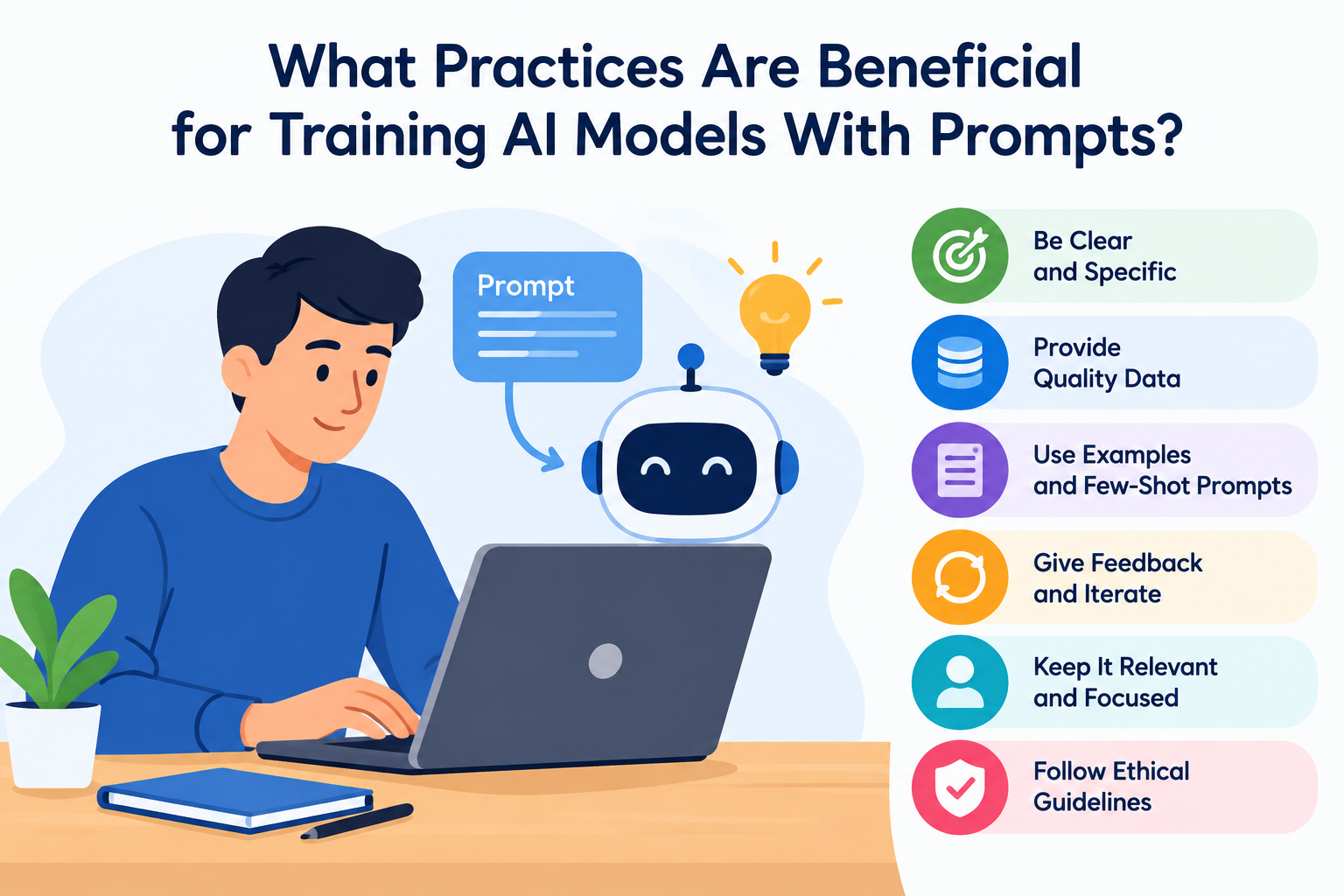
The way prompts are designed, structured, and used during AI model training has a profound impact on how capable, accurate, reliable, and safe the resulting model becomes. Prompts are not just questions put to a finished AI system. In the context of model training they are the structured inputs through which AI models learn what kinds of responses are expected, what quality standards they should meet, how to handle ambiguous situations, and what boundaries define appropriate behavior. Getting prompt-based training right is one of the most consequential decisions in the entire AI development process.
Understanding what an AI prompt is at its foundational level helps frame why prompt quality matters so much during training. A prompt is the instruction or input that guides an AI system’s response. During training prompts shape what the model learns to do with future inputs. Poorly designed training prompts produce models that respond poorly to real-world inputs. Well-designed training prompts produce models that generalize effectively, handle edge cases gracefully, and deliver consistently useful outputs across diverse situations.
This guide covers every major practice that research, industry experience, and the broader AI development community have identified as beneficial for training AI models with prompts. Whether you are working on fine-tuning an existing language model, building a prompt dataset for reinforcement learning from human feedback, or designing instruction tuning data, the practices covered here apply across the full spectrum of prompt-based AI training approaches.
Understanding the Role of Prompts in AI Model Training
Before examining specific beneficial practices it is important to establish a clear understanding of what role prompts actually play in the AI model training process, because this understanding informs every practice that follows.
How Prompts Function During AI Training
In modern large language model development prompts serve as the primary medium through which human knowledge, preferences, and behavioral standards are communicated to the model during training. This occurs through several training paradigms:
Instruction tuning: The model is trained on large datasets of prompt and response pairs that demonstrate how to follow instructions. The prompts are instructions and the responses are high-quality demonstrations of correctly following those instructions. The model learns to generalize from these examples to follow new instructions it has not seen during training.
Reinforcement Learning from Human Feedback (RLHF): Human evaluators compare different model responses to the same prompt and indicate which response is better. These preference signals are used to train a reward model that guides further model training. The prompts used during this evaluation process directly shape what the model learns to optimize for.
Few-shot learning through prompting: Rather than training on massive labeled datasets the model is prompted with a small number of examples demonstrating a task and then asked to complete a new example of the same task. The quality of the few-shot examples embedded in the prompt determines how well the model can generalize the demonstrated pattern.
Chain-of-thought prompting during training: Training prompts that demonstrate step-by-step reasoning teach the model to produce intermediate reasoning steps rather than jumping directly to answers, improving performance on complex reasoning tasks.
Understanding what an AI model is and how it learns from training data provides the technical foundation for appreciating why these prompt-based training paradigms work. AI models learn statistical patterns from their training data and prompts are a structured mechanism for ensuring that the patterns worth learning are well-represented in that training data.
Practice 1: Design Prompts With Clarity and Specificity
The most fundamental practice for effective AI model training with prompts is ensuring that every training prompt is unambiguous, specific, and communicates exactly what the model is expected to do in response.
Why Clarity Matters in Training Prompts
When a training prompt is ambiguous the model must infer what is being asked from context. During inference on new inputs this ambiguity tolerance may manifest as inconsistent outputs because the model has learned that the ambiguous prompt pattern is associated with a variety of different response types. Ambiguous training prompts teach the model to respond inconsistently to ambiguous inputs, which is rarely the desired outcome.
Clear, specific prompts communicate a single unambiguous task. The model trained on clear prompts learns to produce consistent outputs for consistent inputs. This makes the model more predictable and reliable in deployment.
Elements of a Clear Training Prompt
Explicit task description: State precisely what the model should do. Instead of a vague instruction like Write something about climate change use a specific instruction like Write a three-paragraph explanation of how greenhouse gas emissions contribute to global temperature increase suitable for a high school student.
Defined output format: Specify the expected output format where relevant. Indicate whether the response should be a list, a paragraph, a structured document, a single sentence, a JSON object, or another specific format. Models trained with format specifications learn to produce consistently structured outputs.
Explicit constraints and boundaries: Include relevant constraints in the prompt rather than expecting the model to infer them. Word count limits, tone requirements, perspective requirements, and audience considerations should all be stated explicitly.
Single task focus: Each training prompt should ideally test one capability or task at a time. Prompts that bundle multiple different tasks into a single instruction create ambiguity about which task to prioritize and reduce the training signal’s clarity for any individual skill.
Examples of Clarity in Practice
A poorly specified training prompt might read: Tell me about machine learning.
A well-specified training prompt for the same topic might read: Provide a clear definition of machine learning in two to three sentences. Then list three specific real-world applications of machine learning with one sentence explaining each application. Write for an audience of business professionals without a technical background.
The second prompt produces a specific, bounded, format-defined task. The model trained on thousands of similarly well-specified prompts learns to produce structured, appropriately scoped responses to instruction-following tasks.
Practice 2: Build Diverse and Representative Prompt Datasets
A single well-designed prompt is insufficient for effective AI model training. The complete dataset of training prompts must collectively represent the full diversity of inputs the model will encounter in real-world deployment.
Why Prompt Dataset Diversity Matters
An AI model trained on a narrow, homogeneous set of prompts learns to perform well only on inputs that closely resemble its training data. This limitation, called poor generalization, manifests as model failure on inputs that fall outside the narrow distribution of its training prompts even when those inputs are conceptually similar to training examples.
Diverse training prompt datasets ensure the model encounters and learns from a wide range of input types, styles, difficulty levels, domains, and edge cases. This breadth of exposure produces models that generalize effectively to the variety of real-world inputs they will face after deployment.
Dimensions of Prompt Dataset Diversity
Task diversity: Include prompts that exercise all the capabilities the model is intended to have. A general-purpose language model’s training dataset should include summarization prompts, question-answering prompts, creative writing prompts, reasoning prompts, code generation prompts, and other task types in proportions that reflect their intended importance.
Linguistic diversity: Include prompts written in different styles, vocabulary levels, and structures. Some users will write formally, others informally. Some will use complete sentences, others fragments. Training prompts should represent this diversity so the model handles varied real-world input styles.
Domain diversity: Include prompts spanning different subject domains including science, history, technology, arts, business, health, and others. Domain-narrow training produces domain-narrow models.
Difficulty diversity: Include prompts at different difficulty levels from straightforward factual questions to complex multi-step reasoning challenges. A well-calibrated difficulty distribution ensures the model is challenged across its capability range during training.
Edge case coverage: Deliberately include prompts representing challenging edge cases including ambiguous inputs, contradictory requirements, unusual formatting, and situations that require careful judgment. Edge case coverage during training produces models that handle difficult real-world inputs more gracefully.
Cultural and demographic diversity: Include prompts that reference diverse cultural contexts, geographical locations, and demographic groups. Culturally narrow training produces models that perform better for some user populations than others.
Building Diverse Datasets Systematically
Achieving genuine diversity in a large prompt dataset requires systematic effort rather than relying on organic variation. Useful approaches include:
- Taxonomy-based dataset construction where prompts are deliberately sampled from predefined categories to ensure coverage
- Automatic diversity analysis tools that measure the linguistic and semantic coverage of accumulated prompt datasets
- Human review processes that specifically evaluate dataset composition for gaps in coverage
- Adversarial prompt generation that deliberately creates challenging examples in underrepresented categories
Practice 3: Apply Few-Shot Prompting Techniques Effectively
Few-shot prompting is one of the most powerful and widely applied techniques in both AI model training and inference. It involves providing the model with a small number of examples demonstrating the desired input-output pattern before presenting the actual task input.
How Few-Shot Prompting Improves Training
Understanding what prompt engineering is reveals why few-shot prompting is such a valuable technique. By providing concrete examples of the desired behavior within the prompt itself few-shot prompting gives the model unambiguous guidance about what constitutes a correct response for that task type, beyond what the task description alone conveys.
During training few-shot prompts teach the model the meta-skill of learning from in-context examples. A model trained extensively on few-shot prompts learns to recognize when a prompt contains demonstration examples and to use those examples to calibrate its response to the subsequent task input. This capability generalizes to novel task types encountered at inference time.
Best Practices for Few-Shot Training Prompts
Example quality: Every example included in a few-shot training prompt must be high quality. Low-quality or incorrect examples in few-shot demonstrations teach the model incorrect patterns. Each demonstration example should represent the ideal response to that input type.
Example diversity within prompts: The examples included in a single few-shot prompt should demonstrate meaningful variation rather than being minor permutations of the same input type. Diverse examples within a prompt help the model understand the range of the pattern rather than memorizing a narrow template.
Appropriate number of examples: Research indicates that performance improvements from few-shot examples tend to plateau after a certain number of examples and that the optimal number varies by task complexity. Simpler tasks may require only one to two examples while complex tasks may benefit from five to ten examples. Including too many examples may crowd out space for the actual task or introduce noise.
Example ordering: Some research suggests that the order of few-shot examples affects model performance. Placing examples that are most similar to the actual task input later in the sequence, closer to the task itself, tends to produce better results than placing dissimilar examples at the end.
Label balance in examples: For classification tasks ensure that the few-shot examples collectively represent all relevant classes rather than overrepresenting certain classes. Imbalanced few-shot examples can bias the model toward predicting the overrepresented class.
Zero-Shot vs Few-Shot in Training Contexts
Zero-shot prompts, which provide no examples and rely solely on task description, are also an important component of training datasets. Including both zero-shot and few-shot prompts in training ensures the model learns to handle both input types effectively. A model trained only on few-shot prompts may struggle with zero-shot inference inputs and vice versa. Balanced inclusion of both prompt types produces a more versatile model.
Practice 4: Use Chain-of-Thought Prompting for Reasoning Tasks
Chain-of-thought prompting is a technique where the training prompt demonstrates step-by-step reasoning toward the answer rather than providing only the final answer. This approach is particularly valuable for tasks requiring multi-step reasoning, mathematical problem solving, logical inference, and complex decision making.
Why Chain-of-Thought Training Prompts Improve Reasoning
Research published by Google Brain researchers Wei et al. demonstrated that language models trained with chain-of-thought examples develop significantly stronger reasoning capabilities than models trained only on input-output pairs without intermediate reasoning steps. The seminal chain-of-thought prompting paper is available at arxiv.org/abs/2201.11903 and provides detailed experimental evidence for this approach.
When a model sees only the final answer during training it must infer the reasoning process that produced the answer. When the model sees the complete reasoning chain it directly learns to produce intermediate reasoning steps that lead to correct conclusions. This learned behavior generalizes to novel problems where the specific steps must be adapted.
Designing Effective Chain-of-Thought Training Prompts
Show complete reasoning chains: Do not skip steps in the reasoning demonstration even when they feel obvious. The model learns from every demonstrated step and skipped steps create gaps in the reasoning pattern the model learns.
Use natural reasoning language: Write reasoning chains using natural language that describes the reasoning process as a human expert would articulate it. Avoid artificially formalized reasoning notations that differ from natural language expression.
Demonstrate error recovery: Include some training examples where the chain of thought identifies and corrects an initial incorrect direction. This teaches the model to evaluate its reasoning as it proceeds rather than committing to an initial approach regardless of whether it is leading correctly.
Apply to appropriate task types: Chain-of-thought prompting is most beneficial for tasks with genuine multi-step reasoning requirements. Applying it to simple factual recall tasks adds unnecessary verbosity without reasoning benefit. Use chain-of-thought training data selectively for tasks where the reasoning process is genuinely complex.
Include diverse reasoning patterns: Different problem types require different reasoning approaches. Mathematical problems require arithmetic reasoning chains, logical problems require deductive reasoning chains, and causal analysis requires different patterns again. Include diverse reasoning patterns across the chain-of-thought training dataset.
Practice 5: Implement Systematic Prompt Iteration and Refinement
Effective AI model training with prompts is not a single-pass process. It requires systematic iteration where prompts are designed, model outputs are evaluated, weaknesses are identified, prompts are refined, and the cycle repeats until the desired performance standard is achieved.
The Iterative Prompt Refinement Cycle
Design: Create an initial version of the training prompt based on the target capability, task type, and intended difficulty level. Apply the clarity and specificity principles described in Practice 1.
Generate: Use the prompt to generate model outputs, either from a baseline model during prompt dataset construction or from a model being evaluated during fine-tuning.
Evaluate: Assess the generated outputs against defined quality criteria. Identify specific failure patterns including incorrect factual content, format violations, tone mismatches, missing required elements, and other quality dimensions relevant to the task.
Diagnose: Determine whether identified failures are caused by prompt ambiguity, insufficient context, missing constraints, problematic examples, or other specific prompt design issues.
Refine: Modify the prompt to address the diagnosed issues. Add missing constraints, improve clarity in ambiguous sections, replace poor examples with better ones, or restructure the prompt to guide the model more effectively.
Re-evaluate: Generate new outputs with the refined prompt and assess whether the identified failures have been resolved. Check that refinements have not introduced new failure modes.
Document: Maintain records of prompt versions, the failures each version produced, and the refinements that addressed each failure. This documentation builds institutional knowledge about what prompt design choices produce what outcomes.
Tools for Systematic Prompt Iteration
Several platforms support systematic prompt iteration including OpenAI’s playground environment, Anthropic’s Claude interface, and various purpose-built prompt management tools. These platforms allow storing prompt versions, comparing outputs across versions, and systematically tracking refinement progress. OpenAI’s documentation on prompt design is available at platform.openai.com/docs/guides/prompt-engineering.
Practice 6: Incorporate Role and Persona Prompting Appropriately
Role and persona prompting involves instructing the AI model to respond from a specific role, perspective, or character. When applied in training contexts this technique shapes how the model frames its knowledge and response style for different deployment scenarios.
How Role Prompting Shapes Training
A model trained with role prompts that establish specific expert personas learns to adjust its communication style, depth of explanation, vocabulary, and approach based on the role specified. A model instructed to respond as an expert statistician explaining concepts to a general audience learns a different communication pattern than the same model instructed to respond as a technical documentation writer for software developers.
Role prompting in training is particularly valuable for:
- Customer service AI models that should maintain consistent professional personas
- Educational AI models that adapt explanation depth to different learner levels
- Specialized professional assistant models that should exhibit domain expertise
- Creative AI applications that need to adopt specific narrative voices or perspectives
Best Practices for Role Prompting in Training
Define roles specifically: Vague role prompts like Act as an expert produce less consistent behavior than specific role prompts like You are an experienced pediatric nurse explaining medication administration instructions to a parent. The more specific the role definition the more consistently the model learns to inhabit that role.
Align role with task: Ensure the specified role is appropriate for and aligned with the task being performed. A mismatch between role and task creates training signal confusion about what behaviors the role specification is meant to enable.
Include role-consistent constraints: Explicitly state behavioral constraints that follow logically from the role. A medical professional role should include constraints about recommending professional consultation. A children’s educator role should include constraints about age-appropriate content.
Be cautious about problematic role framings: Some role framings can encourage the model to bypass safety guidelines by adopting personas that claim different rules apply to them. Training datasets should not include role prompts designed to circumvent safety behaviors.
Practice 7: Design Prompts That Test Boundary Conditions and Safety
Responsible AI model training requires deliberately including prompts that test how the model handles boundary conditions, sensitive topics, potentially harmful requests, and situations requiring careful judgment. Training only on benign, clear-cut prompts produces models that are unprepared for the full range of real-world inputs.
Why Boundary Testing in Training Matters
Understanding what generative AI is and how it produces outputs reveals why boundary condition training is essential. Generative AI models produce outputs based on patterns learned during training. If harmful or boundary-crossing input types are absent from training data the model has no learned patterns for handling them appropriately and may produce problematic outputs when it encounters them at deployment time.
By deliberately including boundary condition prompts in training alongside exemplary responses demonstrating appropriate handling the model learns what to do when it encounters challenging inputs in the real world.
Types of Boundary Condition Prompts to Include in Training
Ambiguous intent prompts: Prompts where the requester’s intent is unclear and could be interpreted as either benign or problematic. Training responses should demonstrate asking for clarification or responding to the benign interpretation while acknowledging the ambiguity.
Sensitive topic prompts: Prompts touching on sensitive subjects including health, legal advice, financial guidance, and politically controversial topics. Training responses should demonstrate appropriate disclaimers, balanced presentation, and recommendations to consult qualified professionals.
Harmful request prompts: Prompts requesting harmful content, dangerous instructions, or outputs that could cause harm. Training responses should demonstrate clear, helpful refusal that explains why the request cannot be fulfilled without being unnecessarily preachy or unhelpful in tone.
Jailbreak attempt prompts: Prompts that use various techniques to attempt to convince the model to bypass its guidelines. Training on these prompts with responses that maintain appropriate behavior helps the model resist such attempts at deployment.
Factual uncertainty prompts: Prompts asking about topics where the model’s knowledge is uncertain, limited, or where the available information is contested. Training responses should demonstrate appropriate epistemic humility and acknowledgment of uncertainty.
The Importance of High-Quality Responses to Boundary Prompts
The quality of the responses paired with boundary condition prompts in training is critically important. Responses that refuse requests too aggressively, add unnecessary moralizing, or fail to be helpful where helpfulness is possible teach the model poor refusal behavior that frustrates users with legitimate needs. Responses that are too permissive teach the model to comply with problematic requests. Finding the appropriate balance in training responses for boundary conditions is one of the most nuanced challenges in prompt-based AI training.
Practice 8: Ensure High-Quality Human-Generated Reference Responses
The responses paired with training prompts in supervised training datasets must be high quality. The model learns from these paired responses and the quality ceiling of its learned behavior cannot exceed the quality ceiling of the training responses it learned from.
What Makes a High-Quality Training Response
Factual accuracy: All factual claims in training responses must be accurate. Training on factually incorrect responses teaches the model to reproduce those inaccuracies.
Completeness: Training responses should fully address all elements of the prompt. Responses that partially address a prompt teach the model that partial responses are acceptable.
Appropriate tone and register: The tone and formality level of the training response should match what is appropriate for the prompt type and stated audience. Mismatched tone in training responses teaches inconsistent tone calibration.
Proper formatting: If the prompt specifies a particular output format the training response must comply with that specification exactly. Format violations in training responses teach the model that format specifications in prompts can be ignored.
Absence of harmful content: Training responses must not contain harmful, biased, or inappropriate content. Any such content in training data is learned and reproduced by the trained model.
Helpfulness and user value: Training responses should genuinely help the user accomplish their goal. Responses that technically answer a question but are not genuinely helpful teach the model to prioritize surface-level compliance over genuine user value.
Using Human Annotators Effectively
Many AI training workflows use human annotators to write or evaluate training responses. The quality of human annotation has a direct and proportional impact on model quality. Best practices for human annotation in AI training include:
- Comprehensive annotation guidelines that define quality standards explicitly with examples of good and poor responses
- Annotator training programs that ensure consistent interpretation of guidelines across the annotation team
- Regular calibration sessions where annotators discuss disagreements and align on difficult cases
- Quality review processes that catch systematic errors in annotator outputs before they enter the training dataset
- Diverse annotator populations that represent the range of perspectives and backgrounds relevant to the model’s intended users
For detailed guidance on human annotation for AI training the Partnership on AI provides resources at partnershiponai.org.
Practice 9: Apply Consistent Evaluation Frameworks
Training AI models with prompts requires systematic evaluation frameworks that measure whether the training process is producing the desired model behaviors. Without rigorous evaluation it is impossible to know whether prompt design improvements are producing genuine capability improvements or simply shifting failure modes.
Dimensions of Prompt-Based Training Evaluation
Task accuracy: For tasks with objectively correct answers measure the proportion of correct responses. For open-ended tasks develop rubrics that define what constitutes a correct or high-quality response and apply these rubrics consistently.
Instruction following: Measure whether the model follows all constraints specified in the prompt including format requirements, length specifications, style guidelines, and content constraints. A model that produces high-quality content but ignores format specifications is not successfully following instructions.
Consistency: Evaluate whether the model produces consistent responses to semantically equivalent prompts expressed in different surface forms. True instruction understanding should be robust to minor variations in how instructions are expressed.
Generalization: Test the model on prompts it has not encountered during training to assess whether it has learned generalizable patterns or has memorized training examples. Good generalization is the primary measure of successful training.
Safety and alignment: Evaluate the model’s responses to boundary condition and safety-relevant prompts. Measure refusal rates on genuinely harmful requests and helpfulness rates on benign requests that superficially resemble harmful ones.
Bias assessment: Evaluate whether the model’s responses show systematic differences in quality or content across demographic groups, cultural contexts, or other dimensions where bias would be problematic.
Benchmark Evaluation for Prompt-Trained Models
Standardized benchmarks provide reference points for comparing prompt-trained model capabilities against established baselines and competing approaches. Widely used benchmarks for language model evaluation include:
- MMLU (Massive Multitask Language Understanding) which tests knowledge across 57 academic subjects at arxiv.org/abs/2009.03300
- BIG-Bench which tests diverse reasoning and language capabilities at arxiv.org/abs/2206.04615
- HumanEval which tests code generation capabilities
- TruthfulQA which evaluates tendency to produce truthful responses
Using established benchmarks alongside task-specific evaluations provides both absolute performance measurement and relative comparison against known reference points.
Practice 10: Manage Prompt Bias and Representation
Training prompt datasets reflect the biases and representation gaps of the humans who created them. Actively managing bias in training prompts is an essential practice for producing AI models that perform equitably across diverse user populations.
Sources of Bias in Training Prompts
Creator demographic bias: If prompts are primarily created by people from specific demographic groups the prompts will overrepresent those groups’ perspectives, linguistic styles, and frame-of-reference assumptions.
Topic coverage bias: Some topics are inherently more likely to be represented in training data than others, particularly topics that are more commonly discussed in the languages and cultural contexts that dominate AI training datasets.
Quality annotation bias: Human annotators may systematically prefer responses that reflect their own cultural assumptions or communication styles, creating bias in which responses are labeled as high quality.
Historical data bias: Prompts derived from historical text data inherit historical biases present in that text, which may include outdated stereotypes, historical injustices represented as fact, and perspectives that were dominant historically but are now understood as biased.
Practices for Managing Prompt Bias
Diverse prompt creation teams: Build teams of prompt creators that are diverse across demographic dimensions including gender, age, ethnicity, geographic location, educational background, and cultural context.
Bias auditing: Systematically audit completed prompt datasets for representation gaps and systematic biases before using them in training. Several tools and frameworks for bias auditing of AI datasets have been developed by research groups.
Counter-stereotype examples: Deliberately include prompts and responses that present accurate information countering common stereotypes. This helps the model learn accurate representations rather than perpetuating stereotyped associations.
Balanced demographic representation: When prompts involve scenarios featuring people ensure that the demographic characteristics of people represented in those scenarios are diverse rather than defaulting to majority-group representations.
For comprehensive guidance on AI fairness and bias management the AI Fairness 360 toolkit from IBM Research provides practical resources at aif360.mybluemix.net.
Practice 11: Use Structured Prompt Templates for Consistency
When building large training datasets consistency in prompt structure reduces unwanted variation that can confuse training signals. Structured prompt templates define the format, components, and sequencing of training prompts systematically.
Benefits of Prompt Templates in Training
Reduced confounding variation: When prompts vary in structure as well as in content it can be difficult to determine which aspects of the prompt design are responsible for observed model behavior. Templates eliminate structural variation so that content is the primary variable.
Efficient dataset scaling: Templates enable efficient generation of large numbers of training prompts by providing a consistent framework that can be populated with varied content while maintaining structural consistency.
Quality control: Templates make it easier to identify prompts that deviate from quality standards because deviations from the template structure are visible.
Reproducibility: Template-based prompt datasets are more reproducible because the structural decisions are documented in the template rather than being embedded in individual prompt design decisions that may not be consistently documented.
Components of Effective Prompt Templates
A well-designed prompt template for AI training typically includes:
System context section: Establishes the overall context, role, and constraints that apply to the model’s responses in this training example. This section is consistent across many prompts that share a common deployment context.
Task specification section: Defines the specific task the prompt requires. This section varies between prompts and is where the specific instruction or question is placed.
Context or input section: Provides any additional information the model needs to complete the task, such as a document to summarize or a code sample to debug.
Format specification section: Explicitly states the required output format, length constraints, and structural requirements for the response.
Example section (for few-shot prompts): Provides demonstration examples that illustrate the expected response pattern.
Practice 12: Leverage Synthetic Prompt Generation Carefully
The scale of training data required for effective AI model training can exceed what human-generated prompts alone can efficiently provide. Synthetic prompt generation uses AI tools to generate training prompts at scale, but this approach requires careful management to avoid quality and diversity degradation.
When Synthetic Prompt Generation Is Beneficial
Synthetic prompt generation is most beneficial when:
- The training task has clear quality criteria that can be validated programmatically or through automated evaluation
- Human-generated seed prompts provide a representative foundation that synthetic generation can expand upon
- Quality filtering processes can identify and remove low-quality synthetic prompts before they enter the training dataset
- The synthetic generation process introduces genuine diversity rather than simply paraphrasing existing prompts
Risks of Synthetic Prompt Generation
Quality degradation: AI-generated prompts may be less nuanced, less naturally diverse, and less representative of genuine user needs than human-generated prompts. Training on large quantities of lower-quality synthetic prompts can degrade model performance.
Circular training: Training an AI model on prompts generated by another AI model creates a circular dependency where the strengths and weaknesses of the prompt-generating model are amplified in the trained model. This is sometimes called model collapse.
Diversity collapse: AI systems generating large numbers of prompts may converge on similar patterns, producing apparently large but actually low-diversity datasets.
Bias amplification: Biases present in the AI system generating synthetic prompts are reproduced and potentially amplified in the generated dataset.
Best Practices for Synthetic Prompt Use
Combine synthetic and human-generated prompts rather than relying exclusively on either. Use human-generated prompts for the most important and nuanced training examples and synthetic prompts to fill volume gaps in less critical areas. Apply rigorous quality filtering to all synthetic prompts before including them in training datasets.
Practice 13: Document Prompt Design Decisions Thoroughly
Comprehensive documentation of prompt design decisions, dataset composition choices, and evaluation results is an essential practice that supports reproducibility, enables systematic improvement, and facilitates responsible AI development.
What to Document in Prompt-Based Training
Prompt design rationale: Document why specific prompt structures, formats, and content choices were made. This documentation enables future team members to understand the reasoning behind design decisions and to make consistent choices when extending the dataset.
Dataset composition statistics: Document the distribution of prompt types, task categories, difficulty levels, domains, and other relevant dimensions. This enables verification that the intended distribution has been achieved and supports bias auditing.
Quality criteria definitions: Document the specific criteria used to evaluate prompt and response quality. Explicit criteria documentation enables consistent evaluation across annotators and over time.
Iteration history: Document the specific weaknesses identified during each evaluation cycle and the refinements made to address them. This iteration history builds institutional knowledge about what prompt design choices produce what outcomes.
Known limitations: Document the known limitations of the training prompt dataset including identified gaps in coverage, known bias patterns that were not fully addressed, and areas where evaluation was limited.
Practice 14: Apply Transfer Learning Principles to Prompt Design
Transfer learning is the practice of leveraging knowledge from one domain or task to improve performance on a related domain or task. In prompt-based AI training applying transfer learning principles means designing prompts that help the model connect new task types to relevant capabilities it has already developed.
How Transfer Learning Informs Prompt Design
Prompts that explicitly connect a new task to related familiar tasks help the model leverage its existing capabilities rather than learning the new task from scratch. This is particularly valuable when training data for the target task is limited.
For example a prompt that teaches a model to perform sentiment analysis of customer reviews can explicitly connect to the model’s existing capability for understanding emotional language by framing the task in terms of concepts the model has already encountered extensively during pretraining.
Transfer learning principles also inform the sequencing of training examples from simpler to more complex and from familiar to novel. Starting with prompts that are closely related to the model’s existing strong capabilities and progressively introducing more novel or challenging examples is more effective than introducing difficult novel examples from the beginning.
Practice 15: Continuously Update Training Prompts Based on Deployment Feedback
The most effective prompt-based AI training programs are not static. They continuously incorporate feedback from real-world model deployment to identify capability gaps and quality issues that were not apparent during initial training.
Sources of Deployment Feedback for Prompt Improvement
User feedback signals: Explicit user ratings, thumbs up and thumbs down signals, and written feedback identify cases where the model’s responses did not meet user expectations. These signals point to prompt types and task categories where training coverage or quality should be improved.
Failure case analysis: Systematic analysis of cases where the model produced incorrect, unhelpful, or problematic responses identifies specific failure patterns. Each identified failure pattern suggests a gap in training prompt coverage that can be addressed with new or improved training examples.
Distribution shift monitoring: Over time the distribution of real-world user inputs shifts as user needs, language use, and deployment contexts evolve. Monitoring for distribution shift identifies emerging input types that are underrepresented in the current training dataset.
Red teaming findings: Organized red teaming exercises where teams try to elicit problematic model behavior identify vulnerabilities that boundary condition training prompts should address. Red teaming findings should be directly translated into new training prompt examples.
The Continuous Improvement Cycle
Establishing a continuous improvement cycle where deployment findings systematically feed back into training prompt updates ensures that the model’s capabilities and alignment improve over time rather than degrading as deployment conditions evolve. This cycle is a defining characteristic of responsibly maintained production AI systems.
Frequently Asked Questions About Training AI Models With Prompts
What makes a prompt effective for AI model training?
An effective training prompt is clear and specific about what the model should do, represents a genuine use case the model will encounter in deployment, is paired with a high-quality reference response, and is part of a diverse dataset that collectively covers the full range of the model’s intended capabilities.
How many training prompts are needed to train an effective AI model?
The number of training prompts required varies enormously depending on the complexity of the task, the sophistication of the base model being fine-tuned, and the quality of the prompts and responses. Some fine-tuning tasks have been accomplished with hundreds of high-quality examples while general-purpose instruction tuning typically uses millions of examples. Quality is more important than quantity.
What is the difference between zero-shot and few-shot prompts in training?
Zero-shot training prompts provide no examples and rely on the task description alone to convey the expected behavior. Few-shot training prompts include demonstration examples of the desired input-output pattern before the actual task input. Both types are important to include in training datasets so the model learns to handle both input types at inference time.
How does chain-of-thought prompting improve AI model performance?
Chain-of-thought prompting shows the model intermediate reasoning steps rather than only the final answer. Models trained with chain-of-thought examples learn to produce step-by-step reasoning that leads to more accurate conclusions on complex reasoning tasks, particularly mathematical problems and logical inference challenges.
Why is diversity important in AI training prompt datasets?
Diversity in training prompt datasets ensures the model encounters and learns from the full range of input types it will face in deployment. A model trained on narrow, homogeneous prompts learns to perform well only on inputs closely resembling its training data and fails on diverse real-world inputs.
How should AI training prompts handle sensitive or harmful topics?
Training prompt datasets should deliberately include boundary condition prompts covering sensitive topics and harmful requests, paired with responses that demonstrate appropriate handling. This ensures the model learns how to respond appropriately to these inputs at deployment time rather than encountering them unprepared.
What role does human annotation play in prompt-based AI training?
Human annotators write high-quality reference responses paired with training prompts and evaluate model responses to provide preference signals for reinforcement learning. The quality, consistency, and diversity of human annotation directly determines the quality ceiling of the trained model.
How often should training prompts be updated?
Training prompts should be continuously updated based on deployment feedback, identified capability gaps, new use cases, and evolving safety requirements. A static training prompt dataset produces a model whose alignment with real-world needs degrades over time as deployment conditions evolve.
What is the relationship between prompt engineering and AI model training?
Prompt engineering during inference involves designing inputs to elicit the best possible outputs from an already-trained model. Prompt engineering during training involves designing the inputs used to teach the model what good outputs look like. Both draw on similar principles of clarity, specificity, and structured communication but serve different stages of the AI development lifecycle.
Can AI models be trained effectively with synthetic prompts?
Synthetic prompts generated by AI tools can supplement human-generated training prompts at scale but carry risks including quality degradation, diversity collapse, and bias amplification. Best practice is to use synthetic prompts in combination with human-generated prompts, apply rigorous quality filtering, and monitor for synthetic-specific failure patterns.
Disclaimer
This article is intended for educational and informational purposes and provides a general overview of practices beneficial for training AI models with prompts. The field of artificial intelligence and machine learning is rapidly evolving and specific techniques, tools, and best practices change frequently as research advances. Information provided reflects general knowledge and widely discussed approaches in the AI research and development community at the time of writing. This article is not intended as a definitive technical guide for professional AI model development. Always consult current peer-reviewed research, official documentation from AI platform providers, and qualified AI practitioners for guidance on specific AI model training projects.