
 By saman zahra
Introduction
AI chatbots have become one of the most widely used applications of artificial intelligence, appearing in customer service windows, educational platforms, banking apps, and productivity tools that many people use every day. Yet for many users, how they actually work and what they can and cannot do reliably remains unclear. This guide explains what an AI chatbot is, how it processes and responds to your messages, what types exist, and how to use them effectively and safely, starting from the very beginning.
What Is an AI Chatbot?
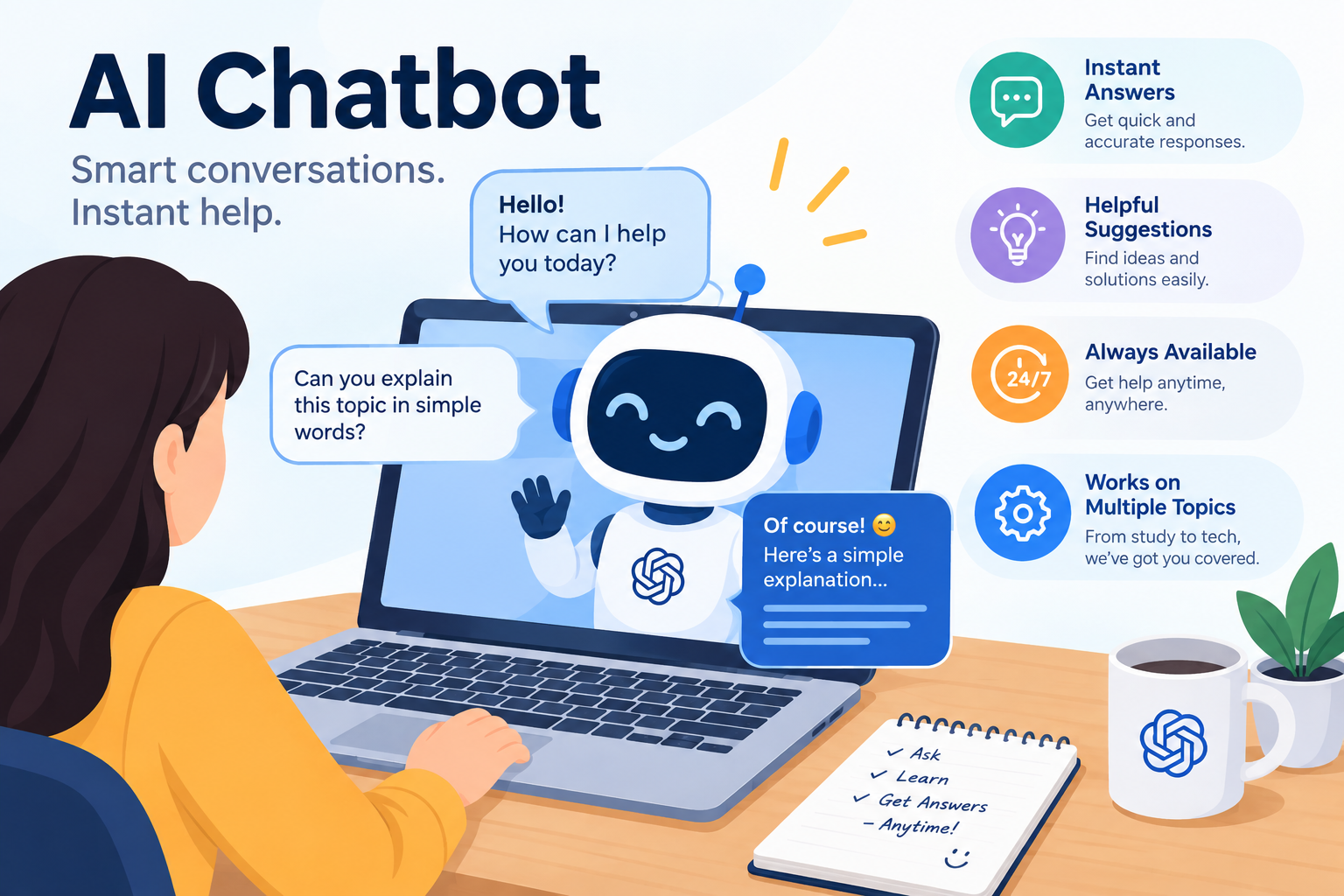
An AI chatbot is a software application that uses artificial intelligence to simulate conversation with users through text or voice in a way that feels natural and human-like. When you type or speak a message to an AI chatbot, it analyzes your input, interprets what you are asking, and generates a relevant response, all in real time.
Unlike older chatbots that could only respond to specific pre-programmed commands, AI chatbots can understand the meaning and context of a wide variety of messages and generate appropriate responses even to questions they were not explicitly programmed to handle. This flexibility comes from the underlying AI models that power the chatbot’s ability to understand and produce language.
Here are some everyday examples of AI chatbots in action:
- A customer service chatbot on a retail website that answers questions about orders, returns, and products in natural, conversational language
- A virtual assistant on a smartphone that understands spoken questions and responds in a coherent, contextually relevant way
- An AI writing assistant that helps users draft, edit, and refine documents through a back-and-forth chat interface
- An educational AI tool that explains concepts, answers student questions, and adapts its explanations to different levels of understanding
- An AI chatbot on a banking app that helps customers check balances, understand transactions, and report issues without waiting for a human agent
In each case, the defining feature is that the AI chatbot can handle the natural, varied way humans actually communicate, rather than requiring users to type exact commands from a fixed menu.
How Is an AI Chatbot Different from a Regular Chatbot?
Not all chatbots are AI chatbots. Understanding the difference explains why AI chatbots are significantly more capable and flexible than their predecessors.
Regular or rule-based chatbots work by following a predefined set of rules and decision trees. They can only respond to specific inputs that match their programmed patterns. If you phrase a question in a way the chatbot was not programmed to recognize, it either fails to respond meaningfully, loops back to a menu, or presents an error message. These chatbots are useful for simple, structured interactions where every possible question can be anticipated and scripted in advance.
AI chatbots work differently. They use machine learning and natural language processing to understand the intent and meaning behind user messages rather than just matching specific keywords or phrases. They can handle varied phrasings of the same question, maintain context across an ongoing conversation, and generate responses to inputs they were not explicitly programmed for.
| Dimension | Rule-Based Chatbot | AI Chatbot |
|---|---|---|
| How it works | Follows predefined decision trees and rules | Uses AI models to understand and generate language |
| Handles varied phrasing | Only if explicitly programmed | Yes, understands intent regardless of exact phrasing |
| Context awareness | Limited or none | Can maintain context across conversation turns |
| Response flexibility | Fixed and scripted | Dynamic and generated in real time |
| Setup complexity | Requires programming every scenario in advance | Trained on data rather than programmed rule by rule |
| Best for | Simple structured interactions with predictable inputs | Complex, varied, and open-ended conversations |
| Error handling | Fails or loops if input is not recognized | Can attempt to handle unexpected or unusual inputs |
Many modern customer service deployments combine elements of both approaches. AI chatbots handle open-ended conversation and complex queries while rule-based flows manage specific structured tasks like processing returns or verifying account numbers. This hybrid approach balances flexibility with reliability for predictable high-volume processes.
How Do AI Chatbots Work?
Understanding the process an AI chatbot follows from receiving your message to delivering a response helps clarify both its capabilities and its limitations.
Step 1: The User Sends a Message
The interaction begins when a user types or speaks a message to the chatbot. This message is the input. In more advanced AI contexts, particularly with large language model-powered tools, this input is also called a prompt. Understanding what an AI prompt is helps users communicate more effectively with AI chatbots from the start.
Step 2: Natural Language Processing
The chatbot uses natural language processing, commonly abbreviated as NLP, to analyze the user’s message. NLP is the branch of artificial intelligence that enables computers to understand, interpret, and generate human language.
Understanding how artificial intelligence works at a foundational level helps clarify why NLP is such a significant technical achievement.
During NLP, the chatbot processes the words, sentence structure, and context of the message to identify what the user is asking or intending. Modern AI chatbots powered by large language models go significantly beyond basic NLP. They can understand nuance, implied meaning, conversational context, and even subtle differences in tone.
Step 3: Understanding Intent and Context
The chatbot determines the intent behind the user’s message, meaning what the user actually wants to know or achieve. Intent recognition allows the chatbot to respond appropriately even when the same question is phrased in many different ways.
In a multi-turn conversation, the chatbot also considers the context of earlier messages in the current session. For example, if a user asks “What is the price?” without specifying a product, the chatbot can use the context of earlier messages in the conversation to infer what product is being referenced and respond accordingly.
Step 4: Generating a Response
Based on its understanding of the input and the conversation context, the chatbot generates a response using the underlying AI model. For AI chatbots powered by large language models, the response is generated by predicting the most appropriate sequence of words given the input and the conversation history. The response is not retrieved from a database of pre-written answers. It is produced dynamically based on learned patterns from the model’s training data.
This is fundamentally different from rule-based chatbots, which retrieve pre-written responses from a fixed library of scripted answers.
Step 5: Delivering the Response
The generated response is delivered to the user through the chat interface as text, or converted to speech in voice-enabled chatbot implementations. The user can then reply and the process continues, building a multi-turn conversation that the chatbot tracks for context throughout the session.
What Technology Powers AI Chatbots?
Several interconnected technologies work together to make modern AI chatbots function. Understanding each one at a basic level demystifies how these tools accomplish what they do.
Natural Language Processing
NLP enables the chatbot to read and understand human language in a structured way rather than treating text as raw sequences of characters. It involves analyzing text for meaning, sentence structure, sentiment, and intent. NLP is what allows an AI chatbot to understand that “Can you help me send back this item?” and “I need to return a product I bought” are asking for the same thing.
Large Language Models
Modern AI chatbots are typically powered by large language models, or LLMs, which are AI models trained on vast amounts of text data to understand and generate human language at a sophisticated level. LLMs give AI chatbots the ability to handle an enormous range of topics and conversation types without being explicitly programmed for each one.
The guide on AI models explains clearly how large language models are trained, what parameters are, and why model scale affects capability. This foundational understanding helps users appreciate both what AI chatbots can do and where their limitations come from.
Machine Learning
Machine learning allows AI chatbots to develop their language capabilities from data rather than from explicit programming rules. Many advanced AI chatbots also benefit from a technique called reinforcement learning from human feedback, in which human reviewers rate chatbot responses and those ratings are used to refine the model’s behavior over time. This process helps align AI chatbot outputs more closely with what users actually find helpful and appropriate.
Context Management
AI chatbots maintain a record of the conversation within a session, allowing them to reference earlier parts of the exchange and provide contextually consistent responses across multiple turns. The length of conversation history a chatbot can consider at once is referred to as its context window. Models with larger context windows can maintain coherence across longer conversations.
Prompt Processing
Every message a user sends to an AI chatbot is processed as a prompt by the underlying AI model. The way users phrase their messages significantly affects the quality and relevance of the chatbot’s response. Learning prompt engineering techniques allows users to communicate with AI chatbots more effectively and get substantially better results from the same tools.
Types of AI Chatbots
AI chatbots come in several distinct categories, each suited to different needs and contexts.
| Type | How It Works | Primary Use | Examples of Use |
|---|---|---|---|
| Rule-Based Chatbot | Follows scripted decision trees and keyword matching | Simple, structured interactions with predictable inputs | Basic FAQ bots, menu-driven customer support |
| AI-Powered Chatbot | Uses NLP and machine learning to understand intent | Open-ended conversation and varied queries | Customer service platforms, virtual assistants |
| Generative AI Chatbot | Powered by large language models | Dynamic content generation and natural conversation | Writing assistance, tutoring, general Q&A |
| Task-Specific Chatbot | Fine-tuned for a specific domain or industry | Specialized interactions within a defined field | Healthcare triage, legal Q&A, HR support |
| Voice Chatbot | Processes and responds to spoken audio input | Hands-free and voice-based interaction | Smart speakers, automated phone support |
| Hybrid Chatbot | Combines rule-based flows with AI conversation | Structured and flexible interaction in the same session | E-commerce support, banking assistance |
Most AI chatbots that users encounter today fall into the generative AI chatbot or hybrid categories. The widespread availability of large language model technology has made generative AI chatbots increasingly common across consumer and business applications. The guide on generative AI provides a deeper explanation of how this technology works and why it has become so central to modern AI chatbot development.
What Can AI Chatbots Do?
The range of tasks AI chatbots can meaningfully assist with has expanded significantly as the underlying technology has advanced.
Answer Questions and Provide Information
AI chatbots can answer a wide range of factual and explanatory questions on topics covered in their training data. They can explain concepts, summarize topics, provide general background information, and respond to follow-up questions within the same conversation, adjusting the depth and detail of their explanations based on how the user responds.
Assist with Writing and Content Tasks
AI chatbots help users draft emails, write documents, edit and improve existing text, generate creative content in various styles and formats, and produce summaries of longer material. They can adapt their writing to match a specified tone, style, and audience based on user instructions.
Provide Customer Support
Businesses deploy AI chatbots to handle customer queries about products, services, orders, and accounts around the clock without requiring a human agent for every interaction. AI chatbots can resolve common issues, collect information from customers to route cases efficiently, and escalate complex or sensitive situations to human agents when appropriate.
Assist with Learning and Explanation
AI chatbots can explain complex topics in accessible terms, answer student questions at different levels of detail, generate practice questions and study materials, and provide personalized explanations adapted to the user’s apparent level of understanding. This makes them valuable educational companions outside of formal classroom settings.
Help with Productivity and Task Management
AI chatbots integrated into productivity tools help users manage tasks, draft communications, organize information, prepare presentations, and summarize long documents. The efficiency gains from these applications can be significant for knowledge workers who handle high volumes of written communication.
Support Research and Analysis
AI chatbots can help users summarize large amounts of text, compare information across multiple sources, explore topics from different angles, and generate structured analyses. They are most effective as research assistants that accelerate initial exploration rather than as definitive sources of verified information.
Translate Languages
AI chatbots can translate text between many languages and assist users in communicating across language barriers, making them useful tools for international businesses, travelers, and language learners.
What AI Chatbots Cannot Do Reliably
An honest understanding of AI chatbot limitations is as important as understanding their capabilities. The NIST AI Risk Management Framework identifies accuracy and reliability as core considerations for responsible AI deployment, and these concerns apply directly to AI chatbots.
- Factual accuracy is not guaranteed. AI chatbots can produce confident-sounding responses that contain errors, outdated information, or entirely fabricated details. This is known as hallucination. Always verify important factual claims through reliable independent sources.
- Real-time information may not be available. Most AI chatbots do not have access to information beyond their training data cutoff date unless specifically connected to live search tools or external data sources.
- Human judgment cannot be fully replaced. AI chatbots are not equipped to handle the full complexity, nuance, and ethical dimensions of high-stakes decisions in medical, legal, or financial contexts. Professional consultation remains essential for these areas.
- True comprehension does not exist in the human sense. AI chatbots process and generate language based on statistical patterns in training data. They do not understand the world as humans do, which can lead to misinterpretation of nuanced, ambiguous, or contextually complex messages.
- Bias can appear in outputs. AI chatbots learn from human-generated data that contains existing biases and imbalances. These can be reflected in chatbot responses in ways that are not always immediately apparent.
- Private information is not accessible. AI chatbots cannot access confidential information about the user beyond what is shared within the current conversation, unless specifically integrated with external systems that have been granted access.
Real-World Uses of AI Chatbots
AI chatbots are deployed across a wide range of industries and contexts. The guide on how AI is changing education, business, and healthcare explores this transformation in depth across several of the sectors discussed below.
Customer Service and Support
AI chatbots handle customer inquiries, complaints, order tracking, returns, and general support queries for businesses across e-commerce, telecommunications, financial services, insurance, and other industries. They provide round-the-clock availability and can manage many simultaneous conversations. Effective implementations combine AI chatbot capability for routine queries with clear escalation pathways to human agents for complex or sensitive cases.
Healthcare
Healthcare providers use AI chatbots for symptom checking, appointment scheduling, medication reminders, and providing general health information. These applications can improve access to preliminary information and reduce administrative burden on healthcare staff. An important and necessary caution applies here: AI chatbots are not a substitute for professional medical diagnosis or advice. Users must always consult qualified healthcare professionals for medical decisions.
Education
Educational platforms use AI chatbots to provide personalized tutoring, answer student questions, explain concepts at different levels of detail, and support language learning through conversational practice. AI chatbots can provide immediate support and feedback outside of classroom hours, extending the availability of educational assistance significantly.
Banking and Financial Services
Banks and financial services companies use AI chatbots to help customers check account information, understand products and services, get guidance on transactions, and report issues efficiently. As with healthcare, an important caution applies: AI chatbots in financial services should not be relied on for personalized financial advice, which requires a qualified professional who understands the individual’s full financial situation.
E-Commerce and Retail
Online retailers use AI chatbots to help customers find products, compare options, track orders, process returns, and receive personalized recommendations based on browsing history and purchase patterns. These tools improve the customer experience while reducing the volume of routine queries reaching human support teams.
Human Resources and Recruitment
HR departments use AI chatbots to answer employee questions about company policies, benefits, procedures, and resources. In recruitment, AI chatbots handle initial candidate engagement and information gathering in early screening stages, allowing HR professionals to focus their attention on more substantive evaluation activities.
Travel and Hospitality
Travel companies and hotels use AI chatbots to assist with bookings, itinerary planning, travel information, and customer support before and during trips. For travelers navigating time zone differences and out-of-hours support needs, around-the-clock AI chatbot availability is particularly practical.
Benefits of AI Chatbots
When deployed thoughtfully, AI chatbots offer genuine and significant advantages for both users and organizations.
- Availability. AI chatbots can operate continuously around the clock without breaks, providing users with access to assistance at any time regardless of time zone or staffing hours.
- Scalability. A single AI chatbot deployment can handle many simultaneous conversations without the need to scale human staffing proportionally to demand volume.
- Consistency. AI chatbots deliver consistent responses to standard queries, reducing variability in the quality and accuracy of information provided across different interaction instances.
- Speed. AI chatbots respond to user queries almost instantly, eliminating wait times that are common in human agent queues, particularly during peak periods.
- Cost efficiency. For organizations handling high volumes of routine interactions, AI chatbots can manage significant query volume at lower cost than equivalent human staffing would require.
- Personalization. Advanced AI chatbots integrated with user data systems can tailor responses to individual context, history, and preferences where data sharing permissions support this.
- Multilingual support. AI chatbots can communicate across multiple languages, extending service reach to diverse user populations without requiring multilingual staffing for every interaction.
Limitations and Risks of AI Chatbots
A responsible view of AI chatbot technology requires clear acknowledgment of its limitations and risks alongside its capabilities.
Hallucinations and Inaccurate Information
AI chatbots can generate plausible-sounding but factually incorrect information, a phenomenon called hallucination. This is one of the most significant risks of AI chatbot use, particularly when users rely on chatbot responses for important decisions without independent verification. Always check important information from AI chatbots through reliable, authoritative sources before acting on it.
Privacy and Data Security Concerns
Messages submitted to AI chatbot platforms are typically processed by the platform’s servers and may be stored or used in model improvement processes. Users should review the privacy policy of any AI chatbot platform before use and avoid sharing sensitive personal, financial, medical, or confidential business information in chatbot conversations. Understanding cybersecurity best practices helps users make informed decisions about what information to share with any online platform, including AI chatbots.
Lack of True Understanding
AI chatbots process language statistically based on patterns learned during training rather than truly understanding meaning the way humans do. This can lead to misinterpretation of nuanced, ambiguous, or complex messages, particularly when the user’s intent is not explicitly stated.
Bias in Responses
AI chatbots learn from human-generated data that contains existing biases. These biases can appear in chatbot responses in ways that may be subtle and not immediately recognizable. Being aware of this possibility helps users evaluate AI chatbot outputs with appropriate critical awareness.
Over-Reliance Risk
Users who accept AI chatbot responses without critical evaluation risk making decisions based on inaccurate or incomplete information. AI chatbots are tools designed to assist human decision-making, not to replace the judgment, verification, and responsibility that humans must retain, particularly for consequential decisions.
Limited Accountability
When an AI chatbot provides incorrect or harmful information, accountability frameworks for who bears responsibility are still developing across many jurisdictions. Users should maintain critical awareness and treat AI chatbot responses as useful but not authoritative starting points rather than as final answers on matters of importance.
How to Get the Best Results from an AI Chatbot
The quality of what you get from an AI chatbot is significantly shaped by how you interact with it. These practical steps help you get more useful, relevant, and accurate responses.
- Be specific and clear in your messages. The more context and detail you provide, the more targeted and relevant the chatbot’s response will be.
- Provide relevant background information about your goal, situation, or audience so the chatbot can generate a more appropriately tailored response.
- If the first response does not fully meet your need, refine your request. Add detail, correct a misunderstanding, or ask the chatbot to approach the question differently.
- Ask follow-up questions to explore a topic more deeply, clarify something in the response, or ask the chatbot to adjust its output in a specific way.
- Specify the format you want, such as a numbered list, a short summary, a table, or a response at a specific length or reading level.
- Always verify factual claims from AI chatbot responses independently through reliable sources before relying on them for important decisions.
- Do not share sensitive personal, financial, medical, or confidential information in chatbot conversations.
- Learn basic prompt engineering techniques to significantly improve the consistency and quality of responses you receive from AI chatbots. The guide on prompt engineering covers these techniques clearly in beginner-friendly terms and is the most practical resource for anyone who wants to get more value from AI chatbot interactions.
AI Chatbots vs Human Agents: What Is the Difference?
Understanding where AI chatbots excel and where human agents remain essential helps both individual users and organizations make informed decisions about when to use each.
| Dimension | AI Chatbot | Human Agent |
|---|---|---|
| Availability | 24 hours a day, 7 days a week | Limited to working hours unless shift-covered |
| Simultaneous conversations | Can handle many at once | Typically one at a time |
| Consistency | Consistent responses to standard queries | Varies between individual agents |
| Empathy and nuance | Limited ability to genuinely empathize | Can provide authentic human empathy and emotional support |
| Complex problem solving | Limited for highly nuanced or novel situations | Better equipped for complex judgment and judgment calls |
| Factual accuracy | Can produce hallucinations and errors | Subject to human knowledge limits but applies judgment |
| Cost | Lower for high-volume routine interactions | Higher for equivalent interaction volume |
| Escalation | Can identify and escalate to a human when needed | Is the escalation destination for complex cases |
| Accountability | Platform provider carries primary responsibility | Individual and organizational accountability applies |
The most effective customer service and support implementations combine AI chatbots for routine, high-volume queries with clear and smooth escalation pathways to human agents for complex, sensitive, or emotionally demanding cases. The question is rarely AI chatbot versus human agent in absolute terms. It is how to combine both effectively to serve users well across the full range of situations they bring.
How to Use an AI Chatbot: A Beginner’s Step-by-Step Guide
If you are using an AI chatbot for the first time, these steps will help you get started effectively and safely.
Step 1: Choose an AI Chatbot Tool
Select an AI chatbot tool appropriate for your intended use. Different chatbots are optimized for different tasks, such as general conversation, writing assistance, customer service, or specialized professional domains. Before creating an account, review the platform’s privacy policy and terms of service to understand how your data is handled.
Step 2: Start a Conversation
Open the chatbot interface and type your first message or question. Be clear and specific about what you need from the start. The chatbot will respond almost immediately based on its processing of your input.
Step 3: Provide Context
Include relevant background information in your message that will help the chatbot understand your situation, audience, or purpose. Context directly improves the relevance and usefulness of the response you receive.
Step 4: Review the Response
Read the chatbot’s response carefully. Assess whether it accurately and completely addresses your question. For any factual information that matters, verify it through reliable independent sources before acting on it or using it in a professional context.
Step 5: Refine and Continue the Conversation
If the response is not quite right, send a follow-up message asking the chatbot to adjust, expand, clarify, or approach the question differently. Multi-turn conversation is one of the most powerful features of AI chatbots, and iterative refinement typically produces significantly better results than accepting the first output.
Step 6: Use the Output Responsibly
Use AI chatbot outputs as a starting point or assistant rather than as a final authoritative answer. Edit, verify, and adapt any content the chatbot generates before using it in professional, academic, or public-facing contexts.
AI Chatbots and Privacy: What You Should Know
Privacy is a practical and important consideration for anyone using AI chatbot tools regularly.
When you interact with an AI chatbot, your messages are typically processed by the platform’s servers and may be stored or used in the platform’s model improvement processes. The specific data handling practices vary significantly between platforms, which is why reviewing the privacy policy before use is genuinely important rather than just a formality.
Practical guidance for protecting your privacy when using AI chatbots:
- Avoid submitting full names combined with account numbers, passwords, financial information, medical records, or confidential business data to AI chatbot platforms.
- Be particularly careful with AI chatbot integrations that request access to personal accounts, email, or data sources. Review what access permissions are being requested and whether they are necessary for the intended use.
- Parents and educators should supervise younger users when using AI chatbot tools and review the platform’s age-appropriateness and data handling policies for minors before allowing access.
- If you are using an AI chatbot in a professional context, check whether your organization has policies governing what information may be submitted to external AI tools.
The Future of AI Chatbots
AI chatbot capabilities are advancing as the underlying models that power them continue to develop in accuracy, context management, and multimodal capability.
Multimodal AI chatbots that can process and respond to both text and images within a single conversation are already available on some platforms and expanding in capability. Users can share an image along with a text question and receive a response that addresses both the visual and textual content together.
Integration of AI chatbots with real-time data sources, external tools, and business systems is increasing their practical utility across professional contexts. Rather than being limited to knowledge from training data alone, chatbots connected to live search tools or internal databases can provide more current and contextually accurate information.
Voice-based AI chatbots are becoming more natural and capable, expanding chatbot utility in hands-free contexts such as driving, cooking, or managing workplace tasks without interrupting physical activity.
Regulatory frameworks governing AI chatbot accountability, transparency, and safety are developing across multiple jurisdictions. Organizations including NIST have published frameworks for AI risk management that address these considerations, reflecting growing recognition that responsible governance of AI chatbot deployment is as important as the technology itself.
Advances in generative AI are the primary driver of improvements in AI chatbot capabilities, as more powerful and efficient language models directly translate to more capable chatbot interactions. For readers who want to understand the broader AI landscape that AI chatbots exist within, the beginner’s guide to artificial intelligence provides valuable foundational context.
Frequently Asked Questions
What is an AI chatbot?
An AI chatbot is a software application that uses artificial intelligence to simulate conversation with users through text or voice. It can understand varied natural language inputs and generate relevant responses dynamically, rather than being limited to pre-programmed scripted answers.
How does an AI chatbot work?
An AI chatbot receives a user message, uses natural language processing to analyze the intent and meaning, considers the conversation context, and uses an underlying AI model to generate a relevant response. This process happens in real time and repeats across each turn in the conversation.
What is the difference between an AI chatbot and a regular chatbot?
Rule-based chatbots follow predefined scripts and can only handle inputs they were explicitly programmed for. AI chatbots use machine learning and natural language processing to understand varied phrasing, maintain context across conversations, and generate dynamic responses to a wide range of inputs.
What technology powers AI chatbots?
Modern AI chatbots are powered by natural language processing, large language models, machine learning, and context management systems. Together these technologies allow AI chatbots to understand, process, and generate human language at a sophisticated level.
What are the different types of AI chatbots?
The main types are rule-based chatbots, AI-powered chatbots, generative AI chatbots, task-specific chatbots, voice chatbots, and hybrid chatbots. Most chatbots users encounter today are generative AI or hybrid types.
What can AI chatbots do?
AI chatbots can answer questions, assist with writing and editing, provide customer support, explain concepts, assist with productivity tasks, support research, translate languages, and engage in extended multi-turn conversations on a wide range of topics.
What can AI chatbots not do reliably?
AI chatbots cannot guarantee factual accuracy and can produce hallucinations. They generally lack access to real-time information beyond their training cutoff unless connected to live tools. They cannot replace human judgment for high-stakes medical, legal, or financial decisions, and they do not truly understand meaning the way humans do.
Are AI chatbot responses always accurate?
No. AI chatbots can produce confident-sounding but factually incorrect responses. This is one of the most important limitations users need to understand. Always verify important factual information independently before relying on it.
What is a chatbot hallucination?
A hallucination is when an AI chatbot generates information that sounds plausible and is presented confidently but is factually incorrect, outdated, or fabricated. It occurs because the model generates language based on patterns rather than from verified factual knowledge.
How do I get better results from an AI chatbot?
Be specific, provide context, specify the format you want, use follow-up messages to refine the response, and learn prompt engineering techniques.
The guide on prompt engineering covers these techniques in practical, beginner-friendly detail.
What is the difference between an AI chatbot and a human agent?
AI chatbots offer continuous availability, consistency, and scalability for routine queries. Human agents provide genuine empathy, nuanced judgment, and accountability for complex or sensitive situations. Effective implementations combine both.
Are AI chatbots safe to use?
AI chatbots are generally safe for everyday use when users take appropriate precautions. Review the platform’s privacy policy, avoid submitting sensitive personal or confidential information, and always verify important information independently.
What information should I not share with an AI chatbot?
Avoid sharing passwords, full financial account details, medical records, confidential business information, or any sensitive personal data that you would not want processed and potentially stored by a third-party platform.
How are AI chatbots used in business?
Businesses use AI chatbots for customer service, HR support, e-commerce assistance, healthcare information, banking support, recruitment, and many other applications where high-volume conversational interaction can be handled more efficiently with AI assistance.
Can AI chatbots replace human customer service agents?
AI chatbots can handle a significant volume of routine customer service queries effectively, but they cannot fully replace human agents for complex, nuanced, or emotionally sensitive situations. The most effective approach combines both.
What is a generative AI chatbot?
A generative AI chatbot is powered by a large language model and generates responses dynamically rather than retrieving pre-written answers. This makes it capable of handling a very wide range of topics and conversation types.
The guide on generative AI explains the technology behind these chatbots in accessible detail.
How do I use an AI chatbot for the first time?
Choose a chatbot appropriate for your task, start with a clear and specific message, provide relevant context, review the response carefully, and use follow-up messages to refine the output. Treat the chatbot as a capable assistant whose outputs need human review before use.
What is prompt engineering and how does it help with AI chatbots?
Prompt engineering is the skill of designing and structuring your messages to AI tools to get better, more relevant, and more useful responses. Applying prompt engineering techniques when using AI chatbots can significantly improve the quality and consistency of the responses you receive.
The full guide on prompt engineering is the recommended starting point for developing this skill.
Disclaimer
This article is intended for educational purposes and provides a general overview of AI chatbots for beginners and everyday users. AI chatbot capabilities, accuracy, and behavior vary significantly between platforms, models, and versions. Always refer to the official documentation of the specific chatbot platform you are using for accurate guidance. AI chatbot outputs can contain errors, inaccuracies, or biases. Never rely solely on AI chatbot responses for critical medical, legal, financial, or safety decisions. Always review the terms of service and privacy policy of any AI chatbot platform before use. Be cautious about sharing sensitive personal information with AI chatbot tools. This article does not constitute an endorsement of any specific AI chatbot product or platform.
About the Author
Zahra is a technology writer and research contributor covering AI, programming, software, cybersecurity, cloud computing, and the latest developments in technology. She focuses on creating clear, practical, and well-researched content that makes complex tech topics easy to understand.