
 By saman zahra
Introduction
Generative AI is one of the most significant developments in technology in recent years, and it is showing up in tools that millions of people use every day. Yet for many people, the term still feels confusing or technical. This guide explains what generative AI is, how it works, what it can create, and how you can start using it, in plain language designed for anyone who is new to the topic.
What Is Generative AI?
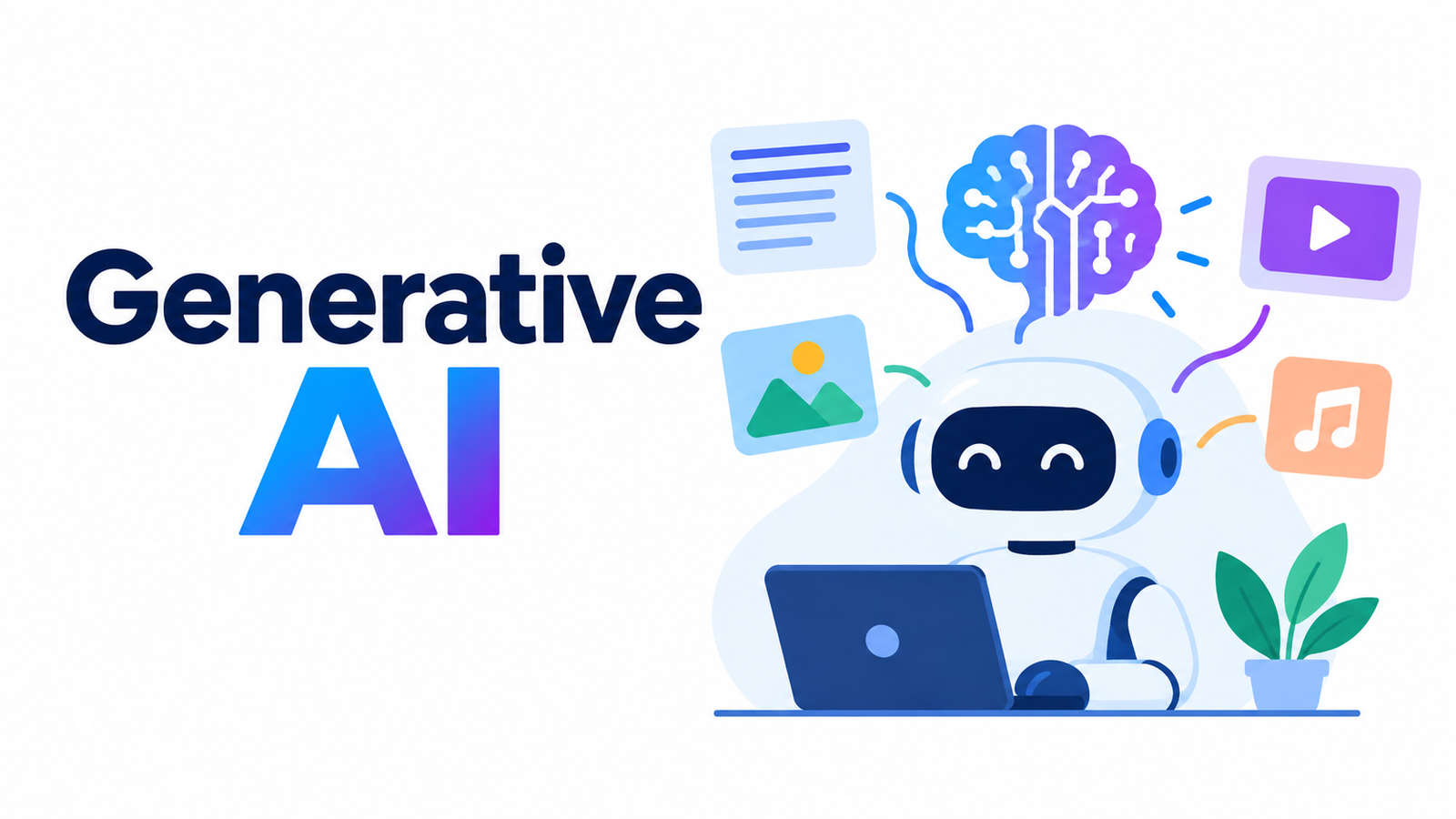
Generative AI is a type of artificial intelligence that can create new content, including text, images, audio, video, and code, by learning patterns from large amounts of existing data. When you give it an instruction or a description, called a prompt, it uses what it has learned to produce something new that matches your request.
Unlike traditional software that follows a fixed set of rules written by a programmer, generative AI learns from examples. It studies patterns in data and uses those patterns to generate original outputs it has never produced before.
The word generative simply means that this type of AI generates or creates, rather than only analyzing or classifying things that already exist.
Here are some straightforward examples of what generative AI can do:
- You type a question and receive a detailed written answer from an AI assistant.
- You describe an image in words and an AI creates that image for you.
- You ask an AI to write a poem, summarize a long document, or draft a professional email.
- You describe a short video scene and an AI generates a video clip from your description.
- You describe a musical mood or style and an AI composes a piece of music to match.
These are not future possibilities. They are things generative AI tools are doing right now, and they are accessible to everyday users without any technical background.
How Does Generative AI Work?
Generative AI models learn by being trained on very large collections of data. The type of data used in training depends on what the model is designed to create.
For text-generating models, the training data typically includes vast amounts of written material from books, websites, articles, academic papers, and other sources. For image-generating models, the training data usually consists of large collections of images paired with text descriptions of those images.
During training, the model processes this data repeatedly and learns patterns within it. A text model learns which words and phrases tend to follow others, how sentences are structured, how arguments are built, and how different styles of writing are expressed. An image model learns what visual patterns correspond to which written descriptions.
Once training is complete, the model does not simply memorize and repeat what it has seen. When a user provides a prompt, the model uses the patterns it has learned to generate a new response that fits the context and intent of that prompt. It is producing something new, not copying and pasting from its training data.
This is why generative AI can write a poem about a topic it has never specifically encountered before, or generate an image of a scene that does not exist in any photograph. It is combining and applying learned patterns in new ways.
What Is a Prompt?
A prompt is the input you provide to a generative AI model to tell it what to create. Depending on the type of tool, a prompt might be a question, an instruction, a description, a partial sentence, an uploaded image, or some combination of these.
The quality and specificity of a prompt has a direct effect on the quality of the output you receive. A vague prompt tends to produce a generic result. A clear, detailed, and specific prompt gives the model more to work with and generally produces a more useful and accurate output.
For example, asking an AI image tool for “a cat” will produce a basic cat image. Asking for “a tabby cat sitting on a stone wall at sunset, soft golden light, watercolor illustration style” gives the model clear direction and is likely to produce a result much closer to what you actually want. Improving your prompt writing is one of the most practical skills you can develop when using generative AI tools.
What Are Large Language Models?
Large language models, commonly abbreviated as LLMs, are a specific type of generative AI model trained on very large text datasets to understand and generate human language.
They are called large because they contain billions of parameters. Parameters are the internal numerical values within a model that are adjusted during training to improve the model’s ability to predict and generate text accurately. The more parameters a model has, the more capacity it generally has to capture complex patterns in language, though size alone does not determine quality.
LLMs power many of the text-based generative AI tools that users interact with directly, including conversational AI assistants, writing aids, and code generation tools. Their capabilities include answering questions, summarizing documents, translating between languages, explaining complex concepts, writing and debugging code, and generating creative content in a wide range of styles and formats.
What Are Diffusion Models?
Diffusion models are a type of generative AI model used primarily for image generation. They work by learning a process of gradually adding random noise to an image until it becomes unrecognizable, and then learning to reverse that process to reconstruct a coherent image from noise.
When applied to generation rather than reconstruction, this trained understanding allows the model to start from random noise and progressively refine it into a coherent image that matches a text description. Many of the AI image generation tools available to everyday users are built on diffusion model architectures.
If you want to explore what AI image generation looks like in practice, the guide on AI art generation provides a practical introduction to these tools and how to use them effectively.
What Can Generative AI Create?
Generative AI is not limited to one type of output. Different models and tools are designed to create different types of content. Here is a breakdown of the main categories.
Text Generation
Generative AI can produce a wide range of written content including articles, essays, summaries, emails, product descriptions, social media posts, scripts, reports, and creative fiction. It can answer questions, explain concepts in different levels of detail, translate between languages, and adapt writing to match specific tones, styles, or audiences.
Text generation is among the most widely used applications of generative AI in both personal productivity and business contexts. From drafting a quick email to summarizing a lengthy research document, text generation tools are being integrated into everyday workflows across many professions.
Image Generation
Generative AI can create entirely new images from text descriptions across a remarkable range of artistic styles including photorealistic, painterly, illustrative, abstract, and many others. Users describe the subject, style, mood, lighting, and composition they want and the AI generates an image to match.
AI image generation has become widely used by content creators, marketers, and designers for producing custom visual assets without needing manual design skills. For a practical guide to AI image generation tools and techniques, the resource on AI art generation is a useful starting point.
Platforms like OpenFuture.ai provide access to multiple generative AI tools including image generation in one accessible location, which is a practical option for users who want to explore different tools without managing many separate accounts.
Video Generation
Generative AI can create short video clips from text descriptions, animate still images into fluid video sequences, and generate motion from various input types. AI video generation is advancing quickly and is increasingly being used by content creators, marketers, and filmmakers for both prototyping and production purposes.
A2E AI is a practical example of a platform that specializes in AI video generation, including image-to-video animation, AI avatar creation, lip synchronization, and other multimedia generation capabilities.
Audio and Music Generation
Generative AI can produce spoken audio from text through text-to-speech tools, replicate voice characteristics for voice synthesis applications, generate original music compositions in various genres and styles, and create sound effects. Audio generative AI has practical applications in accessibility technology, content creation, entertainment production, and business communications.
Code Generation
Generative AI can write, explain, debug, and refactor programming code across a wide range of programming languages. This capability is increasingly used by professional developers to speed up their workflow and is also making basic coding tasks accessible to non-programmers who can describe what they want a piece of code to do in plain language.
Synthetic Data Generation
Generative AI can create synthetic datasets for training other AI models, generate structured data from unstructured inputs, and produce simulated scenarios for research and testing. This application is particularly valuable in fields where real data is limited, sensitive, or expensive to collect, such as medical research and autonomous vehicle development.
Types of Generative AI Models
The table below summarizes the main categories of generative AI models, what they are designed to generate, how they work in simple terms, and where they are commonly applied.
| Model Type | What It Generates | How It Works Simply | Common Applications |
|---|---|---|---|
| Large Language Models (LLMs) | Text and code | Learns patterns in language to predict and generate text sequences | Conversational AI assistants, writing tools, code generation |
| Diffusion Models | Images and sometimes video | Learns to generate images by reversing a process of adding noise to existing images | AI image generators, art creation tools |
| Generative Adversarial Networks (GANs) | Images, video, audio | Two neural networks compete: one generates content and one evaluates it, improving quality through competition | Image synthesis, face generation, video effects |
| Variational Autoencoders (VAEs) | Images and data | Encodes data into a compressed representation and then generates new variations by decoding from that representation | Image editing, data augmentation, style variation |
| Multimodal Models | Text, images, and other content combinations | Trained on multiple content types simultaneously to understand and generate across modalities | Tools that accept both text and image inputs and produce mixed outputs |
Many modern generative AI tools and platforms combine multiple model architectures to handle different types of inputs and outputs within a single system. The specific architecture powering a tool affects its capabilities, its strengths, and its limitations. Understanding the general differences between model types helps set realistic expectations when using specific tools.
Generative AI vs Traditional AI: What Is the Difference?
Traditional AI, sometimes called discriminative AI, is designed to analyze, classify, or make decisions based on existing data. A spam filter that learns to identify unwanted emails, a system that recognizes faces in photographs, or a model that predicts whether a customer is likely to cancel a subscription are all examples of traditional AI applications. These systems learn to distinguish between categories or make predictions, but they do not generate new content.
Generative AI goes further. It not only learns patterns in data but uses those patterns to create entirely new content that did not previously exist.
| Dimension | Traditional AI | Generative AI |
|---|---|---|
| Primary function | Analyze, classify, or predict | Create new content |
| Output type | Labels, decisions, predictions | Text, images, audio, video, code |
| Training approach | Learns to distinguish between categories | Learns patterns to generate new examples |
| Examples | Spam filters, image recognition, recommendation engines | Text generators, AI image creators, AI avatars |
| User interaction | Often automated and running in the background | Frequently directly interactive through prompts |
| Creative capability | Limited to predefined output categories | Produces novel and varied outputs |
The distinction is important for understanding what generative AI can and cannot do. Generative AI excels at creating, varying, and combining content in new ways. It is not inherently more reliable or accurate than other AI types for analytical tasks and, as discussed in the limitations section below, it can produce convincing but incorrect outputs.
Generative AI vs Machine Learning: What Is the Difference?
Machine learning is a broad field of artificial intelligence in which systems learn from data to improve their performance on specific tasks without being explicitly programmed for every possible scenario. Spam filters, recommendation systems, fraud detection tools, and predictive analytics applications all use machine learning.
Generative AI is a subset of machine learning. All generative AI systems use machine learning techniques to learn from training data, but not all machine learning is generative AI. Traditional classification and prediction models are also built using machine learning but are not generative.
The simplest way to think about it is this: machine learning is the broader category that describes how AI systems learn from data. Generative AI is one specific type of application within that category, distinguished by its focus on creating new content rather than analyzing or predicting based on existing data.
Real-World Examples of Generative AI
Generative AI is already present across many areas of everyday life and professional work. Here are practical examples organized by context.
Generative AI in Content Creation
Writers and marketing professionals use generative AI tools to draft articles, social media posts, product descriptions, advertising copy, and email campaigns, using AI-generated drafts as a starting point they then edit and refine. Designers use AI image generators to create custom visuals, concept art, brand imagery, and marketing assets. Video creators use AI tools to generate clips, animate still images, and produce avatar-based video content at a scale that would be difficult to achieve through traditional production.
Platforms like A2E AI serve content creators who need AI-powered video generation, avatar creation, and image animation tools in one place. For those who want access to a wide variety of generative AI tools for content creation without managing many separate platform accounts, OpenFuture.ai provides a broad collection of tools accessible in a single location.
Generative AI in Business and Productivity
Professionals across industries use generative AI to summarize long documents, draft reports, prepare presentation content, and automate repetitive writing tasks. Customer service teams deploy AI-powered chatbots to handle common queries and generate contextually appropriate responses. Developers use AI code assistants to write, review, and debug code more efficiently than working manually, and to explain existing code in plain language.
Generative AI in Education
Students use generative AI tools to research topics, receive explanations of complex concepts in accessible language, practice writing in different languages, and explore ideas from multiple angles. Educators use AI to generate quiz questions, create varied lesson materials, and provide students with tailored explanations suited to different learning levels.
An important caution applies here: AI-generated educational content should always be verified against reliable sources. Generative AI tools can produce inaccurate information with considerable confidence, and this is particularly consequential in learning contexts where accuracy matters.
Generative AI in Healthcare
Researchers use generative AI to model molecular structures, generate synthetic medical data for research purposes where real patient data is limited or sensitive, and assist in the early stages of drug discovery processes. Medical documentation tools use AI to generate clinical notes from voice recordings, helping reduce the administrative workload on healthcare providers.
Healthcare applications of generative AI are subject to strict regulatory and safety requirements. The general public should be aware that AI-generated health information is not a substitute for professional medical advice.
Generative AI in Entertainment
Game developers use generative AI to create dialogue trees, design characters, generate narrative scenarios, and build game environments. Filmmakers and animators use AI tools for concept art generation, scene prototyping, and visual effects production. Musicians and sound designers experiment with AI composition tools to generate melodies, harmonies, and musical arrangements as part of their creative process.
Generative AI in Everyday Life
Many people are already using generative AI without realizing it. Autocomplete and predictive text features on smartphones are early and familiar examples of generative language AI in everyday use. Email smart reply suggestions use generative AI to propose contextually appropriate short responses. Photo editing applications use generative AI to fill in backgrounds, remove unwanted objects from images, and enhance photo quality automatically.
Specialized AI tools are also emerging for specific everyday applications. Readi AI is one example of a focused AI platform with practical everyday applications for users who want to explore what AI can do in a specific context.
How to Use Generative AI as a Beginner
If you have never used a generative AI tool before, the following steps will help you get started in a practical and informed way.
Step 1: Identify What You Want to Create
Before choosing a tool, decide what type of content you need. Do you want to generate text, create an image, produce a video, or experiment with audio? Different generative AI tools specialize in different output types, and choosing the right tool for your goal is the first and most important decision.
Step 2: Choose an Appropriate Tool
Once you know what you want to create, look for a tool that matches your goal.
- For text generation, look for AI writing assistants or conversational AI platforms.
- For image generation, look for AI art and image creation tools. The guide on AI art generation is a useful starting point for exploring image generation tools and understanding how to use them.
- For video generation, look for AI video platforms suited to your creative needs. A2E AI is one example of a platform that covers video generation, AI avatars, and image animation.
- For exploring multiple types of generative AI tools in one place, an aggregator platform can be a convenient starting point. OpenFuture.ai is a practical example where beginners can explore a wide range of generative AI tools without managing separate accounts for each.
Step 3: Write a Clear Prompt
Start with a simple, specific description of what you want the AI to generate. Include details about the content type, subject, style, tone, or format you are looking for. If the first output is not what you expected, adjust your prompt and try again. Getting useful results from generative AI tools is a skill that develops with practice.
Step 4: Review the Output Carefully
This step is not optional. Always review AI-generated content before using it. Check text for factual accuracy, logical consistency, and appropriate tone. Check images for distortions, unexpected visual errors, or inaccuracies. Never use AI-generated content as final output without human review, particularly for professional, medical, legal, or educational purposes. This applies regardless of how confident or polished the output appears.
Step 5: Iterate and Refine
If the initial output does not meet your needs, adjust your prompt and generate again. Most generative AI tools allow multiple attempts. Over time, as you work with specific tools, you will develop a clearer sense of how to prompt them to produce the results you want. This learning curve is a normal and expected part of using generative AI effectively.
Benefits of Generative AI
When used thoughtfully, generative AI offers genuine and practical advantages across many contexts.
- Productivity improvement. Generative AI can complete content creation tasks significantly faster than working manually, allowing users to produce more output in less time and focus their attention on higher-level decisions and editing.
- Accessibility. Generative AI makes capabilities like custom image creation, code writing, and content production accessible to people without specialized design, programming, or writing training.
- Creative exploration. Generative AI allows users to quickly generate and compare a wide range of creative ideas, visual styles, and content directions that would take much longer to explore through manual work.
- Personalization at scale. Businesses can use generative AI to create personalized content variations for large audiences more efficiently than producing each piece individually.
- Research assistance. Generative AI can help users quickly summarize and synthesize information from long documents, though outputs must always be verified against primary sources.
- Cost reduction. Automating certain repetitive content creation tasks with generative AI can reduce production costs in specific business contexts, particularly for high-volume content work.
Risks and Limitations of Generative AI
Understanding the limitations of generative AI is as important as understanding its capabilities. A realistic view of both is essential for using these tools responsibly and effectively.
Hallucinations and Factual Errors
One of the most important things a beginner needs to understand about generative AI is that it can produce confident-sounding but factually incorrect information. This is commonly referred to as a hallucination. The model generates text that fits the patterns of plausible-sounding language, but the specific facts it asserts may be wrong.
This is not a minor technical glitch. It is a fundamental characteristic of how current language models work. Users must independently verify any factual claims generated by AI tools before relying on them, particularly for decisions with significant consequences. The NIST AI Risk Management Framework highlights factual reliability as a core consideration in responsible AI deployment.
Bias in Outputs
Generative AI models learn from human-created data, and human-created data reflects existing human biases. These biases can appear in AI-generated outputs, sometimes in subtle ways and sometimes more overtly. Being aware of potential bias in generative AI outputs is important, particularly when using these tools to create content that will reach broad or diverse audiences.
Copyright and Intellectual Property Concerns
Questions about the copyright status of AI-generated content and the use of copyrighted material in AI training data are active areas of legal debate in many jurisdictions. The legal landscape is still developing, and different countries are taking different approaches. Users should be aware of the terms of service of any generative AI platform they use, particularly regarding ownership and permitted uses of generated outputs, and should monitor developments in this area relevant to their jurisdiction and use case.
Misinformation and Deepfakes
The ability of generative AI to create realistic-looking text, images, audio, and video creates genuine potential for misuse in the production of misleading or false content, including deepfakes, which are synthetic media that depict real people doing or saying things they did not actually do or say. Critical evaluation of media encountered online is increasingly important, and media literacy around AI-generated content is a developing area of public education.
Privacy Considerations
Submitting personal, sensitive, or confidential information to generative AI platforms raises meaningful privacy considerations. Many platforms process and may retain the inputs users provide. Users should review the data handling and privacy policies of any AI tool before submitting personal data, confidential business information, or sensitive communications. Understanding good practices around cybersecurity helps users make informed decisions about what information to share with any online platform, including AI tools.
Environmental Considerations
Training and running large generative AI models requires substantial computational resources and energy. The environmental impact of large-scale AI model training, including energy consumption and associated carbon emissions, is an ongoing discussion among researchers, technology companies, policymakers, and environmental organizations. This does not mean individual users bear responsibility for industry-scale decisions, but it is part of an honest picture of what generative AI involves at a systemic level.
Generative AI Tools: Examples by Category
Text Generation Tools
Conversational AI assistants and AI writing tools powered by large language models are among the most widely used generative AI applications available today. They are used by individuals and organizations for drafting, editing, summarizing, translating, answering questions, and producing written content across personal and professional contexts. These tools are accessed through web interfaces and, increasingly, through integrations built into existing productivity software applications.
AI Image Generation Tools
AI image generators allow users to create custom images from text descriptions across a wide range of styles and subjects. These tools are widely used by content creators, marketers, and designers who need visual assets without manual illustration or photography. For a practical guide to AI image generation tools and how to use them effectively, the resource on AI art generation covers the topic in accessible and practical detail.
AI Video Generation Tools
AI video generation tools can animate still images, create short video clips from text descriptions, generate AI avatars, and produce lip-synced video content. These tools are expanding quickly in capability and are being adopted by content creators, marketers, and filmmakers. A2E AI is one example of an AI multimedia generation platform that covers video generation, avatar creation, image animation, and related capabilities in a single platform.
AI Tool Aggregator Platforms
Some platforms bring together multiple generative AI tools in one place, allowing users to access text, image, audio, and video generation tools without needing separate accounts on multiple platforms. This aggregator model is particularly convenient for users who want to explore different types of generative AI tools without committing to a single specialized platform. OpenFuture.ai is a practical example of this type of platform, providing access to a broad range of generative AI tools through a single interface.
Specialized AI Tools
Beyond general-purpose tools, many specialized generative AI applications exist for specific use cases including education, healthcare research, music composition, code generation, and more. Specialized tools are often designed with a specific workflow or user need in mind and may offer more focused functionality than general platforms in their particular area. Readi AI is one example of a focused AI tool with a specific practical application for everyday users.
How Generative AI Is Different from a Search Engine
This is one of the most common points of confusion for people who are new to generative AI, and it is worth explaining clearly.
A search engine finds and returns links to existing web pages that already match your query. The content you see in search results was written by humans and published online before you searched. The search engine retrieves and ranks it based on relevance and quality signals.
A generative AI model does something fundamentally different. When you provide a prompt, it creates a new response in real time by applying the patterns it learned during training. It is not retrieving a pre-written answer from a database of web pages. It is generating new text based on what it has learned about how language works and what kinds of responses fit different types of questions.
This distinction has important practical implications.
| Dimension | Search Engine | Generative AI |
|---|---|---|
| How it works | Retrieves and ranks existing web pages | Generates new content from learned patterns |
| Output | Links to existing human-written content | Newly created text, images, or other content |
| Source verification | Links back to original source pages | May not cite or link to verifiable sources |
| Factual reliability | Depends on the quality of the source pages returned | Can produce confident-sounding but incorrect information |
| Interactivity | Keyword and query based | Conversational and prompt-based |
Because generative AI creates new responses rather than retrieving existing ones, it does not inherently come with source citations or verifiable references. This makes independent fact-checking particularly important when using generative AI for informational purposes. A search engine that links to a well-sourced article allows you to trace the information to its origin. A generative AI response may sound equally authoritative while being factually incorrect in ways that are not immediately apparent.
The Future of Generative AI
Generative AI capabilities are developing at a notable pace, and several trends in the field are worth understanding as context.
Multimodal AI models that can process and generate combinations of text, images, audio, and video within a single interaction represent an active and growing area of development. Models that previously handled only text or only images are increasingly being designed to work across multiple content types simultaneously.
Integration of generative AI into existing software tools, including word processors, design applications, email platforms, and productivity suites, is already underway and expanding. Many users are encountering generative AI features within tools they already use, even if they do not always recognize them as such.
Regulatory frameworks for generative AI are developing in many jurisdictions. The European Union, the United States, and other governments and international bodies are working to establish policies and guidelines that address concerns around safety, accuracy, copyright, privacy, and potential misuse. IBM and other major technology organizations have engaged actively with policymakers on AI governance frameworks, and bodies such as NIST have published risk management frameworks relevant to AI development and deployment.
The responsible development and use of generative AI, including addressing issues of bias in training data, factual reliability, privacy, intellectual property, and environmental impact, remains an important and ongoing challenge for researchers, developers, companies, and policymakers. These are not marginal concerns but central questions about how this technology develops and who it serves.
Frequently Asked Questions
What is generative AI?
Generative AI is a type of artificial intelligence that creates new content, including text, images, audio, video, and code, by learning patterns from large amounts of existing data and using those patterns to generate new outputs in response to user inputs called prompts.
How does generative AI work?
Generative AI models are trained on large datasets and learn patterns within that data. When a user provides a prompt, the model uses its learned patterns to generate a new output that fits the context and intent of that prompt. It creates new content rather than retrieving pre-existing content.
What can generative AI create?
Generative AI can create text, images, video, audio and music, programming code, and synthetic data. Different tools and model types specialize in different output categories.
What is a prompt in generative AI?
A prompt is the input you provide to a generative AI model to tell it what to create. Prompts can be questions, instructions, descriptions, or other inputs. More specific and detailed prompts generally produce better results.
What is a large language model?
A large language model, or LLM, is a type of generative AI trained on very large text datasets to understand and generate human language. LLMs power many text-based AI tools including conversational assistants and writing aids.
How is generative AI different from traditional AI?
Traditional AI analyzes, classifies, or predicts based on existing data. Generative AI creates new content. A spam filter is traditional AI. An AI writing assistant is generative AI.
How is generative AI different from machine learning?
Machine learning is the broad field in which AI systems learn from data. Generative AI is a specific application within machine learning that focuses on generating new content. All generative AI uses machine learning, but not all machine learning is generative AI.
How is generative AI different from a search engine?
A search engine retrieves and ranks existing web pages. Generative AI creates new content from scratch based on learned patterns. A search engine links to existing sources; generative AI generates responses that may not be linked to verifiable sources.
What are examples of generative AI tools?
Examples include AI writing assistants, AI image generators, AI video generation platforms like A2E AI, AI music composition tools, and AI code assistants. Aggregator platforms like OpenFuture.ai provide access to multiple types of generative AI tools in one place.
Can generative AI make mistakes?
Yes. Generative AI tools can produce factually incorrect, biased, or otherwise flawed outputs. All AI-generated content should be reviewed carefully before use, and factual claims should be verified independently.
What is an AI hallucination?
An AI hallucination is when a generative AI model produces confident-sounding but factually incorrect information. It is not a glitch in the usual sense but a characteristic of how current language models generate text based on patterns rather than verified facts.
Is generative AI content always accurate?
No. Generative AI content is not always accurate. Text-generating AI tools in particular can produce incorrect factual claims. Images can contain visual distortions or inaccuracies. All AI-generated content requires human review.
What are the risks of using generative AI?
Key risks include factual inaccuracies and hallucinations, bias in outputs, copyright and intellectual property uncertainties, potential for misuse in creating misleading content and deepfakes, privacy considerations when submitting personal data, and environmental resource consumption from large-scale model training and operation.
Can anyone use generative AI or do you need technical skills?
Most generative AI tools designed for everyday users are accessible without technical knowledge. You interact with them through plain language prompts. Technical skills are not required for most consumer-facing tools, though understanding how they work helps you use them more effectively and critically.
What is the difference between generative AI and deepfakes?
Deepfakes are a specific application of generative AI in which AI is used to create synthetic media that depicts real people doing or saying things they did not actually do or say. Generative AI is the broader technology; deepfakes are one particular and ethically concerning use of that technology.
Is generative AI the same as robotics?
No. Generative AI refers to AI systems that create content such as text, images, audio, and video. Robotics involves machines designed to perform physical tasks in the real world. While AI including generative AI can be used to control or assist robotic systems, they are distinct fields.
How do I start using generative AI as a beginner?
Identify what type of content you want to create, choose a tool suited to that type of output, write a clear and specific prompt, review the output carefully before using it, and refine your prompt if needed. Platforms like OpenFuture.ai offer a range of generative AI tools in one place, making them a convenient starting point for exploration.
What types of content can generative AI not create reliably?
Generative AI currently struggles with consistent factual accuracy, reliable arithmetic and logical reasoning, precise representation of specific real-world events after a certain training cutoff date, and the fine nuances of human judgment and professional expertise. It is not a reliable substitute for professional advice in legal, medical, financial, or safety-critical domains.
Disclaimer
This article is intended for educational purposes and provides a general overview of generative AI for beginners and everyday users. The generative AI field is evolving rapidly. Specific tools, models, and capabilities described in this article reflect current general understanding and may change as the technology develops. Generative AI outputs including text, images, audio, and video should always be reviewed carefully before use. AI-generated content can contain inaccuracies, biases, or errors. Users are responsible for how they use generative AI tools and the content those tools produce. Always review the terms of service and acceptable use policies of any generative AI platform before use. This article does not constitute an endorsement of any specific generative AI product or platform.
About the Author
Zahra is a technology writer and research contributor covering AI, programming, software, cybersecurity, cloud computing, and the latest developments in technology. She focuses on creating clear, practical, and well-researched content that makes complex tech topics easy to understand.