
 By TechOriginHub Editorial Team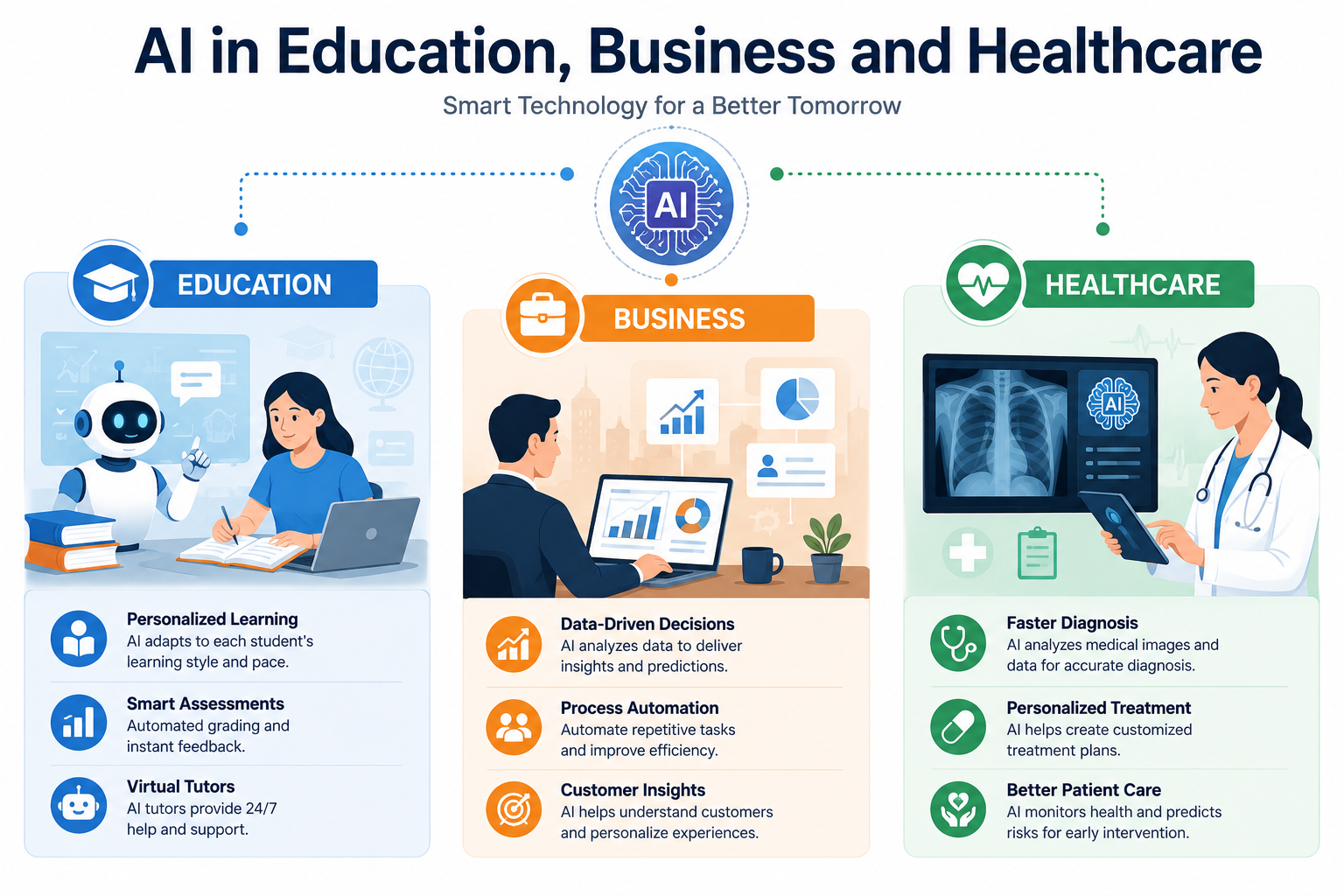
Introduction
There are moments in history when a single technology reshapes how entire civilizations function. The printing press did it. The internet did it. Artificial intelligence is doing it right now, and the pace of that change is unlike anything that came before.
Understanding how AI is changing education, business and healthcare is no longer an academic exercise. It is a practical necessity for anyone who works, learns, receives medical care, or simply lives in the modern world. By 2026, AI has moved well beyond the experimental phase in all three of these sectors. It is embedded in classrooms, boardrooms, and operating rooms in ways that are producing measurable, real-world results.
This guide examines what is actually happening across all three industries, what is working, what the legitimate concerns are, and where things are likely to go from here.
Quick Answer
AI is transforming education through personalized learning, AI tutors, and automated grading. In business, it is revolutionizing customer service, marketing, and data analytics. In healthcare, AI improves medical diagnosis, drug discovery, and patient monitoring. Across all three sectors, AI is increasing efficiency, reducing costs, and enabling capabilities that were previously impossible at scale.
What Is Artificial Intelligence?
Artificial intelligence refers to computer systems that perform tasks that would normally require human intelligence. These tasks include understanding language, recognizing patterns, making decisions, solving problems, and generating new content.
The term covers a broad spectrum of technologies. At the foundational level, machine learning is the practice of training algorithms on large datasets so they can recognize patterns and make predictions without being explicitly programmed for every scenario. Deep learning, a subset of machine learning, uses neural networks inspired by the human brain’s structure to process complex data like images, speech, and text.
Generative AI, which has captured enormous public attention since 2022 and matured significantly by 2026, refers to AI systems that can create new content including text, images, code, audio, and video based on the patterns they learned during training. Tools like ChatGPT, Google Gemini, and Claude are the most visible examples of generative AI in everyday use.
Understanding these distinctions matters because different types of AI are doing different jobs across education, business, and healthcare. The AI diagnosing a medical image uses different underlying technology than the AI tutoring a student or the AI automating a customer service workflow.
Why AI Is Transforming Industries
Faster Decision-Making
AI systems process information at a speed and scale that no human team can match. A financial AI can analyze thousands of variables and flag a fraudulent transaction in milliseconds. A diagnostic AI can process a medical scan and highlight anomalies in seconds. This speed does not just save time; it changes what is possible.
Automation of Repetitive Tasks
An enormous portion of work across every industry involves repetitive, rule-based tasks that are time-consuming for humans but straightforward for AI. Scheduling, data entry, invoice processing, customer query routing, and standardized reporting are all examples of work that AI handles faster and more consistently than human workers.
Superior Data Analysis
Modern organizations generate data at a scale that is simply impossible to analyze manually. AI turns that raw data into actionable intelligence, identifying trends, correlations, and anomalies that would remain invisible to human analysts working through spreadsheets.
Improved Productivity
When AI handles the mechanical, repetitive dimensions of knowledge work, human professionals gain time to focus on the aspects of their jobs that require creativity, judgment, empathy, and strategic thinking. This division of labor consistently produces productivity gains across industries.
Significant Cost Savings
Automation reduces labor costs for high-volume tasks. Predictive AI reduces waste by anticipating equipment failures, supply chain disruptions, and demand fluctuations. Better diagnostic AI reduces the cost of missed diagnoses and treatment errors. Across industries, the cost case for AI adoption has become compelling.
Better Customer and Patient Experiences
AI enables personalization at a scale that was previously impossible. An educational platform that adapts to each student’s learning pace, a retail recommendation engine that knows your preferences better than you do, or a healthcare system that monitors your chronic condition continuously between doctor visits all represent AI delivering better experiences than the pre-AI alternatives.
How AI Is Changing Education
Personalized Learning
Traditional classroom education works on a fundamental compromise: one teacher, thirty students, one pace. AI breaks that compromise. Adaptive learning platforms powered by AI assess each student’s current knowledge, identify gaps, adjust the difficulty of content in real time, and serve practice problems and explanations calibrated to exactly where that student is in their learning journey.
Platforms like Khan Academy’s AI-powered tutoring features and Carnegie Learning’s MATHia system demonstrate this in practice. Students who fall behind get more foundational support. Students who master material quickly get challenged at a higher level. The result is a more equitable educational experience that meets each learner where they are.
AI Tutors
AI tutors have reached a level of capability in 2026 that would have seemed remarkable just five years ago. Students can ask an AI tutor to explain a concept ten different ways, practice conversation in a foreign language for hours without scheduling constraints, work through math problems with step-by-step guidance, and receive immediate, patient feedback on their writing.
The “patience” factor deserves emphasis. Many students hesitate to ask a human teacher the same question three times. An AI tutor has no impatience, no judgment, and infinite availability, which removes a significant psychological barrier to learning.
Automated Grading
Grading represents one of the most time-intensive parts of teaching, and AI has begun to take on meaningful portions of that burden. Multiple choice and short answer grading has been automated reliably for years. By 2026, AI tools can provide preliminary assessment of longer essays, flagging structural weaknesses, factual errors, and stylistic issues for teacher review.
This does not remove teachers from the grading process. It makes grading faster and more consistent, and it frees teachers to focus their time on the qualitative, nuanced feedback that only human educators can provide.
Smart Classrooms
AI-enabled classroom technology in 2026 goes beyond smartboards. Computer vision systems can assess student engagement by analyzing facial expressions and posture, alerting teachers when attention is dropping across the class. Intelligent scheduling systems optimize room allocation and resource management for entire institutions. AI-powered accessibility tools provide real-time transcription, translation, and sign language interpretation for students with disabilities.
Language Learning
Language learning is perhaps the application where AI has delivered the most dramatic user experience improvement over the past few years. Apps like Duolingo have integrated sophisticated AI to create adaptive, conversational practice that adjusts to each learner’s pace and problem areas. AI conversation partners provide authentic speaking practice without the scheduling constraints and cost of human tutors.
For students learning English as a second language, AI-powered pronunciation feedback and writing assistance tools have become daily learning companions in millions of classrooms worldwide.
Research Assistance
AI research tools have transformed how students and academics approach literature reviews, data analysis, and fact-finding. Tools like Perplexity AI provide cited, synthesized answers from current sources. AI can summarize lengthy academic papers, identify relevant research across vast databases, and help students organize complex research into coherent arguments.
The ethical application of these tools, understanding and building on sources rather than replacing original thinking, remains a critical educational conversation, but the research efficiency gains are real and substantial.
AI for Teachers
The benefits of AI in education extend to teachers as much as to students. AI tools help teachers generate differentiated lesson plans for diverse classrooms, create assessment questions aligned to specific learning objectives, translate materials for multilingual families, identify students who are falling behind before they reach a crisis point, and manage administrative workloads that consume significant instructional time.
A study from the OECD published in 2025 found that teachers who integrated AI administrative tools into their workflow reclaimed an average of five to seven hours per week, time they redirected toward direct student interaction.
AI for Students
For students, AI has become a study partner, writing coach, math tutor, research assistant, and career advisor rolled into one accessible platform. The important distinction that educators emphasize consistently is between using AI as a scaffold for learning versus using it as a shortcut that bypasses learning entirely.
Students who use AI effectively ask it to explain concepts, generate practice problems, provide feedback on their own drafts, and explore topics more deeply than class time allows. This supplements learning. Students who simply copy AI outputs without engagement get short-term convenience at the cost of long-term knowledge development.
Benefits of AI in Education
The transformation AI is enabling across educational institutions delivers concrete benefits worth examining individually.
AI dramatically reduces the time students spend waiting for feedback, because AI systems provide instant assessment and guidance rather than waiting for a teacher’s next availability.
Adaptive learning platforms ensure that every student receives instruction calibrated to their level, which reduces both the boredom of students who master content quickly and the frustration of students who need more time.
AI-powered accessibility tools make education more inclusive for students with visual, auditory, or learning disabilities by providing real-time accommodation support that would be expensive or impractical to provide manually.
Early intervention systems that analyze academic performance data identify at-risk students significantly earlier than traditional methods, allowing support to reach students before they disengage entirely.
Language barriers in multilingual classrooms are reduced when AI provides real-time translation and language support for students whose first language is not the primary language of instruction.
Teacher workloads decrease meaningfully when AI handles routine administrative and assessment tasks, which reduces burnout and allows educators to focus their energy where it matters most.
AI enables high-quality educational content to reach geographically remote or economically underserved students who lack access to specialized teachers or well-resourced schools.
Continuous assessment through AI tools provides teachers with detailed, real-time data about each student’s progress, enabling more informed instructional decisions than periodic testing allows.
Professional development for teachers becomes more accessible and personalized when AI platforms provide tailored training based on each educator’s specific skill gaps and goals.
Students develop research and critical thinking skills more efficiently when AI tools help them navigate complex information landscapes rather than getting lost in undifferentiated search results.
Challenges of AI in Education
Privacy
Educational AI platforms collect detailed behavioral, academic, and sometimes biometric data about minors. The privacy implications are significant and require careful governance. Parents and institutions need clear visibility into what data is collected, how it is used, and who has access to it.
Algorithmic Bias
AI systems trained on historical educational data can perpetuate existing inequities. If an adaptive learning algorithm is trained primarily on data from high-performing schools in wealthy districts, it may not serve students from different backgrounds effectively. Addressing bias in educational AI requires deliberate, ongoing attention to training data and outcome monitoring.
Academic Integrity
The availability of powerful AI writing and problem-solving tools has significantly complicated academic integrity. Institutions are developing new approaches to assessment that emphasize process, oral defense, real-world application, and original synthesis rather than content that can be easily generated. This is a genuine challenge that education has not fully resolved.
Digital Divide
The benefits of AI in education are not distributed equally. Students in well-resourced schools with reliable internet access and modern devices benefit most. Students in underserved communities with limited technology access risk being left further behind, which requires deliberate policy and infrastructure investment to address.
Human Supervision
AI tools in educational settings require thoughtful human supervision. An AI tutor that inadvertently reinforces a misconception, or an assessment AI that misscores a creative response, can cause real harm if educators treat AI outputs as authoritative rather than as inputs requiring professional judgment.
How AI Is Changing Business
Customer Service
AI-powered customer service has moved well beyond the frustrating chatbots of a decade ago. In 2026, conversational AI handles complex customer inquiries, resolves account issues, processes returns, schedules service appointments, and escalates nuanced situations to human agents with full context already gathered. Companies like Zendesk and Salesforce have built sophisticated AI agent capabilities that handle the majority of routine customer interactions without human involvement.
The customer experience improvement is real. Resolution times have dropped, availability has extended to 24 hours, and customer satisfaction scores at companies with well-implemented AI service platforms have measurably improved.
Marketing
AI has fundamentally changed how marketing works at every level of the funnel. Content creation, audience segmentation, campaign optimization, A/B testing at scale, personalized email sequences, social media scheduling, and performance analytics all now have powerful AI components.
Generative AI tools allow marketing teams to produce content variations at a scale that would have required entire agencies previously. Predictive analytics tools help marketers identify which customers are most likely to convert or churn, allowing resource allocation to focus where it matters most.
Sales
AI sales tools analyze customer data to identify high-probability leads, recommend optimal outreach timing, draft personalized communications, and provide sales representatives with conversation intelligence that highlights what high-performing sellers do differently. Platforms like Gong and Chorus analyze sales call recordings and provide specific, actionable coaching feedback to sales teams.
AI forecasting tools have significantly improved the accuracy of revenue projections, which benefits planning across the entire organization.
Human Resources
AI has transformed recruitment by helping HR teams screen large applicant pools, identify candidates whose profiles match successful employee patterns, and reduce time-to-hire significantly. Performance management platforms use AI to identify employees at risk of disengagement before they resign, enabling proactive retention conversations.
Employee experience platforms use AI to analyze sentiment from surveys and communications and surface actionable insights for people managers.
Finance
AI has become indispensable in financial services across fraud detection, risk assessment, regulatory compliance, investment analysis, and financial planning. JPMorgan Chase’s AI-powered document review system processes legal agreements in seconds that previously required thousands of hours of lawyer time. Fraud detection algorithms have reduced financial fraud losses significantly by identifying suspicious patterns in real time.
Automated financial reporting and compliance monitoring reduce the risk of regulatory violations while freeing finance professionals to focus on strategic analysis.
Data Analytics
AI has democratized data analysis by making it possible for non-technical business users to query complex datasets using natural language. Business intelligence platforms now allow marketing managers, operations directors, and sales leaders to extract insights from company data without writing a single line of SQL.
This shift from data analysis as a specialized technical skill to a broadly accessible capability is one of the most significant productivity changes AI has enabled in business.
Supply Chain
Supply chain management has become dramatically more resilient and efficient with AI. Predictive demand forecasting reduces overstock and stockout situations. Route optimization algorithms reduce logistics costs and delivery times. Supplier risk monitoring systems flag potential disruptions before they impact operations. Computer vision quality control systems identify manufacturing defects at a speed and consistency that human inspectors cannot match.
Business Automation
Robotic process automation combined with AI now handles complex, multi-step business processes that previously required human intervention at every decision point. Invoice processing, employee onboarding, compliance reporting, data reconciliation, and contract management are all areas where intelligent automation is delivering significant efficiency gains.
Benefits of AI in Business
AI enables businesses to provide personalized customer experiences at a scale that creates meaningful competitive differentiation.
Operational costs decrease substantially when AI automation handles high-volume, rule-based tasks that previously required large teams.
Decision-making improves across the organization when leaders have access to real-time AI-generated insights from their operational data rather than waiting for periodic reports.
Marketing return on investment improves when AI optimization continuously adjusts campaign parameters based on performance data rather than relying on periodic human review.
Customer retention improves when predictive AI identifies churn risk early and enables proactive intervention before customers decide to leave.
Employee satisfaction increases when AI handles the most tedious, repetitive aspects of knowledge work, allowing people to spend more time on the creative and interpersonal dimensions of their roles.
Revenue forecasting accuracy improves with AI predictive models, which enables better resource allocation and reduces the cost of planning errors.
Risk management becomes more proactive when AI continuously monitors for financial fraud, cybersecurity threats, supply chain disruptions, and compliance violations rather than catching problems after they occur.
New product development accelerates when AI-powered market research, customer feedback analysis, and competitive intelligence tools reduce the time from insight to action.
Global operations become manageable at a scale that would previously have required proportionally larger teams when AI handles cross-timezone communications, multilingual content, and distributed workflow coordination.
Small and medium-sized businesses can access capabilities that were previously available only to large enterprises with dedicated specialist teams.
Sustainability goals become more achievable when AI energy optimization, logistics efficiency, and predictive maintenance reduce waste across operations.
Challenges of AI in Business
Job Displacement
The automation of routine tasks creates genuine disruption for workers in affected roles. While AI creates new categories of jobs, the transition is not seamless or universally fair. Workers in roles most susceptible to automation need meaningful support for retraining and transition.
Data Privacy
Business AI systems consume enormous amounts of customer data, raising significant privacy concerns. GDPR in Europe, CCPA in California, and an expanding global landscape of data protection regulations create compliance complexity for businesses deploying AI at scale.
Implementation Costs
Deploying enterprise AI is expensive, requiring investment in infrastructure, data preparation, integration, change management, and ongoing maintenance. The return on investment is real but often takes longer to materialize than initial projections suggest.
Security Vulnerabilities
AI systems introduce new attack surfaces. Adversarial attacks that manipulate AI model inputs, data poisoning that corrupts training datasets, and prompt injection attacks on large language model deployments are all active security concerns that require dedicated attention.
Ethical Concerns
Algorithmic bias in hiring, lending, and pricing decisions creates both ethical problems and legal liability. Businesses deploying AI must actively monitor for discriminatory outcomes and maintain accountability for the decisions their AI systems make.
How AI Is Changing Healthcare
Medical Diagnosis
AI diagnostic systems are demonstrating accuracy rates in specific domains that match or exceed specialist physicians. Google’s DeepMind has developed AI systems that detect over 50 eye diseases from retinal scans with accuracy comparable to expert ophthalmologists. AI models for skin cancer detection have achieved diagnostic accuracy that rivals dermatologists in controlled studies.
In emergency radiology, AI triage systems flag critical findings like brain bleeds and pulmonary embolisms immediately, ensuring urgent cases reach specialist attention faster regardless of hospital workload.
Drug Discovery
The pharmaceutical industry’s traditional drug discovery process is notoriously expensive, slow, and prone to failure. AI is beginning to change that equation significantly. Machine learning models can predict how drug compounds will interact with biological targets, dramatically reducing the number of failed experiments in early discovery phases.
Insilico Medicine used AI to identify and synthesize a novel drug candidate for idiopathic pulmonary fibrosis in less than 18 months, a process that typically takes years. By 2026, AI-assisted drug discovery has become standard practice at major pharmaceutical companies and is accelerating research timelines across dozens of disease areas.
Medical Imaging
Radiology, pathology, and medical imaging more broadly represent the area where AI’s impact on healthcare has been most concretely demonstrated. AI systems analyze X-rays, CT scans, MRIs, and pathology slides to identify findings that require attention, flag potential malignancies, measure anatomical structures, and assist radiologists in managing their increasingly high workloads.
In hospitals where AI imaging tools are deployed, report turnaround times have improved and the rate of incidental findings that might otherwise be overlooked has increased, catching conditions earlier when they are more treatable.
Personalized Medicine
Traditional medicine treats populations. Personalized medicine treats individuals. AI is making personalized medicine practical by analyzing genomic data, treatment history, biomarkers, lifestyle factors, and comparative effectiveness data from millions of patients to predict which treatments are most likely to work for a specific patient’s specific biology.
In oncology, this approach is transforming cancer treatment by matching patients with therapies most likely to be effective for their tumor’s genetic profile, reducing the trial-and-error that characterizes much of current cancer care.
Patient Monitoring
Continuous AI-powered patient monitoring has expanded significantly beyond hospital walls in 2026. Wearable devices monitor heart rhythm, blood oxygen, blood glucose, sleep patterns, and physical activity continuously, with AI algorithms detecting deviations that warrant clinical attention before they become medical emergencies.
For patients with chronic conditions like heart disease, diabetes, and COPD, this continuous monitoring creates a safety net that traditional periodic clinical appointments cannot provide.
Hospital Management
AI has become a powerful operational tool for hospital administration. Patient flow optimization systems predict admission rates and help hospitals allocate staff and resources proactively. Predictive maintenance systems identify medical equipment likely to fail before failure occurs. AI scheduling tools reduce the administrative burden on clinical staff while improving appointment efficiency and reducing no-show rates.
Hospitals using AI operations tools have demonstrated measurable improvements in patient throughput, staff scheduling efficiency, and operational cost management.
Virtual Health Assistants
AI-powered virtual health assistants handle patient triage, appointment scheduling, medication reminders, post-discharge follow-up, chronic disease coaching, and mental health support. These tools extend the reach of healthcare systems into the time between clinical appointments, which is when the majority of health outcomes are actually determined by patient behavior and adherence.
Mental health applications using AI-assisted cognitive behavioral therapy techniques have demonstrated promising clinical outcomes for mild to moderate anxiety and depression, and they offer accessibility advantages for patients who cannot access traditional mental health services.
Administrative Automation
Healthcare’s administrative burden is staggering. Prior authorization, medical coding, claims processing, documentation, scheduling, and billing collectively consume enormous resources that could otherwise support patient care. AI is automating significant portions of these workflows.
Ambient clinical documentation tools that use AI to automatically generate clinical notes from doctor-patient conversations have demonstrated the potential to give physicians meaningful time back each day, addressing a significant driver of clinician burnout.
Benefits of AI in Healthcare
AI diagnostic systems improve the detection rate of serious conditions, particularly in underserved areas where specialist access is limited.
Drug discovery timelines shorten significantly with AI, which means potentially life-saving treatments reach patients faster.
Medical imaging AI reduces the time radiologists spend on routine screening, allowing them to focus their attention on the most complex and ambiguous cases.
Continuous monitoring through AI-enabled wearables catches deterioration in high-risk patients before it requires emergency intervention.
Personalized treatment recommendations based on individual genomic and clinical data improve treatment outcomes and reduce the harm from treatments unlikely to be effective for a specific patient.
Hospital operational efficiency improves when AI optimizes staffing, equipment maintenance, and patient flow, which translates directly into better patient experiences and lower operational costs.
Mental health support becomes more accessible when AI-assisted tools extend care to patients who cannot access traditional services due to cost, geography, or stigma.
Administrative burden on clinical staff decreases when AI handles documentation and coding tasks, which addresses burnout and allows clinicians to spend more time in direct patient care.
Medical errors decrease when AI systems serve as a second pair of eyes, checking for drug interactions, missed diagnoses, and documentation errors.
Healthcare access expands in low-resource settings when AI diagnostic tools allow community health workers to assess conditions that would otherwise require specialist consultation.
Rare disease diagnosis improves when AI systems trained on large patient datasets recognize patterns that individual clinicians might encounter too infrequently to recognize reliably.
Population health management becomes more effective when AI identifies high-risk patient populations and enables proactive outreach before conditions require acute care.
Challenges of AI in Healthcare
Privacy
Medical data is among the most sensitive personal information that exists. AI systems that process patient records, genomic data, and behavioral health information require robust privacy protections and create significant risk when breached. HIPAA in the United States and equivalent regulations globally set the floor, but the evolving complexity of AI data use requires continuous regulatory attention.
Data Security
Healthcare organizations are consistently among the most targeted by ransomware and data theft attacks. AI systems that centralize large volumes of patient data, or that are integrated into critical clinical workflows, create high-value targets that require sophisticated cybersecurity investment and vigilance.
Ethical Concerns
Who bears responsibility when an AI diagnostic system misses a cancer that a human physician might have caught? How do we ensure that AI systems perform equally well across patients of different demographics? How do we prevent the aggregation of medical data from producing discriminatory outcomes in insurance or employment contexts? These ethical questions do not have simple answers and require ongoing multi-stakeholder engagement.
Regulatory Compliance
Medical AI is a regulated field. In the United States, the FDA regulates AI-based medical devices. In Europe, the EU AI Act creates specific obligations for high-risk AI systems in healthcare contexts. Navigating this regulatory landscape requires significant investment and expertise, which creates barriers particularly for smaller health technology companies.
Human Oversight
Healthcare AI at its best augments clinical judgment; at its worst, it undermines it. There is a genuine risk that over-reliance on AI diagnostic tools could erode the clinical skills that allow physicians to recognize when the AI is wrong. Maintaining a culture of critical evaluation of AI recommendations rather than passive acceptance requires deliberate institutional effort.
AI in Education vs Business vs Healthcare
| Factor | AI in Education | AI in Business | AI in Healthcare |
|---|---|---|---|
| Main Uses | Personalized learning, tutoring, grading, research | Customer service, marketing, analytics, automation | Diagnosis, imaging, drug discovery, patient monitoring |
| Key Benefits | Accessibility, personalization, teacher efficiency | Cost savings, productivity, customer experience | Accuracy, speed, accessibility, early detection |
| Primary Challenges | Academic integrity, digital divide, privacy | Job displacement, security, implementation costs | Privacy, regulatory compliance, human oversight |
| Popular AI Tools | Khan Academy AI, Duolingo, ChatGPT, Claude | Salesforce Einstein, Zendesk AI, IBM Watson | DeepMind Health, Epic AI, Nuance Dragon Ambient |
| Adoption Rate (2026) | Rapidly growing, uneven across institutions | High in large enterprises, growing in SMBs | Growing, led by radiology and drug discovery |
| Future Potential | AI-native curricula, universal tutoring access | Full workflow automation, AI decision-makers | Genomic medicine, AI-first diagnostics |
| Regulatory Environment | Emerging frameworks, varies by country | Complex, multi-jurisdictional | Highly regulated, FDA and EU AI Act |
| Human Role | Essential for mentorship, creativity, judgment | Strategic, creative, relationship management | Irreplaceable for complex clinical judgment and care |
Future of AI Across Industries
The trajectory of AI development across education, business, and healthcare over the next several years points toward deeper integration, greater autonomy, and more significant impact, alongside more sophisticated governance frameworks.
In education, the emergence of genuinely personalized learning paths that adapt not just to academic performance but to learning style, emotional state, and long-term career aspirations represents a realistic near-term development. AI will increasingly bridge the gap between formal education and continuous professional development, making lifelong learning more accessible and effective.
In business, AI agents that can autonomously execute complex multi-step workflows, manage vendor relationships, conduct market research, and propose strategic recommendations will become standard tools for organizations of every size. The distinction between AI as a tool and AI as a team member will continue to blur in ways that require new management and governance thinking.
In healthcare, the convergence of AI with genomics, wearable monitoring, and electronic health records promises to make truly personalized, predictive, preventive medicine a practical reality rather than an aspirational concept. AI that can predict disease onset years before symptoms appear, based on continuous monitoring of biomarkers, will shift healthcare from a reactive to a genuinely preventive discipline.
Across all three sectors, the regulatory and governance frameworks for AI are maturing. The EU AI Act is establishing a risk-based approach to AI regulation that other jurisdictions are studying. Industry-specific frameworks for educational AI, medical AI, and business AI are developing alongside general-purpose regulation, creating a more structured environment for responsible development.
The organizations and institutions that will thrive in this environment are those that invest not just in AI technology but in the human capabilities to use it wisely: critical evaluation, ethical reasoning, and the judgment to know when AI recommendations should be followed and when they should be questioned.
Frequently Asked Questions
How is AI changing education?
AI is transforming education through adaptive learning platforms that personalize instruction for each student, AI tutoring tools that provide immediate and patient support, automated grading systems that give teachers time back, and accessibility tools that support students with disabilities. The most significant change is the shift from one-size-fits-all instruction toward truly personalized learning at scale.
How is AI used in business?
Businesses use AI across customer service automation, marketing personalization, sales intelligence, financial fraud detection, HR recruiting, supply chain optimization, and data analytics. The common thread is using AI to handle high-volume, data-intensive tasks faster and more accurately than human teams can manage alone, while freeing human workers to focus on strategic and relationship-intensive work.
How is AI improving healthcare?
AI improves healthcare through more accurate and faster diagnostic imaging analysis, accelerated drug discovery, continuous patient monitoring through wearable devices, personalized treatment selection based on genomic data, and administrative automation that reduces clinician burden. In each application, the goal is better outcomes for patients delivered more efficiently.
What are the biggest benefits of AI?
The biggest benefits of AI across industries include dramatically improved speed and efficiency, the ability to process and analyze data at scales impossible for human teams, personalization of services and experiences at scale, early detection and prevention of problems ranging from disease to equipment failure to customer churn, and the democratization of capabilities that were previously available only to large, well-resourced organizations.
Can AI replace teachers?
No. AI can handle specific instructional tasks like practice, assessment, and content delivery with increasing effectiveness, but it cannot replace the human dimensions of teaching: mentorship, emotional support, inspiration, the ability to recognize when a student is struggling for reasons beyond academic content, and the modeling of values and character. The future of education involves AI and teachers working in complementary roles.
Can AI replace doctors?
No. AI can and does support specific diagnostic and analytical tasks with impressive accuracy in defined domains, but clinical medicine requires holistic patient assessment, complex ethical judgment, human communication, and contextual understanding that AI cannot replicate. The most effective healthcare model pairs AI’s analytical capabilities with physician judgment and the irreplaceable human elements of the patient-doctor relationship.
Can AI replace business professionals?
AI will automate specific tasks performed by business professionals, but it is unlikely to fully replace the roles that require strategic judgment, creativity, relationship management, ethical reasoning, and leadership. The business professionals most at risk of role disruption are those whose work consists predominantly of routine, rule-based tasks. Those who develop skills in working effectively alongside AI tools will find their capabilities significantly enhanced rather than replaced.
Is AI safe?
AI safety is a genuine and actively studied concern. Current AI systems carry specific risks including algorithmic bias, security vulnerabilities, and the potential for misuse. Researchers, governments, and industry organizations are actively developing safety frameworks, testing protocols, and regulatory requirements to address these risks. AI is neither categorically safe nor categorically dangerous; the outcome depends on how it is developed, deployed, and governed.
What industries benefit most from AI?
In 2026, healthcare, financial services, retail, manufacturing, education, and logistics are among the sectors showing the largest measurable impacts from AI adoption. Healthcare benefits from AI’s pattern recognition capabilities applied to biological data. Financial services benefit from AI’s fraud detection and risk modeling. Manufacturing benefits from predictive maintenance and quality control automation.
What are the risks of AI?
The primary risks of AI include algorithmic bias that produces discriminatory outcomes, privacy violations from large-scale data collection and analysis, job displacement for workers in roles susceptible to automation, security vulnerabilities introduced by AI systems themselves, misinformation generated by capable generative AI systems, and broader questions about appropriate human oversight of increasingly autonomous systems.
What is the future of AI?
The future of AI across industries involves deeper integration into everyday workflows, greater autonomy in executing complex tasks, more sophisticated personalization, and more mature governance frameworks. Over the next five to ten years, AI is likely to transition from a tool that humans use to a collaborative agent that works alongside humans in ways that fundamentally reshape how work, learning, and healthcare are organized. Managing this transition responsibly is one of the defining challenges of the coming decade.
How can businesses start using AI?
Businesses starting their AI journey should begin by identifying specific, high-value problems where data is available and the task is well-defined. Starting with proven, off-the-shelf AI tools rather than building custom models is almost always the right approach initially. Investing in data quality before deploying AI, piloting in limited contexts before scaling, training employees on effective AI collaboration, and establishing clear accountability for AI-assisted decisions are all practices that contribute to successful AI adoption.
Final Thoughts
Understanding how AI is changing education, business and healthcare is the first step toward navigating this transformation thoughtfully. The evidence from 2026 is clear: AI is delivering real, measurable benefits across all three sectors, and those benefits will expand as the technology continues to mature.
At the same time, the challenges and risks are genuine. Privacy, bias, job disruption, and the need for sustained human oversight are not problems to minimize or dismiss. They are problems that require serious attention from technologists, policymakers, educators, healthcare professionals, and business leaders working together.
The most important insight this guide can offer is that AI works best as a collaborator with human expertise, not as a replacement for it. The schools, businesses, and healthcare systems that will benefit most from AI are those that invest in helping their people work effectively alongside it, maintaining the critical judgment, ethical awareness, and human judgment that make the difference between AI as a force for good and AI as a source of new problems.
Responsible, thoughtful AI adoption is not just a competitive strategy. In a world increasingly shaped by intelligent systems, it is a fundamental obligation to the students, customers, patients, and communities that institutions of every kind exist to serve.
People Also Ask
How is AI changing education?
AI is making education more personalized, accessible, and efficient through adaptive learning platforms, AI tutors, automated assessment, and tools that help teachers manage administrative workloads more effectively.
How is AI transforming businesses?
AI is transforming businesses by automating routine operations, improving customer experiences, enabling data-driven decision-making, and creating competitive advantages through personalization and predictive analytics.
How is AI improving healthcare?
AI is improving healthcare through more accurate diagnostics, accelerated drug discovery, continuous patient monitoring, personalized treatment selection, and administrative automation that gives clinicians more time for patient care.
What are the benefits of AI?
The key benefits include speed, scale, personalization, early detection of problems, democratized access to sophisticated capabilities, and the freeing of human talent for creative and strategic work.
What are the risks of AI?
Primary risks include algorithmic bias, privacy violations, security vulnerabilities, job disruption, misinformation generation, and insufficient human oversight of consequential automated decisions.
Can AI replace teachers?
No. AI handles specific instructional tasks effectively but cannot replicate mentorship, emotional support, inspiration, and the human dimensions of education that make the most significant difference in student development.
Can AI replace doctors?
No. AI supports specific diagnostic and analytical tasks but cannot replicate holistic clinical judgment, complex ethical decision-making, or the human elements of the patient-physician relationship.
What industries use AI the most?
Healthcare, financial services, retail, manufacturing, logistics, and education are currently among the highest-adoption sectors for AI in 2026.
Is AI good for society?
AI has significant potential to benefit society through improved healthcare outcomes, more accessible education, and greater economic productivity. Whether those benefits are realized equitably depends on how deliberately society addresses the associated challenges of bias, privacy, and displacement.
What is the future of AI?
The future of AI involves deeper workflow integration, greater autonomy, more personalization, and more mature governance. Managing the transition to an AI-augmented society responsibly is one of the defining challenges and opportunities of the coming decade.
References
- OpenAI. (2026). OpenAI Official Website. https://openai.com
- Google. (2026). Google AI. https://ai.google
- Microsoft. (2026). Microsoft AI. https://www.microsoft.com/ai
- IBM. (2026). IBM Artificial Intelligence. https://www.ibm.com/artificial-intelligence
- World Health Organization. (2026). WHO Official Website. https://www.who.int
- UNESCO. (2026). UNESCO Official Website. https://www.unesco.org
Author
TechOriginHub Editorial Team
The TechOriginHub Editorial Team is a team of experienced technology writers, AI researchers, business analysts, and digital innovation experts committed to creating accurate, practical, and easy-to-understand technology content. We specialize in artificial intelligence, cybersecurity, software, programming, cloud computing, and emerging technologies. Every article is carefully researched, fact-checked, and reviewed to ensure it meets Google’s Helpful Content and E-E-A-T standards while providing readers with trustworthy, up-to-date, and actionable information.
Technology Disclaimer
This article is for informational and educational purposes only. Artificial intelligence technologies, software, regulations, pricing, and industry applications continue to evolve rapidly. While every effort has been made to ensure the accuracy and relevance of the information presented, readers should independently verify important details through official sources before making educational, business, healthcare, or technology-related decisions. The examples, tools, and case studies discussed are intended for general informational purposes and should not be considered professional medical, legal, financial, or business advice. TechOriginHub is not affiliated with or endorsed by any organization or product mentioned unless explicitly stated.