
 By TechOriginHub Editorial Team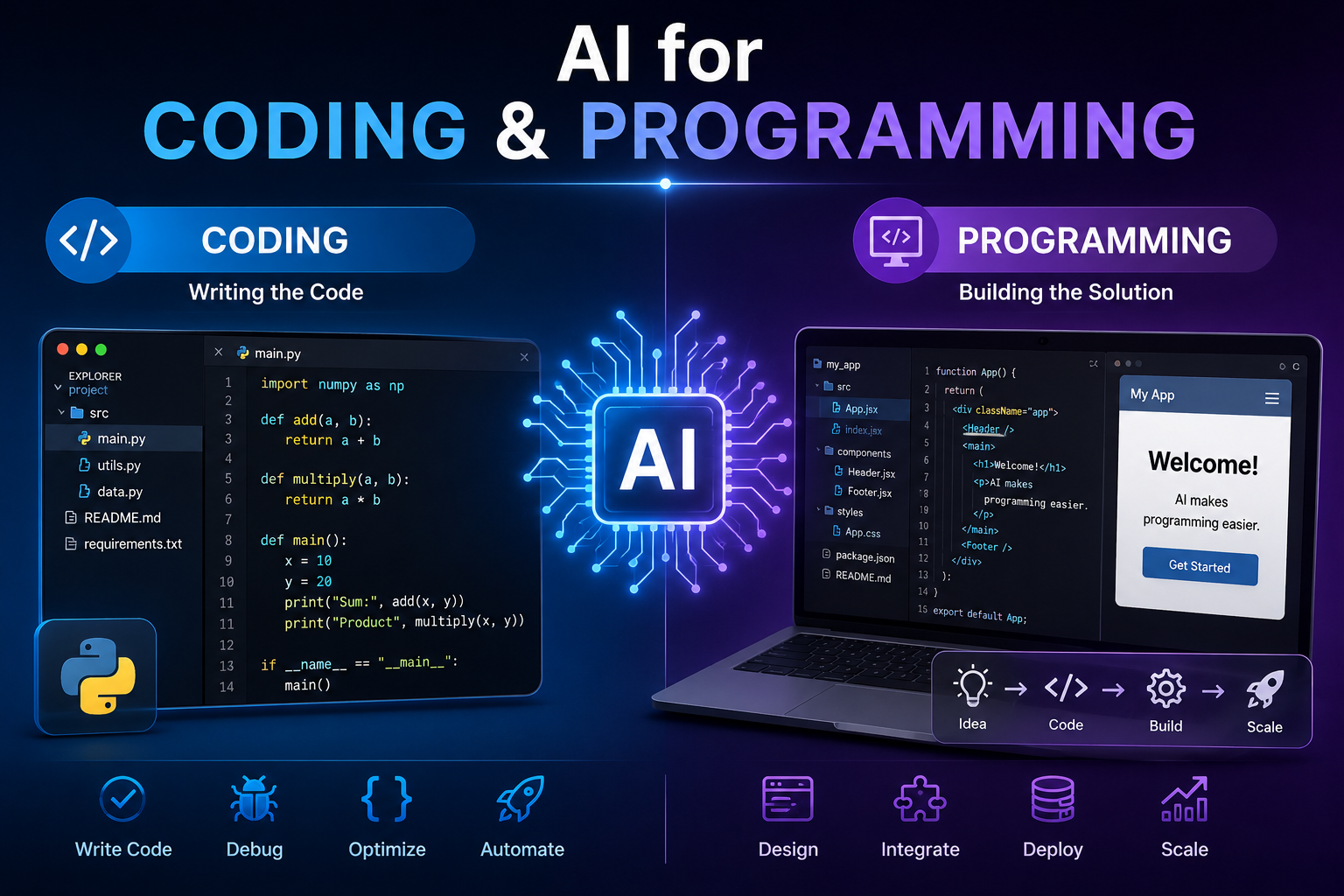
Introduction
Software development has always rewarded people who work smarter, not just harder. In 2026, knowing how to use AI for coding has become one of the most valuable skills a developer can have, regardless of experience level. The tools have matured dramatically, the workflows are well established, and the productivity gains are real and measurable.
The impact is visible across the entire development landscape. Junior developers write production-quality code faster than ever before. Senior engineers spend less time on boilerplate and more time on architecture and problem-solving. Data scientists prototype models in hours instead of days. Freelancers take on more projects without sacrificing quality.
But AI coding tools are not magic. They are powerful assistants that still require the developer to think critically, test thoroughly, and understand the code being produced. The developers who get the most value from AI in 2026 are those who have learned to collaborate with it intelligently, not those who hand everything over blindly and hope for the best.
This guide covers everything from choosing the right AI coding tool to building an effective development workflow, writing better prompts, avoiding common pitfalls, and getting results you can actually ship.
Quick Answer
To use AI for coding, choose a tool like GitHub Copilot, ChatGPT, or Cursor AI. Describe your task clearly in a well-structured prompt, generate sample code, read and understand the output, test it thoroughly, and use AI to help debug any errors. Always review AI-generated code before deploying it in production environments.
What Is AI Coding?
AI Coding Assistants
AI coding assistants are software tools that use artificial intelligence to help developers write, complete, debug, explain, optimize, and document code. They can suggest the next line of code as you type, generate entire functions from a plain English description, identify bugs in existing code, and explain unfamiliar syntax in simple terms.
The experience of working with a modern AI coding assistant in 2026 feels less like using a tool and more like pair-programming with a knowledgeable colleague who has read every documentation page ever written and can recall any of it on demand.
How AI Generates Code
AI coding tools are built on large language models trained on enormous datasets that include open-source code repositories, technical documentation, programming tutorials, Stack Overflow discussions, and academic computer science literature. Through this training, the models develop a deep understanding of programming syntax, logic patterns, common algorithms, and software design principles.
When you provide a prompt describing what you want your code to do, the model analyzes your input, draws on its training, and predicts the most appropriate code sequence to satisfy your request. The quality of that output depends heavily on the clarity of your prompt and the specific model powering the tool.
Large Language Models in Coding
The LLMs driving today’s best coding tools include OpenAI’s GPT-4o and o3, Anthropic’s Claude 3.7, Google’s Gemini 2.0 Ultra, and specialized code-focused models like GitHub Copilot’s proprietary model trained specifically on code. Each model has different strengths in terms of supported languages, context window size, reasoning depth, and code generation accuracy.
Some tools, like Cursor AI, use a combination of models and let developers choose which underlying AI powers specific tasks, giving experienced users fine-grained control over their development environment.
Common AI Coding Tools
The AI coding tool landscape in 2026 includes IDE-integrated assistants like GitHub Copilot, Cursor AI, Codeium, and Tabnine that provide real-time suggestions as you write. It also includes conversational AI tools like ChatGPT and Claude that you query for specific coding help. Platforms like Replit AI combine a cloud development environment with AI assistance, while Amazon Q Developer focuses specifically on enterprise software development within AWS ecosystems.
Benefits of Using AI for Coding
Dramatically Faster Code Writing
The most immediate and quantifiable benefit of AI coding assistance is raw speed. Developers using AI tools in 2026 consistently report writing code significantly faster, particularly for repetitive tasks, standard data structures, API integrations, and boilerplate code that follows well-established patterns.
Real-Time Debugging Assistance
Staring at a bug for two hours used to be a normal part of software development. AI tools have changed that experience significantly. You can paste an error message or problematic code block into ChatGPT or Claude and receive a clear explanation of what is wrong and how to fix it, often within seconds.
Code Explanation for Learning
AI tools are exceptional at explaining code in plain English. A beginner can paste a confusing Python function into ChatGPT and ask for a line-by-line explanation. This accelerates the learning curve for new programmers in a way that no textbook can fully replicate.
Automatic Documentation Generation
Writing documentation is one of the most universally disliked parts of software development. AI tools can generate docstrings, README files, inline comments, and API documentation automatically from existing code, saving hours of tedious work without sacrificing quality.
Code Refactoring and Optimization
AI tools can analyze existing code and suggest cleaner, more efficient, or more Pythonic rewrites. This is particularly valuable for developers inheriting legacy codebases or students learning to move from working code to well-written code.
Language Translation Between Codebases
Converting code from one programming language to another is a task AI handles remarkably well. Translating a Python script to JavaScript, converting a MySQL query to PostgreSQL syntax, or porting a legacy C++ function to modern Rust becomes significantly faster with AI assistance.
Test Generation
Writing unit tests is critically important but often deprioritized due to time constraints. AI tools can generate comprehensive test suites for existing functions, covering edge cases that even experienced developers might overlook.
Algorithm Implementation
Implementing classic algorithms, data structures, sorting methods, or graph traversal logic is something AI handles with high accuracy. Developers working on competitive programming, interview preparation, or algorithm-heavy projects get tremendous value from AI-generated implementations they can study and adapt.
API Integration Assistance
Integrating third-party APIs involves reading documentation, handling authentication, formatting requests, and parsing responses, all of which is time-consuming and error-prone. AI tools that have been trained on API documentation can generate integration code quickly and accurately.
Faster Onboarding for New Technologies
Learning a new framework, language, or library is much less intimidating when you have an AI tool that can answer specific questions instantly, generate example code in the technology you are learning, and explain concepts at exactly the level you need.
Reducing Cognitive Load
Software development requires holding a lot of context in your head simultaneously. AI assistants reduce cognitive load by handling the mechanical aspects of coding, like remembering exact method names, syntax details, and standard patterns, freeing mental bandwidth for higher-order problem-solving.
Prototyping Speed
Building a proof of concept or minimum viable feature used to take days. AI coding tools allow developers to prototype functional code in hours, which accelerates the feedback loop between idea and validation dramatically.
Best AI Tools for Coding
ChatGPT
Overview: ChatGPT, powered by OpenAI’s GPT-4o and o3 models, is the most versatile AI tool for coding conversations. It handles everything from explaining syntax to generating complete application features, debugging complex errors, and discussing architectural decisions.
Key Features: Multi-language code generation, Advanced Data Analysis with live code execution, web search integration, code explanation, debugging assistance, algorithm design, and technical documentation.
Best For: General coding questions, debugging, learning new languages, architecture discussions, and generating code for any major programming language.
Free Plan: Yes, with access to GPT-4o.
Paid Pricing: $20/month (Plus), $30/user/month (Team).
Pros: Extremely versatile, excellent for multi-turn coding conversations, strong reasoning on complex logic problems, and runs code directly in the Advanced Data Analysis environment.
Cons: Not embedded in your code editor natively, so workflow requires switching between contexts. Requires clear prompts to get production-quality output.
Overall Rating: 4.7 / 5
GitHub Copilot
Overview: GitHub Copilot, developed by GitHub in partnership with OpenAI, is the most widely adopted AI coding assistant integrated directly into development environments. It provides real-time code completions, function generation, and chat-based assistance without leaving your IDE.
Key Features: Real-time inline code suggestions, Copilot Chat for conversational coding help, multi-file context awareness, pull request summaries, test generation, and integration with VS Code, JetBrains IDEs, Visual Studio, and Neovim.
Best For: Professional developers who want AI assistance embedded directly in their existing workflow without context switching.
Free Plan: Yes, limited free tier introduced in 2024 and expanded in 2025.
Paid Pricing: $10/month (Individual), $19/user/month (Business).
Pros: Seamless IDE integration, excellent inline completions, strong multi-language support, and the most mature enterprise offering in the market.
Cons: Requires subscription for full capabilities, and the suggestions sometimes need substantial review for complex or security-sensitive code.
Overall Rating: 4.8 / 5
Google Gemini
Overview: Google Gemini integrates deeply into Google’s development ecosystem, including Android Studio and Google Cloud tools. In 2026, Gemini Code Assist has become a strong competitor in the enterprise and cloud development space.
Key Features: Real-time code completion, Gemini Code Assist for Google Cloud, Android Studio integration, multi-file awareness, code generation, debugging assistance, and documentation support.
Best For: Google Cloud developers, Android developers, and teams working within the Google ecosystem.
Free Plan: Yes, through Google AI Studio.
Paid Pricing: Gemini Advanced at $20/month; Gemini Code Assist Enterprise at custom pricing.
Pros: Deep Google Cloud and Android integration, strong factual grounding through real-time search, and excellent for cloud infrastructure code.
Cons: Less competitive for general-purpose development outside the Google ecosystem, and some features require Google Workspace.
Overall Rating: 4.5 / 5
Claude AI
Overview: Claude, built by Anthropic, has earned a strong reputation among developers for its thoughtful, nuanced handling of complex coding problems. Its large context window makes it particularly valuable when working with long codebases or extensive technical specifications.
Key Features: Very large context window for analyzing long code files, strong code explanation, careful reasoning on complex logic, excellent at reviewing code for bugs and security issues, and generates well-commented output.
Best For: Code review, security analysis, working with large files, refactoring complex codebases, and developers who want thorough explanations alongside generated code.
Free Plan: Yes.
Paid Pricing: $20/month (Pro).
Pros: Exceptional at handling long codebases, strong security awareness, well-reasoned outputs, and produces clearly commented and documented code.
Cons: Not embedded in IDEs natively, and requires switching to the web interface or API integration for use in development workflows.
Overall Rating: 4.6 / 5
Amazon Q Developer
Overview: Amazon Q Developer (formerly CodeWhisperer) is Amazon’s enterprise-grade AI coding assistant built specifically for AWS development. In 2026, it has evolved into a comprehensive developer tool with deep AWS ecosystem integration.
Key Features: Real-time code suggestions optimized for AWS services, security scanning, infrastructure as code generation, CLI assistance, and integration with VS Code, JetBrains, and AWS Cloud9.
Best For: AWS developers, cloud engineers, and enterprise development teams building on Amazon’s infrastructure.
Free Plan: Yes, with a generous free tier for individual developers.
Paid Pricing: Included with AWS Builder ID; professional tier pricing through AWS.
Pros: Outstanding for AWS-specific development, strong security vulnerability scanning, good free tier, and excellent for infrastructure as code work with CloudFormation and CDK.
Cons: Less versatile outside the AWS ecosystem, and the non-AWS code suggestions are not as strong as GitHub Copilot or Cursor.
Overall Rating: 4.4 / 5
Cursor AI
Overview: Cursor AI is a code editor built from the ground up with AI at its core. Rather than adding AI as a plugin to an existing editor, Cursor is designed from the ground up as an AI-native coding environment. It has gained a devoted following among developers who want the most seamless possible AI coding experience.
Key Features: Multi-model support (GPT-4o, Claude, and others), codebase-wide context understanding, natural language code editing, AI-powered terminal assistance, and multi-file generation capabilities.
Best For: Developers who want a fully AI-native editor experience and the flexibility to switch between underlying models based on the task.
Free Plan: Yes, with limited AI usage.
Paid Pricing: $20/month (Pro).
Pros: Outstanding codebase-aware context, flexible model switching, the most integrated AI coding experience available, and excellent for complex multi-file projects.
Cons: Replaces your existing editor rather than plugging into it, which requires workflow adjustment. Some developers prefer the familiarity of VS Code with Copilot.
Overall Rating: 4.7 / 5
Replit AI
Overview: Replit combines a browser-based development environment with integrated AI assistance, making it particularly accessible for beginners and students who want to start coding without complex local setup.
Key Features: In-browser IDE, AI code generation and completion, Replit Agent for building apps from natural language descriptions, collaborative coding, deployment hosting, and support for 50+ programming languages.
Best For: Beginners learning to code, students, educators, and developers who want to build and deploy simple applications quickly without local environment setup.
Free Plan: Yes.
Paid Pricing: From $25/month (Core).
Pros: Zero-setup environment, excellent for beginners, Replit Agent can scaffold entire applications, and built-in deployment hosting.
Cons: Less suitable for complex professional development, and the browser-based environment has performance limitations for resource-intensive projects.
Overall Rating: 4.3 / 5
Codeium
Overview: Codeium is a free AI coding assistant that has attracted a large developer following by offering a generous free tier with no usage limits for individual developers. It supports an impressive range of IDEs and programming languages.
Key Features: Real-time code completions, natural language code generation, chat assistant, support for 70+ programming languages, and integration with VS Code, JetBrains, Vim, Emacs, and more.
Best For: Individual developers who want capable AI coding assistance without a paid subscription, and teams looking for a cost-effective alternative to Copilot.
Free Plan: Yes, with no usage limits for individuals.
Paid Pricing: Enterprise plans available with team features.
Pros: Generous free tier, wide IDE support, strong language coverage, fast completion speeds, and solid quality for a free tool.
Cons: Not quite at the same level as GitHub Copilot or Cursor for advanced use cases, and enterprise features require contacting sales.
Overall Rating: 4.2 / 5
Tabnine
Overview: Tabnine is an AI code assistant with a particular emphasis on privacy and enterprise security. It offers the option to run models locally on your machine, which appeals to organizations with strict data privacy requirements.
Key Features: Local model option for maximum privacy, real-time completions, team learning (adapts to your codebase style), code generation, and integration with major IDEs.
Best For: Enterprise teams with strict data privacy requirements, organizations that cannot send code to external servers, and developers who prioritize privacy alongside AI assistance.
Free Plan: Yes, with limited features.
Paid Pricing: From $12/month (Pro).
Pros: Strong privacy controls, local model option, adapts to team coding style over time, and solid enterprise security features.
Cons: The local model is less powerful than cloud-based alternatives, and the overall capability is somewhat behind GitHub Copilot and Cursor in standard use cases.
Overall Rating: 4.1 / 5
Windsurf
Overview: Windsurf, developed by Codeium, is a newer AI-native code editor that competes directly with Cursor AI. It has gained significant attention in 2026 for its innovative Cascade feature, which allows multi-step autonomous coding tasks within a single coherent workflow.
Key Features: Cascade agentic coding mode for multi-step tasks, real-time collaboration, deep codebase understanding, multi-model support, and terminal integration.
Best For: Developers who want agentic AI capabilities that can handle multi-step development tasks autonomously, and teams looking for an alternative to Cursor AI.
Free Plan: Yes.
Paid Pricing: From $15/month (Pro).
Pros: Innovative Cascade feature for autonomous multi-step coding, strong codebase awareness, competitive pricing, and active development with frequent feature updates.
Cons: Newer and less battle-tested than GitHub Copilot or Cursor, and some enterprise features are still maturing.
Overall Rating: 4.4 / 5
AI Coding Tools Comparison Table
| Tool | Best For | Free Plan | Paid Price | IDE Integration | Multi-Language | Agentic Features | Rating |
|---|---|---|---|---|---|---|---|
| ChatGPT | General coding, learning | Yes | $20/month | No (web-based) | Yes (all major) | Limited | 4.7/5 |
| GitHub Copilot | Professional developers | Yes (limited) | $10/month | Yes (VS Code, JetBrains) | Yes | Yes (Workspace) | 4.8/5 |
| Google Gemini | Google/Cloud development | Yes | $20/month | Yes (Android Studio) | Yes | Limited | 4.5/5 |
| Claude AI | Code review, large files | Yes | $20/month | No (web-based) | Yes | Limited | 4.6/5 |
| Amazon Q Developer | AWS development | Yes | AWS pricing | Yes (VS Code, Cloud9) | Yes | Yes | 4.4/5 |
| Cursor AI | AI-native development | Yes (limited) | $20/month | Built-in editor | Yes | Yes | 4.7/5 |
| Replit AI | Beginners, students | Yes | $25/month | Browser-based | Yes (50+) | Yes (Agent) | 4.3/5 |
| Codeium | Free alternative | Yes (unlimited) | Enterprise | Yes (70+ IDEs) | Yes (70+) | No | 4.2/5 |
| Tabnine | Privacy-focused teams | Yes (limited) | $12/month | Yes (major IDEs) | Yes | No | 4.1/5 |
| Windsurf | Agentic coding | Yes | $15/month | Built-in editor | Yes | Yes (Cascade) | 4.4/5 |
Step-by-Step: How to Use AI for Coding
Choose the Right AI Tool
Start by matching the tool to your specific development context. If you work primarily in VS Code and want AI integrated directly into your existing workflow, GitHub Copilot or Codeium make the most sense. If you prefer an AI-native editor, Cursor AI or Windsurf are worth evaluating.
If you are a student or beginner without a local development environment, Replit AI removes setup friction entirely and lets you start coding in a browser immediately. If your work is AWS-heavy, Amazon Q Developer is the most contextually appropriate choice.
Do not choose based on popularity alone. Choose based on your tech stack, your privacy requirements, your budget, and whether you prefer real-time inline suggestions or conversational AI assistance or both.
Describe Your Coding Task Clearly
The quality of AI-generated code depends almost entirely on the quality of your prompt. Before typing, take thirty seconds to think about exactly what you need. What language? What framework? What inputs does the function take? What should the output look like? What edge cases matter?
A clear, specific description consistently produces better code than a vague one. Compare these two prompts: “Write a login function” versus “Write a Python function that takes a username and password as parameters, hashes the password using bcrypt, compares it against a value retrieved from a PostgreSQL database, returns a JWT token on success, and raises a ValueError with an appropriate message on failure.” The second prompt produces something significantly more useful and closer to production-ready.
Generate Sample Code
Once you have a clear prompt, generate your initial code. Treat this as a starting point, not a final answer. For simple, well-defined tasks, the first output may be very close to what you need. For complex features with multiple dependencies and edge cases, expect to iterate through several versions.
Ask the AI to generate code with comments explaining each significant step. This makes the review and understanding process faster and helps you catch logical errors more easily.
Understand the Generated Code
This step is non-negotiable, especially for developers who are still learning. Before you use any AI-generated code, make sure you understand what it does and how it does it. If something is unclear, ask the AI to explain it. Ask “Why did you use this approach instead of X?” or “Walk me through what this function does line by line.”
Deploying code you do not understand is a security and maintenance risk. When something breaks in production at 2 AM, you need to be able to diagnose and fix it quickly. That requires genuine understanding of the code you are running.
Test the Code
Write tests or use the AI to generate tests for the code before integrating it into your project. Test for the happy path (expected inputs and outputs), edge cases (empty inputs, null values, maximum values), and error conditions (invalid data types, network failures, permission errors).
AI-generated code often handles the common cases well but misses edge cases that only appear in real-world usage. Thorough testing before integration is how you catch those gaps before they affect users or data.
Debug Errors with AI
When tests fail or errors appear, AI tools are excellent debugging partners. Copy the error message, the relevant stack trace, and the problematic code block into your AI tool and ask for an explanation and fix.
Be specific about the context: “I am running this Python 3.11 FastAPI endpoint on AWS Lambda and receiving a 500 error with this stack trace. What is causing this and how do I fix it?” The more context you provide, the more accurate and actionable the debugging assistance becomes.
Optimize Performance
Once your code works correctly, ask the AI to review it for performance improvements. Questions like “How can I reduce the time complexity of this function?” or “Is there a more efficient way to query this database?” often surface optimizations you might have missed under time pressure.
Be specific about your performance constraints. An algorithm that works fine for 100 records may need a completely different approach for 10 million records, and telling the AI about your scale requirements helps it suggest appropriate solutions.
Improve Security
Security review is an area where AI tools provide genuine value, particularly for developers who are not security specialists. Ask Claude or ChatGPT to review your code for common vulnerabilities: SQL injection risks, insecure authentication handling, unvalidated inputs, exposed API keys, improper error handling that leaks sensitive information, and insecure dependency usage.
Amazon Q Developer’s built-in security scanning is particularly strong for this use case. Regardless of the tool, always do a security review pass before pushing code to production.
Document the Code
Ask your AI tool to generate documentation for the code you have written or reviewed. This includes inline comments explaining complex logic, docstrings for functions and classes, README content explaining how to set up and use the module, and API documentation for endpoints.
Documentation generated with AI saves hours of tedious writing and tends to be more complete than documentation written quickly by a developer eager to move on to the next task.
Final Human Review
No AI-generated code should go to production without a thorough human review. Read through the complete implementation critically. Check that it integrates cleanly with your existing architecture. Verify that it follows your team’s coding standards and style guide. Confirm that the error handling is appropriate for your production environment. Make sure it does not introduce any security vulnerabilities or performance regressions.
The final review is where your engineering experience and contextual knowledge of the system come in. AI tools do not know your deployment environment, your team’s agreed-upon patterns, or the specific business rules that govern your application. You do.
Best AI Prompts for Coding
Strong, specific prompts produce significantly better code than vague requests. The table below provides practical examples across languages and use cases.
| Language / Use Case | Prompt Example |
|---|---|
| Python | “Write a Python function that reads a CSV file, removes rows with missing values in the ’email’ column, validates email format using regex, and returns a cleaned pandas DataFrame. Include error handling for file not found and type errors.” |
| Python | “Write a Python class for a Redis cache wrapper with methods for get, set, delete, and TTL management. Use the redis-py library. Include type hints and docstrings.” |
| JavaScript | “Write a JavaScript function that debounces a search input field with a 300ms delay. Use modern ES6 syntax. Include a comment explaining why debouncing is used here.” |
| JavaScript | “Write an async JavaScript function that fetches data from a REST API, handles network errors, retries up to three times with exponential backoff, and returns parsed JSON.” |
| HTML | “Write semantic HTML5 markup for a blog post page including header, navigation, main article with proper heading hierarchy, author bio section, and footer. Use ARIA attributes for accessibility.” |
| CSS | “Write CSS for a responsive card grid layout using CSS Grid. The grid should show one column on mobile, two columns on tablet, and three columns on desktop. Use CSS custom properties for spacing.” |
| React | “Write a React functional component for a modal dialog that accepts title, content, and onClose props. Use React hooks for state management. Include keyboard accessibility so pressing Escape closes the modal.” |
| React | “Write a custom React hook called useLocalStorage that synchronizes state with localStorage. Handle JSON serialization, initial value defaults, and server-side rendering safely.” |
| Node.js | “Write a Node.js Express middleware function that validates JWT tokens on protected routes, attaches the decoded user object to req.user, and returns appropriate 401 or 403 errors on failure.” |
| SQL | “Write a PostgreSQL query that retrieves the top 10 customers by total order value in the last 90 days, including customer name, email, order count, and total spend. Join the customers and orders tables.” |
| SQL | “Write a SQL migration script to add an index on the email column of the users table if the index does not already exist. Include a rollback statement.” |
| C++ | “Write a C++ function that implements binary search on a sorted integer vector. Use iterative approach, handle edge cases for empty vector and target not found, and include time complexity documentation in comments.” |
| Java | “Write a Java Spring Boot controller endpoint for a POST request to /api/users that accepts a JSON body, validates required fields using Bean Validation annotations, saves to the database via JPA, and returns 201 Created with the saved object.” |
| APIs | “Write Python code to authenticate with the Stripe API using an API key, create a new customer, and charge them $50 using a payment method token. Include error handling for StripeError exceptions.” |
| Debugging | “I am getting this error in my Node.js application: [paste error]. Here is the relevant code: [paste code]. What is causing this error and how do I fix it?” |
| Code Optimization | “Review this Python function for performance issues: [paste function]. It currently processes 10,000 records in 8 seconds. Suggest specific optimizations to reduce execution time.” |
| Algorithm Practice | “Implement Dijkstra’s shortest path algorithm in Python. Use a priority queue for efficiency. Include a clear explanation of the time complexity and a simple test case demonstrating the algorithm.” |
| Interview Preparation | “Give me 5 medium-difficulty LeetCode-style problems on dynamic programming. For each problem, provide the problem statement, an example input and output, and a hint about which DP approach to use.” |
| Test Generation | “Write pytest unit tests for this Python function: [paste function]. Cover the happy path, at least three edge cases, and one test for each expected exception.” |
| Documentation | “Generate a comprehensive README.md file for this Node.js REST API project. Include sections for project description, prerequisites, installation, environment variables, API endpoints with example requests and responses, and contributing guidelines.” |
AI Coding Workflow
A structured workflow transforms AI from an occasional shortcut into a systematic productivity multiplier across your entire development process.
| Phase | Activity | AI Tool | Human Role | Time with AI |
|---|---|---|---|---|
| 1. Planning | Define requirements, architecture design | ChatGPT, Claude | Decision-making, final design | 30 min |
| 2. Research | Explore libraries, frameworks, API docs | Perplexity AI, ChatGPT | Evaluate options | 20 min |
| 3. Setup | Scaffold project structure, configure tooling | Cursor AI, Replit AI | Verify configuration | 15 min |
| 4. Development | Write functions, components, endpoints | GitHub Copilot, Cursor, ChatGPT | Review and iterate | 2–4 hours |
| 5. Testing | Generate unit and integration tests | ChatGPT, Claude | Run tests, fix failures | 45 min |
| 6. Debugging | Diagnose and fix errors | ChatGPT, Claude, GitHub Copilot | Confirm fixes | 30 min |
| 7. Code Review | Security and quality review | Claude, Amazon Q Developer | Final approval | 30 min |
| 8. Documentation | Generate comments, README, API docs | ChatGPT, Claude | Review and customize | 20 min |
| 9. Optimization | Performance improvements | ChatGPT, Claude | Benchmark and validate | 30 min |
| 10. Deployment | Deployment scripts, CI/CD configuration | Amazon Q Developer, ChatGPT | Verify deployment | 20 min |
AI vs Traditional Programming
| Factor | AI-Assisted Programming | Traditional Programming |
|---|---|---|
| Speed | Significantly faster for boilerplate and standard patterns | Slower, especially for repetitive tasks |
| Learning Curve | Lowers barrier for beginners substantially | Higher initial learning curve without assistance |
| Productivity | Higher output per developer per day | Strong but limited by individual knowledge and memory |
| Debugging | AI can suggest fixes in seconds | Often requires extended manual analysis |
| Code Quality | Good first drafts, requires human review for excellence | High quality from experienced developers, but variable |
| Accuracy | Strong for common patterns, can fail on complex edge cases | More reliable for complex logic when developer is experienced |
| Security | Needs explicit security prompting and human review | Security awareness varies by developer experience |
| Cost | Low marginal cost at scale with subscription tools | High cost for senior developer time at scale |
| Creativity | Strong for standard solutions, weaker for novel approaches | Better for genuinely novel problem-solving |
| Best Use Cases | Boilerplate, standard APIs, documentation, testing, refactoring | Novel algorithms, complex architecture, security-critical systems |
Common Mistakes to Avoid
Blindly Trusting AI-Generated Code
The most dangerous mistake you can make with AI coding tools is treating the output as automatically correct. AI tools make mistakes. They produce code that looks right but contains subtle logical errors, incorrect assumptions about your environment, or deprecated methods from older library versions. Every line of AI-generated code deserves critical evaluation.
Skipping Testing
Never deploy AI-generated code without writing and running tests. The AI does not know your production environment, your real data distribution, or the edge cases your users will inevitably trigger. Testing is the safety net that catches the gaps between what the AI understood and what your application actually needs to handle.
Ignoring Security Issues
AI tools are not inherently security-aware unless you explicitly ask them to consider security. Code generated without security constraints may include SQL injection vulnerabilities, improperly stored credentials, insecure direct object references, missing input validation, or overly permissive access controls. Always ask for a security review as a separate, explicit step.
Writing Weak Prompts
“Make a login page” is a weak prompt that produces generic, unusable output. Investing sixty seconds in writing a detailed, specific prompt saves thirty minutes of editing and iteration on the back end. Describe inputs, outputs, constraints, error handling requirements, the framework you are using, and any specific patterns you want followed.
Not Understanding Generated Code
Developers who use AI-generated code they do not understand create technical debt that accumulates quickly. When something breaks, they cannot fix it. When requirements change, they cannot adapt it. When a security auditor asks how the authentication system works, they cannot explain it. Understanding is not optional; it is your responsibility as the developer who ships the code.
Copy-Pasting Without Review
Copying code directly from an AI response without reading it is a recipe for production incidents. Even when the code looks correct at a glance, there may be import statements missing, environment-specific assumptions baked in, hardcoded values that should be configurable, or logic that works for the example but not for your specific data shapes.
Is AI Good for Software Development?
The professional software development community in 2026 has largely reached a consensus: AI tools make good developers more productive and help junior developers grow faster. They do not replace the need for engineering fundamentals, system design skills, or critical thinking.
For professional development teams, AI tools accelerate sprint velocity, reduce time spent on repetitive implementation work, and improve code consistency across team members. Code review workflows benefit when AI tools handle the initial pass for obvious issues, allowing human reviewers to focus on architecture, business logic correctness, and system-level concerns.
Team collaboration improves when AI tools generate clearer documentation, because everyone on the team understands the codebase better when functions and APIs are well-documented.
Security remains the area requiring the most careful human oversight. AI tools can identify common vulnerabilities, but sophisticated security review still requires experienced human judgment, threat modeling, and knowledge of the specific attack vectors relevant to your application and industry.
The most important principle for professional use is maintaining a culture of human oversight. AI suggestions should be treated as proposals by a smart but imperfect colleague, reviewed critically before acceptance, and never deployed to production without a human engineer taking responsibility for the final code.
Tips for Getting Better Coding Results with AI
Always specify the programming language, framework version, and any key libraries at the beginning of your prompt. Assumptions about environment lead to incompatible code.
Break complex features into smaller, well-defined sub-problems and tackle them sequentially rather than asking for an entire feature in one enormous prompt.
Ask the AI to explain its approach before writing code for complex algorithmic problems. Understanding the strategy first helps you catch logical errors before they are embedded in implementation.
When debugging, always provide the full error message and the complete stack trace, not just a description of the problem. Specific error text allows the AI to identify the exact failure point.
Use the AI to generate multiple implementation options and ask it to explain the trade-offs between them. This is especially useful for architecture decisions where different approaches have different performance, scalability, or maintainability implications.
Ask for code with inline comments by default. Comments explain the why behind implementation choices, not just the what, and they make review and future maintenance significantly easier.
After generating code, ask the AI: “What are the potential weaknesses or failure modes of this implementation?” This adversarial question often surfaces issues the initial generation did not address.
Use AI to review code written by others. Pasting a function and asking “What does this do, and what potential issues do you see?” is one of the most practical applications of AI in collaborative development.
Maintain a library of prompts that have worked well for your specific tech stack. Reusing and refining proven prompts is more efficient than starting fresh every time.
When working with new APIs or libraries, ask the AI to generate a minimal working example first before building toward the full implementation. Verifying the baseline works prevents building on a broken foundation.
Set up your AI tool’s system prompt or persistent instructions to reflect your coding standards. Specifying preferences like “always use TypeScript strict mode,” “prefer async/await over promise chains,” or “follow PEP 8 formatting” produces more consistent output.
For large refactoring tasks, ask the AI to explain the current code before asking it to rewrite it. This ensures the rewrite preserves the correct behavior, not the AI’s guess about intended behavior.
Always ask for error handling to be included in generated code. AI tools often omit comprehensive error handling unless you explicitly request it.
Use AI to generate code snippets for technical blog posts, internal wiki documentation, or team knowledge-sharing articles. This produces consistent, working examples much faster than writing them manually.
Review AI-generated code for hardcoded values that should be environment variables or configuration parameters. Production-ready code should not contain hardcoded database URLs, API keys, or environment-specific paths.
Frequently Asked Questions
Can AI write code?
Yes. AI tools can generate code in virtually every major programming language, from Python and JavaScript to Java, C++, Rust, Go, and SQL. They can write functions, classes, API endpoints, database queries, test suites, and complete application features. The quality varies depending on the complexity of the task and the quality of the prompt, but AI-generated code for well-defined tasks is often very close to production-ready with minor review and adjustment.
Which AI tool is best for coding?
GitHub Copilot is the best choice for professional developers who want seamless IDE integration and the most mature enterprise feature set. Cursor AI is the best choice for developers who want the most advanced AI-native editing experience. ChatGPT and Claude are the best conversational coding assistants for debugging, learning, and complex problem-solving. The best tool for you depends on your tech stack, workflow preferences, and whether you prioritize IDE integration or conversational depth.
Is GitHub Copilot better than ChatGPT for coding?
They serve different purposes. GitHub Copilot is better for real-time inline suggestions as you type within your development environment. ChatGPT is better for conversational coding assistance, debugging complex problems, explaining code, and generating longer, more complex implementations. Many professional developers use both: Copilot in the IDE for speed, ChatGPT for deeper problem-solving conversations.
Can beginners learn programming with AI?
Yes, AI tools are genuinely excellent learning companions for beginners. They can explain concepts at any level, generate example code that demonstrates specific principles, answer specific questions instantly, and provide detailed explanations of code that a beginner finds confusing. The key is using AI to learn and understand, not to skip understanding. Beginners who ask AI to explain code rather than just copy it develop much stronger programming skills.
Can AI debug code?
Yes, and this is one of the most immediately practical applications. Providing an AI tool with an error message, the relevant stack trace, and the problematic code block produces accurate debugging assistance for the large majority of common errors. The AI can explain what the error means, identify the root cause, and suggest specific fixes. Complex bugs involving race conditions, environment-specific issues, or subtle state management problems may still require experienced human debugging, but AI handles the majority of everyday debugging tasks effectively.
Is AI-generated code safe?
Not automatically. AI-generated code can contain security vulnerabilities including SQL injection risks, insecure input handling, improper authentication logic, hardcoded credentials, and more. Safety requires explicitly asking for security-conscious code, running security scanning tools, and performing a human security review before deploying to production. Amazon Q Developer and Claude are particularly strong at identifying security issues in generated code.
Can AI replace programmers?
No. AI tools change what programmers do rather than replacing them. The mechanical aspects of writing standard code patterns become faster with AI assistance, but the fundamentally important parts of software development, such as understanding business requirements, designing scalable systems, making architectural decisions, ensuring security, and taking engineering responsibility for what ships to production, still require human expertise. Programmers who use AI tools effectively are more productive, not less valuable.
Is AI good for web development?
Yes, AI tools are particularly strong for web development across the full stack. They generate React components, Node.js endpoints, CSS layouts, SQL queries, REST API integrations, and deployment configurations effectively. Tools like Cursor AI and GitHub Copilot with web framework-specific context produce especially useful suggestions for front-end and back-end web development tasks.
Which AI is best for Python?
ChatGPT and Claude both perform exceptionally well for Python development. ChatGPT’s Advanced Data Analysis feature can execute Python code directly, making it ideal for data science and scripting tasks. Claude’s large context window makes it excellent for working with large Python codebases. GitHub Copilot and Codeium both provide strong real-time Python completions within IDEs.
Can AI build complete applications?
AI tools can scaffold and implement significant portions of applications, especially when using agentic features like Replit Agent, Cursor AI’s multi-file editing, or Windsurf’s Cascade mode. However, building production-grade applications that handle real users, real data, and real security requirements still requires experienced developer oversight throughout the process. AI can dramatically accelerate application development, but it cannot independently make the architectural and product decisions that determine whether an application succeeds.
Is AI coding worth using?
For the overwhelming majority of developers in 2026, yes. The time savings are real, the quality of assistance has reached a genuinely useful level, and the tools have become stable enough to integrate into professional workflows. Even conservative estimates suggest AI coding tools increase developer productivity by 30 to 50 percent for tasks involving standard patterns and boilerplate, which compounds significantly over the course of a development career.
What are the limitations of AI coding tools?
AI coding tools struggle with highly novel algorithmic problems that do not resemble anything in their training data. They lack knowledge of your specific codebase’s architecture, business rules, and team conventions unless you provide that context explicitly. They can produce subtly incorrect code that passes basic inspection but fails under specific conditions. They are not reliably security-aware without explicit prompting. They cannot make product decisions or understand the business context behind technical requirements. And they require the developer to maintain genuine understanding of the code being produced.
Final Verdict
For developers at every experience level, AI coding tools in 2026 represent a genuine productivity multiplier when used thoughtfully and critically. The key word is “tool.” A well-used AI coding assistant makes you a better, faster, more capable developer. A poorly used one creates technical debt, security vulnerabilities, and code you cannot maintain.
For beginners: Start with Replit AI, which removes setup friction and lets you focus on learning. Use ChatGPT as a patient tutor that explains everything at your level. Ask questions constantly, and always make sure you understand the code before you move on.
For students: Use ChatGPT and Claude for concept explanation, algorithm implementation, and debugging homework projects. Use GitHub Copilot’s free tier for practice projects. Prioritize understanding over completion.
For professional developers: GitHub Copilot or Cursor AI for IDE integration, Claude for complex code review and security analysis, ChatGPT for problem-solving conversations, and Amazon Q Developer if your work is primarily AWS-based.
For web developers: Cursor AI or GitHub Copilot for daily development, ChatGPT for React, Node.js, and API integration questions, and Claude for reviewing and refactoring existing codebases.
For mobile developers: GitHub Copilot with Android Studio or Xcode, Google Gemini for Android-specific development, and ChatGPT for Swift and Kotlin questions.
For data scientists: ChatGPT with Advanced Data Analysis for Python and data manipulation work, Claude for analyzing large notebooks and data pipeline code, and Codeium as a free IDE assistant for Jupyter notebooks.
For freelancers: Cursor AI or GitHub Copilot for productivity gains across client projects, ChatGPT for rapid prototyping and debugging, and Replit AI for quickly scaffolding new project types you are encountering for the first time.
The fundamentals of how to use AI for coding remain consistent across all these groups: prompt clearly, understand what is generated, test thoroughly, review for security, and take responsibility for what you ship. Do those things consistently, and AI coding tools will become one of the most valuable assets in your professional toolkit.
People Also Ask
How do you use AI for coding?
Choose an AI coding tool like GitHub Copilot or ChatGPT. Write a clear, specific prompt describing what you need. Review and understand the generated code. Test it thoroughly. Debug errors with AI assistance. Always perform a human review before deploying to production.
Which AI tool is best for programming?
GitHub Copilot is the best for IDE-integrated real-time suggestions. Cursor AI is the best AI-native editor. ChatGPT and Claude are the best conversational coding assistants. The best choice depends on your workflow and tech stack.
Can ChatGPT write code?
Yes. ChatGPT writes code in virtually every major programming language and can generate functions, classes, APIs, database queries, test suites, and complete feature implementations from natural language descriptions.
Is GitHub Copilot worth it?
Yes for most professional developers. The time savings on boilerplate, documentation, and standard implementations justify the subscription cost, and the IDE integration makes it the most seamless AI coding experience available.
Can AI replace programmers?
No. AI tools automate repetitive coding tasks but cannot replace the system design, architectural thinking, security expertise, business logic understanding, and engineering judgment that professional developers provide.
Is AI coding safe?
AI-generated code requires explicit security review. Ask for security-conscious output, run security scanning tools, and always have an experienced developer review security-sensitive code before deployment.
Can AI debug code?
Yes. Providing an error message, stack trace, and relevant code to ChatGPT or Claude produces accurate debugging assistance for the majority of common development errors.
Which AI is best for Python?
ChatGPT with Advanced Data Analysis is excellent for Python, especially for data science. Claude handles large Python codebases well. GitHub Copilot and Codeium provide strong real-time Python completions in IDEs.
Is AI useful for beginners learning programming?
Yes. AI tools explain concepts at any level, generate example code, answer specific questions instantly, and provide detailed explanations of confusing code, making them excellent learning companions for beginners.
What are the best AI coding prompts?
The best coding prompts are specific and detailed. Include the programming language, framework, input parameters, expected output, error handling requirements, and any constraints on approach. Specific prompts consistently produce better output than vague ones.
References
- OpenAI. (2026). OpenAI Official Website. https://openai.com
- GitHub. (2026). GitHub Copilot. https://github.com/features/copilot
- Google. (2026). Google AI. https://ai.google
- Anthropic. (2026). Claude AI. https://www.anthropic.com
- Amazon Web Services. (2026). Amazon Q Developer. https://aws.amazon.com/q
- Cursor. (2026). Cursor AI Code Editor. https://cursor.com
- Replit. (2026). Replit AI Development Platform. https://replit.com
- Codeium. (2026). Codeium AI Coding Assistant. https://codeium.com
- Tabnine. (2026). Tabnine AI Code Completion. https://www.tabnine.com
Author Bio
TechOriginHub Editorial Team
The TechOriginHub Editorial Team is a team of experienced technology writers, software developers, AI researchers, and cybersecurity enthusiasts dedicated to producing accurate, practical, and easy-to-understand technology content. We specialize in artificial intelligence, software development, programming, cybersecurity, and emerging technologies. Every article is thoroughly researched, fact-checked, and reviewed to ensure accuracy, clarity, and compliance with Google’s Helpful Content and E-E-A-T guidelines, helping readers make informed technology decisions.
Technology Disclaimer
This article is for informational and educational purposes only. AI coding tools, programming assistants, software development platforms, features, pricing, supported programming languages, and capabilities may change over time. While we strive to provide accurate and up-to-date information, AI-generated code should always be reviewed, tested, and validated before use in production or commercial projects. TechOriginHub is not affiliated with or endorsed by any of the companies or products mentioned unless explicitly stated. Always refer to the official documentation and websites for the latest information, best practices, licensing terms, and security recommendations.