
 By TechOriginHub Editorial Team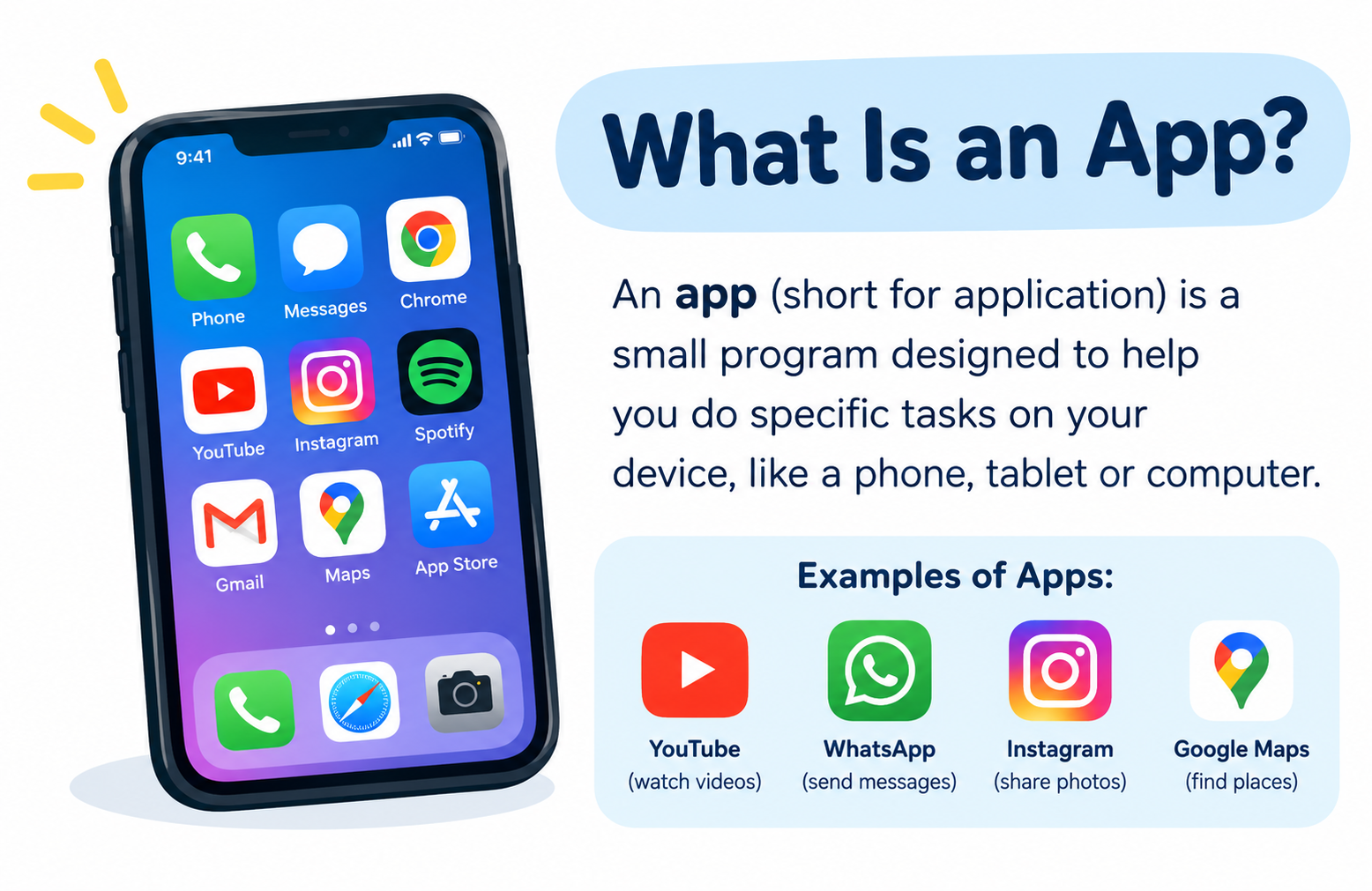
Introduction
You use them to send messages, check the weather, stream music, manage your bank account, and play games. Apps are such a natural part of daily life that most people never stop to think about what they actually are.
So what is an app? An app, short for application or application software, is a program designed to help users perform specific tasks or access particular services on a device. Apps run on smartphones, tablets, computers, smart TVs, web browsers, and many other devices depending on their type and purpose.
This guide explains what apps are, how they work, the different types you will encounter, how they are built, and what to consider before installing one.
Quick Answer: What Is an App?
An app is a software program designed to perform specific tasks or provide specific functionality for users. The word “app” is short for “application” or “application software.” Apps can run on smartphones, tablets, computers, browsers, and other devices. They range from simple tools like calculators to complex platforms like banking systems and social media networks.
What Is an App?
An app is a software program created to perform specific tasks or provide specific functionality for a user. The term comes from the word “application,” which in computing refers to software designed to help users do something practical, whether that is writing a document, navigating to a destination, or communicating with friends.
Apps are distinct from operating systems. An operating system, such as Windows, macOS, Android, or iOS, manages the underlying hardware and provides a foundation for other software to run. Apps are the programs that run on top of that foundation and give users the tools to do things. Your phone’s calendar, your music streaming service, your email client, and your navigation tool are all apps.
The word “app” became widely used alongside the growth of smartphone app stores, but apps exist across many platforms beyond mobile devices. A word processor on a desktop computer, a web-based project management tool, and a game on a smart TV are all apps in the broader sense of the word.
Understanding what software is provides helpful context for understanding apps, since every app is a form of software, though not all software is an app in the specific sense most people use the term.
How Do Apps Work?
At a basic level, every app follows a similar pattern: it receives input from the user, processes that input using application logic, and produces output that the user sees or hears. The details of how this happens vary significantly depending on the type of app and its complexity.
User Interface
The user interface is what you see and interact with when you open an app. It includes buttons, menus, text fields, images, and other visual elements. When you tap a button or type a search query, you are providing input to the app through its interface. Good interface design makes an app feel intuitive. Poor interface design makes even a powerful app frustrating to use.
Application Logic
Behind the interface sits the application logic, the code that determines what happens when you interact with the app. When you tap “send” on a message, the application logic processes your action, packages the message, and passes it to the appropriate service. This logic is built by developers using programming languages and follows specific rules and algorithms to produce consistent, predictable results.
Data and Processing
Apps work with data constantly. A weather app processes location data and forecast information. A fitness app processes workout data and health metrics. A photo editor processes image files. This data processing happens according to the algorithms written into the app’s code. Some processing happens entirely on the device, while other apps send data to remote servers for processing and retrieve the results.
APIs and Online Services
Many modern apps do not work in isolation. They connect to external services through APIs (Application Programming Interfaces) to access data and functionality they do not manage themselves. A travel booking app uses APIs to retrieve flight schedules from airlines. A weather app uses an API to access forecast data from a weather service. APIs allow apps to be far more capable than they could be if they had to build every feature from scratch.
Databases and Cloud Services
Apps that store and retrieve information, such as email clients, social media platforms, and banking apps, typically rely on databases and cloud computing infrastructure. Your messages, contacts, and account details are stored in databases managed by servers that the app connects to when needed. This is why some apps require an internet connection to access your data, while others can store information directly on your device and work offline.
Not every app requires an internet connection. Many apps, such as calculators, offline games, and local note-taking tools, work entirely or partly without network access. The need for connectivity depends on what the app does and where it stores its data.
What Are the Different Types of Apps?
The word “app” covers a wide range of software across many different platforms and delivery methods. Understanding these distinctions helps you make sense of the apps you use and encounter.
Mobile Apps
Mobile apps are designed to run on smartphones and tablets. They are downloaded and installed through platform-specific app stores, such as the Apple App Store for iOS devices or Google Play for Android devices. Mobile apps are optimized for touchscreen interfaces and smaller screens, and they can access device features such as the camera, GPS, microphone, and contacts depending on the permissions granted.
Mobile apps are either native (built specifically for one platform) or cross-platform (designed to work on multiple platforms from a shared codebase).
Web Apps
Web apps run inside a web browser rather than being installed on a device. They look and behave like apps but are accessed through a URL rather than downloaded from an app store. Email services accessed through a browser, online document editors, and browser-based project management tools are examples of web apps.
Web apps are platform-independent, meaning the same web app works on any device with a compatible browser. However, they typically have more limited access to device hardware compared to native mobile or desktop apps.
Desktop Apps
Desktop apps are installed and run on computers running operating systems such as Windows, macOS, or Linux. They are designed for the larger screens, keyboards, and processing power of desktop and laptop computers. Word processors, image editing software, and development environments are common examples of desktop apps.
Native Apps
A native app is built specifically for one operating system or platform using the tools, languages, and frameworks designed for that platform. An iOS native app is built with Swift or Objective-C using Apple’s development tools. An Android native app is built with Kotlin or Java using Google’s development tools.
Native apps typically offer the best performance and deepest access to device features because they are designed specifically for that platform’s capabilities.
Cross-Platform Apps
Cross-platform apps are built using tools and frameworks that allow a single codebase to run on multiple platforms. Rather than building separate apps for iOS and Android, developers use cross-platform frameworks such as Flutter or React Native to create one app that works on both. This can reduce development time and cost but may involve trade-offs in performance or access to platform-specific features.
Hybrid Apps
Hybrid apps combine elements of native apps and web apps. They are built using web technologies such as HTML, CSS, and JavaScript but are packaged inside a native app container that allows them to be distributed through app stores and access some device features. Hybrid apps offer a middle ground between the write-once convenience of web apps and the distribution benefits of native apps.
Progressive Web Apps
Progressive Web Apps, commonly called PWAs, are web applications built with modern web technologies that provide an app-like experience within a browser. PWAs can be added to a device’s home screen, work offline in some capacity, receive notifications, and behave similarly to native apps in many respects, all without requiring installation through an app store. They represent an evolving area of web and app development.
Mobile Apps vs Web Apps vs Desktop Apps
| Feature | Mobile App | Web App | Desktop App |
|---|---|---|---|
| Where it runs | Smartphone or tablet | Web browser | Computer (Windows, macOS, Linux) |
| Installation | Downloaded from app store | No installation required | Downloaded and installed locally |
| Internet requirement | Varies (some offline, some online) | Generally requires internet | Varies (many work offline) |
| Performance | High (especially native) | Moderate | High |
| Updates | App store updates | Automatic via browser | Manual or automatic download |
| Device access | Camera, GPS, contacts (with permissions) | Limited device access | High device access |
| Examples | Instagram, Google Maps mobile | Gmail in browser, Notion web | Microsoft Word, Adobe Photoshop |
| Typical use cases | On-the-go tasks, location-based services | Collaboration, productivity tools | Professional software, development tools |
What Are Apps Used For?
Apps cover virtually every area of daily life and professional work. Here is a look at the most common categories.
Communication
Communication apps allow people to send messages, make voice and video calls, and share files. These apps have largely shifted personal and professional communication away from traditional phone calls and emails for many people.
Productivity
Productivity apps help users organize work, manage tasks, write documents, create spreadsheets, and collaborate with others. Tools in this category range from simple to-do list apps to comprehensive office suites. If you are a student or professional looking for options, the TechOriginHub guide to the best software for students covers several useful productivity tools.
Education
Education apps provide learning experiences across subjects ranging from language learning to mathematics, coding, science, and professional skills. They range from simple flashcard tools to interactive course platforms.
Entertainment
Entertainment apps deliver music, video, podcasts, e-books, and other media content. Streaming services, podcast players, and digital reading platforms all fall into this category.
Gaming
Gaming apps span simple mobile puzzle games to graphically complex titles. Mobile gaming has grown into one of the largest segments of the app market, with games available across every genre.
Finance
Finance apps include banking applications, budgeting tools, investment platforms, and payment apps. These allow users to manage money, track spending, transfer funds, and monitor investments from their devices.
Shopping
Shopping apps allow users to browse products, compare prices, make purchases, and track deliveries from retailers and marketplaces directly on their devices.
Business
Business apps support professional activities including project management, customer relationship management, team communication, invoicing, and analytics. Many businesses rely on suites of connected apps to manage their operations.
Health and Fitness
Health apps track physical activity, monitor sleep, log nutrition, and support mental wellness. Some connect to wearable devices to gather real-time health data.
Utilities
Utility apps perform specific practical functions such as scanning documents, converting file formats, checking network connections, managing passwords, and providing system information.
Common Examples of Apps
Here are familiar examples across different categories to illustrate the variety of apps in everyday use:
- Communication: Messaging apps, email clients, video calling tools
- Productivity: Document editors, spreadsheet apps, note-taking tools such as Notion and task management tools like Trello
- Collaboration: Cloud-based office suites such as Google Workspace and productivity platforms such as Microsoft Office
- Social media: Image sharing platforms, short-form video apps, professional networking tools
- Navigation: Map and turn-by-turn navigation apps
- Music streaming: Audio streaming services
- Video streaming: Video on demand platforms
- Finance: Mobile banking apps, budgeting tools, payment apps
- Health: Step counters, calorie trackers, meditation apps
- Gaming: Puzzle games, strategy games, action games
- Shopping: Retail apps, marketplace apps, price comparison tools
- Development tools: Code editors such as Visual Studio Code and version control tools
These examples illustrate how apps serve nearly every purpose imaginable across personal and professional contexts.
What Is the Difference Between an App and a Website?
The distinction between apps and websites is an important one, though it has become blurry as web technology has advanced.
A website is a collection of pages accessed through a browser using a URL. Websites present information and content. The experience is generally more static than an app, though modern websites can be quite interactive.
A web app is accessed through a browser like a website, but it behaves more like a traditional app. It accepts input, processes it, and produces dynamic results. The line between a feature-rich website and a web app is genuinely unclear in many cases.
A native app is installed on a device and runs independently of the browser. Key differences between apps and websites include:
- Installation: Apps are installed on devices. Websites are visited through a browser.
- Device access: Native apps can access device features like the camera, GPS, and offline storage. Websites generally have more limited access.
- Offline functionality: Many apps can work without an internet connection. Most websites require a connection to load content.
- User experience: Apps are typically optimized for their specific platform, offering smoother interactions and faster response times.
- Updates: Website updates happen on the server and are immediately visible to all users. App updates are pushed through app stores and require users to update their installed version.
Understanding how web browsers work provides useful context for understanding how web apps and websites relate to each other from a technical perspective.
What Is the Difference Between an App and Software?
This is a common source of confusion, and the answer is straightforward. An app is a type of software. Software is the broader category that includes operating systems, device drivers, development tools, apps, and everything else that runs on a computing device.
When people use the word “software,” they often mean application software, which is the category that apps belong to. Application software refers to programs designed to help users perform tasks, as opposed to system software (like operating systems) that manages hardware and supports other software.
So every app is software, but not every piece of software is what most people mean when they say “app.” An operating system is software but not an app. A device driver is software but not an app. A word processor, a game, a social media client, and a photo editor are all both software and apps.
The TechOriginHub guide to what software is goes into more detail on the broader software landscape if you want to explore this distinction further.
How Are Apps Developed?
Building an app involves a series of stages, from initial concept through to ongoing maintenance after launch.
1. Idea and requirements. The process begins with defining what the app will do, who it is for, and what problem it solves. Clear requirements help development teams stay focused and aligned.
2. User interface and experience design. Designers create wireframes and prototypes showing how the app will look and how users will navigate through it. Good design decisions at this stage make the development process smoother.
3. Programming. Developers write the source code that makes the app function. This is where programming languages, frameworks, and development tools are used to build the application logic, connect to APIs, and implement the designed interface.
4. APIs and backend services. Many apps connect to backend systems that handle data storage, user authentication, and other server-side functions. Developers integrate these services during the build phase.
5. Testing and debugging. Before release, apps are tested thoroughly to identify and fix errors. Debugging is the process of finding and resolving these problems. Testing covers functionality, performance, security, and compatibility across different devices and operating systems.
6. Security and privacy review. App developers should assess how the app handles user data, what permissions it requests, and whether appropriate security measures are in place before publishing.
7. Publishing. Mobile apps are submitted to app stores such as the Apple App Store or Google Play, which review submissions before making them available to users. Web apps are deployed to servers. Desktop apps may be distributed directly or through software repositories.
8. Updates and maintenance. After launch, developers release updates to fix bugs, add features, improve performance, and address security issues. Maintaining an app is an ongoing process.
Using tools like Git for version control and platforms like GitHub for collaboration are standard practices in modern app development teams. Development environments such as an IDE provide the tools developers need to write, test, and debug their code efficiently.
What Programming Languages Are Used to Build Apps?
Different types of apps are typically built using different programming languages. Here is an overview of commonly used languages for app development.
Kotlin is the preferred language for Android app development, officially supported by Google. It is a modern language designed to be concise and safe, and it interoperates with Java.
Java was the original primary language for Android development and remains widely used. Many existing Android apps are built in Java, and new developers may encounter Java codebases when contributing to established projects.
Swift is Apple’s programming language for iOS, macOS, and other Apple platform development. It was designed to be fast, safe, and expressive, and it has become the standard for new Apple platform development.
JavaScript is widely used for web app development, both on the front end (what users see) and, with Node.js, on the back end (server-side processing). Frameworks such as React Native also allow JavaScript to be used for cross-platform mobile app development. The TechOriginHub guide to JavaScript explains how this versatile language works in more detail.
TypeScript is a version of JavaScript that adds static typing, which helps catch certain types of errors during development. It is widely used in large-scale web and app development projects and compiles to standard JavaScript.
Dart is the programming language used with Flutter, Google’s cross-platform framework for building mobile, web, and desktop apps from a single codebase. Dart is designed for building fast, expressive user interfaces.
No single programming language is universally the best choice for app development. The right language depends on the type of app being built, the target platform, the development team’s existing skills, and the specific requirements of the project. Python is also used in app development, particularly for back-end services and data processing. Understanding what programming is more broadly helps provide context for how these languages fit into the development process.
App Permissions and Why They Matter
When you install an app, it may request permission to access features and data on your device. These permissions might include access to your camera, microphone, location, contacts, storage, or other sensors.
Permissions exist because apps need access to specific device capabilities to function. A navigation app genuinely needs location access. A messaging app genuinely needs access to your contacts if you want to find people to message. A camera app obviously needs camera access.
However, permissions deserve careful consideration. An app requesting more access than it needs to perform its stated function is worth scrutinizing. A simple flashlight app requesting access to your contacts, for example, has no obvious legitimate reason for that access.
Before granting permissions, consider whether the access requested makes sense for what the app does. Both Android and iOS allow you to review and adjust app permissions through your device settings, and it is good practice to review permissions periodically. You can also grant or deny permissions individually on modern mobile operating systems.
App Security and Privacy Considerations
Apps handle personal data, and understanding the security and privacy implications of the apps you use is important.
Data collection varies enormously between apps. Some collect only the minimum data needed to function. Others collect extensive data about your behavior, location, usage patterns, and preferences. App privacy policies, while often lengthy, explain what data is collected and how it is used. App stores increasingly require developers to provide simplified privacy summaries.
Malicious apps do exist. Apps distributed through unofficial channels carry higher risk because they have not passed through the review processes of official app stores. Even on official stores, occasionally harmful apps pass initial review. Downloading apps only from official sources significantly reduces risk.
Security updates are important. Developers release updates to fix security vulnerabilities discovered after an app is published. Keeping your apps updated is one of the simplest and most effective security practices.
Account security matters for apps that require login. Using strong, unique passwords and enabling two-factor authentication where available protects your accounts in apps that handle sensitive data.
Understanding broader cybersecurity principles provides a useful foundation for thinking about app security in context.
App Updates and Why They Matter
Developers release updates to their apps regularly for several reasons. Understanding why updates are important helps you maintain a safer, better-performing app experience.
Bug fixes address problems discovered after launch. Some bugs cause minor annoyances. Others cause data loss or security vulnerabilities. Updates that fix bugs are worth installing.
Security patches address vulnerabilities that could be exploited by malicious actors. Security-related updates are among the most important to install promptly.
New features add functionality that was not available when you originally installed the app.
Performance improvements make apps faster, more stable, and less demanding on battery and memory.
Platform compatibility updates ensure apps continue working correctly as the underlying operating system is updated.
Enabling automatic updates for trusted apps is a practical way to ensure you benefit from bug fixes and security patches without having to monitor update releases manually.
Advantages and Limitations of Apps
Advantages:
- Apps are designed for specific tasks, making them focused and efficient
- Mobile apps are optimized for touch interfaces and portable devices
- Many apps work offline or with limited connectivity
- Apps can access device hardware features that websites generally cannot
- Well-designed apps provide faster, smoother experiences than browser-based alternatives
- App stores provide a centralized, reviewed distribution channel
Limitations:
- Apps take up storage space on your device
- Mobile apps must be developed separately for different platforms unless cross-platform tools are used
- Apps require maintenance and updates
- Some apps collect more user data than many users realize or prefer
- App store policies can restrict what apps are permitted to do
- Web apps may have limited functionality compared to native apps in some areas
What to Consider Before Installing an App
Not every app deserves a place on your device. Here are practical considerations before installing something new.
Developer or publisher. Research who made the app. Established developers with a track record of legitimate apps are generally more trustworthy than unknown publishers with no history.
Permissions requested. Review what access the app is asking for before you grant it. If the permissions seem excessive for the app’s stated purpose, reconsider installing it or deny unnecessary permissions after installation.
Reviews and ratings. User reviews can surface common problems, misleading claims, and consistent issues that official descriptions do not mention. Look beyond the average rating at the content of recent reviews.
Update history. An app that has not been updated in a long time may not be maintained, which can mean security vulnerabilities are not being addressed.
Privacy practices. Check the privacy policy or the app store’s privacy summary to understand what data is collected and how it is used.
Official download source. Download apps from official sources such as the Apple App Store or Google Play for mobile devices, or from official developer websites for desktop software. Avoid downloading from third-party websites that are not the official source.
Frequently Asked Questions
What is an app in simple words?
An app is a software program designed to help you do something specific on a device, such as sending messages, navigating to a location, managing your money, or playing a game. The word “app” is short for “application.”
What does app stand for?
App stands for “application,” which is short for “application software.” Application software refers to programs designed to help users perform specific tasks, as opposed to system software that manages hardware.
What is the difference between an app and software?
Software is the broad category that includes all programs running on computing devices, including operating systems, device drivers, and applications. An app is a specific type of software designed for user-facing tasks. Every app is software, but not every piece of software is an app in the common sense of the word.
What is a mobile app?
A mobile app is a software application designed to run on smartphones and tablets. Mobile apps are downloaded through platform-specific app stores and are optimized for touchscreen interfaces and the capabilities of mobile devices.
What is a web app?
A web app is an application that runs inside a web browser rather than being installed on a device. Web apps are accessed through a URL and generally work across different devices and operating systems without requiring separate installations.
Do all apps require the internet?
No. Many apps work entirely or partly offline. Calculators, offline games, local note-taking apps, and many media players can function without an internet connection. Apps that require data from remote servers, such as social media platforms or banking apps, typically need internet access to function fully.
How are apps made?
Apps are made through a process that includes defining requirements, designing the interface, writing code in a programming language, integrating APIs and backend services, testing and debugging, reviewing security and privacy, and publishing through the appropriate channel. After release, developers continue to update and maintain the app.
What programming languages are used to make apps?
Common programming languages for app development include Kotlin and Java for Android, Swift for iOS, JavaScript and TypeScript for web apps and cross-platform mobile development, and Dart for Flutter-based cross-platform apps. The right language depends on the type of app and target platform.
Are apps safe to use?
Most apps from reputable developers distributed through official app stores are safe, but no app is risk-free. Reviewing permissions, downloading only from official sources, keeping apps updated, and reading privacy policies reduces risk. Being selective about which apps you install is a sensible approach to app safety.
What is the difference between an app and a website?
A website is a collection of pages accessed through a browser. An app is a program designed to be installed or run as a dedicated application. Apps generally offer more interactive functionality, device integration, and offline capability than websites. The distinction has blurred with the development of web apps and progressive web apps that deliver app-like experiences through browsers.
References
- Apple Developer Documentation. App Store Review Guidelines. Apple Inc. https://developer.apple.com/app-store/review/guidelines/
- Google Developer Documentation. Android Developers Guide. Google LLC. https://developer.android.com/guide
- MDN Web Docs. Progressive Web Apps (PWAs). Mozilla Developer Network. https://developer.mozilla.org/en-US/docs/Web/Progressive_web_apps
- MDN Web Docs. Introduction to Web APIs. Mozilla Developer Network. https://developer.mozilla.org/en-US/docs/Learn/JavaScript/Client-side_web_APIs/Introduction
- Apple Developer Documentation. Swift Programming Language. Apple Inc. https://developer.apple.com/swift/
- Google Developer Documentation. Kotlin for Android. Google LLC. https://developer.android.com/kotlin
- Flutter Documentation. Flutter and Dart. Google LLC. https://docs.flutter.dev/
- Microsoft Learn. What is an application? Microsoft Corporation. https://learn.microsoft.com/en-us/
- MDN Web Docs. JavaScript Guide. Mozilla Developer Network. https://developer.mozilla.org/en-US/docs/Web/JavaScript/Guide
- National Institute of Standards and Technology (NIST). Mobile Application Security. https://www.nist.gov/
Disclaimer
This article is for educational and informational purposes. App platforms, programming languages, development tools, and security practices evolve over time. Always consult current official documentation for the platforms, languages, and tools you are working with.
Author: TechOriginHub Editorial Team
Author Bio: TechOriginHub Editorial Team covers practical technology, programming, software, cybersecurity, cloud computing, databases, and internet topics with a focus on clear and useful guidance.
 Zohan q