
 By TechOriginHub Editorial Team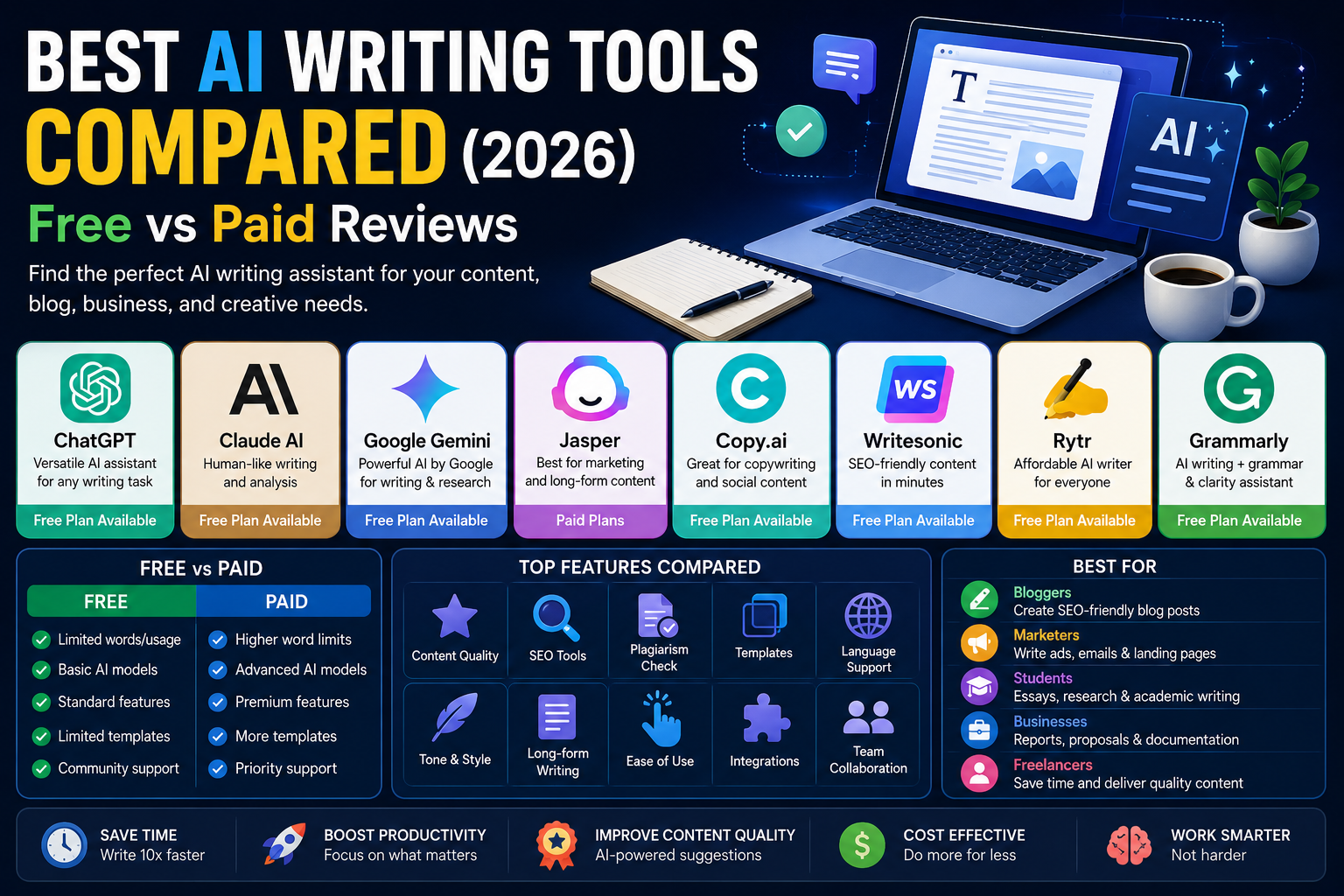
Introduction
Writing has always been one of the most time-consuming parts of running a blog, managing a business, or creating content at scale. Researching a topic, drafting an outline, writing a first draft, editing for clarity, optimizing for search engines — each step demands focused time and mental energy. That is exactly why the best AI writing tools have moved from being a novelty to an essential part of the professional workflow for millions of writers, marketers, and business owners worldwide.
In 2026, AI writing tools have matured considerably. The gap between AI-generated content and human writing has narrowed. The tools themselves have become more specialized, more accurate, and more integrated with the platforms that writers already use. But the market is also crowded and confusing, with dozens of options making similar-sounding claims about quality, speed, and value.
This guide cuts through that noise. We tested twelve of the most widely used AI writing tools, evaluated them honestly across nine key criteria, and built this comparison to help you find the right fit — whether you are a blogger, a student, an SEO professional, a freelance copywriter, or a business owner managing content at scale.
Quick Answer — Featured Snippet
The best AI writing tools in 2026 are ChatGPT for general versatility, Claude AI for long-form quality, Jasper AI for marketing teams, Writesonic for SEO content, and Grammarly AI for editing and refinement. Free options include ChatGPT Free, Google Gemini, and Rytr. The right tool depends on your use case, budget, and the type of content you produce most frequently.
What Are AI Writing Tools?
AI writing tools are software applications that use artificial intelligence — specifically large language models — to help users create, edit, improve, and optimize written content. They range from general-purpose AI assistants that can help with virtually any writing task to specialized platforms built specifically for SEO content, marketing copy, academic writing, or creative fiction.
At the technical level, these tools work by processing your input — a topic, an outline, a rough draft, or a set of instructions — and generating text based on patterns learned from training on enormous volumes of written content. The best modern tools go several steps further, incorporating real-time web access for research, SEO analysis features, readability scoring, and integrations with content management systems and productivity platforms.
The practical benefits are significant. AI writing tools reduce the time required to produce a first draft from hours to minutes. They help overcome writer’s block by generating starting points and ideas. They improve consistency across large volumes of content. They assist non-native English speakers in producing polished professional writing. And they allow small teams to produce the content volume that would previously have required a much larger staff.
Who benefits most from AI writing tools? The honest answer is a broad range of people. Bloggers use them to produce more posts without sacrificing quality. SEO professionals use them to generate optimized content at scale. Marketing teams use them for ad copy, email sequences, and social media content. Students use them to understand topics and refine drafts. Freelance writers use them to handle more clients simultaneously. Business owners use them to maintain a professional content presence without hiring a full content team.
How We Tested These AI Writing Tools
Every tool in this comparison was evaluated against the same nine criteria, using real-world writing tasks across multiple content types — blog posts, marketing copy, product descriptions, academic summaries, email sequences, and social media content.
Content Quality was evaluated by examining the output for naturalness, coherence, factual accuracy, and how much editing was required to produce publication-ready content. We paid particular attention to whether output sounded genuinely human or had the telltale patterns of obvious AI generation.
Accuracy measured how reliably each tool produced factually correct information, and how clearly it communicated uncertainty rather than confidently generating incorrect claims.
Ease of Use assessed the learning curve for new users, the clarity of the interface, and how quickly someone unfamiliar with AI tools could produce useful results.
Speed measured the time from prompt submission to output delivery, both for short-form content like social posts and long-form content like full blog articles.
SEO Features evaluated whether each tool offered keyword integration, meta description generation, readability analysis, content scoring, or integration with SEO platforms like Surfer SEO or SemRush.
Pricing examined both the cost of paid plans and the generosity of free tiers, including what features are available at each price point.
Value for Money considered the quality and volume of output achievable relative to the subscription cost, accounting for both free and paid plan options.
Language Support assessed how many languages each tool supports and how well it performs in non-English languages.
Integrations evaluated connections with third-party platforms including WordPress, Google Docs, Notion, Shopify, and major CRM and marketing platforms.
Best AI Writing Tools Compared
ChatGPT
Overview: ChatGPT remains the most versatile and widely used AI writing tool in 2026. Built on OpenAI’s GPT-4o architecture, it handles virtually any writing task — blog posts, marketing copy, email drafts, social media content, academic summaries, creative writing, and technical documentation — with consistent quality and a remarkably natural conversational flow.
Key Features: Multimodal input accepting text, images, and documents. Persistent memory that learns your preferences over time. A custom instructions feature that maintains your preferred tone and style across sessions. Access to browsing for research-backed content. Code interpreter for data analysis tasks. Integration with a wide range of third-party tools through the GPT Store.
Best For: General-purpose writing assistance across any content type, users who need one tool that does everything reasonably well, and professionals who want flexible AI assistance rather than a specialized content platform.
Free Plan: Available with access to GPT-4o mini and occasional GPT-4o usage. Meaningful free access but with usage limits during peak periods.
Paid Pricing: ChatGPT Plus at twenty dollars per month provides priority GPT-4o access, higher usage limits, and full access to advanced tools including image generation and data analysis.
Pros: Unmatched versatility, natural writing style that requires minimal editing, strong factual reasoning, excellent at following complex instructions, constantly improving, large community with extensive prompt resources.
Cons: Free tier has usage limits that interrupt heavy workflows, can hallucinate facts particularly on specific statistics and recent events, no built-in SEO features, long-form content sometimes requires significant editing for structure and flow.
Overall Rating: 9.2 out of 10
Claude AI
Overview: Claude, developed by Anthropic, has established itself as the preferred tool for writers who prioritize output quality over everything else. Its writing is consistently the most natural-sounding of any AI tool tested. Long-form content — articles, reports, detailed analyses — is Claude’s clearest strength, and its ability to handle very long documents within a single context makes it exceptionally useful for editing and summarizing existing work.
Key Features: Extended context window that handles very long documents even on the free tier. Strong instruction-following that produces outputs closely aligned with detailed style requirements. Constitutional AI training that makes it less likely to produce misleading or harmful content. Thoughtful reasoning that produces well-structured, logically coherent arguments.
Best For: Long-form article writing, editing and refining existing drafts, analytical and research-based content, and any writing task where quality and nuance are the primary concerns.
Free Plan: Access to Claude 3.5 Sonnet with daily usage limits that reset every twenty-four hours.
Paid Pricing: Claude Pro at twenty dollars per month provides higher usage limits and priority access during peak times.
Pros: Best-in-class long-form writing quality, exceptional at maintaining consistent tone across lengthy pieces, very strong at following nuanced style instructions, large context window for document analysis.
Cons: Daily usage limits on the free tier are restrictive for high-volume production, no built-in SEO features, no image generation, fewer third-party integrations than some competitors, web browsing limited compared to ChatGPT.
Overall Rating: 9.0 out of 10
Google Gemini
Overview: Google Gemini brings a distinct advantage that no other tool on this list can fully replicate: native integration with Google’s ecosystem. For writers working within Google Docs, Gmail, or Google Workspace, Gemini provides AI assistance without requiring a context switch to a separate application. Its real-time internet access means research-backed writing is genuinely accessible on the free tier.
Key Features: Native integration with Google Docs, Gmail, Slides, and Sheets. Real-time web access for research and current information. Multimodal capability for analyzing images alongside text. Strong multilingual performance across a wide range of languages. Integration with Google Search for grounding factual claims.
Best For: Writers who live in Google Workspace, content requiring up-to-date information, multilingual content creation, and users who want AI writing assistance integrated into their existing tools without additional cost.
Free Plan: Access to Gemini 1.5 Flash with real-time search integration at no cost.
Paid Pricing: Google One AI Premium at nineteen dollars and ninety-nine cents per month provides Gemini Advanced with the most powerful 1.5 Pro model and deeper Workspace integration.
Pros: Real-time information access on free tier, seamless Google Workspace integration, strong multilingual capability, no separate application needed for Google users.
Cons: Creative writing quality is less consistently strong than ChatGPT or Claude, deep Workspace AI integration requires a paid subscription, less specialized for content marketing use cases than dedicated writing tools.
Overall Rating: 8.5 out of 10
Jasper AI
Overview: Jasper AI is built specifically for marketing teams and content professionals who need to produce high volumes of branded content consistently. Unlike general-purpose AI assistants, Jasper is engineered around marketing workflows — brand voice management, team collaboration, campaign-level content planning, and integration with SEO tools. It is more expensive than most options on this list, and that premium is justified primarily for teams with serious content production needs.
Key Features: Brand voice training that learns and maintains your specific tone, terminology, and style across all content. A template library with over fifty marketing-specific content templates. Native integration with Surfer SEO for optimized long-form content. Team collaboration features with user roles, permissions, and shared brand assets. A Chrome extension for AI assistance across the web.
Best For: Marketing teams managing multiple brands, content agencies, and businesses that produce large volumes of branded content and need consistent voice and SEO optimization built into the workflow.
Free Plan: No permanent free plan. A seven-day free trial is available.
Paid Pricing: Creator plan at thirty-nine dollars per month for individual users. Teams plan at ninety-nine dollars per month for three seats with full collaboration features. Business plans available with custom pricing.
Pros: Exceptional brand voice management, strong SEO integration with Surfer, purpose-built for marketing workflows, excellent team collaboration features, large template library for marketing content.
Cons: Significantly more expensive than general-purpose alternatives, no permanent free plan, overkill for individual bloggers or students, Surfer SEO integration requires a separate Surfer subscription for full benefit.
Overall Rating: 8.7 out of 10
Copy.ai
Overview: Copy.ai has evolved from a simple copywriting tool into a broader marketing content platform with a strong emphasis on workflow automation and go-to-market content production. Its free plan is among the most generous in the category, and its workflow automation features make it genuinely interesting for marketing teams looking to systematize content production.
Key Features: A generous free plan with unlimited projects. Workflow automation that strings together multiple content tasks into repeatable processes. A large library of templates covering social media, ads, emails, product descriptions, and sales copy. Brand voice settings for consistent tone. Infobase feature that stores your brand information for AI to reference automatically.
Best For: Marketing professionals who need to systematize content production, small business owners who need varied marketing copy from a single platform, and individual creators who want a generous free tier for copy-focused tasks.
Free Plan: Free plan with limited monthly word credits and access to core features. One of the more accessible free tiers in the paid-tool category.
Paid Pricing: Starter plan at thirty-six dollars per month. Advanced plan at one hundred eighty-six dollars per month with workflow automation and team features.
Pros: Generous free tier, strong workflow automation at higher tiers, good template variety for marketing copy, easy to use without a learning curve, solid for short-form copy tasks.
Cons: Long-form content quality is less consistent than ChatGPT or Claude, advanced automation features require expensive plans, less suitable for academic or editorial writing, content can feel formulaic for some output types.
Overall Rating: 8.2 out of 10
Writesonic
Overview: Writesonic has made SEO-optimized content production its clear focus, and it delivers on that promise more consistently than most competitors. Its integration with real-time search for factual grounding and its built-in SEO scoring make it a strong choice for writers whose primary concern is producing content that ranks. The platform has also developed a capable AI chatbot called Chatsonic that provides research assistance alongside content generation.
Key Features: AI Article Writer that produces SEO-optimized long-form content from a keyword or topic input. Chatsonic with real-time web access and GPT-4-powered responses. Brand voice settings for consistent tone. Surfer SEO integration for content optimization scoring. Product description and ad copy generators. Landing page and email sequence templates.
Best For: SEO content writers, bloggers focused on organic search traffic, digital marketing agencies producing SEO articles at volume, and content teams who want SEO optimization built into the writing workflow.
Free Plan: Free trial with a limited word credit allocation for new users.
Paid Pricing: Individual plan at around twenty dollars per month with one hundred sixty thousand words. Teams plans available at higher price points with more words and seats.
Pros: Strong SEO-focused content generation, real-time web access through Chatsonic, built-in content scoring, good value for high-volume SEO content production, Surfer integration for optimization.
Cons: Content can feel structured for SEO at the expense of readability, word count pricing model can feel restrictive for heavy users, long-form output sometimes requires significant editing for voice and flow.
Overall Rating: 8.3 out of 10
Rytr
Overview: Rytr occupies the budget end of the AI writing tool market, and it does so honestly and effectively. For individual bloggers, students, and small business owners who need basic AI writing assistance without a large monthly expense, Rytr delivers solid results for common content types at a price point that is hard to argue with. It is not going to compete with Jasper for enterprise marketing workflows, but it was never intended to.
Key Features: Over forty use case templates covering blog posts, emails, ad copy, social media captions, product descriptions, and more. Tone of voice selector with over twenty preset tones. Multilingual support for over thirty languages. A built-in plagiarism checker. Rytr Chrome extension for writing assistance across the web. Simple, clean interface with minimal learning curve.
Best For: Budget-conscious individual creators, students, freelancers producing high volumes of short-form content, small business owners who need variety without significant monthly cost.
Free Plan: Free plan provides ten thousand characters per month — useful for light use and evaluation but restrictive for regular content production.
Paid Pricing: Saver plan at around nine dollars per month with one hundred thousand characters. Unlimited plan at around twenty-nine dollars per month with no character limits.
Pros: Very affordable, genuinely unlimited plan available, easy to learn, solid for short-form content, good multilingual support, plagiarism checker included.
Cons: Output quality for long-form content is noticeably lower than premium tools, lacks advanced SEO features, less suitable for nuanced or highly specialized content, limited team collaboration capabilities.
Overall Rating: 7.8 out of 10
Grammarly AI
Overview: Grammarly occupies a distinct position in the AI writing tool landscape. Rather than generating content from scratch, Grammarly’s primary value is in refining, improving, and ensuring the quality of writing you have already produced. Its AI features — tone adjustment, rewriting suggestions, full-sentence rewrites, and the GrammarlyGO generative feature — have expanded its capabilities, but editing and quality assurance remain its core strength.
Key Features: Real-time grammar, spelling, punctuation, and style correction across browsers, desktop apps, and Microsoft Office. GrammarlyGO for generating text, rewrites, and responses from prompts. Tone detection and adjustment recommendations. Clarity and engagement scoring. Plagiarism detection on Premium plans. Team features with brand tone guidelines on Grammarly Business.
Best For: Anyone who wants to improve the quality and clarity of their writing, professionals who communicate in writing frequently, non-native English speakers, and teams who need consistent writing standards across members.
Free Plan: The free version provides grammar and spelling correction — genuinely useful for everyday writing quality. GrammarlyGO and advanced writing suggestions require Premium.
Paid Pricing: Grammarly Premium at around twelve dollars per month with full access to style, clarity, and tone features. Grammarly Business at around fifteen dollars per member per month with team features.
Pros: Works everywhere you write online, dramatically improves writing quality, strong tone detection, easy to use, free tier is genuinely useful, trusted by professionals globally.
Cons: Not a content generation tool in the traditional sense, GrammarlyGO generative features are less powerful than dedicated AI writing tools, plagiarism detection requires Premium, less useful for users who need bulk content creation.
Overall Rating: 8.6 out of 10
Notion AI
Overview: Notion AI integrates AI writing assistance directly into the Notion workspace, making it the strongest option for teams and individuals who already use Notion as their central hub for notes, documentation, and project management. The integration is seamless — AI assistance is available wherever you are in your Notion workspace without switching contexts.
Key Features: AI writing assistance within Notion pages and databases. Summarization of lengthy documents and meeting notes. Action item extraction from notes and transcripts. Translation within Notion documents. Writing improvement and tone adjustment. Autofill for Notion database properties using AI.
Best For: Teams and individuals using Notion for content planning, documentation, and project management who want AI assistance integrated directly into their existing workspace.
Free Plan: A limited trial of Notion AI is available. Ongoing AI access requires the paid add-on.
Paid Pricing: Notion AI add-on at ten dollars per member per month on top of the base Notion subscription.
Pros: Perfectly integrated with Notion workflows, no context switching, strong summarization and extraction, useful for teams managing content in Notion, good multilingual support.
Cons: AI is a paid add-on rather than included, less powerful for standalone content generation than dedicated tools, only valuable if you are already a Notion user.
Overall Rating: 8.0 out of 10
Microsoft Copilot
Overview: Microsoft Copilot offers a compelling combination: GPT-4-class AI writing assistance available entirely free at copilot.microsoft.com, with additional deep integration into Microsoft 365 apps for paying subscribers. For users already working in Word, Outlook, and Teams, Copilot represents AI writing assistance in the tools where much professional writing already happens.
Key Features: Free access to GPT-4-class writing assistance with Bing search integration for real-time information. Copilot in Word for document drafting and editing. Copilot in Outlook for email drafting and summarization. Copilot in Teams for meeting transcription and summary. Image generation via DALL-E on the free tier.
Best For: Microsoft 365 users who want AI writing assistance integrated into Word and Outlook, business professionals who communicate primarily through Microsoft tools, and users who want strong free AI writing access without a monthly subscription.
Free Plan: Genuinely capable free access at copilot.microsoft.com with no subscription required.
Paid Pricing: Microsoft 365 Copilot at thirty dollars per user per month for deep integration inside Office applications.
Pros: Strong free tier with no monthly cost, deep Word and Outlook integration for subscribers, real-time information access, image generation on free plan, trusted Microsoft infrastructure.
Cons: Deep Office integration is expensive, less specialized than purpose-built AI writing tools, Microsoft 365 Copilot pricing is aimed at enterprise rather than individual users.
Overall Rating: 8.4 out of 10
QuillBot AI
Overview: QuillBot has built a loyal following among students, academics, and non-native English writers with its paraphrasing and rewriting capabilities. While it has expanded into broader AI writing assistance, its paraphraser remains its strongest and most distinctive feature — and it is the only tool in this comparison with a free paraphrasing tool that is genuinely useful without a paid plan.
Key Features: AI paraphraser with multiple rewriting modes — Standard, Fluency, Formal, Simple, Creative, and more. Grammar checker. Summarizer for condensing long documents. Citation generator for academic references. Co-Writer feature combining writing, research, and paraphrasing in one interface. Translation support for over forty languages.
Best For: Students rewriting and improving drafts, academic writers who need paraphrasing and summarization, non-native English speakers improving writing clarity, and professionals who need quick document summarization.
Free Plan: Free paraphrasing with limited monthly use, free grammar checker, and limited summarizer access.
Paid Pricing: QuillBot Premium at around thirteen dollars per month for unlimited paraphrasing, full grammar checker, and advanced features.
Pros: Best free paraphrasing tool available, strong for academic and student use, citation generator is a significant student-focused advantage, multilingual support, affordable premium pricing.
Cons: Not well-suited for generating original long-form content, less effective for marketing copy or SEO content production, paraphrasing can sometimes reduce specificity or nuance in technical writing.
Overall Rating: 8.1 out of 10
Sudowrite
Overview: Sudowrite occupies a unique and genuinely underserved niche: it is built specifically for fiction writers, novelists, screenwriters, and creative writing professionals. While every other tool on this list focuses primarily on informational or marketing content, Sudowrite focuses on narrative craft — character development, plot structuring, prose style, and the specific challenges of long-form creative storytelling.
Key Features: Write mode for AI-assisted scene and chapter drafting. Rewrite tool for refining prose with specific style targets. Story Bible for storing character profiles, world-building notes, and narrative details that AI references for consistency. Brainstorm tool for plot and character development. Describe feature for generating sensory-rich scene description. Canvas view for visualizing and structuring complete narratives.
Best For: Fiction writers, novelists, screenwriters, and creative writing students who want AI assistance designed specifically for narrative craft rather than informational content.
Free Plan: Free trial available for new users with limited credits.
Paid Pricing: Hobby and Student plan at around nineteen dollars per month. Professional plan at around twenty-nine dollars per month. Max plan at around one hundred dollars per month for high-volume writers.
Pros: Purpose-built for fiction and creative writing, genuinely understands narrative structure and prose craft, Story Bible maintains consistency across long projects, unique features unavailable in general-purpose tools.
Cons: Not suitable for informational, marketing, or SEO content, more expensive than general-purpose tools for equivalent word output, niche enough that most content writers will not need it.
Overall Rating: 8.8 out of 10 (for its target use case of creative fiction writing)
AI Writing Tools Comparison Table
| Tool | Best For | Free Version | Starting Price | SEO Features | Long-form Writing | Content Quality | Ease of Use | Rating |
|---|---|---|---|---|---|---|---|---|
| ChatGPT | General writing | Yes | $20/mo | Limited | Strong | Excellent | Very Easy | 9.2/10 |
| Claude AI | Long-form quality | Yes | $20/mo | None | Excellent | Excellent | Easy | 9.0/10 |
| Google Gemini | Google Workspace | Yes | $19.99/mo | Limited | Good | Very Good | Very Easy | 8.5/10 |
| Jasper AI | Marketing teams | Trial only | $39/mo | Strong | Good | Very Good | Moderate | 8.7/10 |
| Copy.ai | Marketing copy | Yes | $36/mo | Limited | Moderate | Good | Easy | 8.2/10 |
| Writesonic | SEO content | Trial only | $20/mo | Strong | Good | Good | Easy | 8.3/10 |
| Rytr | Budget users | Yes | $9/mo | None | Moderate | Good | Very Easy | 7.8/10 |
| Grammarly AI | Editing/refining | Yes | $12/mo | None | N/A | Excellent | Very Easy | 8.6/10 |
| Notion AI | Notion users | Trial only | +$10/mo | None | Good | Good | Easy | 8.0/10 |
| MS Copilot | Office users | Yes | $30/mo | Limited | Good | Very Good | Easy | 8.4/10 |
| QuillBot | Paraphrasing | Yes | $13/mo | None | Limited | Good | Very Easy | 8.1/10 |
| Sudowrite | Fiction writing | Trial only | $19/mo | None | Excellent | Excellent | Moderate | 8.8/10 |
Free vs Paid AI Writing Tools
| Feature | Free Tools | Paid Tools |
|---|---|---|
| Word or Character Limits | Restricted monthly allowances | High limits or unlimited |
| AI Model Quality | Standard or limited models | Latest, most powerful models |
| Content Quality | Good for casual use | Optimized for professional production |
| SEO Features | Largely unavailable | Available on specialist tools |
| Team Collaboration | Not available | Available on team plans |
| Brand Voice Settings | Not available | Available on most paid tools |
| Third-party Integrations | Limited | WordPress, Surfer SEO, CRM platforms |
| Customer Support | Community and documentation | Priority email or live chat |
| Plagiarism Detection | Not included | Available on Grammarly, some others |
| Long-form Templates | Basic or none | Extensive template libraries |
| Best For | Evaluation, light use, students | Professional and business production |
Best AI Writing Tools by Use Case
| Use Case | Best Tool | Runner Up | Key Reason |
|---|---|---|---|
| Blogging | ChatGPT | Claude AI | Versatile, natural long-form output |
| SEO Content | Writesonic | Jasper AI | Built-in SEO optimization |
| Copywriting | Jasper AI | Copy.ai | Marketing templates, brand voice |
| Academic Writing | QuillBot | Claude AI | Paraphrasing, citations, summarization |
| Email Writing | Microsoft Copilot | ChatGPT | Native Outlook integration |
| Marketing | Jasper AI | Copy.ai | Campaign-level content tools |
| Social Media | Copy.ai | ChatGPT | Social content templates |
| Business Writing | Microsoft Copilot | Grammarly AI | Office integration, quality refinement |
| Students | QuillBot | ChatGPT Free | Free paraphrasing and summarization |
| Freelancers | Claude AI | ChatGPT | Quality output, flexible free tier |
| Creative Fiction | Sudowrite | Claude AI | Purpose-built narrative tools |
| Non-native English | Grammarly AI | QuillBot | Real-time correction everywhere |
Which AI Writing Tool Is Best for SEO?
For writers whose primary goal is producing content that ranks in search engines, Writesonic and Jasper AI are the two strongest options, for different budget points.
Writesonic’s Article Writer generates SEO-structured long-form content from a target keyword, incorporates real-time web research for factual accuracy, and offers Surfer SEO integration for content scoring and optimization. For an individual SEO writer or small team, it delivers strong value at a competitive price point.
Jasper AI with Surfer SEO integration is the more powerful combination for teams — the brand voice management ensures consistency at scale, and the Surfer integration provides real-time SEO guidance during the writing process. The higher price is justified for agencies and marketing teams where SEO content volume is significant.
ChatGPT is worth mentioning here as well. While it has no built-in SEO tools, its ability to generate well-structured, readable content that can be optimized separately using dedicated SEO tools makes it a viable option for experienced SEO writers comfortable with a two-tool workflow.
Which AI Writing Tool Is Best for Bloggers?
Bloggers need a tool that produces natural-reading, well-structured long-form content with minimal editing time — and that is ideally available at low or no cost.
Claude AI is the top recommendation for bloggers who prioritize output quality. Its long-form writing is consistently the most natural and coherent of any tool tested. The free tier, while limited in daily volume, is sufficient for bloggers publishing several posts per week. Claude Pro at twenty dollars per month removes those limitations.
ChatGPT is the stronger choice for bloggers who need versatility — topic research, content ideation, headline generation, meta description writing, and social media promotion copy alongside the blog post itself. Its breadth makes it a more complete blogging workflow tool.
For bloggers on an absolute zero budget, the combination of ChatGPT Free for drafting and Grammarly Free for editing covers the basics effectively, though usage limits on ChatGPT’s free tier require strategic use.
Which AI Writing Tool Is Best for Students?
Students have specific needs that differ from professional content creators: help understanding complex topics, paraphrasing for originality, summarizing long readings, and improving the quality of their own writing without replacing it entirely.
QuillBot is the most directly useful tool for most students. The free paraphrasing tool helps rework research and source material into original language. The summarizer condenses lengthy academic readings. The citation generator handles reference formatting. These are the specific pain points of academic writing, and QuillBot addresses them more directly than any general-purpose AI assistant.
ChatGPT Free is valuable for concept explanation and brainstorming. Asking ChatGPT to explain a complex economic theory or summarize the themes of a novel in simple terms provides a genuine learning aid. Students should use it for understanding rather than direct copying — both for academic integrity reasons and because using AI output directly without understanding the content undermines the learning process.
Google Gemini is worth mentioning for students already using Google Workspace, since it integrates directly into Google Docs where most student writing happens.
Which AI Writing Tool Is Best for Businesses?
Business writing encompasses a wide range of tasks — internal documentation, external communications, marketing content, reports, and proposals. The right tool depends on which of these your business prioritizes.
For Microsoft-centric organizations, Microsoft 365 Copilot is the most integrated solution, providing AI assistance inside Word, Outlook, and Teams where business writing already happens. The thirty-dollar-per-user monthly cost is significant, but the ROI for teams producing high volumes of business documents and communications is measurable.
For marketing-focused businesses, Jasper AI’s brand voice management and marketing template library make it the strongest dedicated choice. The ability to produce brand-consistent content across multiple writers and channels is a genuine operational advantage at scale.
For small businesses without a dedicated marketing team, the free tiers of ChatGPT or Microsoft Copilot combined with Grammarly Premium for quality assurance cover most business writing needs at minimal cost.
Tips for Choosing the Right AI Writing Tool
Define your primary use case before looking at features. A tool with a hundred templates is not more useful to you if eighty of them are irrelevant to your work. Identify the three content types you produce most frequently and prioritize tools that excel specifically at those.
Test with real work, not demo content. Every tool performs well on the sample prompts shown in their marketing. Test each tool with an actual writing task from your real workflow and evaluate the output against what you would have written yourself.
Factor in the editing time, not just the generation time. A tool that generates a draft in thirty seconds but requires forty-five minutes of editing may actually be slower than a tool that takes two minutes but produces near-publication-ready copy. Output quality and the editing burden it creates are more important than raw generation speed.
Consider your workflow ecosystem. A tool that integrates directly with your existing platforms — Google Docs, WordPress, Notion, Microsoft Office — will see far more consistent daily use than one that requires context-switching to a separate application.
Start free, upgrade strategically. Use free tiers to validate that a tool genuinely improves your output quality for your specific use case before paying for a monthly subscription. Most tools offer sufficient free access to make a confident evaluation.
Common Mistakes to Avoid
Publishing AI output without editing is the most consequential mistake in AI-assisted content production. AI writing tools generate plausible-sounding text, not necessarily accurate or perfectly suited text. Every piece of AI-generated content requires human review, fact-checking, and voice refinement before publication.
Over-relying on a single tool for every task. Different tools have genuine specialized strengths. Using ChatGPT for everything when Writesonic would produce better SEO content, or using a general-purpose tool for fiction when Sudowrite is purpose-built for it, means accepting mediocre results where better options exist.
Neglecting to train the AI on your voice and brand. Most paid tools offer brand voice settings, custom instructions, or style guidelines. Writers who invest time in these settings produce dramatically better, more consistent output than those who use default settings for every prompt.
Ignoring the fact that AI tools date quickly. The AI writing tool that was best-in-class six months ago may have been surpassed. Stay informed about major updates, new tool releases, and capability changes. The tools we have tested reflect the market in 2026, but this landscape evolves continuously.
Using AI writing tools for academic submission without disclosure where required. Academic institutions have rapidly developing AI usage policies. Using AI writing tools in ways that violate your institution’s academic integrity policies carries real consequences. Always understand the rules of your specific context.
Future of AI Writing Software
The trajectory of AI writing tools in 2026 points toward several clear directions that will reshape the category over the next two to three years.
Personalization will deepen. Future tools will learn individual writing styles, vocabulary preferences, and structural tendencies with far greater accuracy than today’s brand voice settings allow, producing outputs that genuinely require less editing because they more closely match each writer’s natural voice from the outset.
Real-time research integration will become standard across all tiers. The distinction between tools with and without web access is already blurring, and within the next two years, factually grounded, research-backed content generation will be a baseline expectation rather than a premium differentiator.
SEO intelligence will become more sophisticated. AI writing tools will move beyond keyword insertion toward a deeper understanding of search intent, topical authority, and content gap analysis, making the line between AI writing tools and AI SEO platforms increasingly blurred.
Multimodal content creation will integrate more fully. The combination of text generation, image creation, and video production within a single content workflow is already emerging and will mature into coherent end-to-end content production platforms.
Quality benchmarks will continue to rise. The output quality of free-tier AI writing tools in 2027 will likely exceed what is available today on paid plans, driven by continued model improvements and intense market competition.
Frequently Asked Questions
What is the best AI writing tool?
ChatGPT is the best general-purpose AI writing tool for most users due to its versatility, output quality, and constant improvement. Claude AI is the best choice specifically for long-form writing quality. Jasper AI leads for marketing teams needing brand consistency and SEO integration. The genuinely best tool depends on your specific use case, content type, and budget.
Is ChatGPT better than Jasper?
For general writing versatility and raw output quality, ChatGPT matches or exceeds Jasper in most individual writing tasks. Jasper AI is specifically better for marketing teams because of its brand voice management, team collaboration features, and dedicated marketing templates — capabilities ChatGPT does not offer natively. For individual writers, ChatGPT at twenty dollars per month typically delivers better value than Jasper at thirty-nine dollars per month.
Which AI writing tool is free?
ChatGPT, Google Gemini, Microsoft Copilot, Grammarly, QuillBot, Rytr, and Copy.ai all offer free plans with meaningful (if limited) access. ChatGPT Free and Google Gemini Free are the strongest general-purpose free options. QuillBot Free is the best free option specifically for paraphrasing and academic writing. Grammarly Free is the best free option for grammar correction and writing improvement.
Which AI writing software is best for SEO?
Writesonic and Jasper AI are the two strongest options for SEO-focused content production. Writesonic’s Article Writer generates structured SEO content with real-time research and Surfer integration. Jasper AI with Surfer SEO provides a more powerful combination for teams. For individual SEO writers on a tighter budget, Writesonic’s lower starting price point typically delivers better value.
Is AI writing good for blogging?
Yes, AI writing tools are genuinely beneficial for bloggers when used correctly. They accelerate the production of first drafts, help overcome writer’s block, generate content ideas, and assist with the supporting elements of a post — meta descriptions, social media captions, email promotion. The most effective approach is using AI as a drafting assistant while maintaining your own editorial voice and fact-checking outputs before publication.
Which AI tool creates the most human-like content?
Claude AI consistently produces the most naturally human-sounding writing in our testing, particularly for long-form content. Its outputs require less editing to remove obvious AI patterns than most competitors. ChatGPT is a close second. The more detailed and specific your prompts, the more human-like the outputs from both tools become — vague prompts produce generic results regardless of the underlying model quality.
Can AI writing tools replace human writers?
AI writing tools cannot fully replace human writers in 2026. They excel at generating structured, factual, and formulaic content at speed and scale. They struggle with genuine originality, deep subject matter expertise, authentic personal voice, complex emotional nuance, and the creative judgment that distinguishes great writing from competent content. The realistic and current relationship is collaborative augmentation rather than replacement — AI handles volume and speed while human writers contribute judgment, expertise, and voice.
Which AI writing tool supports multiple languages?
Google Gemini, DeepL (for translation specifically), QuillBot, and Rytr offer the broadest multilingual support. Google Gemini is particularly strong across European languages and a growing number of Asian languages. Rytr supports over thirty languages. ChatGPT and Claude also perform well in many languages, though their strongest performance is in English. For dedicated translation rather than multilingual writing, DeepL remains the highest-accuracy option for European language pairs.
Which AI writer is best for students?
QuillBot is the most directly useful AI writing tool for students due to its free paraphrasing tool, summarizer, and citation generator. ChatGPT Free is the best supplement for concept explanation, brainstorming, and understanding complex topics. Google Gemini integrates well with Google Docs for students working in that environment. Students should always verify AI-generated information and adhere to their institution’s academic integrity policies.
Which AI writing tool offers the best value?
For individual users on a budget, Rytr’s Unlimited plan at twenty-nine dollars per month delivers the best volume-to-price ratio. For quality-focused individual users, Claude Pro or ChatGPT Plus at twenty dollars per month each deliver strong value. For professional marketers and SEO teams, Jasper AI and Writesonic justify their higher costs with specialized features that general-purpose tools lack. Microsoft Copilot’s free tier offers exceptional value for users who do not need premium features.
How do I avoid AI writing tool output sounding robotic?
Provide detailed, specific prompts that include your target tone, audience, and key points you want covered. Use custom instructions or brand voice settings to train the tool on your preferred style. Always edit the output — change word choices, vary sentence length, add personal examples and opinions. Treat AI output as a first draft, not a finished product. The more specific your input, the less generic the output.
Are there any AI writing tools designed for creative fiction?
Yes. Sudowrite is specifically designed for fiction writers, novelists, and screenwriters, offering features tailored to narrative craft including scene generation, character development, story structure tools, and a Story Bible for maintaining narrative consistency across long projects. Claude AI is also a strong option for fiction, though it is a general-purpose tool rather than one built specifically for creative writing. Most other tools on this list focus primarily on informational and marketing content.
Final Verdict
Choosing among the best AI writing tools comes down to matching the right tool to your specific workflow, content type, and budget. Here are our top recommendations for each user type.
Best overall for individuals: ChatGPT Plus at twenty dollars per month — the combination of versatility, quality, and continuous improvement makes it the strongest single investment for most writers.
Best for long-form writing quality: Claude AI Pro at twenty dollars per month — when the quality of the output matters more than anything else, Claude produces the most naturally written, well-reasoned long-form content consistently.
Best for marketing teams: Jasper AI Teams plan — brand voice management, team collaboration, and Surfer SEO integration make it the most complete marketing content platform for agencies and in-house teams.
Best for SEO content production: Writesonic — purpose-built SEO content generation at a competitive price point for individual SEO writers and small teams.
Best free option: ChatGPT Free for general writing, QuillBot Free for paraphrasing and academic use, Microsoft Copilot for users who want free image generation and research alongside writing assistance.
Best for students: QuillBot for academic-specific needs, ChatGPT Free for concept learning and brainstorming.
Best for bloggers: Claude AI for quality, ChatGPT for versatility across the full blogging workflow.
Best for grammar and editing: Grammarly AI — no other tool matches its coverage across every platform where you write.
Best for fiction writers: Sudowrite — purpose-built for narrative craft in a way that no general-purpose tool replicates.
The best AI writing tools in 2026 are genuinely capable writing partners. Used with clear prompts, critical editorial judgment, and an understanding of each tool’s specific strengths, they can transform the speed and quality of your content production in ways that were simply not possible just a few years ago.
References
- OpenAI Documentation — GPT-4o capabilities, ChatGPT features, and API documentation.
https://platform.openai.com/docs - Anthropic — Claude AI model documentation, safety principles, and subscription information.
https://www.anthropic.com - Google AI — Official documentation for Google Gemini capabilities and Workspace integration.
https://ai.google - Jasper AI — Official Jasper platform documentation covering features, brand voice, and pricing.
https://www.jasper.ai - Copy.ai — Official Copy.ai platform covering workflow automation, templates, and plan details.
https://www.copy.ai - Writesonic — Official Writesonic platform covering Article Writer, Chatsonic, and SEO features.
https://writesonic.com - Rytr — Official Rytr platform covering use case templates, pricing, and language support.
https://rytr.me - Grammarly — Official Grammarly platform covering writing assistant features and Premium capabilities.
https://www.grammarly.com - Notion — Official Notion platform covering Notion AI add-on features and pricing.
https://www.notion.so - Microsoft Copilot — Official Microsoft 365 Copilot documentation covering features and pricing.
https://www.microsoft.com/microsoft-365/copilot
Author Bio
TechOriginHub Editorial Team
The TechOriginHub Editorial Team consists of experienced technology journalists, AI software reviewers, and SEO content strategists committed to delivering accurate, hands-on, and genuinely useful technology content. With direct testing experience across dozens of AI writing tools and a deep understanding of content production workflows for bloggers, marketers, and businesses, the team provides honest, balanced assessments grounded in real-world usage rather than marketing materials. Every review on TechOriginHub is based on direct product testing and verified against official documentation.
Disclaimer
Disclaimer: This article is for informational and educational purposes only. AI writing tools, features, pricing, and subscription plans may change over time. Always verify the latest information on the official website before making a purchase decision.