
 By TechOriginHub Editorial Team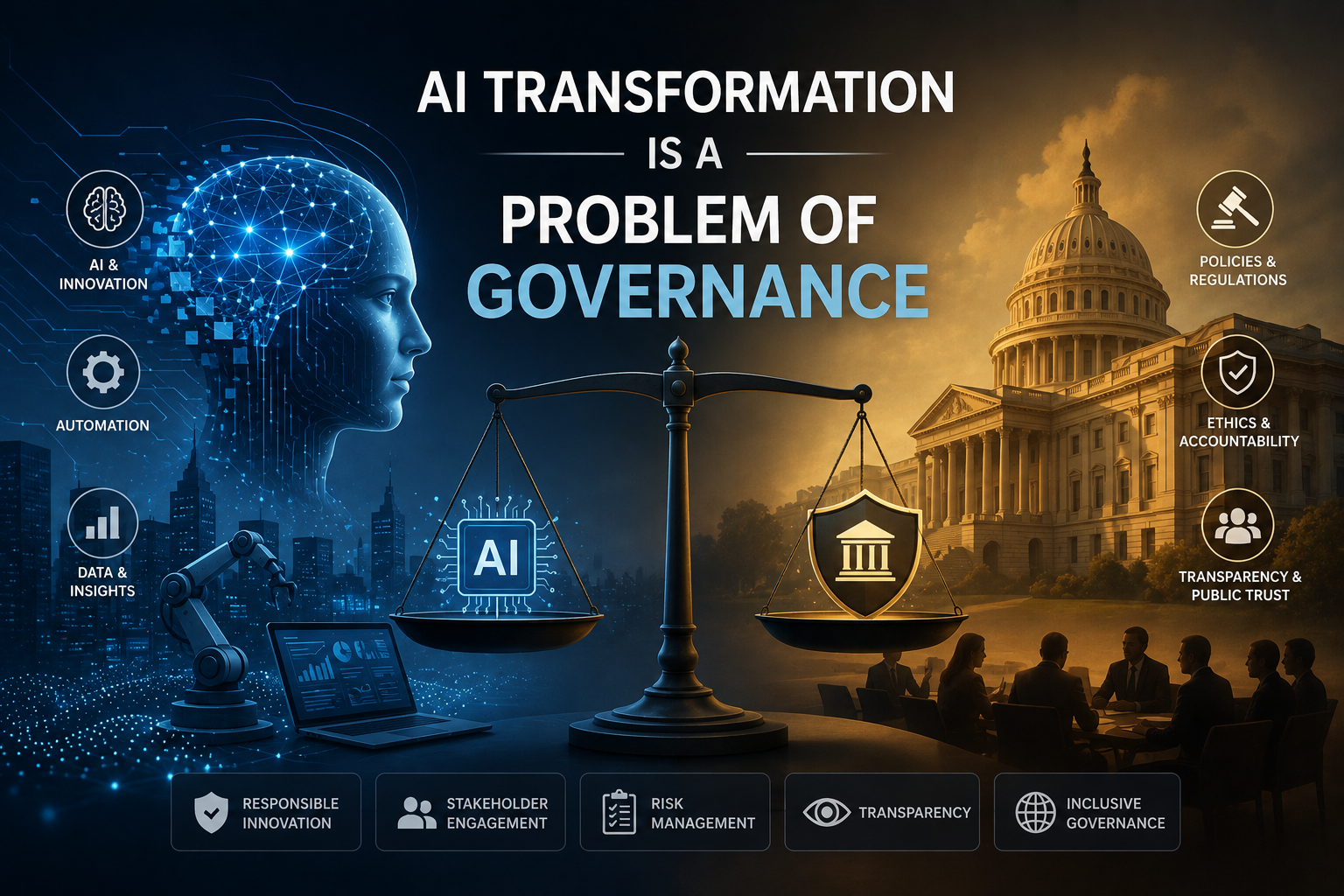
Introduction
Many organizations have spent significant time and money selecting the right AI tools, building the right infrastructure, and hiring the right technical talent. Yet a growing number of those same organizations find that their AI initiatives stall, produce inconsistent results, or create unexpected problems as they try to scale beyond initial experiments.
The reason is often not the technology itself. When AI moves from a single proof-of-concept to something that touches hiring decisions, customer interactions, financial operations, or sensitive data across an entire organization, the central challenge becomes organizational, not technical. In other words, AI transformation is a problem of governance.
This does not mean that technology, data quality, and model selection are unimportant. They absolutely matter. However, once AI starts making or influencing real decisions at scale, the critical questions become: Who is responsible? Who approved this? What data is being used and how? What happens when the system is wrong? How do we monitor it over time?
These are governance questions. And without clear answers, even technically impressive AI deployments can create serious risks around accountability, security, compliance, and trust.
Quick Answer for Featured Snippet
AI transformation is a problem of governance because scaling AI across an organization creates critical questions about accountability, data usage, risk management, security, and oversight that technology alone cannot answer. Governance provides the policies, processes, and responsibilities that allow organizations to use AI effectively, safely, and consistently at scale.
What Is AI Transformation?
AI transformation refers to the process of fundamentally changing how an organization operates by integrating artificial intelligence into its core workflows, decision-making processes, products, and services. It goes well beyond installing a chatbot or automating a single repetitive task.
When an organization truly transforms with AI, it might change how employees do their jobs, how customers receive services, how leaders access information, and how the business competes in its market. Think of a financial services company that moves from manual loan assessment to AI-assisted underwriting, or a healthcare provider that uses AI to support clinical documentation and patient communication across the entire system.
It is worth distinguishing three related but different concepts:
AI adoption is the process of introducing AI tools or systems into an organization. This might mean a marketing team starting to use a generative AI writing tool or an IT team deploying an AI-powered security product. Adoption can be narrow and departmental.
AI automation refers to using AI to perform tasks that people previously did manually, such as routing customer support tickets, scanning invoices, or flagging anomalies in data.
AI transformation is broader. It involves sustained, strategic change across the organization, often affecting culture, processes, roles, and how value is created. Understanding what artificial intelligence is and how it works is an important starting point before attempting organizational transformation with it.
What Is AI Governance?
AI governance is the collection of policies, processes, responsibilities, standards, and controls that an organization puts in place to manage how AI systems are developed, deployed, used, and monitored.
Governance defines who makes decisions about AI, who is accountable when something goes wrong, what data AI systems can access, and how AI outputs are reviewed and validated. It is not simply an ethics document that sits on a shelf. Effective governance is a living operational framework that shapes how AI is used every day.
Think of AI governance as similar to financial governance. A company does not simply trust that all financial decisions will be made correctly by well-meaning employees. It establishes processes for approvals, audits, reporting, and accountability. AI governance applies the same disciplined thinking to how AI systems are introduced and managed.
Governance also connects closely to concepts of machine learning model oversight, cloud security, and data security, because AI systems often depend on large volumes of data processed through cloud infrastructure.
Why Is AI Transformation a Problem of Governance?
When a small team experiments with an AI tool in isolation, governance needs are relatively simple. When AI starts influencing decisions across dozens of departments, interacting with thousands of customers, and processing sensitive personal or business data, the stakes change dramatically. Here is why governance becomes the central challenge.
AI Changes How Decisions Are Made
AI systems do not simply automate work. They influence, support, and sometimes replace human judgment in decisions that can have significant consequences. When an AI system recommends which job candidates to advance, which loan applications to approve, or which customers to flag for fraud review, those decisions carry real-world implications for real people.
Governance helps organizations determine which decisions AI is permitted to support, which decisions require human review, and what standards AI-assisted decisions must meet.
AI Creates New Accountability Questions
Traditional business processes have clear ownership. Someone approves a document, signs a contract, or authorizes a transaction. When an AI system makes a recommendation or takes an action that leads to a problem, accountability can become genuinely unclear.
Was the problem caused by the model? The training data? The way the system was deployed? The way employees used it? Without governance that assigns ownership and accountability upfront, organizations often discover these questions only after something goes wrong.
AI Uses Large Amounts of Data
AI systems, particularly those built on machine learning or generative AI, depend on data to function. That data might include customer information, employee records, financial data, health information, or proprietary business knowledge. Governance defines what data AI systems are permitted to access, how that data must be protected, and how long it can be retained.
Without data governance integrated into AI governance, organizations risk exposing sensitive information to systems that were never designed to handle it appropriately.
AI Can Introduce Security and Privacy Risks
AI tools and systems create new potential attack surfaces and privacy risks. Employees might input sensitive information into third-party AI services. AI-generated outputs might expose confidential data. Malicious actors can attempt to manipulate AI systems through techniques such as prompt injection.
Connecting AI governance with cybersecurity and data security practices is essential for managing these risks responsibly.
AI Systems Can Produce Incorrect or Biased Results
AI systems can make mistakes, produce biased outputs, or perform differently on real-world data than they did during testing. Generative AI tools, for example, can produce outputs that are plausible-sounding but factually incorrect, a phenomenon commonly called hallucination.
Governance establishes how outputs are validated, what human review processes are required, and what happens when errors are discovered.
AI Adoption Can Become Fragmented Across Departments
In many organizations, different departments adopt AI tools independently, without coordination. The marketing team uses one AI platform, the finance team uses another, and the customer service team uses a third. Some of these tools may have overlapping functions, inconsistent security standards, or conflicting data practices.
This fragmentation creates what some practitioners call shadow AI, meaning AI usage that is happening outside any organizational oversight or control. Governance creates the structure that brings these scattered adoptions under a consistent framework.
AI Requires Ongoing Monitoring After Deployment
One of the most important and frequently overlooked aspects of AI transformation is that AI systems are not static. Models can drift over time as real-world data changes. Performance can degrade. Use cases can expand beyond their original scope. Governance establishes monitoring requirements and review cycles that keep AI systems performing as intended throughout their lifecycle.
AI Adoption vs AI Transformation vs AI Governance
| Aspect | AI Adoption | AI Transformation | AI Governance |
|---|---|---|---|
| Definition | Introducing AI tools or systems into the organization | Strategically changing how the organization operates using AI | Policies, processes and controls for managing AI responsibly |
| Main Goal | Use AI for specific tasks or workflows | Reshape operations, culture and competitive position | Ensure AI is used safely, accountably and consistently |
| Typical Activities | Piloting tools, training users, initial deployment | Redesigning workflows, scaling AI broadly, cultural change | Creating policies, assigning ownership, monitoring, auditing |
| Main Risks | Selecting the wrong tool, poor user adoption | Fragmented rollouts, unclear accountability, compliance gaps | Governance becoming a bureaucratic obstacle or being ignored |
| Example | A sales team starts using an AI writing assistant | A company replaces manual underwriting with AI-assisted decisions | Creating an AI risk classification process and approval workflow |
What Happens When AI Transformation Lacks Governance?
When organizations pursue AI transformation without adequate governance, several predictable problems tend to emerge. None of these are guaranteed to happen in every situation, but they represent real and recurring challenges that organizations encounter.
Shadow AI is one of the most common early signs. Employees begin using AI tools, including free or consumer-grade tools, without any organizational awareness. Sensitive business data may be entered into systems that were never approved for that purpose and that the organization has no visibility into.
Unclear accountability creates problems when AI outputs lead to poor decisions. Without designated owners for AI systems, responsibility becomes difficult to establish.
Inconsistent AI policies mean that some teams operate with careful controls while others use AI with no restrictions at all. This creates uneven risk exposure across the organization.
Compliance problems can follow if AI systems process personal data in ways that conflict with privacy regulations or if AI-assisted decisions conflict with industry regulations or employment laws.
Duplicate and disconnected AI projects waste budget and create technical debt. Different teams solve the same problem independently without sharing learning or infrastructure.
Difficulty scaling successful pilots is perhaps the most frustrating outcome. A team builds a genuinely useful AI tool, but the organization cannot confidently deploy it more broadly because there is no framework for approving, securing, and monitoring it at scale.
The Key Pillars of AI Governance
Clear Ownership and Accountability
Every AI system used in an organization should have a named owner who is responsible for its use, its performance, and its risks. This person or team is the first point of accountability when something goes wrong and the primary voice for decisions about how the system is used.
AI Risk Management
Not all AI use cases carry the same level of risk. An AI tool that suggests playlist recommendations carries very different risk than an AI system that influences hiring or credit decisions. Governance includes a process for classifying AI use cases by risk level and applying proportionate controls to each.
Data Governance
AI governance must be connected to how data is managed. This means defining what data AI systems can access, how data is prepared and validated, who controls access, and how data retention and deletion are handled. Poor data governance undermines AI reliability and creates privacy and compliance risks.
Security and Privacy
AI systems that process sensitive information must be protected with appropriate security controls. This includes access management, encryption, vendor security reviews, and monitoring for unusual activity. Employees should also have clear guidance about what information should and should not be entered into AI tools.
Human Oversight
Some AI decisions require human review before action is taken. Governance defines where human oversight is mandatory, what qualifications reviewers need, and how review processes are documented. Human oversight is not about distrusting AI. It is about maintaining accountability where the stakes are high enough to warrant it.
Transparency and Documentation
Organizations should be able to explain what AI systems they use, what those systems do, what data they use, and how decisions informed by AI are made. This transparency serves employees, customers, auditors, and regulators.
Monitoring and Continuous Review
AI systems need ongoing monitoring to ensure they continue to perform as expected. This includes tracking accuracy, reviewing outputs for unexpected patterns, and periodically reassessing whether the system still fits its intended purpose.
Compliance and Regulatory Awareness
AI governance must account for applicable laws and regulations. These vary by industry, geography, and the type of data being processed. Relevant frameworks include the NIST AI Risk Management Framework and, where applicable, the European Union AI Act. Organizations in regulated industries should work with legal and compliance teams to understand their specific obligations.
How to Build an AI Governance Framework
Building an AI governance framework does not have to be complicated, but it does require deliberate effort. Here is a practical approach:
Step 1: Create an inventory of AI systems. Before you can govern AI, you need to know what AI you are using. Conduct a thorough review of all AI tools, platforms, and systems currently in use across the organization.
Step 2: Identify business owners. Assign a named owner to each AI system or use case. The owner is accountable for how the system is used and how it performs.
Step 3: Classify AI use cases by risk. Evaluate the potential impact of each AI system if it makes errors, produces biased outputs, or is misused. Higher-risk applications require stricter controls.
Step 4: Define acceptable data usage. Specify what data each AI system is permitted to access and process. Ensure these rules align with your data privacy policies and applicable regulations.
Step 5: Establish approval processes. Create a clear process for approving new AI tools and use cases. This prevents shadow AI and ensures new systems meet your security and governance standards before deployment.
Step 6: Define human oversight requirements. For higher-risk use cases, specify when human review is required, who conducts it, and how it is documented.
Step 7: Monitor AI performance and risks. Set up monitoring for key performance indicators and for risks such as unexpected outputs, data access anomalies, or performance degradation.
Step 8: Document important AI decisions. Maintain records of significant decisions made with AI assistance, the data used, and the rationale applied. Documentation supports accountability and regulatory compliance.
Step 9: Train employees. Employees who use AI tools need to understand the organization’s policies, the limits of AI systems, and when to seek human review or escalate concerns.
Step 10: Review and update governance policies. AI technology evolves quickly. Governance policies should be reviewed regularly and updated as technology, regulations, and organizational needs change.
AI Governance and Responsible AI
Responsible AI is a broad concept that refers to developing and using AI in ways that are ethical, fair, transparent, and accountable. AI governance is the operational mechanism through which responsible AI principles are actually put into practice within an organization.
Responsible AI typically addresses several interconnected values. Fairness means that AI systems should not produce discriminatory outcomes based on protected characteristics. Transparency means that stakeholders should be able to understand, at an appropriate level, how AI systems work and how they influence decisions. Accountability means that someone is responsible for how AI systems perform. Privacy means that personal information is handled appropriately. Reliability means that AI systems perform consistently and safely.
Human oversight connects all of these values together by ensuring that people remain involved in consequential decisions and that AI systems remain subject to review and correction.
It is important to be clear: responsible AI principles and governance frameworks can significantly reduce the risks associated with AI. They cannot eliminate every possible risk. AI systems will still sometimes make mistakes, and organizational governance is part of how those mistakes are identified and addressed.
AI Governance and Cybersecurity
AI transformation and cybersecurity need to be connected from the beginning, not treated as separate concerns.
AI systems often process sensitive business and personal data, making them targets for attackers seeking to access or manipulate that information. Access controls should be applied to AI systems just as they are to any other enterprise system containing sensitive data.
Employee use of AI tools creates new data exposure risks. If employees enter customer data, financial records, or proprietary business information into consumer AI products or unapproved third-party services, that information may be processed and stored in ways the organization cannot control.
Prompt injection is an emerging security concern where malicious content embedded in inputs to an AI system attempts to manipulate the system’s behavior or extract sensitive information. Organizations using generative AI tools such as ChatGPT, Microsoft Copilot, or similar systems should be aware of this risk and build appropriate controls.
AI is also changing the threat landscape more broadly. AI-generated phishing messages and social engineering content are becoming more convincing, which creates additional challenges for employee security training and awareness.
Third-party AI vendors should be evaluated with the same rigor applied to any third-party service that accesses organizational data. Vendor security reviews, data processing agreements, and clear contractual obligations around data handling are important components of AI governance.
Cloud computing infrastructure often underpins AI platforms and services, making cloud security an important part of the overall AI security picture.
The Role of Leadership in AI Governance
A common and costly mistake is treating AI governance as purely an IT responsibility. Effective AI governance requires active involvement from leadership across the organization.
Executives set the tone by communicating that responsible AI use is an organizational priority, not an obstacle. Executive sponsorship helps give governance initiatives the authority they need to work.
IT teams provide technical expertise about how AI systems function, how they are integrated into existing systems, and how they should be secured and monitored.
Security teams assess the specific risks that AI tools and deployments introduce and help establish appropriate controls.
Legal and compliance teams advise on applicable regulations, data protection requirements, and contractual obligations with AI vendors.
Data teams provide guidance on data quality, data access policies, and the suitability of data for specific AI use cases.
Product and business teams understand how AI systems affect customers and business operations and are best positioned to assess the business impact of both the AI systems and the governance controls applied to them.
Employees who use AI tools daily are critical informants about how AI is actually being used in practice, including uses that may fall outside existing policies.
Cross-functional governance structures, such as an AI governance committee or working group with representation from each of these areas, help ensure that governance decisions are informed, balanced, and practically implementable.
AI Governance for Small Businesses
Small businesses often assume that AI governance is only relevant for large enterprises with dedicated compliance teams. In reality, small businesses face many of the same fundamental risks and simply need a proportionate approach.
Start with an approved AI tool list. Know which AI tools your team is using and make deliberate decisions about which ones are acceptable. Unofficial use of AI tools with no organizational awareness creates the same data risks regardless of company size.
Create a basic AI usage policy. A simple, clear document explaining what employees can and cannot do with AI tools is more valuable than a sophisticated framework that nobody reads.
Establish sensitive-data rules. Specify clearly what types of information should not be entered into AI tools. Customer personal data, financial records, and proprietary business information should typically be off-limits for consumer AI tools.
Require human review for important decisions. Even in a small team, decisions with significant business or customer impact should involve a human check rather than being delegated entirely to AI outputs.
Train your team. A brief onboarding session about AI usage expectations goes a long way toward preventing accidental data exposure or misuse.
Review your policies regularly. AI tools change quickly. A policy written today may need updating within months as new tools and new risks emerge.
AI Governance for Enterprises
Larger organizations face additional complexity that requires more structured governance approaches.
Formal AI inventories cataloguing every AI system in use, including vendor tools, internally developed models, and embedded AI in third-party software, provide the visibility needed to govern effectively.
Risk classification frameworks allow organizations to apply controls proportionate to the stakes of each AI application, avoiding both under-governance of high-risk systems and over-governance of low-risk tools.
Access controls ensure that AI systems can only access the data they need and that only authorized personnel can configure or modify them.
Vendor management involves assessing the security, data handling practices, and contractual terms of third-party AI providers before deployment.
Audit trails document how AI systems were used, what inputs they received, and what outputs they produced. These records support both internal accountability and external regulatory review.
Model monitoring tracks the performance of AI systems over time, detecting degradation, drift, or unexpected behavior before it causes significant problems.
Cross-functional governance teams coordinate AI decisions across departments, prevent duplication, and ensure that organizational standards are consistently applied.
Does AI Governance Slow Down AI Transformation?
This is a fair and important question. The honest answer is that it depends on how governance is designed and implemented.
Poorly designed governance can create unnecessary bureaucracy. If every AI use case requires months of committee review before anything can proceed, teams will find ways around the process, which is the opposite of what governance intends to achieve.
Practical governance, on the other hand, provides clear guardrails that actually make it easier to move forward with confidence. When teams know what is approved, what data they can use, and what oversight is required, they can proceed quickly within those boundaries rather than stopping to debate each new decision from scratch.
The right framing is this: governance should enable responsible AI adoption, not simply prevent AI adoption. Good governance answers questions in advance so that teams are not blocked waiting for approvals that have no clear process.
How AI Governance Helps Organizations Scale AI
Governance is not just a risk management tool. It also enables growth and consistency in how AI is used across the organization.
When governance provides a clear framework, successful AI pilots can be assessed against known standards and scaled with confidence rather than leaving each team to reinvent the wheel. Standardized processes mean that what works in one department can be adapted and applied elsewhere without starting from zero.
Governance also builds employee and stakeholder trust. When people understand that AI is being used thoughtfully with appropriate oversight, they are more likely to engage with AI tools constructively rather than resisting them.
As AI systems evolve, governance provides the monitoring and review processes that catch emerging problems early, before they become costly incidents. This continuity of oversight is what allows organizations to maintain confidence in their AI systems over time rather than simply hoping they continue to perform well.
Common AI Governance Mistakes
Treating governance as a one-time document. Creating a policy and never reviewing it again is not governance. It is paperwork. Governance requires ongoing attention.
Assigning unclear ownership. If everyone is responsible for an AI system, effectively nobody is. Named ownership must be specific.
Ignoring employee AI usage. Employees may be using AI tools in ways that leadership is unaware of. Governance that only addresses officially approved systems misses a significant portion of real-world AI use.
Focusing only on model accuracy. A highly accurate model can still create serious problems if it is applied inappropriately, uses impermissible data, or lacks human oversight in high-stakes situations.
Ignoring cybersecurity. AI governance that does not integrate with security practice leaves organizations exposed to data breaches, unauthorized access, and manipulation of AI systems.
Failing to monitor AI after deployment. Deploying an AI system and never reviewing its performance again is a governance failure. Systems change. Data changes. Monitoring is not optional.
Applying the same controls to every AI use case. A risk-proportionate approach is more practical and sustainable than treating a low-stakes content suggestion tool with the same scrutiny as a high-stakes hiring or credit decision system.
Not updating policies as technology changes. AI capabilities and associated risks evolve rapidly. Governance frameworks must be reviewed and updated regularly to remain relevant.
AI Transformation Governance Checklist
Use this checklist to assess your organization’s current AI governance posture.
- Complete inventory of all AI systems in use
- Named owner assigned to each AI system
- Approved AI tool list established and communicated
- Data usage rules defined for each AI use case
- Risk assessment completed for all AI systems
- Security review conducted for all AI tools and vendors
- Human oversight requirements defined for higher-risk applications
- Documentation standards established for AI decisions
- Monitoring processes in place for all deployed AI systems
- Employee training completed on AI usage policies
- Incident response process defined for AI-related problems
- Governance policies scheduled for regular review and update
Frequently Asked Questions
Why is AI transformation a problem of governance?
AI transformation is a problem of governance because scaling AI across an organization creates critical questions that technology alone cannot answer: Who is accountable when AI makes a mistake? What data can AI access? Who approves new AI use cases? How are AI systems monitored over time? Governance provides the framework to answer these questions consistently and responsibly.
What is AI governance?
AI governance is the collection of policies, processes, responsibilities, and controls that an organization uses to manage how AI systems are developed, deployed, used, and monitored. It establishes accountability, manages risk, and ensures AI is used in ways that align with organizational values and applicable regulations.
What is the difference between AI adoption and AI transformation?
AI adoption means introducing AI tools or systems into specific tasks or workflows. AI transformation is a broader, strategic process of changing how an organization operates, competes, and creates value through AI, affecting processes, culture, and decision-making across the organization.
Why does AI need governance?
AI needs governance because AI systems can influence or make consequential decisions, process sensitive data, produce incorrect or biased outputs, and create security and compliance risks. Without governance, accountability becomes unclear, risks are unmanaged, and scaling AI reliably becomes very difficult.
What are the main pillars of AI governance?
The main pillars typically include clear ownership and accountability, AI risk management, data governance, security and privacy, human oversight, transparency and documentation, monitoring and continuous review, and compliance and regulatory awareness.
Who is responsible for AI governance?
AI governance is a cross-functional responsibility involving executives, IT teams, security teams, legal and compliance teams, data teams, product teams, and employees. Treating it as solely an IT issue typically leads to incomplete governance.
Does AI governance slow down innovation?
Well-designed governance does not slow down innovation. It provides clear guardrails that allow teams to move forward with confidence. Poorly designed governance can create unnecessary obstacles, which is why governance frameworks should be practical and proportionate to the risks involved.
How can small businesses implement AI governance?
Small businesses can start with an approved AI tool list, a basic usage policy, clear rules about sensitive data, human review requirements for important decisions, employee training, and a commitment to reviewing policies regularly. Governance does not require a large bureaucracy to be effective.
What are the biggest AI governance risks?
Key risks include shadow AI usage outside organizational oversight, unclear accountability for AI decisions, data exposure through unapproved AI tools, compliance failures related to data privacy or industry regulations, unmonitored model performance degradation, and cybersecurity vulnerabilities in AI systems and the data they process.
How does AI governance improve responsible AI adoption?
AI governance translates responsible AI principles, such as fairness, transparency, accountability, and privacy, into operational practice. It establishes the processes through which those values are consistently applied to real AI systems in real organizational contexts, making responsible AI adoption a practical reality rather than an aspiration.
Sources and Further Reading
- NIST AI Risk Management Framework (AI RMF 1.0) — National Institute of Standards and Technology. Provides a voluntary framework for organizations to manage AI risks. https://www.nist.gov/system/files/documents/2023/01/26/AI_RMF_1.pdf
- OECD AI Principles — Organisation for Economic Co-operation and Development. Internationally recognized principles for responsible stewardship of trustworthy AI. https://oecd.ai/en/ai-principles
- EU AI Act — European Commission. The European Union’s regulatory framework for AI, establishing risk categories and requirements for AI systems. https://digital-strategy.ec.europa.eu/en/policies/regulatory-framework-ai
- CISA Guidance on AI and Cybersecurity — Cybersecurity and Infrastructure Security Agency. Guidance on AI-related cybersecurity risks and practices. https://www.cisa.gov/ai
- ISO/IEC 42001:2023 — Artificial Intelligence Management System — International Organization for Standardization. An international standard providing a framework for organizations to establish, implement, and maintain an AI management system. https://www.iso.org/standard/81230.html
- NIST Cybersecurity Framework 2.0 — National Institute of Standards and Technology. Relevant to organizations integrating AI governance with broader cybersecurity risk management. https://www.nist.gov/cyberframework
- Microsoft Responsible AI Principles — Microsoft. Describes the principles and practices Microsoft applies to responsible AI development. https://www.microsoft.com/en-us/ai/responsible-ai
- Google AI Principles — Google. Outlines Google’s approach to responsible AI development and deployment. https://ai.google/responsibility/principles/