
 By TechOriginHub Editorial Team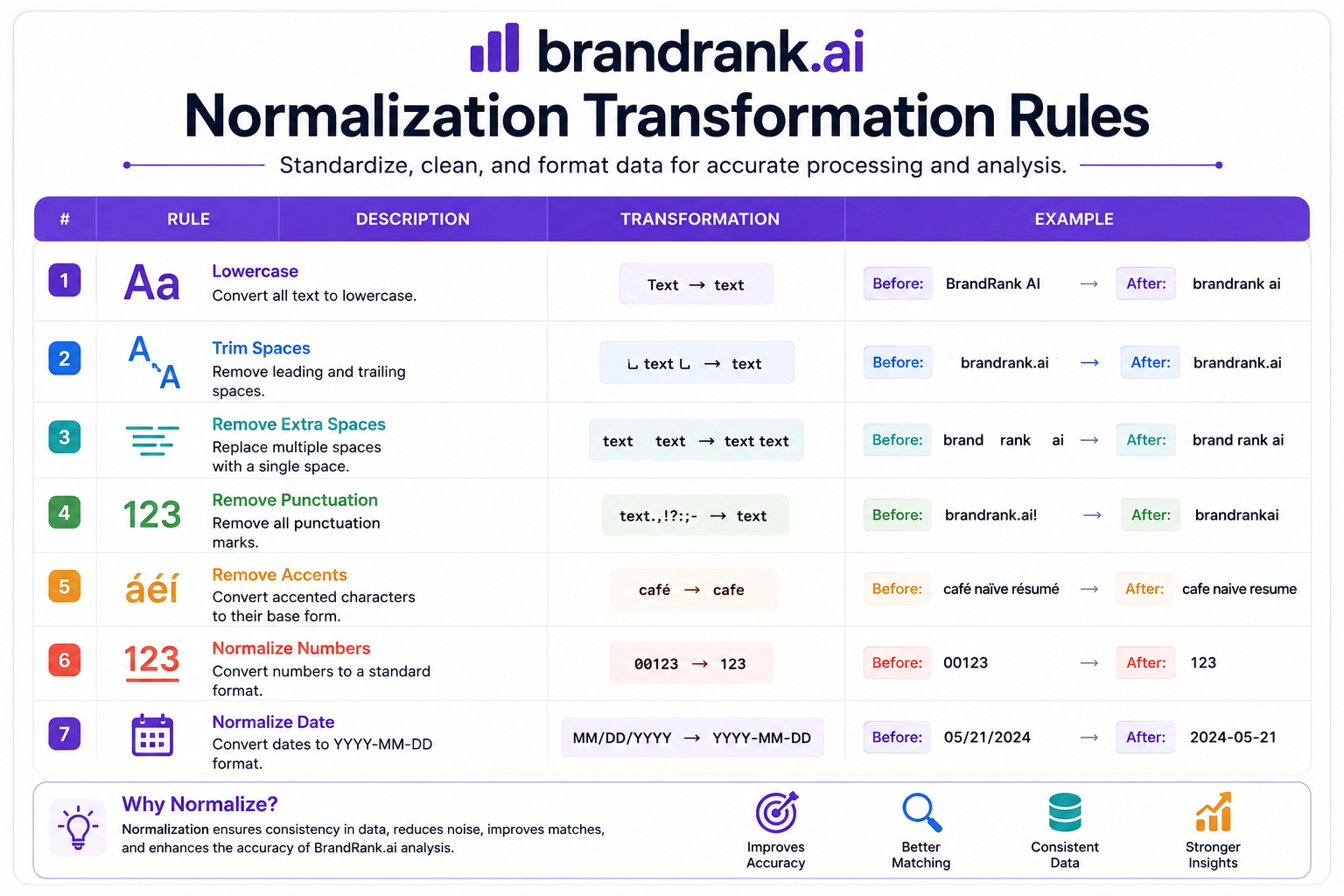
Introduction
The way consumers discover brands has changed significantly. AI-powered search tools now generate direct responses to user queries, and in doing so, they shape which brands appear, how they are described, and what impressions form in the minds of potential customers. For marketers and brand managers, understanding and influencing how their brand appears in these AI-generated responses has become a new and important challenge.
BrandRank.ai is a platform built specifically to address this challenge. It monitors how brands are represented in AI-generated search outputs and provides data that helps marketers understand their brand’s AI visibility and identify opportunities to improve it. Central to how the platform produces meaningful, reliable analysis is a set of systematic data processing procedures known as BrandRank.ai normalization transformation rules.
These rules are not a simple setting or a single feature. They represent the foundational data processing layer that makes it possible to turn raw, varied, and inconsistent AI search output data into structured, comparable brand performance metrics. This article explains what these rules are, how they work conceptually, why they matter, and what brands can do with this understanding.
Quick Answer: What Are BrandRank.ai Normalization Transformation Rules?
BrandRank.ai normalization transformation rules are the systematic processes the platform applies to raw brand data collected from AI-generated search outputs. These rules standardize, clean, and transform diverse data inputs into consistent, comparable formats that allow meaningful brand performance analysis and scoring. Normalization adjusts data to a common scale so different inputs can be fairly compared. Transformation rules convert raw inputs into structured formats suitable for analysis. Together, they form the analytical foundation of BrandRank.ai’s brand visibility measurement system.
What Is BrandRank.ai?
BrandRank.ai is an AI brand visibility monitoring platform designed to help brands understand and improve how they are represented in AI-generated search responses. As AI-powered search tools increasingly answer user queries directly, the way a brand appears in those responses carries real consequences for awareness, perception, and consumer decision-making.
Traditional search engine optimization focuses on achieving high rankings in human-reviewed search results pages. BrandRank.ai addresses a different and newer challenge: how does a brand appear when an AI system generates a response to a question about a topic, product, or service category? The platform collects and analyzes AI search output data, applies structured processing to it, and provides marketers and brand managers with performance metrics that reflect their brand’s standing in this AI-driven discovery environment.
A simplified way to think about what BrandRank.ai does: imagine asking a knowledgeable assistant which brands are leaders in a particular category. The assistant’s answer reflects what they know and how they perceive those brands. BrandRank.ai systematically monitors what AI systems say when asked similar questions, and it measures how favorably, frequently, and prominently a brand appears in those answers. This analogy is simplified, but it captures the platform’s core purpose.
The platform is designed for brand managers, digital marketers, SEO professionals, and content strategists who need to navigate the evolving search landscape where AI-generated responses play a growing role in shaping consumer discovery.
What Is Normalization in Data Analysis?
Normalization is a foundational concept in data science that refers to the process of adjusting values in a dataset to a common, comparable scale. The goal is to make it possible to compare data points that originally exist in different formats, ranges, or units without one data source unfairly dominating the analysis simply because of its scale.
A simple analogy helps here. Imagine you want to compare the prices of products sold in different countries. Some prices are in US dollars, some in euros, some in British pounds, and some in Japanese yen. Before you can meaningfully compare them, you need to convert everything into a single common currency. Normalization in data analysis works in a similar way, translating varied data points into a standardized form that makes fair comparison possible. This analogy is simplified, but it illustrates the core purpose of normalization.
Without normalization, raw data from different sources can produce misleading analysis. A brand that generates a large volume of AI mentions on a widely used platform might appear to dominate, not because it genuinely has stronger brand representation, but simply because more data was collected from that source. Normalization corrects for these differences, allowing the analysis to reflect genuine performance rather than artifacts of data collection variation.
It is important to note that normalization is a general data science concept with well-established methods and a broad range of applications across analytics, machine learning, and data engineering. Its application within BrandRank.ai is a specific implementation of this general principle in the context of AI brand visibility measurement.
What Are Transformation Rules in Data Processing?
Transformation rules are the defined procedures that govern how raw data inputs are converted, cleaned, restructured, and mapped into a standardized format that is suitable for analysis. Before any meaningful analysis can occur, raw data typically needs to go through a transformation process that resolves inconsistencies, fills gaps, and organizes information into a usable structure.
Raw data from real-world sources is rarely clean or consistent. Data transformation addresses this reality through a set of systematic rules that handle common challenges including:
Data cleaning: Removing errors, duplicates, and irrelevant entries that would distort analysis results.
Format standardization: Converting data from different formats into a consistent structure. A date that appears as “January 15, 2024” in one source and “15/01/2024” in another needs to be standardized before both can be treated as equivalent data points.
Value mapping: Converting coded or categorical values into consistent labels that can be compared across sources.
Handling missing data: Applying defined rules for what to do when expected data points are absent, whether that means substituting a default value, flagging the gap for review, or excluding the record from analysis.
Structural reorganization: Reshaping data so that it fits the schema required by the analysis model or scoring system.
Transformation rules are a standard and well-established component of data engineering and analytics pipeline design. Every serious data analysis system that draws from multiple sources applies some form of transformation rules to its inputs before processing them. BrandRank.ai’s use of transformation rules is an application of this standard practice to the specific domain of AI brand visibility data.
What Are BrandRank.ai Normalization Transformation Rules?
BrandRank.ai normalization transformation rules are the combined, systematic rule set that the platform applies to raw data collected from AI-generated search outputs in order to produce consistent, reliable brand performance metrics. These rules govern both the normalization of data to a common scale and the transformation of raw inputs into structured, analyzable formats.
Conceptually, the process works like this:
Raw AI search output data → Normalization transformation rules applied → Standardized brand data → Brand scoring and analysis → Actionable brand visibility insights
At the raw input stage, the data the platform collects is varied, unstructured, and inconsistent. Different AI search tools produce responses in different styles and formats. Queries vary in phrasing and scope. Brand mentions appear in different contexts, with different levels of prominence, and with different associated sentiment. A single data point, such as a brand mention in one AI response, tells you very little on its own without a structured framework for interpreting its significance.
The normalization transformation rules address this challenge systematically. They standardize how brand mentions are counted and weighted, how sentiment signals are categorized and scaled, how the context and positioning of a brand mention are interpreted, and how data from different AI platforms and query types is brought to a comparable basis.
The result of applying these rules is standardized brand data that can be used to generate brand scores that are consistent, comparable across time periods, and meaningful for benchmarking against competitors.
It is important to be clear about what is confirmed and what is principle-based in this description. The general framework of applying normalization and transformation rules to raw AI output data to produce brand visibility metrics reflects established data science practice. The specific proprietary details of how BrandRank.ai implements these rules, including the exact weighting systems, scoring formulas, and algorithmic choices involved, are platform-specific and are not fully publicly disclosed. Users who need precise implementation details should consult BrandRank.ai’s official documentation.
Why Do Normalization Transformation Rules Matter for Brand Analysis?
The importance of normalization transformation rules becomes clear when you consider what brand analysis would look like without them.
Without normalization, data collected from different AI platforms, different query types, and different time periods cannot be fairly compared. A brand that is heavily mentioned in responses from one AI tool but rarely mentioned in another cannot be accurately assessed without accounting for the volume and nature of data collected from each source. Raw mention counts without normalization would simply reflect data collection patterns rather than genuine brand performance differences.
Without transformation rules, raw AI search output data is too inconsistent and unstructured to support reliable analysis. AI-generated responses vary enormously in length, format, and style. Brand mentions can be direct or indirect, prominent or peripheral, positive or negative. Without systematic rules for how to interpret and categorize these variations, the analysis would produce results that are effectively incomparable from one data set to the next.
Together, normalization and transformation rules enable what data scientists call an apples-to-apples comparison. By bringing all data to a consistent format and scale, the rules make it possible to track a brand’s performance over time, compare it against competitors, and identify genuine trends rather than artifacts of data collection variation.
For brands and marketers, this matters because the decisions made based on platform data, including content investments, messaging adjustments, and competitive strategy, are only as reliable as the data processing underlying the metrics. Understanding that BrandRank.ai’s outputs are the product of structured, systematic data processing rather than raw, unprocessed counts helps users interpret those outputs appropriately and apply them with realistic expectations.
What Data Do BrandRank.ai Normalization Transformation Rules Process?
Based on the general principles that govern AI brand visibility platforms and what is publicly known about BrandRank.ai’s approach, the normalization transformation rules would typically process several categories of data inputs. Where specific BrandRank.ai inputs are not publicly confirmed in detail, the following reflects the types of data that normalization transformation rules in a brand AI visibility platform would characteristically handle.
Brand mentions in AI-generated responses. The most fundamental input is whether and how a brand is mentioned when AI systems respond to relevant queries. Mentions vary in directness, context, and prominence, and the rules process these variations into standardized signals.
Sentiment associated with brand mentions. A brand mention that is framed positively carries different significance from one framed neutrally or negatively. Transformation rules categorize and normalize sentiment signals so that sentiment data from different sources can be compared consistently.
Context of brand appearance. The context in which a brand is mentioned, whether it appears as a recommended option, a cautionary example, a market leader, or a minor player, affects how that mention should be interpreted and weighted.
Competitive positioning in AI responses. Where a brand appears relative to competitors in AI-generated responses is a meaningful signal. The rules process positioning data to reflect relative competitive standing in a consistent, comparable format.
Frequency and prominence of brand mentions. How often a brand is mentioned and how prominently it features in responses, whether it leads the response or appears as an afterthought, are inputs that normalization rules bring to a common scale.
Source diversity of AI outputs analyzed. Data collected from multiple AI search platforms needs to be normalized to account for differences in how those platforms generate responses and how frequently they are queried.
Query types and categories analyzed. Different categories of queries, product recommendations, informational questions, comparisons, may produce different brand visibility patterns. Transformation rules ensure that data from different query types is processed in a consistent and interpretable way.
How Do Normalization Transformation Rules Affect Brand Scoring?
Brand scores in BrandRank.ai are the outputs of applying normalization transformation rules to collected data. The rules directly determine the quality and reliability of those scores.
When raw data is normalized and transformed consistently, the resulting scores reflect genuine differences in brand performance rather than differences in data collection circumstances. A brand score produced through rigorous normalization transformation rules can be compared against last month’s score with confidence that any change reflects real shifts in AI brand visibility rather than variation in data quality or collection patterns.
Consistent data processing also enables competitive benchmarking. When the same normalization transformation rules are applied to data about multiple brands, the resulting scores exist on the same scale and can be meaningfully compared. A brand scoring higher than a competitor on a normalized metric has a genuine data-supported claim to that advantage, not simply a favorable data collection artifact.
For practical use, brand scores produced through this process give marketing teams a consistent basis for tracking progress, communicating performance to stakeholders, and making informed decisions about where to invest in brand content and messaging. Scores should be understood as indicators of relative performance and trend direction rather than absolute measures of brand strength.
BrandRank.ai Normalization Transformation Rules and AI Search Visibility
AI search visibility refers to how prominently and favorably a brand appears when AI-powered search tools generate responses to user queries. As more consumers use AI-assisted search to find products, compare options, and make purchasing decisions, AI brand visibility has become a meaningful dimension of overall brand presence that sits alongside traditional search visibility.
AI-generated responses differ from traditional search results in important ways. A traditional search results page shows a list of links that users can evaluate and click. An AI-generated response synthesizes information and presents it as a direct answer, often naming specific brands with descriptions and recommendations. The brand that appears in an AI response is not simply one result among many. It is a brand that the AI system has selected as relevant and worth mentioning, which carries its own form of implicit endorsement or relevance signal.
Monitoring this form of visibility requires data processing that is specifically adapted to the nature of AI-generated outputs. Standard web analytics tools and traditional SEO metrics were not designed for this purpose. BrandRank.ai’s normalization transformation rules are part of what makes its brand visibility monitoring approach adapted to the specific characteristics of AI search data, handling the variability and complexity of AI-generated text in a way that produces meaningful, actionable metrics.
The rules make it possible to track AI brand visibility systematically, compare it across competitors, and observe how it changes over time in response to changes in brand content, messaging, and the AI systems themselves.
How Brands Can Use This Understanding to Improve Their AI Presence
Understanding how BrandRank.ai normalization transformation rules work has practical implications for how brands approach their AI visibility strategy. The key insight is that AI systems draw on the information available about a brand online, and the quality, consistency, and authority of that information significantly influences how the brand is represented in AI-generated responses.
Invest in the quality and consistency of brand information. AI systems synthesize information from many sources. Brands that have clear, accurate, consistent, and authoritative information available across their website, publications, and third-party coverage are better positioned to be represented accurately and favorably in AI-generated responses.
Maintain consistent brand messaging across all channels. Inconsistent brand messaging creates conflicting signals that can result in unclear or diluted brand representation in AI outputs. Consistent messaging reinforces a coherent brand identity that AI systems can draw from reliably.
Build authoritative brand content. Content that demonstrates genuine expertise, authority, and trustworthiness in a brand’s area of focus provides AI systems with high-quality information to reference. This does not mean gaming AI systems, but rather producing content that is genuinely useful and well-regarded.
Monitor AI brand representation regularly. Brand visibility in AI search outputs is not static. It can change as AI models are updated, as the competitive landscape shifts, and as the quality of brand information online evolves. Regular monitoring provides the data needed to detect and respond to changes.
Use platform data to identify gaps. When BrandRank.ai data indicates that a brand has weak visibility in particular topic areas or query categories, that is actionable information. It points to areas where the brand’s content or online presence may not be providing AI systems with sufficient relevant information.
Address negative or absent representation proactively. If a brand is represented negatively or inconsistently in AI outputs, or absent from responses where it should appear, the appropriate response is to strengthen the genuine quality and authority of brand content and information rather than to attempt to manipulate AI outputs directly.
BrandRank.ai Use Cases
BrandRank.ai serves a range of practical applications for organizations managing their brand presence in the AI search era.
Brand Monitoring
The most fundamental use case is tracking how a brand appears in AI search responses over time. Regular monitoring allows brand teams to observe trends, detect unexpected changes in brand representation, and understand the baseline from which improvement efforts are measured. Consistent data collection and normalization transformation rules ensure that monitoring data is comparable across periods.
Competitive Analysis
BrandRank.ai allows brands to compare their AI visibility against competitors within the same category or market. When the same normalization transformation rules are applied to data about multiple brands, the resulting scores are comparable and can reveal genuine competitive positioning in AI search outputs. Identifying where competitors are more prominently featured provides direction for brand visibility improvement efforts.
Content Strategy
Brand visibility data from BrandRank.ai can inform content strategy decisions. When data reveals that a brand has weak AI visibility in specific topic areas or query categories, content teams can prioritize creating authoritative content in those areas to strengthen the brand’s information presence and, over time, its representation in AI responses.
Reputation Management
Monitoring the sentiment associated with brand mentions in AI-generated outputs is a form of AI reputation management. If a brand is being represented negatively or inaccurately in AI responses, early detection through systematic monitoring allows the brand team to investigate root causes and take appropriate action to strengthen the quality and accuracy of brand information online.
Marketing Reporting
As AI search visibility becomes an increasingly recognized dimension of brand performance, marketing teams need metrics they can communicate to stakeholders. BrandRank.ai’s normalized brand scores provide a structured basis for reporting AI brand visibility performance, demonstrating progress over time and supporting resource allocation decisions.
BrandRank.ai vs Traditional SEO Metrics
BrandRank.ai addresses a different dimension of brand performance from traditional SEO tools, though both are relevant in the current search landscape.
| Feature | BrandRank.ai / AI Visibility | Traditional SEO |
|---|---|---|
| Focus | Brand representation in AI-generated responses | Rankings in traditional search engine results pages |
| Data source | AI search output analysis | Search engine index and ranking data |
| Measurement | Brand mentions, sentiment, positioning in AI outputs | Keyword rankings, organic traffic, backlinks |
| Normalization | Applied to AI output data from multiple platforms | Applied to search metric data |
| Use case | AI search era brand management | Traditional search optimization |
| Evolution speed | Tied to AI model development pace | Tied to search engine algorithm updates |
Traditional SEO tools measure how well a brand’s web pages rank for specific keywords in search engine results. BrandRank.ai measures how the brand is represented in the synthesized, conversational responses that AI search tools generate. These are complementary concerns, not competing ones. A brand that performs well in traditional search and also has strong, authoritative content is generally better positioned for AI visibility as well, but the specific dynamics of AI-generated responses require dedicated monitoring and analysis.
Limitations and Considerations
An honest assessment of BrandRank.ai normalization transformation rules includes acknowledging where uncertainty and limitation exist.
Proprietary implementation details are not fully publicly disclosed. The specific algorithmic choices, weighting systems, and rule configurations that BrandRank.ai uses in its normalization transformation process are platform-specific. This article explains these concepts based on established data science principles and publicly available information, but it does not have access to the platform’s internal technical specifications.
AI search outputs are inherently variable. The responses that AI search tools generate can change with model updates, changes in training data, and variations in how queries are phrased. This variability is a challenge that normalization transformation rules address, but they cannot eliminate the fundamental variability of the underlying AI outputs being monitored.
Normalized scores are representations, not absolute truths. Brand scores produced through normalization are meaningful indicators of relative performance and trend direction. They are not absolute measures of brand strength or guarantees of consumer perception. They should be interpreted as one input among many in a broader brand performance picture.
The AI search landscape is evolving rapidly. The platforms, models, and dynamics that shape AI search visibility are changing at a pace that requires ongoing methodological adaptation. Approaches that are appropriate today may need adjustment as the landscape evolves. Always review BrandRank.ai’s current documentation for the most up-to-date information on its methodology.
Platform data should complement, not replace, other metrics. AI brand visibility data is most valuable when used alongside other brand performance indicators including traditional SEO metrics, direct consumer research, brand tracking studies, and business performance data.
BrandRank.ai Best Practices
Getting the most from BrandRank.ai and its normalization transformation rules involves applying the platform’s data thoughtfully and within a realistic understanding of what it measures.
- Start with the quality of brand information online. AI brand visibility is built on the foundation of accurate, consistent, and authoritative brand information available across digital channels. No monitoring tool can substitute for investing in that foundation.
- Use BrandRank.ai data alongside other brand performance metrics. AI visibility scores provide one perspective on brand performance. Triangulating with traditional SEO data, consumer research, and business metrics produces a more complete and reliable picture.
- Treat normalized scores as trend indicators. Month-over-month and quarter-over-quarter trends in normalized brand scores are more meaningful than point-in-time absolute values. Focus on trajectory rather than static numbers.
- Monitor competitor AI visibility regularly. Understanding your own brand’s AI visibility in isolation provides limited strategic value. Competitive context transforms data points into actionable competitive intelligence.
- Use visibility gap data to inform content priorities. When the platform identifies topic areas or query categories where brand visibility is weak, treat this as direction for content investment rather than a reflection of fixed brand limitations.
- Keep brand information accurate and consistent. Discrepancies in brand information across different online sources create conflicting signals that can affect AI representation. Consistency is a foundational requirement for strong AI visibility.
- Review platform documentation for current methodology details. Normalization transformation rules and platform methodologies evolve. Staying informed about how the platform currently processes data helps ensure you are interpreting outputs correctly.
- Revisit AI brand visibility strategy regularly. As AI search tools evolve, the dynamics of AI brand representation will shift. Build regular review cycles into your brand visibility strategy rather than treating it as a one-time project.
Frequently Asked Questions
What are BrandRank.ai normalization transformation rules?
They are the systematic data processing rules BrandRank.ai applies to raw AI search output data to standardize, clean, and transform it into consistent, comparable formats for brand performance analysis and scoring.
What is BrandRank.ai?
BrandRank.ai is an AI brand visibility monitoring platform that tracks how brands appear in AI-generated search responses and provides metrics to help marketers understand and improve their brand’s AI presence.
What does normalization mean in data analysis?
Normalization is the process of adjusting data values to a common, comparable scale so that data from different sources or with different ranges can be fairly analyzed and compared.
What are transformation rules in data processing?
Transformation rules are defined procedures for converting raw data inputs into structured, standardized formats by cleaning, mapping, reformatting, and reorganizing the data before analysis.
Why do brands need normalization transformation rules?
Without normalization and transformation, raw data from different AI platforms and query types cannot be fairly compared. These rules enable consistent, reliable analysis that reflects genuine brand performance rather than data collection artifacts.
How do BrandRank.ai normalization transformation rules work?
Conceptually, they take raw AI search output data and apply systematic standardization and structuring processes to produce normalized brand data that feeds into scoring and analysis models. Exact proprietary details are not fully publicly disclosed.
What data does BrandRank.ai analyze?
The platform analyzes data from AI-generated search outputs including brand mentions, associated sentiment, context of appearance, competitive positioning, mention frequency and prominence, and data from multiple AI search platforms.
How do normalization transformation rules affect brand scores?
They directly determine the reliability and comparability of brand scores. Consistent normalization and transformation produce scores that genuinely reflect brand performance differences rather than data quality variations.
What is AI brand visibility?
AI brand visibility refers to how prominently and favorably a brand appears when AI-powered search tools generate responses to relevant user queries.
How is AI search visibility different from traditional SEO?
Traditional SEO focuses on ranking in search engine results pages. AI search visibility concerns how a brand is represented in AI-generated responses that synthesize and present information directly to users without requiring them to click through results.
What is brand scoring in BrandRank.ai?
Brand scoring is the output of the platform’s analysis pipeline, producing numerical metrics that reflect a brand’s AI visibility performance across dimensions such as mention frequency, sentiment, and competitive positioning.
Can normalization transformation rules guarantee better brand rankings?
No. Normalization transformation rules are a data processing mechanism that enables reliable measurement. They do not guarantee improved brand representation in AI outputs, which depends on the quality and authority of the brand’s information online.
Why is consistent brand data important for AI visibility?
AI systems draw on available information to generate responses. Consistent, accurate, and authoritative brand information across digital channels provides AI systems with reliable signals about the brand, supporting more accurate and favorable representation.
What is sentiment analysis in brand monitoring?
Sentiment analysis is the process of categorizing the emotional tone associated with brand mentions as positive, negative, or neutral. In BrandRank.ai’s context, transformation rules process raw sentiment signals into standardized categories for consistent analysis.
How does BrandRank.ai compare brands against competitors?
By applying the same normalization transformation rules to data about multiple brands, the platform produces scores on a common scale that allow meaningful competitive comparison of AI brand visibility.
What are the limitations of BrandRank.ai normalization transformation rules?
Proprietary implementation details are not fully public, AI outputs are inherently variable, normalized scores are representations rather than absolute truths, and the AI search landscape is evolving rapidly.
How often should brands review their AI visibility data?
Regular review, at minimum monthly, is advisable. More frequent monitoring may be warranted when significant brand activities, competitive changes, or AI model updates occur.
Is BrandRank.ai suitable for small businesses?
This depends on the business’s specific needs and the resources available for brand monitoring. Small businesses in competitive categories where AI search visibility matters may find value in the platform. Reviewing current pricing and features on BrandRank.ai’s official website is the best way to assess fit.
What is the difference between normalization and transformation?
Normalization adjusts data to a common, comparable scale. Transformation converts raw data into a structured, standardized format. Both are necessary components of a reliable data processing pipeline, and BrandRank.ai applies both through its normalization transformation rules.
How do I improve my brand’s AI search visibility?
Focus on producing high-quality, authoritative, and consistent brand content and information across digital channels. Monitor your AI visibility regularly, identify gaps, and address them through content investment and brand information accuracy.
Does BrandRank.ai replace traditional SEO tools?
No. BrandRank.ai and traditional SEO tools address different dimensions of brand search visibility. Both are relevant in the current search landscape and are best used as complementary rather than competing resources.
What types of AI search tools does BrandRank.ai monitor?
BrandRank.ai monitors AI-generated search outputs from AI-powered search tools. The specific platforms included in monitoring may vary and evolve over time. Review the official BrandRank.ai documentation for current coverage details.
Final Thoughts
BrandRank.ai is a platform designed for the evolving reality of AI-powered search, where the way a brand is represented in AI-generated responses increasingly shapes consumer discovery and perception. At the heart of the platform’s ability to produce meaningful, reliable brand visibility metrics lies its use of systematic data processing procedures.
Normalization, as a data science concept, adjusts varied data to a common, comparable scale. Transformation rules convert raw, inconsistent inputs into structured formats suitable for analysis. Together, applied to the raw data collected from AI-generated search outputs, these processes form what the platform refers to as its normalization transformation rules.
BrandRank.ai normalization transformation rules are what make it possible to turn the variable, unstructured outputs of multiple AI search platforms into consistent, comparable brand performance scores. Without this processing layer, the data would be too inconsistent to support reliable trend analysis, competitive benchmarking, or actionable brand strategy insights.
For brands and marketers, understanding these rules matters because it clarifies what platform outputs represent and how to interpret them appropriately. Brand scores produced through normalization transformation rules are meaningful trend indicators, not absolute measures. They reflect the quality of structured data processing applied to inherently variable AI output data. Using them effectively means treating them as one valuable input within a broader brand performance measurement approach, combining them with traditional metrics, consumer research, and genuine investment in brand content quality.
The limitations are real. Proprietary implementation details are not fully public. AI search outputs vary with model updates and query changes. Scores are representations, not certainties. And the AI search landscape will continue to evolve in ways that require ongoing methodological adaptation.
Within those realistic expectations, BrandRank.ai normalization transformation rules represent the systematic data processing foundation that makes meaningful brand AI visibility analysis possible, helping brands understand and improve how they appear in the AI-generated search responses that increasingly shape consumer discovery.
References
- Han, J., Kamber, M., and Pei, J. (2011). Data Mining: Concepts and Techniques (3rd ed.). Morgan Kaufmann. Chapter 3: Data Preprocessing.
- Géron, A. (2022). Hands-On Machine Learning with Scikit-Learn, Keras, and TensorFlow (3rd ed.). O’Reilly Media. Chapter 2: End-to-End Machine Learning Project (Data Transformation Pipelines).
- National Institute of Standards and Technology (NIST). Big Data Interoperability Framework: Volume 2, Big Data Taxonomies. https://www.nist.gov/system/files/documents/2017/09/14/NIST.SP.1500-2r1.pdf
- BrandRank.ai. Official Platform Documentation. https://brandrank.ai/
- Bommasani, R., Hudson, D. A., Aditi, E., et al. (2021). On the Opportunities and Risks of Foundation Models. Stanford University Center for Research on Foundation Models. https://arxiv.org/abs/2108.07258
- Aggarwal, C. C. (2015). Data Mining: The Textbook. Springer. Chapter 2: Data Preparation (Normalization and Transformation).
- Search Engine Journal. Generative Engine Optimization: The Future of SEO in the AI Era. https://www.searchenginejournal.com/
- MIT Sloan Management Review. How Brands Should Prepare for AI-Powered Search. https://sloanreview.mit.edu/
Disclaimer
This article is for educational and informational purposes only. BrandRank.ai features, methodologies, normalization transformation rules, pricing, and platform capabilities are subject to change. The exact proprietary details of BrandRank.ai’s normalization transformation rules may not be fully publicly disclosed. Always review the official BrandRank.ai website and documentation for current and accurate information. This article does not constitute marketing, legal, or professional advice.