
 By Zohan q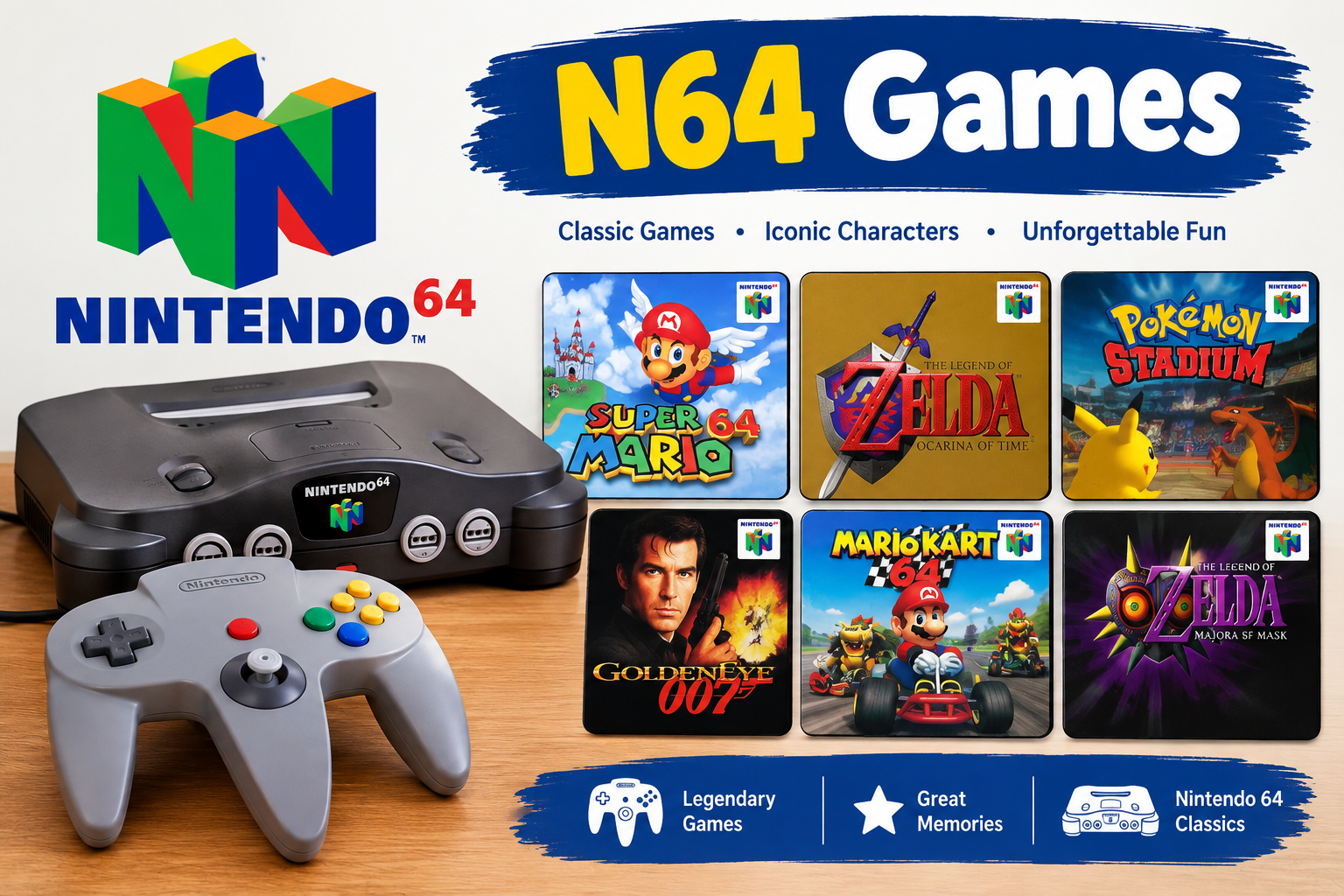
What Is the Nintendo 64?
The Nintendo 64, commonly called the N64, was Nintendo’s third home gaming console. It launched in Japan in June 1996, followed by North America in September 1996, and reached Europe and Australia in 1997. The console took its name from its 64-bit processor, which was a significant leap in processing power compared to the 16-bit consoles that preceded it.
The N64 represented Nintendo’s transition from 2D gaming into fully realized 3D worlds. While competitors like Sony with the PlayStation and Sega with the Saturn were already working in 3D space, the N64’s debut titles, particularly Super Mario 64, demonstrated a standard of 3D game design that set the bar for the entire industry.
One of the most discussed decisions Nintendo made with the N64 was sticking with cartridges when Sony and Sega had moved to CD-based media. Cartridges loaded faster and were more durable, but they cost more to manufacture and held less data than CDs. This meant some third-party developers chose to develop for PlayStation instead, which affected the N64’s library size. Despite this, the games that were made for the N64 are among the most influential ever produced.
The N64 controller was unlike anything players had used before. Its three-pronged design housed a central analog stick, which became the primary input method for 3D games and set the template for analog control in gaming. The controller also featured a slot at the back for accessories including the Rumble Pak and the Expansion Pak.
The North American N64 library includes approximately 388 officially released titles. Many of the most celebrated N64 games are now accessible through the Nintendo Switch Online service with a Nintendo Switch Online + Expansion Pack membership. Visit nintendo.com for the current list of available titles, as the selection changes over time.
Why N64 Games Still Matter Today
The N64’s significance goes well beyond nostalgia. Many of the design decisions made in N64 games between 1996 and 2001 became the foundations of entire genres that continue to evolve today.
3D game design conventions. Super Mario 64 and Ocarina of Time essentially invented the playbook for how 3D platformers and 3D action-adventure games work. Camera control, analog movement, spatial puzzle design, and the use of a lock-on targeting system all trace their mainstream adoption back to this era and this hardware.
Multiplayer gaming culture. GoldenEye 007 and Mario Kart 64 helped define what split-screen multiplayer meant for home consoles. The social experience of four players gathered around a single television, competing and laughing together, became a cultural touchstone of the late 1990s and directly influenced how developers have approached local multiplayer ever since.
Genre-defining mechanics. Star Fox 64 refined the rail shooter format. Super Smash Bros. invented the platform fighter genre. Paper Mario created a template for accessible RPG mechanics built around beloved characters. Each of these games created something that is still being built upon today.
Genuine playability. Beyond historical significance, many N64 games simply hold up as enjoyable experiences for modern players. The core mechanics of Ocarina of Time, Banjo-Kazooie, and Mario Kart 64 remain satisfying regardless of when you first encounter them.
How We Selected These Games
The games covered in this article were chosen based on several overlapping criteria rather than any single metric.
Critical reception at release. Games that were widely recognized as exceptional at the time of their release were prioritized. This reflects documented historical reviews and coverage from gaming publications of the era.
Long-term cultural and industry impact. Games that influenced other developers, spawned sequels or spiritual successors, or shaped how entire genres were designed received additional weight.
Community standing. The retro gaming community continues to discuss, play, and celebrate certain N64 titles more than others. Community consensus across platforms like Reddit, gaming forums, and dedicated retro gaming communities informed the selection.
Genre diversity. The N64 library spans platformers, racing games, shooters, RPGs, rail shooters, and more. This list aims to represent that range rather than focusing exclusively on one type of game.
Modern accessibility. Games that a player picking up a controller for the first time today can still find enjoyable were given preference over titles that require significant historical context to appreciate.
These selections are not ranked purely by sales figures. Sales data from the N64 era is documented in various public historical records, but sales alone do not determine a game’s quality or lasting value.
Best N64 Games of All Time
The following games are selected based on their critical reputation, cultural impact, community standing, and enduring playability. Each entry is a real, officially released Nintendo 64 title with a documented history of critical and community recognition.
The Legend of Zelda: Ocarina of Time (1998)
Genre: Action-adventure
Developer: Nintendo EAD
Publisher: Nintendo
Release year: 1998
What makes it significant: Ocarina of Time is among the most critically acclaimed video games ever made and is consistently cited in discussions of the greatest games in the medium’s history. It took the Zelda formula that had been established in 2D and reimagined it entirely in three dimensions without losing any of the series’ core identity.
How it plays: Players control Link across a large 3D overworld and a series of themed dungeons. The game introduced Z-targeting, a lock-on system that allowed players to focus on enemies and interact with objects in 3D space without the camera becoming disorienting. The day and night cycle affects which characters and events are available in the world. Dungeons require solving environmental puzzles using items collected throughout the adventure, with each dungeon building on what came before.
Why it still holds up: The puzzle design remains clever and satisfying. The world feels cohesive and meaningful despite being built on 1998 hardware. The story, while familiar in structure, is told with enough craft that it still resonates. The Z-targeting system, while superseded by more modern approaches, remains functional and manageable.
Who it is best for: Anyone interested in adventure games, story-driven experiences, or gaming history. An essential starting point for anyone exploring the N64 library.
Key strengths: Revolutionary 3D design, outstanding dungeon craftsmanship, memorable music composed by Koji Kondo, timeless puzzle structure.
Potential limitations: Some players find the early sections slow before the adventure opens up. The Water Temple dungeon is widely noted as the game’s most frustrating section.
Super Mario 64 (1996)
Genre: 3D platformer
Developer: Nintendo EAD
Publisher: Nintendo
Release year: 1996
What makes it significant: Super Mario 64 launched alongside the N64 itself and demonstrated almost immediately what 3D gaming could be. Before it, 3D platformers had struggled to find a coherent design language. Mario 64 provided one that the entire industry adopted and built upon.
How it plays: Players navigate Mario through a hub world called Peach’s Castle and enter self-contained 3D levels through paintings on the walls. Each level contains multiple Power Stars hidden in different locations and accessed through different objectives. Mario’s movement is fluid and expressive, with a range of jumps, rolls, dives, and spins that give players precise control over how they interact with the environment.
Why it still holds up: The movement system is genuinely joyful to use. Exploring each level to find all its stars rewards curiosity and experimentation. The game’s structure, with multiple objectives per level rather than a single linear path, gives players agency that many modern games still try to replicate.
Who it is best for: Platformer fans of any age. Parents introducing younger players to 3D games. Anyone interested in understanding the roots of modern game design.
Key strengths: Pioneering movement system, charming level design, accessible entry point to the N64 library, playable without a story investment.
Potential limitations: The camera, while groundbreaking at the time, requires manual adjustment more often than modern players may expect. Some stars require very specific tricks that can frustrate newcomers.
GoldenEye 007 (1997)
Genre: First-person shooter
Developer: Rare
Publisher: Nintendo
Release year: 1997
Content note: GoldenEye 007 carries a Teen rating from the ESRB due to violence. It is not recommended for young children.
What makes it significant: GoldenEye 007 changed what console first-person shooters could be. Before it, the FPS genre was largely considered a PC gaming format. GoldenEye demonstrated that a first-person shooter could work exceptionally well on a console controller and that the genre had a place in living room gaming. Its multiplayer mode became one of the most celebrated local gaming experiences of its generation.
How it plays: The single-player campaign follows the plot of the 1995 Bond film, sending players through mission-based levels with objectives that vary depending on the difficulty selected. Higher difficulties add more complex objectives, requiring players to engage with levels more thoughtfully. The four-player split-screen multiplayer mode supports deathmatch and other competitive modes across multiple arenas with selectable characters from the Bond universe.
Why it still holds up: The mission structure and objective-based design feel ahead of their time. The multiplayer retains its social entertainment value in the right group context. The level design is creative and varied.
Who it is best for: Groups looking for a classic multiplayer experience, players interested in gaming history, fans of the Bond franchise.
Key strengths: Landmark multiplayer design, mission-based single player with genuine replayability across difficulties, wide character roster for multiplayer.
Potential limitations: The control scheme, with aiming spread across the N64 controller’s layout, feels unusual to players accustomed to dual-analog controls. The game’s complex licensing situation involving the Bond property has made it difficult to access through modern digital platforms for much of its history, though this situation has evolved. Verify current availability through official channels.
Mario Kart 64 (1996 Japan, 1997 internationally)
Genre: Kart racing
Developer: Nintendo EAD
Publisher: Nintendo
Release year: 1996 in Japan, 1997 in North America and Europe
What makes it significant: Mario Kart 64 took the kart racing formula of the SNES original and expanded it into fully 3D tracks with four-player split-screen racing. It became one of the defining party gaming experiences of the N64 era and helped cement the Mario Kart series as Nintendo’s flagship multiplayer franchise.
How it plays: Players choose from eight Mario franchise characters and race across 16 tracks divided into four cups. Items collected from item boxes provide offensive and defensive tools including shells, banana peels, lightning bolts, and the iconic blue shell. The four-player split-screen mode divides the television into quarters and allows friends to race simultaneously.
Why it still holds up: The track designs remain inventive and memorable. Toad’s Turnpike, Rainbow Road, and Koopa Troopa Beach are still discussed and referenced decades later. The item system creates chaotic, unpredictable races that generate genuine excitement regardless of skill level.
Who it is best for: Any group looking for a party game. Families with children. New players who want an immediately accessible N64 experience.
Key strengths: Iconic track design, outstanding local multiplayer, accessible for all skill levels, strong long-term replayability.
Potential limitations: The battle mode arenas are considered a step down from the SNES original by some players. The single-player experience is less compelling without others to race against.
The Legend of Zelda: Majora’s Mask (2000)
Genre: Action-adventure
Developer: Nintendo EAD
Publisher: Nintendo
Release year: 2000
What makes it significant: Majora’s Mask is one of the most distinctive games in the Zelda series and one of the most structurally innovative games on the N64. Developed in approximately a year using Ocarina of Time’s engine, it took the established formula and built something genuinely strange and emotionally resonant around it.
How it plays: The game centers on a three-day time loop. The moon is falling toward the world of Termina and will destroy it in 72 in-game hours. Link must repeatedly reset this cycle using the Ocarina, using knowledge and items gained in previous loops to make progress. Masks collected throughout the game grant different abilities and allow Link to transform into three other forms. The structure rewards methodical exploration and attention to each character’s schedule within the three-day cycle.
Why it still holds up: The time loop mechanic creates a puzzle structure unlike almost anything else in gaming. The emotional weight of the story, with its themes of loss and acceptance, resonates in ways that feel mature and considered. The world is smaller than Ocarina of Time’s Hyrule but far more densely populated with meaningful content.
Who it is best for: Players who have finished Ocarina of Time and want a follow-up that challenges them differently. Players who appreciate unusual narrative structures and darker themes in their games.
Key strengths: Unique time-loop structure, emotionally resonant storytelling, excellent dungeon design, strong character writing for a 2000 game.
Potential limitations: The time limit creates pressure that some players find stressful rather than engaging. It works best played after Ocarina of Time rather than as a first N64 Zelda experience. Requires the Expansion Pak to run.
Donkey Kong 64 (1999)
Genre: 3D platformer, collectathon
Developer: Rare
Publisher: Nintendo
Release year: 1999
What makes it significant: Donkey Kong 64 is the largest collectathon platformer on the N64, featuring five playable Kong characters each with their own abilities, items, and collectibles. It pushed the hardware’s capabilities and offered an enormous amount of content for its time.
How it plays: Players switch between five playable characters: Donkey Kong, Diddy Kong, Tiny Kong, Lanky Kong, and Chunky Kong. Each character can only collect certain items and access certain areas, encouraging players to switch between them throughout each world. The game contains a substantial number of collectibles including golden bananas, banana medals, blueprint pieces, and more.
Why it still holds up: The world design is colorful and imaginative. Each character has a distinct playstyle and personality. For players who enjoy thorough exploration and collecting, the game offers significant content.
Who it is best for: Players who enjoy large, exploration-heavy platformers and are comfortable with extensive collecting. Fans of the Donkey Kong Country series.
Key strengths: Large and detailed worlds, five distinct playable characters, strong visual presentation for its era, significant content volume.
Potential limitations: The sheer volume of collectibles is a point of significant division among players. Some find the collection requirements tedious rather than rewarding. Requires both the Expansion Pak and the Pak was included in the original packaging, making it notable as the game that bundled the accessory.
Star Fox 64 (1997)
Genre: Rail shooter
Developer: Nintendo EAD
Publisher: Nintendo
Release year: 1997
What makes it significant: Star Fox 64 was the first game to use the Rumble Pak accessory in North America, introducing haptic feedback to mainstream console gaming. Beyond that, it refined the rail shooter format with branching level paths, fully voiced dialogue, and a multiplayer dogfight mode that extended its replay value significantly.
How it plays: Players pilot Fox McCloud’s Arwing spacecraft through a series of levels, shooting enemies and protecting teammates. The branching path system means that how well players perform on each level determines which route through the solar system they take, with different paths leading to different levels and ultimately different endings. The multiplayer mode supports up to four players in aerial dogfight combat.
Why it still holds up: The core shooting mechanics are tight and satisfying. The branching paths give the game significant replayability compared to a linear shooter. The voice acting and character interactions give the campaign personality and entertainment value that holds up well.
Who it is best for: Players who enjoy arcade-style action games. Groups looking for a fun multiplayer mode. Players who appreciate games with high replay value in a short session format.
Key strengths: Introduced Rumble Pak support, branching level structure, memorable characters and dialogue, strong multiplayer mode.
Potential limitations: Individual levels can feel short. Players who prefer open-world or exploration-based games may find the rail format restrictive.
Banjo-Kazooie (1998)
Genre: 3D platformer, collectathon
Developer: Rare
Publisher: Nintendo
Release year: 1998
What makes it significant: Banjo-Kazooie is widely considered one of the finest 3D platformers ever made and the high point of the collectathon subgenre. Developed by Rare at the peak of their creative output during the N64 era, it balanced exploration, humor, music, and platforming in a way that has been difficult to replicate.
How it plays: Players control Banjo the bear with Kazooie the bird living in his backpack. The duo has a wide range of moves that expand throughout the game. Worlds are accessed through a central hub, Gruntilda’s Lair, and each world contains jiggies, musical notes, Jinjos, and other collectibles to find. The game is rich with humor, secrets, and personality.
Why it still holds up: The world design is consistently creative and charming. The music composed by Grant Kirkhope is exceptional and remains beloved by fans. The move set feels generous and satisfying to use. The humor in the dialogue remains genuinely funny.
Who it is best for: Fans of 3D platformers. Players looking for a game with warmth and personality. Anyone who enjoyed Super Mario 64 and wants a different take on the same core formula.
Key strengths: Excellent world design, outstanding music, strong humor and writing, satisfying collectible structure, wide range of moves.
Potential limitations: Like most collectathon games of the era, 100 percent completion requires exhaustive exploration that some players may find repetitive. The sequel, Banjo-Tooie, is also available on N64 for players who want more after finishing this one.
Super Smash Bros. (1999)
Genre: Platform fighter
Developer: HAL Laboratory
Publisher: Nintendo
Release year: 1999
What makes it significant: Super Smash Bros. invented a new subgenre of fighting game. Rather than depleting health bars, players fight on platforms and try to knock opponents off the stage. The game featured twelve playable Nintendo characters including Mario, Link, Pikachu, Kirby, and Samus, creating a crossover that felt genuinely special at a time when such things were rare.
How it plays: Players choose from the roster of Nintendo characters and fight on a series of platform-based stages. Damage accumulates as a percentage. Higher percentages mean characters fly further when hit, making them easier to knock off the stage. Matches can be played with items for a chaotic experience or without them for a more competitive setting. The game supports up to four simultaneous players.
Why it still holds up: The core platform fighter concept remains entertaining and accessible. The roster, while small by the standards of later entries in the series, covers enough familiar characters to generate excitement. For players who want to explore where the series began, this is where it started.
Who it is best for: Groups looking for a competitive yet accessible fighting game. Players interested in the history of the Smash Bros. series. Fans of Nintendo’s character lineup.
Key strengths: Created an entirely new fighting game format, excellent multiplayer up to four players, accessible to players with no fighting game experience, iconic Nintendo crossover roster.
Potential limitations: The roster is significantly smaller than later Smash games. Some mechanics feel unrefined compared to Melee and subsequent entries. Players coming from later games in the series may find it basic by comparison.
Paper Mario (2000 Japan, 2001 North America)
Genre: RPG
Developer: Intelligent Systems
Publisher: Nintendo
Release year: 2000 in Japan, 2001 in North America
What makes it significant: Paper Mario made RPG mechanics accessible to players who might have found traditional RPGs intimidating. The paper aesthetic, Mario characters, and approachable turn-based combat created an entry point to the genre that was welcoming without being shallow.
How it plays: Mario travels through a series of chapters, each with a distinct location and story. Combat is turn-based with an action command system where timing button presses during attacks and defenses increases their effectiveness. Mario is accompanied by a rotating cast of partner characters each with their own abilities used in both combat and exploration.
Why it still holds up: The writing and humor remain charming. The action command system gives turn-based combat an active quality that prevents it from feeling passive. The chapter structure keeps the pace moving. For players new to RPGs, it remains one of the most gentle and enjoyable introductions to the genre.
Who it is best for: Players interested in RPGs who want an accessible starting point. Mario fans who want something different from the platformer entries. Players who enjoy story-driven games with humor and character.
Key strengths: Accessible RPG mechanics, strong writing and humor, charming paper aesthetic, well-paced chapter structure, memorable partner characters.
Potential limitations: Combat can feel simple for players experienced with more complex RPG systems. The game is best appreciated by players who enjoy reading dialogue rather than skipping it.
Perfect Dark (2000)
Genre: First-person shooter
Developer: Rare
Publisher: Nintendo
Release year: 2000
What makes it significant: Perfect Dark was Rare’s follow-up to GoldenEye 007 using a heavily upgraded version of the same engine. It expanded on GoldenEye’s formula with a more ambitious single-player campaign, significantly expanded multiplayer options, and the addition of combat simulants, which were AI-controlled bots that could fill multiplayer matches without requiring human players.
How it plays: Players control Joanna Dark, a secret agent navigating a science fiction conspiracy across mission-based levels. The campaign is longer and more complex than GoldenEye’s. The multiplayer supports up to four human players alongside AI bots, with extensive customization of bot difficulty and behavior. The game also featured a cooperative mode and a counter-operative mode where one player works against the others during the campaign.
Why it still holds up: The multiplayer bot system was genuinely ahead of its time and remains fun for groups who want to fill out matches. The campaign is ambitious for its era. The weapon variety and gadget design show impressive creativity.
Who it is best for: Players who enjoyed GoldenEye and want more from the same template. Groups looking for a technically impressive N64 shooter. Solo players who want a substantial FPS campaign.
Key strengths: Technical showcase for the N64, AI bot support for multiplayer, diverse weapon and gadget selection, cooperative play option, significant content volume.
Potential limitations: Requires the Expansion Pak for the full experience and some features. Frame rate can suffer in intense situations. The campaign’s story, while ambitious, can feel convoluted.
Wave Race 64 (1996)
Genre: Water racing
Developer: Nintendo EAD
Publisher: Nintendo
Release year: 1996
What makes it significant: Wave Race 64 launched alongside the N64 and demonstrated the console’s capability through its water physics simulation. The way the water moved, reacted to the jet skis, and affected handling was remarkably impressive for 1996 and remains technically interesting as a historical artifact.
How it plays: Players race jet skis across eight courses in various weather and water conditions. Handling is affected by wave height and direction. Stunt mode allows players to perform tricks for points. The game supports two-player split-screen racing.
Why it still holds up: The racing feels precise and rewarding. Learning to work with the water conditions rather than against them creates a skill curve that satisfies. The course variety keeps the experience from becoming repetitive within a session.
Who it is best for: Racing game fans. Players interested in the N64’s technical achievements. Those looking for a racing experience distinct from the kart racing format of Mario Kart 64.
Key strengths: Impressive water physics for its era, tight and responsive controls, accessible but rewarding skill curve, clean and functional two-player mode.
Potential limitations: The game’s content volume is modest by modern standards. Players looking for a large roster of vehicles or tracks will find it limited.
Pokemon Snap (1999)
Genre: On-rails photography
Developer: HAL Laboratory
Publisher: Nintendo
Release year: 1999
What makes it significant: Pokemon Snap is genuinely unlike almost anything else on the N64. Rather than fighting or racing, players photograph Pokemon in their natural habitats. The game was aimed at a broad audience including younger players and casual fans and delivered an experience that required creativity and observation rather than reflexes.
How it plays: Players ride an automated vehicle called the ZERO-ONE through six environments, photographing Pokemon using a limited supply of film. Different items can be used to interact with Pokemon and trigger behaviors that create better photo opportunities. Photos are scored by Professor Oak at the end of each course based on size, pose, technique, and whether the Pokemon is centered.
Why it still holds up: The creativity involved in getting the best possible photo of each Pokemon remains engaging. The short individual course length makes it easy to pick up for brief sessions. A sequel, New Pokemon Snap, was released for Nintendo Switch in 2021, which demonstrates the enduring appeal of the concept.
Who it is best for: Pokemon fans of any age. Younger players. Casual gamers looking for a relaxed experience. Players who prefer observation and creativity over action.
Key strengths: Unique and creative concept, accessible to all ages, charming Pokemon presentation, low-stress gameplay, strong replay incentive from chasing better photo scores.
Potential limitations: The game is short. Players looking for a long or mechanically complex experience will exhaust it quickly. The on-rails format removes player agency over movement.
F-Zero X (1998)
Genre: Futuristic racing
Developer: Nintendo EAD
Publisher: Nintendo
Release year: 1998
What makes it significant: F-Zero X prioritized pure speed and precise racing over items and chaos. With up to 30 racers on track simultaneously and courses designed around extreme speed and aggressive contact between vehicles, it offered a racing experience fundamentally different from Mario Kart 64’s party racing format.
How it plays: Players choose from 30 characters and their associated machines and race across 24 tracks spread across six cups. The boost system depletes health, creating a risk-reward dynamic where players must decide when to push for speed and when to conserve their energy meter. Contact with other vehicles and walls deals damage that can destroy a machine. The game supports two-player split-screen racing.
Why it still holds up: The sense of speed remains impressive. The precise handling rewards practice and creates a genuine mastery curve. The track variety, including the randomized Death Race and X Cup courses, extends longevity beyond the standard cup structure.
Who it is best for: Players who want a serious, skill-based racing challenge. Fans of the F-Zero franchise. Those who prefer competition without item-based randomness.
Key strengths: Exceptional sense of speed, 30 racers on track simultaneously, 24 tracks plus additional modes, precise and rewarding handling model.
Potential limitations: No items means success or failure depends almost entirely on skill and consistency, which can frustrate casual players. The lack of a story mode limits single-player context.
Conker’s Bad Fur Day (2001)
Genre: 3D platformer
Developer: Rare
Publisher: Nintendo / THQ
Release year: 2001
Content warning: Conker’s Bad Fur Day is rated M for Mature by the ESRB. It contains strong adult humor, crude language, graphic cartoon violence, and mature themes throughout. It is not appropriate for children. This entry is included because of its significance as a technically accomplished and genuinely funny mature game, not as a family recommendation.
What makes it significant: Conker’s Bad Fur Day is a deliberate subversion of the family-friendly platformer genre that defined the N64’s library. Using the same collectathon platformer structure as Banjo-Kazooie, it built an adult comedy around it that parodied gaming conventions, film, and popular culture. It was technically one of the most impressive games on the system at the end of the console’s commercial life.
How it plays: Players control Conker the squirrel across a series of themed environments that shift genre repeatedly, including war parodies, heist sequences, and horror sections. The game uses context-sensitive pads that trigger different actions depending on the area, reducing the need for a complex button layout. The multiplayer mode includes several competitive modes including a tank battle and a version of capture the flag.
Why it still holds up: The humor, while deliberately crude, is genuinely creative and consistently surprising. The game’s willingness to parody its own format remains refreshing. The technical quality of the graphics and animation for a 2001 N64 game is remarkable.
Who it is best for: Adult players with a taste for irreverent humor. Fans of Rare’s N64 output who want to see the studio’s most technically ambitious work. Players who enjoy games that actively play with genre conventions.
Key strengths: Outstanding technical achievement for the hardware, genuinely funny adult humor, creative variety in gameplay scenarios, impressive multiplayer modes.
Potential limitations: Mature content makes it completely unsuitable for younger players or those sensitive to crude humor. The context-sensitive mechanic, while clever, can occasionally be unclear about what action is available.
Best N64 Multiplayer Games
The N64 was exceptional for local multiplayer and produced some of the greatest couch gaming experiences ever made. These titles represent the strongest multiplayer options the platform offers.
GoldenEye 007 remains the most historically significant multiplayer experience on the N64. Four-player split-screen, a strong character roster, and multiple game modes created an experience that held up at parties for years after the console’s commercial run ended.
Mario Kart 64 is the most immediately accessible multiplayer option. Anyone can pick up a controller and understand what to do within minutes, and the item system ensures that races remain competitive and entertaining regardless of skill gaps between players.
Super Smash Bros. introduced platform fighting to living rooms and remains genuinely fun in a local multiplayer context. The accessible mechanics and Nintendo character roster make it a natural conversation starter.
Perfect Dark extended the GoldenEye multiplayer experience with AI bot support, meaning groups of any size can fill out matches to four competitors without requiring four human players. The customization options for bot behavior and match settings are impressive for their era.
Mario Party series deserves mention here. While not covered in the main game profiles above, the Mario Party series on N64, including Mario Party, Mario Party 2, and Mario Party 3, defined the board game party game genre on the platform. The combination of a virtual board game with competitive minigames became one of the N64’s most played local multiplayer experiences. These games are widely available and worth seeking out for groups.
Best N64 Games for Beginners
Players new to the N64 or to retro gaming generally benefit from starting with games that have gentle learning curves, clear objectives, and immediately rewarding gameplay.
Super Mario 64 is the most recommended starting point. The movement is intuitive, the objectives are clearly communicated, and each star can be attempted in any order within a world. There is no punishment for failure beyond trying the objective again.
Mario Kart 64 requires no prior gaming knowledge. The controls are simple, races are short, and the item system means that less experienced players can still have competitive moments through lucky item use.
Pokemon Snap has almost no mechanical complexity. Players ride a rail through environments and press a button to take photographs. The challenge comes from observation and creativity rather than precise input timing, making it welcoming to very new players.
Banjo-Kazooie has a gentle opening world, Mumbo’s Mountain, that introduces mechanics gradually. The game is patient with players who explore at their own pace and never punishes curiosity.
Best N64 Games for Kids
The N64 library includes excellent age-appropriate content. The following titles are suitable for children and families.
- Super Mario 64 — E rated, no combat, accessible and charming
- Mario Kart 64 — E rated, competitive but friendly, immediately fun
- Banjo-Kazooie — E rated, humorous and warm, generous gameplay
- Pokemon Snap — E rated, relaxed and creative, Pokemon appeal
- Donkey Kong 64 — E rated, colorful and large, familiar characters
Not recommended for children:
- Conker’s Bad Fur Day is rated M for Mature and is entirely inappropriate for younger audiences
- GoldenEye 007 is rated T for Teen and contains sustained violence
Always check ESRB or regional age rating labels on game packaging before purchasing for younger players.
Best N64 Single Player Games
These titles offer the strongest solo experiences on the platform.
The Legend of Zelda: Ocarina of Time is the definitive single-player N64 experience. The combination of exploration, puzzle solving, story, and music creates something that holds attention for the full length of the adventure.
The Legend of Zelda: Majora’s Mask offers a different and more emotionally complex solo experience for players who want something that challenges them structurally and narratively.
Super Mario 64 provides an endlessly replayable solo platformer that rewards exploration and mastery of movement.
Banjo-Kazooie delivers a warm, satisfying single-player collectathon with enough content to occupy players for a full weekend.
Paper Mario suits players who enjoy story-driven games and want an RPG that does not overwhelm with complexity.
Conker’s Bad Fur Day (M for Mature) offers adult players one of the most technically impressive and genuinely funny single-player experiences on the platform.
Best N64 Racing Games
The N64 produced three distinctly different racing experiences that represent different ends of the racing game spectrum.
Mario Kart 64 is chaotic, social, and accessible. Items create unpredictable races where positions change constantly. It is racing as a party game.
F-Zero X is the opposite. No items, extreme speed, and 30 competitors make it a precision racing challenge where consistency and skill determine the outcome. It rewards practice and punishes carelessness.
Wave Race 64 occupies a middle ground. It is a realistic water sports racing game where the environment itself, through wave physics, becomes part of the challenge. It is quieter and more focused than either of the above.
All three are worth experiencing. Which one suits you depends on whether you want social chaos, serious competition, or precise skill-based racing.
N64 Games Ranked by Genre
| Genre | Recommended Game | Why |
|---|---|---|
| 3D Platformer | Super Mario 64 | Invented modern 3D platforming conventions |
| Collectathon Platformer | Banjo-Kazooie | Best balance of collecting and platforming |
| Kart Racing | Mario Kart 64 | Definitive party racing experience |
| Futuristic Racing | F-Zero X | Pure speed and precision racing |
| Water Racing | Wave Race 64 | Outstanding water physics and handling |
| Platform Fighter | Super Smash Bros. | Created the genre |
| First-Person Shooter | GoldenEye 007 | Defined console FPS multiplayer |
| Advanced FPS | Perfect Dark | Technical peak of N64 shooter design |
| 3D Action Adventure | The Legend of Zelda: Ocarina of Time | Foundational 3D adventure game design |
| RPG | Paper Mario | Most accessible N64 RPG experience |
| Rail Shooter | Star Fox 64 | Definitive rail shooter with branching paths |
| Photography / Unique | Pokemon Snap | Entirely unique creative experience |
| Mature Platformer | Conker’s Bad Fur Day (M) | Technical showpiece with adult humor |
How to Play N64 Games Today
There are legitimate ways to experience N64 games in the current era.
Original N64 hardware and cartridges remain available through second-hand markets including eBay, local retro gaming shops, and dedicated retro game retailers. Original cartridges are the most authentic way to experience these games, though prices for popular titles have risen significantly as collector interest has grown. Verify the condition and authenticity of cartridges when purchasing from private sellers.
Nintendo Switch Online + Expansion Pack provides access to a curated selection of N64 titles through the Nintendo Switch Online service. This is the most convenient legitimate option for players who already own a Nintendo Switch. The available game list changes over time and is managed by Nintendo. Visit nintendo.com directly to see which N64 titles are currently included in the service, as the selection is updated periodically.
This article does not cover or recommend unauthorized emulation methods, ROM distribution sites, or any software that reproduces copyrighted game content without authorization. Always use legitimate channels to access these games.
N64 Controller and Hardware Notes
The N64 controller is one of the most unusual designs in gaming history. Its three-pronged shape was designed to be held two different ways depending on whether a game used the analog stick or the directional pad as the primary input. In practice, the vast majority of N64 games used the analog stick, meaning players held the right and center prongs with the left hand on the analog stick and the right hand on the face buttons.
The analog stick was the controller’s most important innovation. It allowed precise graduated movement in any direction, which was essential for the 3D games the N64 was built to run. Without it, games like Super Mario 64 and Ocarina of Time would not have been possible in the same form.
The Expansion Pak was an accessory that plugged into the memory expansion port on the top of the console and doubled its RAM from 4 MB to 8 MB. Some games required it, including Majora’s Mask and Donkey Kong 64. Others used it for enhanced graphics or features. It was a common accessory and is worth seeking out alongside original hardware.
The Rumble Pak was a battery-powered accessory that plugged into the controller’s accessory port and provided vibration feedback in supported games. Star Fox 64 was the first North American game to use it and it came bundled with that title. It was a significant moment in making haptic feedback a standard gaming feature.
Original N64 hardware can be found through second-hand markets. Prices vary by condition, included accessories, and regional availability. When purchasing second-hand hardware, verify that the console outputs a signal compatible with your television, as older composite video output may require an adapter for modern displays.
N64 Games That Defined a Generation
The N64’s library shaped gaming in ways that are still visible today. Super Mario 64 and Ocarina of Time are the clearest examples. The mechanics they introduced, from 3D analog control to Z-targeting lock-on systems, became so standard that they are now invisible infrastructure that players take for granted in every modern action game.
GoldenEye 007 changed the understanding of what a first-person shooter could be on a console. The mission-based structure with varied objectives across difficulties influenced shooter design for years and helped establish competitive multiplayer as a core feature of console gaming rather than an afterthought.
Super Smash Bros. created a genre that shows no signs of slowing. The platform fighter format it invented continues to generate some of gaming’s most passionate competitive communities, with later entries in the series among the best-selling games on Nintendo hardware.
Paper Mario demonstrated that turn-based RPGs could reach audiences beyond dedicated RPG fans. The approach of building accessible mechanics around beloved characters with strong writing has influenced countless games in the decades since.
The broader cultural impact of the N64 era was a generation of players who grew up believing that games could tell stories, create worlds worth exploring, and generate social experiences worth sharing. That belief drives game development and game purchasing today, decades after the last N64 cartridge rolled off the production line.
Frequently Asked Questions
What are the best N64 games of all time?
The most critically acclaimed and culturally significant N64 games include The Legend of Zelda: Ocarina of Time, Super Mario 64, GoldenEye 007, Mario Kart 64, Banjo-Kazooie, and Super Smash Bros. These titles are consistently cited across critical and community sources as the platform’s defining experiences.
How many games are on the N64?
The North American N64 library includes approximately 388 officially released titles. The total number varies by region, as some titles were released only in Japan or only in certain markets.
What was the best-selling N64 game?
Super Mario 64 is widely documented as the best-selling N64 game. As a launch title bundled with the console in some regions, it had a significant advantage in reaching players at the start of the platform’s life.
Are N64 games still worth playing today?
Yes. Many N64 titles remain genuinely enjoyable experiences rather than purely historical artifacts. Ocarina of Time, Super Mario 64, Banjo-Kazooie, Mario Kart 64, and Paper Mario in particular hold up well for modern players approaching them for the first time.
What N64 games are available on Nintendo Switch?
Nintendo Switch Online + Expansion Pack includes a selection of N64 titles. The specific games available change over time. Visit nintendo.com for the current and accurate list of included titles.
What is the rarest N64 game?
Rarity among N64 games is a documented area of collector interest, with titles like Conker’s Bad Fur Day, Harvest Moon 64, and Bomberman 64: The Second Attack among those considered rare and valuable in collector markets. Rarity and value fluctuate based on collector demand. Consult current collector pricing guides for accurate current information.
Is GoldenEye 007 available today?
GoldenEye 007’s availability has been complicated by its multi-party licensing situation involving the Bond property and multiple rights holders. The situation has evolved over the years. Verify current legitimate availability through official Nintendo and Microsoft channels for the most accurate current information.
What is the best N64 game for beginners?
Super Mario 64 is the most recommended starting point. Its intuitive controls, clear objectives, and forgiving structure make it welcoming to players new to 3D games or the N64 library.
What is the best N64 multiplayer game?
Mario Kart 64 is the most accessible multiplayer experience and works well with any group regardless of gaming experience. GoldenEye 007 and Super Smash Bros. are excellent choices for groups looking for competitive options.
What is the best N64 single player game?
The Legend of Zelda: Ocarina of Time is the most widely recognized single-player N64 experience. Its combination of exploration, puzzle design, story, and music creates a complete solo adventure that remains compelling today.
Can kids play N64 games?
Many N64 games are suitable for children, including Super Mario 64, Mario Kart 64, Banjo-Kazooie, Pokemon Snap, and Donkey Kong 64. Conker’s Bad Fur Day is rated M for Mature and is not appropriate for children. GoldenEye 007 is rated T for Teen. Always check age ratings before purchasing for younger players.
What accessories did the N64 have?
Key N64 accessories include the Expansion Pak which increased RAM and enabled certain games or features, the Rumble Pak which provided vibration feedback in supported games, the Controller Pak which provided memory card save storage for games that used it, and the Transfer Pak which connected Game Boy cartridges to N64 games in certain titles.
What N64 games are worth money today?
Collector values for N64 cartridges vary significantly based on rarity, condition, and demand. Generally, complete-in-box copies of rare titles command the highest prices. Games like Conker’s Bad Fur Day, Harvest Moon 64, and certain sports titles produced in limited quantities are documented as carrying premium collector prices. Consult current collector marketplaces for accurate pricing.
Is the N64 worth buying today?
For players with a genuine interest in gaming history or a nostalgic connection to the platform, yes. Original hardware provides an authentic experience that is difficult to replicate through other means. However, original hardware requires an older television or an adapter for modern displays, cartridge prices for popular titles have risen, and the Nintendo Switch Online + Expansion Pack service provides legitimate access to many key titles at a lower overall cost if you already own a Switch.
Disclaimer:
This article reflects the author’s editorial selections and widely documented critical and community reception of Nintendo 64 games. Sales figures, release dates, and technical details are based on publicly available historical records and may vary across sources. Game availability through modern platforms such as Nintendo Switch Online is subject to change. Always verify current availability through Nintendo’s official channels at nintendo.com. This article may contain affiliate links. If you purchase through those links, the author or publisher may earn a commission at no additional cost to you. All recommendations are based on editorial judgment, not paid placement.
By Zohan
Zohan is a technology writer covering smartphones, apps, software, gadgets, gaming, reviews, and practical how-to guides. He focuses on making technology simple, useful, and easy to understand for everyday users. His work helps readers understand technology, explore useful tools, and make informed decisions about the products and services they use.