
 By Saad Qureshi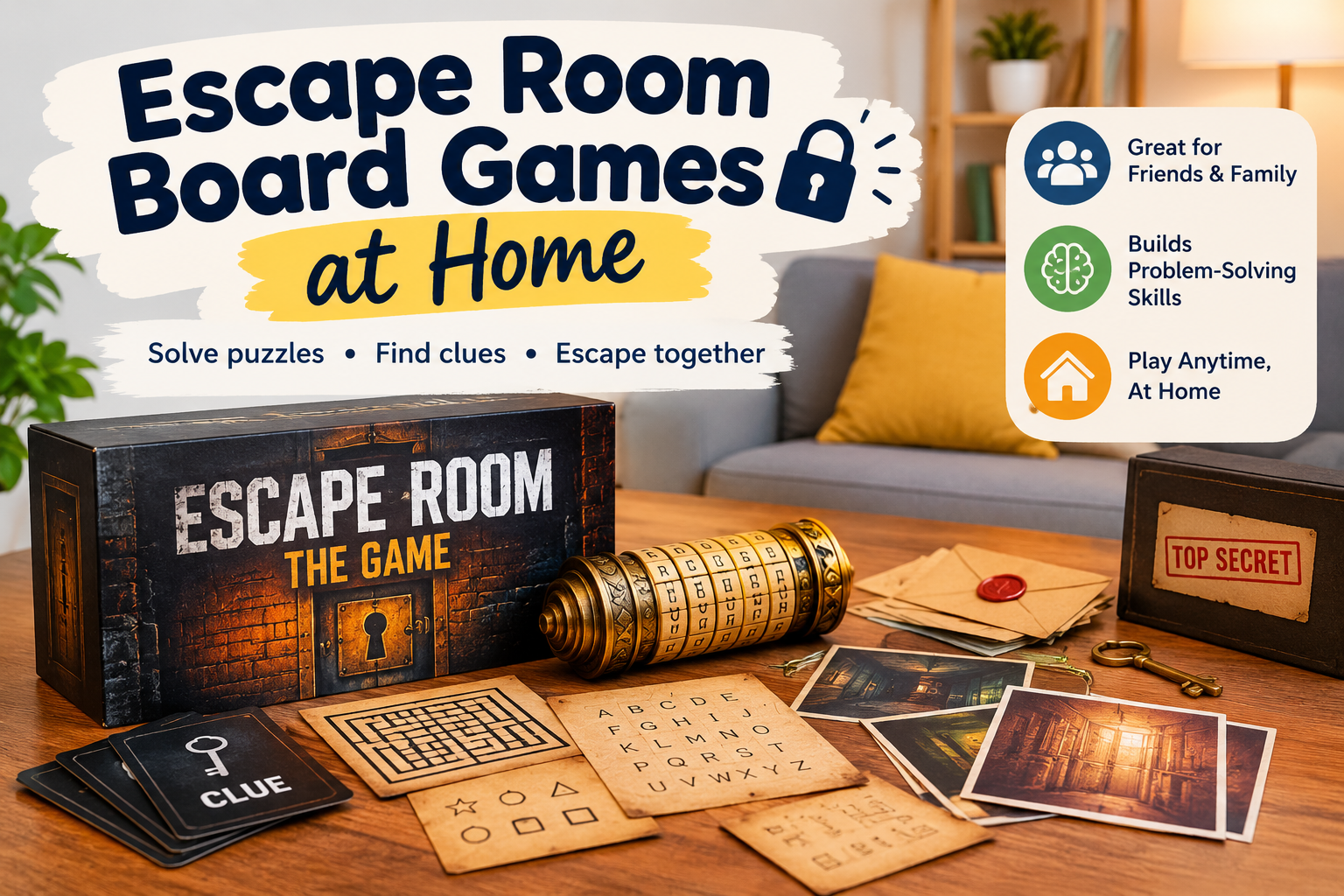
Escape rooms have become one of the most popular social activities of the past decade, but booking one for a group is not always practical. Escape room board games solve that problem by bringing the same puzzle-solving, clue-decoding excitement to your kitchen table. Whether you are planning a family game night, a date night at home, or a gathering with friends, there is an escape room board game designed to fit your group and your budget.
What Are Escape Room Board Games?
Escape room board games are tabletop games that recreate the experience of a physical escape room in a format you can play at home. Players work together as a team to examine clues, solve puzzles, and complete a scenario before time runs out or within as few hints as possible. Most of these games are fully cooperative, meaning everyone plays on the same side rather than competing against each other.
These games vary widely. Some use decks of cards. Others rely on printed booklets with physical puzzle components. Some connect to a smartphone app for timers and hints. The themes range from mystery and detective work to horror, sci-fi, and historical adventure. Difficulty levels span from gentle family-friendly puzzles to head-scratching challenges designed for experienced puzzle enthusiasts.
How Do Escape Room Board Games Work?
Despite the variety in formats and themes, most escape room board games follow a similar basic structure.
- Players read the scenario introduction. A short story or briefing sets up the premise. You might be locked in a haunted mansion, trapped on a spaceship, or trying to solve a crime before the detective arrives.
- Players examine the game components. Depending on the game, this could mean drawing cards, reading booklets, examining physical puzzle pieces, or opening an app on a phone or tablet.
- Players solve puzzles and decode clues. Puzzles are typically connected. Solving one reveals information needed for the next. Players work together, talking through possibilities and trying different approaches.
- Correct answers unlock the next stage. In some games, a correct code opens a new section of cards or a decoder device confirms the answer. In others, the app verifies the solution and moves the story forward.
- Players try to complete the scenario efficiently. Some games track time strictly. Others count how many hints you used as a scoring mechanic. The goal is usually to finish with the best possible result.
Companion apps are used in some games to provide background audio, a countdown timer, hint access, and answer verification. The app does not play the game for you. It supports the physical components and adds atmosphere.
Code-based systems are used in games where players enter a numerical or alphabetical answer into a decoder device or reference a solution booklet to confirm they are on the right track.
One-time versus replayable experiences is an important distinction. Some games, particularly those in the Exit series, involve physically cutting, folding, or writing on components as part of solving puzzles. Once played, these components cannot be restored. Other games are designed to be reset and replayed with new players.
When several of these games use companion apps, understanding what an app actually is helps clarify how that part of the experience works. The article on what is an app explains the basics clearly for anyone unfamiliar with how apps function on phones and tablets.
Escape Room Board Games vs Real Escape Rooms
Both formats deliver puzzle-solving entertainment, but they offer different experiences at very different price points.
| Feature | Escape Room Board Game | Real Escape Room |
|---|---|---|
| Cost per play | Varies by retailer and region; generally much lower per session | Typically charged per person per session |
| Number of players | Usually 1 to 6 depending on the game | Usually 2 to 10 depending on the venue |
| Location | Your home | Physical venue |
| Replayability | Varies by game; some are one-time only | Not replayable in the same room |
| Difficulty adjustment | Some games offer multiple difficulty levels or hint systems | Set by the venue; hints provided by a game master |
| Family and age friendliness | Wide range of age ratings and difficulty levels available | Varies by venue and room theme |
| Time commitment | Typically 45 to 90 minutes | Usually 60 minutes with arrival and briefing time |
| Availability | Available whenever you want to play | Requires booking and travel |
The board game version cannot replicate the full physical immersion of being locked in a themed room with life-sized props and puzzles built into the environment. What it does offer is flexibility, lower cost, the comfort of your own home, and the ability to pause, take a break, or replay the experience with a new group.
Types of Escape Room Board Games
Understanding the main formats helps you choose the right game for your group before you spend any money.
Card-Based Escape Games
Card-based games use a deck of puzzle cards as the primary component. Players draw, examine, and interact with cards to find hidden connections, codes, and clues. This format is compact, portable, and easy to set up. The Unlock and Deckscape series are well-known examples of this approach.
Booklet and Puzzle Games
These games use printed booklets, folded paper components, or physical items that players manipulate as part of solving puzzles. The Exit series is the most prominent example. The physical interaction with components can make puzzles feel more tactile and satisfying, but games in this category are often one-time experiences because the components are used up during play.
App-Assisted Escape Games
Some games pair physical components with a free smartphone or tablet app. The app typically handles the timer, provides atmospheric sound effects, offers a tiered hint system, and verifies answers so players do not need to flip through a solution booklet. If you are new to using apps for games, the article on what is a mobile app explains how these applications work on your device.
Replayable Escape Games
A growing number of games are designed specifically so that components can be reset after play. This makes them more economical for families or groups who want to play with multiple different people over time. Some puzzle systems use dry-erase components or sealed envelopes that preserve the solution for future playthroughs.
Campaign and Series Escape Games
Several publishers have built entire series of connected or standalone scenarios under a single brand. The Exit series has dozens of individual titles. The Unlock series releases new scenario collections regularly. The Escape Tales series uses connected narrative choices across its titles. Buying into a series means you always have a new scenario available once you finish the previous one.
What to Look for When Choosing an Escape Room Board Game
With so many options available, a few key questions help narrow the choice before you buy.
- Player count. Check the minimum and maximum player count on the box. Some games work best with two to four players. Others support larger groups more comfortably.
- Age rating and difficulty. Publishers typically rate their games for age and difficulty. Beginner entries are gentler on puzzle complexity and assume no prior experience. Expert entries can challenge even seasoned puzzle solvers.
- Theme. Your group’s preferences matter. Horror themes may not suit families with younger children. Mystery and adventure themes tend to have broader appeal.
- Play time. Most scenarios run between 45 and 90 minutes. If your group has a limited window, choose a shorter scenario or one with a natural stopping point.
- Replayability. If you plan to play with multiple different groups, a replayable game offers better long-term value. If you are playing once with one group, a one-time experience is perfectly fine.
- App requirement. Some games require a companion app to function. Check whether the app is available for your device and operating system before purchasing the physical game. The article on what is an Android app and what is an iPhone app explain the platform-specific details if you are unsure which applies to your device.
- Language availability. Some games are published in multiple languages. Verify that a version in your preferred language is available in your region.
- Series versus standalone. Most escape room board game series are designed so each title works independently. You do not need to play them in order unless the publisher specifically states otherwise.
- Price and value. Compare the cost of the game against the cost of a real escape room for the same number of players. Even premium escape room board games typically represent significant savings per session.
Best Escape Room Board Games to Play at Home
The games below are selected based on their widespread availability, strong reputation among players, and suitability for home play across different group sizes and experience levels. Each has been widely reviewed and documented by the board gaming community and is available through major retailers.
Prices, availability, and editions vary by region and retailer. Always check current pricing and availability before purchasing.
Unlock! Series (Space Cowboys)
What it is: Unlock! is a card-based escape game series published by Space Cowboys that uses a free companion app alongside physical card components. Each box typically contains multiple scenarios of varying difficulty and theme.
Theme and story: The series covers a wide range of themes across its releases, including adventure, mystery, horror, and science fiction. Individual boxes have included scenarios set in haunted locations, exotic adventures, and science-fiction settings. New themed collections are released regularly.
How it plays: Players lay out an initial set of numbered cards on the table. Objects and locations are represented by cards with numbers printed on them. Combining two cards by adding their numbers together reveals a new card from the deck. The free Unlock! app verifies answers, tracks time, and provides tiered hints when players are stuck. Some puzzle elements are app-based, using the phone’s camera or touch screen as part of the solution.
Player count and recommended age: Typically 1 to 6 players, recommended for ages 10 and up depending on the specific scenario.
Approximate play time: Approximately 60 to 75 minutes per scenario.
Difficulty level: Ranges from beginner to expert across different scenarios within the series. Many boxes include a tutorial scenario to introduce new players to the mechanics.
Replayability: Individual scenarios are not replayable once completed. However, because each box contains multiple scenarios and new boxes are released regularly, the series offers significant ongoing content.
Companion app: Yes. The free Unlock! app is available for Android and iOS and is required for answer verification and hints.
Who it is best for: Groups who enjoy narrative-driven puzzle experiences and are comfortable using a smartphone app during play. Also suitable for solo play.
Key strengths: Large and growing library of scenarios, free app, tutorial scenario for beginners, wide range of themes and difficulty levels, compact and portable format.
Potential limitations: The app is required for full play, which means a charged device needs to be available. Some players find the card-combining mechanic takes time to get used to initially.
Official information is available at Space Cowboys.
Exit: The Game Series (KOSMOS)
What it is: Exit: The Game is a widely acclaimed series of puzzle games published by KOSMOS and distributed in many regions by Thames and Kosmos. The series is known for its innovative physical puzzle mechanics and multiple difficulty levels.
Theme and story: The series covers a broad range of settings including an abandoned cabin, a haunted roller coaster, a sunken treasure ship, a witch’s kitchen, a polar station, and many more. Each title is a standalone scenario with its own unique story and puzzles.
How it plays: Each box contains a booklet, a decoder disk, and various physical components. Puzzles often require players to physically interact with the components in unexpected ways, including cutting, folding, or writing on items as part of the solution. The decoder disk is used to verify answers by aligning symbols or numbers. No app is required, making it fully self-contained.
Player count and recommended age: Typically 1 to 4 players. Age recommendations vary by title, with some beginner entries recommended from age 10 and others aimed at older players.
Approximate play time: Approximately 45 to 90 minutes depending on the title and group experience.
Difficulty level: Clearly rated on the box using a star system from one star for introductory to four stars for expert. This makes it straightforward to choose an appropriate entry point.
Replayability: Generally not replayable. The physical puzzle mechanics involve using components in ways that cannot be restored. This is by design and is a core part of how the puzzles work.
Companion app: No app required. The decoder disk included in the box handles answer verification.
Who it is best for: Players who enjoy physical, tactile puzzle solving and do not mind a one-time experience. The clear difficulty rating system makes it easy to find the right entry point.
Key strengths: No app required, clear difficulty levels, large number of available titles, tactile and innovative puzzle design, widely available in many languages and regions.
Potential limitations: Cannot be replayed after completion. Some puzzles require cutting or writing on components, which means the game is consumed during play.
Official information is available at Thames and Kosmos.
Escape Room: The Game (Identity Games)
What it is: Escape Room: The Game is a physical escape room kit published by Identity Games. It includes a Chrono Decoder device, scenario booklets, and physical puzzle components designed to replicate the feel of a real escape room at home.
Theme and story: The base game typically includes multiple scenarios. Expansion packs are available separately, adding new scenarios with different themes including prison breaks, virus outbreaks, and other dramatic settings.
How it plays: Each scenario uses a booklet as the primary guide, with puzzle components spread across keys, cards, and physical items. Players solve puzzles and enter four-digit codes into the Chrono Decoder, which uses colored keys to verify whether answers are correct. The decoder adds a physical dimension to answer checking that goes beyond a simple booklet lookup.
Player count and recommended age: Typically 3 to 5 players, recommended for ages 16 and up due to scenario themes and puzzle complexity.
Approximate play time: Approximately 60 minutes per scenario.
Difficulty level: Intermediate, designed for players with some puzzle-solving experience or those comfortable with moderate challenge.
Replayability: The scenario booklets and physical components are generally one-time experiences. The Chrono Decoder device is reused across scenarios and expansion packs.
Companion app: An optional companion app is available for some scenarios, but the decoder device handles core play without it.
Who it is best for: Groups of three to five adults or older teenagers looking for a more physical and immersive home escape room experience. The decoder device adds a satisfying tactile element to correct answers.
Key strengths: Physical decoder device adds immersion, multiple scenarios included in the base game, wide range of expansion packs, does not require an app for core play.
Potential limitations: Higher minimum player count makes it less suitable for two players. Recommended age of 16 and up limits family use with younger children. Expansion packs are purchased separately.
Official information is available at Identity Games.
Deckscape Series (dV Giochi)
What it is: Deckscape is a compact card-based escape game series published by dV Giochi. Each title in the series is a single deck of cards representing a complete escape room scenario.
Theme and story: The series covers a variety of themes including mystery, heist, time travel, Egyptian adventure, and more. Each title is a standalone scenario.
How it plays: Players work through a deck of cards in sequence. Each card presents a puzzle, location, or piece of information. Solving each puzzle correctly lets players advance to the next card. Incorrect answers result in time penalties tracked on a scoring system. The entire game is contained within the card deck with no additional components required.
Player count and recommended age: Typically 1 to 6 players, recommended for ages 12 and up.
Approximate play time: Approximately 30 to 60 minutes per scenario, making it one of the shorter options in the genre.
Difficulty level: Generally beginner to intermediate, making it one of the more accessible series for newcomers to escape room board games.
Replayability: Not designed for replay once the puzzles are known, though the compact format makes it easy to share or pass on to a new group.
Companion app: No app required. Entirely self-contained within the card deck.
Who it is best for: Beginners, travelers, and groups looking for a quick and portable escape room experience that requires no setup and no devices.
Key strengths: Extremely compact and portable, no app required, beginner-friendly, quick play time, low barrier to entry, easy to find and purchase.
Potential limitations: Shorter play time and simpler mechanics may not satisfy experienced puzzle enthusiasts looking for a deeper challenge.
Chronicles of Crime (Lucky Duck Games)
What it is: Chronicles of Crime is an award-winning cooperative detective game published by Lucky Duck Games that uses a companion app alongside physical card and board components to create an immersive crime investigation experience.
Theme and story: Players take on the role of detectives investigating crimes in different settings and time periods. Different editions cover modern crime, 1900s London, and a futuristic cyberpunk setting, among others. Each edition is standalone.
How it plays: Players use the app to scan QR codes printed on location cards, character cards, and item cards. Scanning a card within the correct scene context triggers dialogue, clues, and story information through the app. Players question suspects, visit locations, and analyze evidence to solve the crime before time runs out.
Player count and recommended age: Typically 1 to 4 players, recommended for ages 14 and up.
Approximate play time: Approximately 60 to 90 minutes per scenario.
Difficulty level: Intermediate, with a tutorial scenario included to introduce the mechanic.
Replayability: Scenarios are replayable with new players since no physical components are permanently altered. Additional scenarios are available through the app.
Companion app: Yes. The app is required and is available for Android and iOS. It handles QR scanning, dialogue, clues, and scenario management.
Who it is best for: Groups who enjoy detective stories and investigative puzzles rather than traditional coded puzzle sequences. Works well for players who find pure puzzle solving less interesting than narrative mystery.
Key strengths: Strong narrative and investigative feel, replayable scenarios, multiple editions available, app adds genuine depth to the experience.
Potential limitations: App is required and must be downloaded before play. More focused on investigation and deduction than traditional escape room puzzle mechanics, which may not suit players looking specifically for coded puzzle challenges.
Official information is available at Lucky Duck Games.
Escape Tales Series (Board&Dice)
What it is: Escape Tales is a narrative-heavy escape game series published by Board&Dice that blends escape room puzzle mechanics with branching story choices similar to a choose-your-own-adventure format.
Theme and story: The series includes titles such as The Awakening, Low Memory, and Children of Wyrmwoods, each with its own distinct story and setting. The games deal with mature themes in some entries, so checking the specific title’s content before playing with younger audiences is worthwhile.
How it plays: Players navigate a story by examining locations represented on cards and solving puzzles to progress. A companion app verifies answers and tracks story choices. Decisions made during play affect the narrative path, leading to different outcomes depending on the choices made. This branching structure gives the game more replay potential than a strictly linear escape game.
Player count and recommended age: Typically 1 to 4 players, recommended for ages 16 and up for most titles due to mature themes.
Approximate play time: Significantly longer than most escape room board games, with some titles designed for multiple sessions totaling several hours. Individual sessions can be paused and resumed using the app.
Difficulty level: Intermediate to advanced, with the narrative layer adding complexity beyond simple puzzle solving.
Replayability: The branching narrative structure means different playthroughs can lead to different story outcomes, offering more replay value than purely linear games.
Companion app: Yes. The free app is required and is available for Android and iOS.
Who it is best for: Players who want a deeper, story-driven experience that combines puzzle solving with meaningful narrative choices. Suitable for groups comfortable with longer play sessions.
Key strengths: Rich narrative and branching story, longer total play time for more immersive experience, replayable through different story paths, mature and thematic storytelling.
Potential limitations: Mature themes in some titles limit family use. Longer play time requires more commitment than a typical game night. App is required.
Official information is available at Board&Dice.
Clue/Cluedo Escape Series (Hasbro)
What it is: The Clue Escape series is a family-friendly escape game series published by Hasbro that uses the familiar Clue and Cluedo theme and characters in an escape room puzzle format.
Theme and story: Players find themselves locked in locations connected to the classic Clue/Cluedo mystery universe, working together to solve puzzles and escape before time runs out. The familiar characters and settings make the series immediately accessible to anyone who has played Clue before.
How it plays: The game uses puzzle cards and a companion booklet. Players work through clues connected to the Clue universe, solving puzzles to advance through the scenario. The format is straightforward and well suited to players new to escape room board games.
Player count and recommended age: Typically 2 to 6 players, recommended for ages 10 and up, making it one of the more family-friendly options in the genre.
Approximate play time: Approximately 60 minutes per scenario.
Difficulty level: Beginner to intermediate, designed to be accessible to families and players new to the escape room format.
Replayability: Individual scenarios are generally one-time experiences, but the familiar theme and accessible puzzles make it easy to introduce to new players.
Companion app: No app required for core play.
Who it is best for: Families with older children, groups already familiar with Clue/Cluedo, and newcomers to escape room board games looking for an accessible entry point with a recognizable theme.
Key strengths: Familiar theme lowers the barrier to entry, family-friendly age rating, no app required, accessible puzzle design, widely available through major retailers.
Potential limitations: Experienced puzzle enthusiasts may find the difficulty level too gentle. Primarily one-time play experiences.
Official information is available at Hasbro.
Quick Comparison Table: Best Escape Room Board Games at Home
| Game | Series or Standalone | Player Count | Recommended Age | Difficulty | App Required | Replayability | Best For |
|---|---|---|---|---|---|---|---|
| Unlock! | Series | 1 to 6 | 10 and up | Beginner to Expert | Yes (free) | No per scenario | All groups, solo play |
| Exit: The Game | Series | 1 to 4 | 10 and up (varies) | 1 to 4 stars | No | No | Tactile puzzle lovers |
| Escape Room: The Game | Series with expansions | 3 to 5 | 16 and up | Intermediate | Optional | No | Adult groups |
| Deckscape | Series | 1 to 6 | 12 and up | Beginner to Intermediate | No | No | Beginners, travelers |
| Chronicles of Crime | Series | 1 to 4 | 14 and up | Intermediate | Yes (free) | Yes | Detective story fans |
| Escape Tales | Series | 1 to 4 | 16 and up | Intermediate to Advanced | Yes (free) | Partially | Story-driven groups |
| Clue/Cluedo Escape | Series | 2 to 6 | 10 and up | Beginner to Intermediate | No | No | Families, beginners |
Are Escape Room Board Games Worth It?
For most groups, yes. The value case for escape room board games at home is straightforward when you consider the cost comparison. A real escape room typically charges per person per session, which adds up quickly for a group of four or more. An escape room board game represents a fraction of that cost for the same number of players.
Beyond cost, escape room board games offer flexibility that a real venue cannot. You can pause mid-game, play at whatever hour suits your schedule, and create your own atmosphere with snacks, drinks, and music of your choice.
The main limitation is the one-time play nature of many titles. Games that involve cutting or writing on components cannot be replayed. For groups who play regularly, this means buying new titles to maintain fresh experiences. The Exit series, for example, has dozens of titles available, which means the ongoing cost is manageable, but it is a consideration.
For families, couples, and friend groups who want a shared puzzle-solving experience without the expense and logistics of a real escape room, escape room board games deliver strong value. For players who need a challenge that matches a professional escape room’s production quality and physical immersion, the board game format will always offer a different rather than equal experience.
Escape Room Board Games for Beginners
The best starting points for newcomers to the genre share a few common qualities: clear instructions, accessible puzzle difficulty, a helpful hint system, and a play time that does not overstay its welcome.
Deckscape is the most accessible entry point. The compact card format is self-explanatory, play time is short enough to finish comfortably in one sitting, and the puzzles are designed to be approachable rather than overwhelming.
Exit: The Game (one-star difficulty titles) such as The Abandoned Cabin or The Mysterious Museum are specifically designed for beginners, rated at the lowest difficulty level in the series. They introduce physical puzzle mechanics gently and include helpful hint systems.
Clue/Cluedo Escape benefits from a familiar theme that removes the learning curve of adapting to an entirely new universe. If your group already knows the Clue characters and setting, picking up the escape game mechanics feels natural.
Unlock! (tutorial scenarios) include a short tutorial card scenario in many of their boxes that teaches the mechanic before the full game begins. This makes the transition into play smooth even for groups who have never tried an app-assisted card game before.
Escape Room Board Games for Two Players
Two players have a slightly different dynamic than larger groups. Without four or five people sharing the puzzle load, each player carries more of the problem-solving responsibility, which many couples and friends find more engaging rather than less.
Most escape room board games support two players, but some are better suited to it than others.
Unlock! works well with two players. The card-combining mechanic encourages discussion between exactly two people without the noise and cross-talk that can arise in larger groups.
Exit: The Game is consistently recommended for two players across the board gaming community. The focused puzzle structure suits a pair working methodically through components together.
Deckscape is comfortable with two players and benefits from the lower player count because each person has full visibility of the cards being examined.
Escape Tales suits two players who both enjoy narrative games and want a shared story experience that unfolds over a longer session.
Escape Room: The Game specifies a minimum of three players, making it the least suitable option for a two-player session among those listed here.
Escape Room Board Games for Families
Family play requires attention to age ratings, content themes, and puzzle complexity. A good family escape room board game keeps younger players engaged without making older players feel underchanneled.
Clue/Cluedo Escape is the most natural family choice. The age rating starts at 10, the theme is familiar and non-threatening, and the cooperative format means everyone contributes rather than competing.
Exit: The Game (beginner and family-rated titles) includes several titles specifically designed and labeled for family play. The Haunted Roller Coaster and similar family-rated entries use age-appropriate themes and gentler puzzle complexity while still providing satisfying challenges for adults.
Deckscape works well with older children and teenagers. The puzzles are accessible without being condescending, and the short play time works well for families who cannot commit to a full evening.
Chronicles of Crime suits families with teenagers. The detective and investigation theme tends to engage older children who enjoy mystery and deduction rather than abstract puzzle mechanics.
Avoid Escape Tales and the adult-themed Exit entries for younger audiences. Always check the specific title’s age rating and content notes before purchasing for family use.
Escape Room Board Games for Date Night
Escape room board games make an excellent date night activity. Cooperative play naturally encourages conversation, shared problem-solving, and the satisfying experience of working through a challenge together.
Unlock! offers atmospheric scenarios with good narrative framing, and the app adds background sound that contributes to the mood. Choosing a mystery or adventure scenario over a horror theme tends to work better for a relaxed evening.
Exit: The Game with a two-star difficulty title provides enough challenge to feel rewarding without becoming frustrating. The focused two-player dynamic works naturally in this format.
Escape Tales suits couples who enjoy story-driven experiences and want something that feels more like a shared narrative than a timed challenge. The longer play time can be spread across multiple evenings if preferred.
Play time is worth considering for date night. A 60 to 75 minute game fits naturally into an evening without consuming the entire night.
Escape Room Board Games for Game Night Groups
Larger groups of three to six players bring energy and diverse thinking to escape room board games, which can lead to faster puzzle solving through varied perspectives.
Unlock! supports up to six players and works well with larger groups because the card format allows everyone to examine components simultaneously.
Clue/Cluedo Escape supports up to six players and benefits from a familiar theme that gets a group of mixed experience levels up to speed quickly.
Escape Room: The Game is specifically designed for groups of three to five and uses a physical decoder device that gives everyone a satisfying moment of confirmation when a correct answer is entered.
Chronicles of Crime works particularly well with groups who enjoy lively discussion and debate. The investigative format naturally generates conversation as players debate which suspect to question next or which location to visit.
For game night groups, avoid games with lower maximum player counts unless the group is comfortable splitting into a smaller team and the others watch or participate informally.
Tips for Playing Escape Room Board Games at Home
A few practical habits make the experience smoother and more enjoyable regardless of which game you choose.
- Read all instructions before starting. Understanding how the verification system works before you begin prevents confusion mid-game.
- Designate a timekeeper or app manager. If the game uses an app, one person should take responsibility for managing hints and tracking time so others can focus on puzzles.
- Use the hint system. Hints exist to keep the game moving. Getting stuck for twenty minutes on a single puzzle drains the energy from the session. A well-timed hint keeps everyone engaged.
- Clear a large table with good lighting. Puzzle components are often small and detailed. Adequate space and light make a genuine difference in comfort and playability.
- Minimize distractions. Phones on silent, television off, and a dedicated block of time makes the experience more immersive and enjoyable.
- Take photos of components before destructive puzzle steps. If a puzzle requires cutting or folding a component, photograph it first. This helps if you want to verify a solution later or share the experience with someone else.
- Start with a beginner entry if your group is new to the genre. An overwhelming first experience can put people off. A well-chosen beginner game that ends in success is more likely to inspire another session.
- Play with people who enjoy the format. Escape room board games reward patience, communication, and lateral thinking. A group that engages willingly will have a significantly better experience than one where participation is reluctant.
Frequently Asked Questions
What are escape room board games?
Escape room board games are tabletop games that recreate the experience of a physical escape room. Players work together to solve puzzles, decode clues, and complete a scenario within a set time limit or using as few hints as possible.
How do escape room board games work?
Players read a scenario introduction, examine cards or booklets, solve puzzles in sequence, and verify answers using a decoder device, solution booklet, or companion app. Correct answers advance the story until the scenario is completed.
Are escape room board games replayable?
It depends on the game. Some, like Chronicles of Crime, are designed for replay. Others, like the Exit series, involve components that are permanently altered during play and cannot be reset. Check the specific title before purchasing if replayability is important to you.
How many players do escape room board games need?
Most support one to four or one to six players. The minimum is usually one, making solo play possible for many titles. Check the specific game’s player count before buying for a particular group size.
Are escape room board games good for beginners?
Yes, particularly beginner-rated titles from the Exit series, the Deckscape series, and the Clue/Cluedo Escape series. Many games include tutorial elements specifically designed for first-time players.
Are escape room board games suitable for children?
Some are. Family-rated Exit titles, Clue/Cluedo Escape, and Deckscape are generally suitable for children aged 10 and up. Escape Tales and adult-themed Exit titles are designed for older audiences. Always check the age rating on the specific title.
How long do escape room board games take to play?
Most scenarios run between 45 and 90 minutes. Escape Tales is designed for longer sessions that can span multiple evenings. Deckscape scenarios can be completed in 30 to 60 minutes.
Do escape room board games require a smartphone app?
Not all of them. Exit: The Game, Deckscape, and Clue/Cluedo Escape do not require an app. Unlock!, Chronicles of Crime, and Escape Tales use free companion apps that enhance the experience. When an app is required, verify it is available for your device before purchasing.
Are escape room board games worth the money?
For most groups, yes. The cost per session is significantly lower than a real escape room. Series with multiple available titles, such as Exit and Unlock, provide ongoing value as new scenarios are released regularly.
What is the best escape room board game for beginners?
Deckscape and beginner-rated Exit titles are the most accessible starting points. Both have gentle puzzle difficulty, clear instructions, and manageable play times.
What is the best escape room board game for two players?
Exit: The Game and Unlock! are consistently recommended for two players. Both formats work naturally with a pair and provide satisfying puzzle experiences without requiring a larger group.
What is the best escape room board game for families?
Clue/Cluedo Escape and family-rated Exit titles are the strongest family options. Both offer age-appropriate themes, accessible puzzles, and cooperative play that keeps everyone involved.
Can you play escape room board games alone?
Yes. Many escape room board games explicitly support solo play, including Unlock!, Exit: The Game, Deckscape, and Escape Tales. Solo play works particularly well for players who enjoy puzzle solving at their own pace.
Where can I buy escape room board games?
Escape room board games are widely available through major online retailers, specialty board game stores, and general retail chains. Checking availability on BoardGameGeek can help you identify which titles are available in your region and find current retailer listings.
Disclaimer:
This article contains general recommendations based on publicly available product information and widely reported player experiences. Product availability, pricing, and features are subject to change. Always verify current prices, availability, and age ratings directly with the retailer or manufacturer before purchasing. Some links in this article may be affiliate links, meaning the author or publisher may earn a commission if you purchase through those links at no additional cost to you. All recommendations are based on research and editorial judgment, not paid placement.
By Zohan
Zohan is a technology writer covering smartphones, apps, software, gadgets, gaming, reviews, and practical how-to guides. He focuses on making technology simple, useful, and easy to understand for everyday users. His work helps readers understand technology, explore useful tools, and make informed decisions about the products and services they use.