
 By saman zahra
Introduction
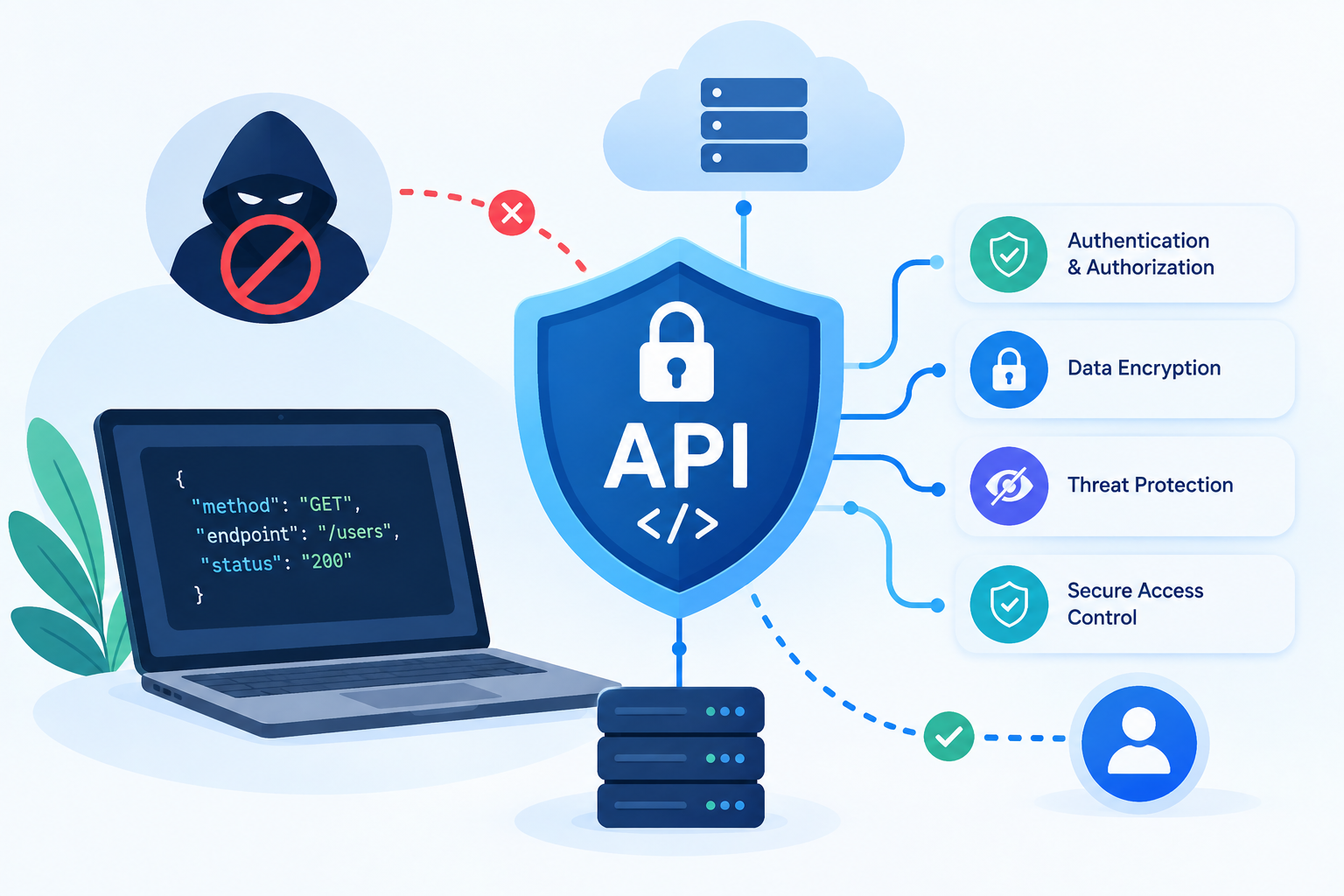
APIs power nearly every digital interaction people have today, from mobile banking and online shopping to social media and weather apps. They are the invisible connective tissue of modern software. Yet despite their central role in how applications work, APIs are frequently underprotected and actively targeted by attackers looking for direct access to sensitive data and backend systems.
This guide explains what APIs are, what API security means, the most critical risks and attack types, the best practices developers and organizations should follow, and how API security fits within the broader security landscape.
What Is an API?
Before addressing API security, it helps to understand what an API is.
An API, which stands for Application Programming Interface, is a set of rules and protocols that allows different software applications to communicate and share data with each other. Rather than two applications connecting directly, the API defines how requests are made, what data can be exchanged, and how responses are formatted.
A simple analogy makes this concrete. Think of an API like a waiter in a restaurant. You sit at your table and look at the menu. You do not walk into the kitchen to make your food yourself. Instead, the waiter takes your order, delivers it to the kitchen, and brings your food back to you. The waiter is the intermediary that connects the customer to the kitchen. An API works the same way: it sits between two software systems, taking requests from one and returning responses from the other.
Real-world examples of APIs in everyday use:
- When you log into a website using your Google account, a Google API handles the authentication communication between the website and Google’s systems
- When a weather app displays current conditions, it is using a weather service API to retrieve live data from a remote server
- When you book a flight through a travel website, the site uses airline APIs to check availability, pricing, and seat inventory in real time
- When a payment is processed through an online checkout, a payment gateway API handles the transaction securely between the retailer and the financial institution
APIs are everywhere in modern software. This ubiquity is precisely what makes API security a critical concern across every cybersecurity discipline.
What Is API Security?
API security refers to the practices, controls, and tools used to protect APIs from unauthorized access, misuse, data theft, and attacks that could compromise the systems and data the API connects.
APIs are a primary target for attackers because they provide direct programmatic access to application functionality and data. Unlike a website’s user interface, which a human navigates visually, an API is accessed by code, meaning an attacker can write automated scripts to probe and exploit it at scale without the limitations of manual interaction.
An insecure API can expose sensitive data, allow unauthorized actions to be performed on behalf of users, and provide attackers with a direct pathway into backend databases and systems that would otherwise require far more effort to reach.
API security involves several interconnected areas of practice:
- Authentication and authorization: Controlling who and what can access an API and what they are permitted to do
- Input validation and sanitization: Checking all data sent to the API to ensure it is safe to process
- Encryption: Protecting data transmitted through the API from interception
- Traffic monitoring: Watching API activity for suspicious patterns and attacks in progress
- Rate limiting: Preventing abuse by restricting how frequently the API can be called
API security is a specialized and critical component within the broader cybersecurity field. Understanding where it fits among the types of cybersecurity disciplines helps organizations ensure they are not treating it as an afterthought.
Why Is API Security Important?
APIs are among the most commonly targeted attack surfaces in modern cybersecurity. The reason comes down to a fundamental characteristic: APIs are designed for programmatic access, which means they are reachable by automated tools that can probe them far faster and more systematically than any human attacker navigating a website.
Unlike a website’s user interface, which is visible and navigated by people, APIs often operate in the background, less visible to the organization but fully accessible to anyone who knows how to call them. This creates a dangerous gap between what organizations think they are exposing and what attackers can actually reach.
The consequences of a compromised API include:
- Unauthorized access to sensitive user data, personal information, financial records, and health data
- Data theft at scale, because a single API request can return thousands of records if not properly controlled
- Unauthorized actions performed on behalf of users, such as transfers, purchases, or account changes
- Complete compromise of backend systems and databases connected through the API
- Regulatory penalties under frameworks such as GDPR, HIPAA, and PCI DSS for failure to protect personal data
- Significant and lasting reputational damage when breaches become public
The growth of mobile applications, cloud services, microservices architectures, and interconnected third-party integrations means organizations are exposing more APIs than ever before. Every new API is a new attack surface that requires deliberate security attention.
API security is closely related to web application security, and both must be addressed together as part of a comprehensive strategy. More broadly, API security is a critical subset of the application security discipline that covers security across all layers of software, not only the user-facing interface.
The OWASP API Security Top Ten
The Open Web Application Security Project, known as OWASP, publishes the API Security Top Ten, which is the most widely referenced list of critical API security risks. OWASP is a nonprofit organization dedicated to improving software security, and its API Security Top Ten serves as the standard baseline reference for API security used by developers, security professionals, and organizations worldwide.
Always consult the official OWASP website at owasp.org for the most current version of the API Security Top Ten, as it is updated to reflect changes in the threat landscape.
OWASP API Security Top Ten Summary
| Risk | Name | What It Means Simply |
|---|---|---|
| API1 | Broken Object Level Authorization | API returns data for objects the requesting user should not be authorized to access |
| API2 | Broken Authentication | Weak or missing authentication allows unauthorized access to the API |
| API3 | Broken Object Property Level Authorization | API exposes or allows modification of object properties the user should not have access to |
| API4 | Unrestricted Resource Consumption | API allows excessive requests consuming resources and potentially enabling denial of service |
| API5 | Broken Function Level Authorization | Users can access API functions reserved for higher-privilege roles |
| API6 | Unrestricted Access to Sensitive Business Flows | API does not protect critical business flows from automated abuse |
| API7 | Server-Side Request Forgery | API can be manipulated into making requests to unintended internal or external systems |
| API8 | Security Misconfiguration | API is deployed with incorrect, incomplete, or insecure configuration |
| API9 | Improper Inventory Management | Outdated, undocumented, or shadow APIs are deployed and unprotected |
| API10 | Unsafe Consumption of APIs | The application consumes third-party API data without adequate validation |
The OWASP API Security Top Ten is not an exhaustive list of every possible API security risk. It is a prioritized guide to the most commonly exploited and impactful categories. Organizations and developers that systematically address these ten risk categories significantly reduce their exposure to the most common and damaging API attacks.
The National Institute of Standards and Technology (NIST) also publishes guidance on secure software development and cybersecurity frameworks that complement the OWASP API security guidance, and both are frequently referenced together in professional security practice.
Common API Security Risks and Attacks Explained
Broken Object Level Authorization
Broken Object Level Authorization is consistently ranked as the most critical API security risk in the OWASP framework, and for good reason. It is among the most frequently exploited vulnerabilities in real-world API breaches.
APIs typically work with objects, such as user accounts, orders, documents, or medical records, identified by unique identifiers. When a request is made for a specific object, the API should verify not only that the requester is authenticated but also that they are specifically authorized to access that particular object.
Broken Object Level Authorization occurs when that second check is absent or insufficient.
Example: A user with account ID 1001 calls the API to retrieve their order history. They modify the API request to use account ID 1002 instead. Because the API only checks that the user is logged in rather than verifying they own account 1002, it returns that account’s order history to the attacker.
Prevention: Implement authorization checks for every object-level access request. Verifying that a user is authenticated is not sufficient. The API must also verify that the authenticated user is permitted to access the specific object being requested.
Broken Authentication
Authentication weaknesses allow attackers to bypass identity verification entirely and gain unauthorized access to the API.
Common API authentication weaknesses include:
- Endpoints that require no authentication at all for sensitive operations
- Weak, short, or predictable API keys that can be guessed or brute-forced
- Access tokens with no expiration that remain valid indefinitely even after a session ends
- No rate limiting on authentication endpoints, allowing unlimited login attempts
- Credentials transmitted over unencrypted connections where they can be intercepted
Prevention: Use established authentication standards, issue short-lived tokens, rate-limit all authentication endpoints, and always transmit credentials over encrypted connections. For sensitive administrative API endpoints, two-factor authentication adds a meaningful additional layer of protection that significantly raises the cost for an attacker attempting unauthorized access.
Excessive Data Exposure
APIs sometimes return far more data than the client application actually needs, relying on the client-side application to filter out sensitive fields before displaying them to users. This creates a serious problem when attackers bypass the application and call the API directly.
Example: A mobile banking app calls an API to display a user’s account balance. The API returns a full user object including the account balance, transaction history, hashed credentials, internal account identifiers, and linked account details. The mobile app only displays the balance, so developers assume the other fields are hidden. An attacker calling the API directly receives the entire object.
Prevention: Design APIs to return only the minimum data actually required for each specific request. Never rely on client-side applications to hide fields that should not be transmitted in the first place. Filtering must happen at the API level.
Unrestricted Resource Consumption
APIs without proper rate limiting and resource controls can be abused to consume excessive server resources, disrupt service for legitimate users, or extract large volumes of data through automated scraping.
An attacker who can send unlimited requests to an API can overwhelm it with traffic, causing degraded performance or complete unavailability for legitimate users. They can also systematically extract an entire database of user records one request at a time if no limits are in place.
Prevention: Implement rate limiting that restricts how many requests a client can make within a defined time window. Set limits on response sizes, query complexity, and the total resources any single client can consume.
Broken Function Level Authorization
APIs often expose different endpoints for different functions, including administrative functions intended only for privileged users. Broken Function Level Authorization occurs when the API does not properly verify that a user has the required role or permission before allowing access to those privileged functions.
Example: A regular user discovers an undocumented administrative API endpoint by reading error messages or inspecting the application’s network traffic. They call the endpoint and are able to access or modify other users’ data because the API checks authentication but not the user’s role.
Prevention: Implement role-based access controls that explicitly verify a user’s role and permissions before allowing access to any sensitive or administrative API function. Administrative endpoints should never be accessible to standard user accounts regardless of how they are discovered.
Injection Attacks Through APIs
APIs that accept user input are vulnerable to injection attacks, including SQL injection, command injection, and other forms of malicious input that get executed by backend systems.
When an API passes user-supplied input directly to a database query, system command, or template engine without proper validation, an attacker can craft input that changes the behavior of that backend operation. Injection through APIs is essentially the same vulnerability as injection in web application security but accessed through a programmatic rather than visual interface, often making it easier to automate and exploit at scale.
Prevention: Validate and sanitize all input received through API requests. Use parameterized queries for all database interactions. Never assume that because input arrives through an API rather than a web form it is inherently safer or more trustworthy.
Security Misconfiguration
API security misconfiguration is one of the most common and most preventable API security issues. It does not require any coding vulnerability to exploit. It simply requires that an attacker find an API that was not configured securely.
Common examples of API security misconfiguration:
- APIs deployed with default credentials or no authentication requirement
- Unnecessary HTTP methods enabled, such as DELETE or PUT when only GET is needed
- Detailed error messages that reveal internal system architecture, technology stack, or data structure to attackers
- Missing security headers in API responses
- APIs accessible over unencrypted HTTP rather than HTTPS
- Cross-Origin Resource Sharing, known as CORS, configured too permissively, allowing requests from any origin
Prevention: Follow security hardening guidelines for all API deployments. Conduct regular configuration reviews. Disable all features, methods, and endpoints that are not actively required for the API’s intended function.
Improper Inventory Management
Organizations that build and deploy APIs over time frequently lose track of all the APIs they have running. The result is shadow APIs, legacy endpoints, and older API versions that remain accessible but are no longer monitored, maintained, or updated.
These forgotten APIs are particularly dangerous because they may contain vulnerabilities that have already been fixed in the current version, but since no one is aware they are still running, they are never patched or retired.
Prevention: Maintain a complete and current inventory of every API the organization has deployed, including internal APIs, external APIs, older versions, and APIs built by third parties on behalf of the organization. Conduct regular audits of the inventory and properly retire APIs that are no longer needed.
Man-in-the-Middle Attacks on APIs
If API communications travel over unencrypted connections, an attacker positioned between the client and the API server can intercept and read or modify the data being exchanged. This is particularly dangerous when APIs transmit authentication tokens, session credentials, or sensitive personal and financial data.
Attackers can also use techniques similar to phishing attacks to trick users or systems into sending API credentials to attacker-controlled endpoints, effectively stealing access without needing to break encryption.
Prevention: Always use HTTPS with properly configured, current TLS versions for all API communications. Never transmit API keys, authentication tokens, or sensitive data over unencrypted HTTP connections under any circumstances.
API Key Theft and Misuse
API keys are credential strings used to authenticate access to an API. An attacker who obtains a valid API key can use it to access the API with the same authorization level as the legitimate key holder, often without any indication to the organization that the key has been compromised.
API keys are commonly leaked through:
- Hard-coding them directly into application source code that is then committed to a public or shared code repository
- Including them in mobile application code that can be extracted by decompiling the application
- Transmitting them over unencrypted connections where they can be captured
- Insufficient access controls on systems and configuration files where keys are stored
Prevention: Never hard-code API keys in source code. Store keys securely using environment variables or dedicated secret management systems. Rotate keys regularly and immediately whenever a key is suspected of being compromised. Scope each API key to the minimum permissions required for its specific function.
Types of APIs and Their Security Considerations
| API Type | What It Is | Common Security Considerations |
|---|---|---|
| REST API | Uses HTTP requests to perform operations on resources | Authentication, HTTPS, input validation, rate limiting, proper HTTP method control |
| GraphQL API | Allows clients to request exactly the data they need in a single query | Query depth limiting, authorization at resolver level, introspection control |
| SOAP API | Uses XML-based messaging protocol with formal structure | XML injection, schema validation, transport security |
| WebSocket API | Provides persistent bidirectional communication between client and server | Authentication on connection establishment, message validation, rate limiting |
| Internal API | Used within an organization between internal services and microservices | Still requires authentication and authorization despite being internal |
| Third-Party API | An external API your application consumes for data or services | Validate all received data, secure storage of credentials, monitor for changes |
REST APIs are the most widely used API type today and face the broadest range of security threats. They are the primary focus of most API security guidance including the OWASP API Security Top Ten.
GraphQL APIs present unique security challenges. Their flexibility allows clients to construct complex queries that can retrieve large amounts of data or consume significant server resources with a single request. Controlling query depth, complexity, and authorization at the individual field resolver level requires specific attention.
Internal APIs are frequently under-secured because organizations assume that access to the internal network provides sufficient protection. This assumption is fundamentally incompatible with modern zero trust security principles, which require that no network location, including the internal network, is trusted by default.
API Authentication Methods
API Keys
An API key is a unique identifier string passed with API requests to authenticate the caller. API keys are straightforward to implement and widely used, but they provide only basic authentication. They do not identify individual users, they do not expire automatically, and if compromised they must be rotated immediately to revoke access.
API keys should be treated exactly like passwords. Store them securely, never expose them in client-side code or public repositories, scope them to minimum required permissions, and rotate them on a regular schedule.
OAuth 2.0
OAuth 2.0 is a widely used and well-established authorization framework that allows applications to obtain limited access to resources on third-party services without sharing user passwords. It is the standard mechanism behind features like “log in with Google” or “connect with Facebook” on websites and applications.
OAuth 2.0 issues access tokens that the API client presents with each request. Tokens can be scoped to specific permissions, limiting what the token holder can do, and have defined expiration times after which they must be refreshed or reissued. This time-limited and scope-limited design reduces the impact of a compromised token compared to a static API key with broad permissions.
JSON Web Tokens
JSON Web Tokens, commonly called JWTs, are a widely used format for API authentication tokens. A JWT contains encoded claims about the user and their permissions and is cryptographically signed to prevent tampering. The API receiving a JWT validates the signature to confirm it was issued by a trusted authority and has not been modified.
JWTs must be properly validated by the API on every request. Weak JWT validation, such as accepting tokens with no signature check or failing to verify expiration, is a well-documented and commonly exploited API security vulnerability.
Mutual TLS
Mutual TLS, abbreviated as mTLS, requires both the client and the server to present cryptographic certificates to verify their identities before establishing a connection. This provides stronger authentication than token-based approaches because both parties must prove their identity, not just the client.
Mutual TLS is commonly used for machine-to-machine API communication in high-security contexts such as financial services, healthcare data exchange, and internal microservice communication where strong identity assurance is required on both ends of every connection.
API Security Controls and Best Practices
Implement Strong Authentication and Authorization
Every API endpoint that exposes sensitive data or functionality must require authentication. No endpoint that can return personal data, financial information, or perform state-changing operations should be accessible without verified identity.
Use established authentication standards such as OAuth 2.0 rather than building custom authentication systems. Custom-built authentication is a common source of serious vulnerabilities because the security edge cases that well-established standards already address must be independently discovered and handled.
Implement authorization checks for every request, verifying not just that the user is authenticated but that they are specifically authorized to perform the requested action on the specific resource being accessed. This is the control that prevents Broken Object Level Authorization vulnerabilities.
Apply the principle of least privilege: grant API clients only the minimum permissions they genuinely need for their intended function. For sensitive administrative API endpoints, two-factor authentication adds a critical additional verification layer that protects access even when primary credentials are compromised.
Use HTTPS for All API Communications
All API traffic must be encrypted using HTTPS with properly configured, current TLS versions. Transmitting API credentials, tokens, or sensitive data over unencrypted HTTP is an unacceptable security risk regardless of the perceived sensitivity of the data or the intended audience of the API.
Enforce HTTPS at the API gateway or server level, rejecting unencrypted connections rather than simply redirecting them.
Implement Rate Limiting and Throttling
Rate limiting restricts how many requests a specific client can make to an API within a defined time period. This is a fundamental control that prevents brute force attacks on authentication endpoints, automated denial of service attempts, and systematic data scraping.
Rate limits should be configured per API key or authenticated user, targeting specific clients rather than applying a blanket limit to all traffic. Different endpoints may warrant different rate limits based on their sensitivity and expected usage patterns.
Validate and Sanitize All Input
Every piece of data received through an API request must be treated as potentially malicious until validated. Validate all input against expected data types, formats, lengths, and value ranges. Reject requests that contain unexpected or invalid data before processing them.
Sanitize inputs that will be used in database queries, system commands, or other sensitive operations to prevent injection attacks regardless of how the input was structured.
Return Only Necessary Data
API responses should contain only the data the requesting client actually needs for its specific function. Returning full database objects when a subset of fields is sufficient exposes sensitive information that the client was never intended to receive.
Design response schemas deliberately to include only the fields needed. This filtering must happen at the API level, not at the client application level, because clients cannot be trusted to suppress data that the API has already transmitted.
Maintain a Complete API Inventory
Keep a current and complete inventory of every API deployed, including internal service APIs, external customer-facing APIs, older API versions, and APIs built by third-party developers on the organization’s behalf.
Regularly audit the inventory to identify APIs that are no longer needed or have been superseded by updated versions. Properly retire and shut down outdated APIs rather than simply stopping to use them while leaving them accessible.
Implement API Security Testing
Conduct regular security testing of all APIs, including automated vulnerability scanning and penetration testing by qualified security professionals. Include APIs in the scope of all application security testing programs and treat them with the same rigor as any other application component.
Ethical hacking and penetration testing are critical methods for identifying API security vulnerabilities before real attackers can find and exploit them. A penetration tester approaching an API with the same techniques as a real attacker surfaces weaknesses that automated scanning tools frequently miss.
Use an API Gateway
An API gateway acts as a centralized entry point for API traffic. It can enforce authentication, rate limiting, logging, input validation, and other security policies consistently across all APIs passing through it.
API gateways reduce the risk of individual APIs being deployed with inconsistent or missing security controls by centralizing enforcement rather than relying on each API implementation to independently implement every security measure correctly.
Implement Comprehensive Logging and Monitoring
Log all API requests including caller identity, endpoint accessed, timestamp, HTTP method, and response code. Store logs in a secure location where they cannot be tampered with by an attacker who has gained access to the application.
Monitor API logs for anomalous patterns including unusual request volumes, repeated authentication failures, access to administrative endpoints, and responses returning unusually large data volumes. Alerts on suspicious patterns enable faster detection and response to attacks in progress rather than discovering them after significant damage has occurred.
Secure API Keys and Credentials
Store API keys and credentials in dedicated secret management systems, not in source code, configuration files, or environment variables committed to version control repositories. Rotate API keys on a regular schedule and immediately whenever a key is suspected of being compromised.
Scope every API key to the minimum permissions required for its specific intended function. A key used only to read product catalog data should have no ability to create, modify, or delete records.
API Security vs Web Application Security: What Is the Difference?
Web application security and API security address different but overlapping attack surfaces of the same overall application. Understanding the distinction helps organizations ensure neither is neglected.
Web application security focuses on protecting the user-facing interface of web applications, including the HTML, CSS, and JavaScript that users interact with through their browsers. It addresses threats that exploit how browsers render and execute content.
API security focuses on protecting the programmatic interfaces through which applications communicate with each other and with backend services. It addresses threats that exploit how applications request and exchange data directly, bypassing the user interface entirely.
| Dimension | Web Application Security | API Security |
|---|---|---|
| What it protects | User-facing web interface and its rendering in browsers | Programmatic data and service interfaces accessed by code |
| Primary interaction | Human users navigating through browsers | Applications and automated clients making programmatic requests |
| Key threats | XSS, CSRF, clickjacking, form-based injection | Broken authorization, injection, excessive data exposure, rate abuse |
| Key controls | Input validation, CSP, WAF, security headers | Authentication, authorization, rate limiting, input validation, response filtering |
| Visibility | User interface is visible and navigable | APIs often operate invisibly in the background |
| Data exposure risk | Limited by what is rendered and displayed | Can expose large volumes of raw structured data per request |
API security and web application security are complementary disciplines that must both be addressed as part of a complete security strategy. Securing one while neglecting the other leaves meaningful gaps that attackers can exploit. Together they are both components of the broader application security discipline that addresses security across the full software stack.
API Security and Network Security
Network security controls protect the infrastructure through which API traffic travels. Even a well-secured API can be exposed if network-level controls do not appropriately restrict which systems and networks can reach it.
Network-level controls that support API security include:
- Firewalls that restrict API access to authorized source IP addresses or ranges, particularly for internal and administrative APIs
- Network segmentation that limits which internal systems can communicate with sensitive internal APIs, reducing the blast radius of a compromised system
- Intrusion detection systems that monitor network traffic for API attack patterns and alert security teams to suspicious activity
Network security is a necessary complement to API-level security controls, not a substitute for them. An attacker who bypasses network controls still faces the API’s authentication and authorization requirements. An attacker who exploits an API vulnerability may still be detected or contained by network monitoring.
Understanding network security and how it relates to API security helps organizations build a more complete and layered defense posture.
API Security and Zero Trust
The zero trust security model operates on the principle of never trust, always verify. No user, device, system, or network location is automatically trusted based on its position or previous access history.
Applied to API security, zero trust means no API caller is automatically trusted based on where their request originates, including from inside the organization’s network perimeter. Every request must be explicitly verified.
Zero trust principles applied to API security:
- Require authentication for every API request regardless of whether it originates from inside or outside the network
- Verify authorization for every specific action on every specific resource, not just at the time of initial login
- Continuously monitor API traffic for anomalous behavior rather than assuming authenticated sessions remain safe throughout their lifetime
- Grant minimum necessary permissions to every API client and restrict scope as tightly as possible
The zero trust model is particularly relevant for internal APIs. Organizations frequently apply strong security to their external-facing APIs while treating internal APIs as inherently safe because they are inside the network perimeter. This is precisely the assumption that zero trust challenges and that attackers who gain any internal foothold exploit. Understanding zero trust security in depth provides important context for how API security policies should be designed, particularly for organizations with complex microservice architectures where internal APIs are numerous.
API Security and Cloud Security
A large and growing proportion of modern APIs are deployed in cloud environments and consumed by cloud-native applications, mobile applications, and third-party integrations.
Cloud API security introduces specific considerations that organizations must address deliberately:
- Cloud provider APIs: The APIs provided by cloud platforms to manage infrastructure must be secured with strong authentication, minimal privilege, and careful access management. A compromised cloud management API can give an attacker control over the organization’s entire cloud environment.
- Cloud-deployed application APIs: APIs deployed on cloud infrastructure must be protected by cloud-native security controls including cloud WAF services, API gateway offerings, and network security groups.
- Configuration management: Cloud API deployments must be carefully configured to prevent accidentally exposing internal APIs to the public internet. Misconfigured cloud API deployments are a common cause of data breaches.
- Shared responsibility: Cloud providers secure the underlying infrastructure, but the organization is responsible for securing the APIs it deploys on that infrastructure. Understanding the provider’s shared responsibility model is essential for identifying which security responsibilities fall to the organization.
Cloud security principles and practices are directly relevant to any organization deploying APIs in cloud environments. The intersection of cloud architecture and API design creates specific security challenges that require both cloud security expertise and API security knowledge to address effectively.
For organizations relying on cloud-native API services, cloud security is not a separate discipline from API security but an integral part of how API security is implemented and managed.
API Security Testing Methods
Security testing is how organizations verify that their API security controls are effective and identify vulnerabilities before attackers do.
| Testing Method | What It Does | When Used |
|---|---|---|
| Static Analysis (SAST) | Reviews API source code for security vulnerabilities without running the application | During development |
| Dynamic Testing (DAST) | Tests the running API by sending crafted requests to identify vulnerabilities | Before and after deployment |
| Penetration Testing | Qualified security professionals attempt to exploit API vulnerabilities in a controlled manner | Before major releases and periodically |
| Fuzzing | Sends invalid, unexpected, or random data to the API to discover unexpected behaviors and vulnerabilities | During testing and quality assurance |
| Vulnerability Scanning | Automated scanning for known API vulnerabilities and misconfigurations | Regularly and continuously |
| Manual Security Review | Human expert review of API design, implementation, authentication logic, and authorization controls | During design, development, and security audits |
Testing APIs specifically for security vulnerabilities requires tools and approaches designed for API testing rather than tools built primarily for testing web browser interfaces. API-specific testing tools can send arbitrary request structures, modify headers and authentication tokens, and test endpoint behaviors in ways that general web testing tools are not designed for.
API penetration testing should cover all endpoints including those intended for internal use only. Internal endpoints are frequently left out of security testing scope based on the incorrect assumption that internal network access provides sufficient protection.
Ethical hacking professionals conducting API penetration tests approach the assessment with the same mindset and tools as real attackers, systematically probing authentication, authorization, input handling, rate limiting, and business logic for weaknesses that automated scanning tools may not surface.
API Security Best Practices Summary
The following checklist reflects the core practices that developers and organizations should apply to every API they build and deploy. This list is a starting point, not a complete security specification. Always consult qualified security professionals for guidance specific to your environment.
- Implement strong authentication using established standards such as OAuth 2.0 for every API endpoint
- Enforce authorization checks for every request at both the object level and the function level, not just at authentication time
- Always use HTTPS with current TLS configuration for all API communications without exception
- Implement rate limiting and throttling to prevent brute force, denial of service, and automated scraping
- Validate and sanitize all input received through API requests regardless of the source
- Return only the minimum data necessary in API responses, filtering at the API level rather than the client level
- Maintain a complete and current inventory of all deployed APIs and retire those no longer needed
- Store API keys and credentials in secure secret management systems and rotate them regularly
- Implement comprehensive logging and monitoring for all API traffic and alert on anomalous patterns
- Conduct regular security testing including penetration testing by qualified professionals and automated vulnerability scanning
- Use an API gateway to enforce consistent security policies across all APIs
- Apply zero trust principles requiring authentication and authorization for every request from every source
- Keep all API dependencies and underlying components updated to address known vulnerabilities
- Protect the devices and systems that access and host APIs through appropriate endpoint security controls that complement API-level protections
CISA (cisa.gov) publishes vulnerability advisories and secure development guidance that supports organizations in building and maintaining secure API environments as part of a broader cybersecurity program.
Common API Security Mistakes to Avoid
Assuming Internal APIs Are Safe
Many organizations apply strong security controls to their external-facing APIs while leaving internal APIs with minimal or no authentication, reasoning that internal network access provides sufficient protection.
Attackers who gain any foothold inside the network, whether through a phishing attack, a compromised endpoint, or another vulnerability, can exploit poorly secured internal APIs to move laterally and access sensitive systems and data far more easily than they could if internal APIs were properly secured. All APIs, regardless of their intended audience, require proper authentication and authorization.
Hard-Coding API Keys in Source Code
Placing API keys directly in application source code is a serious and common security mistake, particularly when that code is stored in public or shared version control repositories. Automated tools continuously scan public repositories for exposed credentials, and API keys found this way are frequently exploited within hours of exposure.
Always use environment variables or dedicated secret management systems to store API credentials. Never commit credentials to any repository, even private ones, as access controls on repositories can change and historical commits may be accessible even after a key appears to have been removed.
Not Implementing Rate Limiting
APIs deployed without rate limiting are fully vulnerable to brute force attacks on authentication endpoints, systematic data extraction through automated requests, and denial of service through request flooding. Rate limiting is a fundamental control that has well-understood implementation patterns and should be in place from the beginning of API development rather than added later in response to an incident.
Returning Too Much Data
Returning complete data objects when only specific fields are needed by the client exposes sensitive information that would not be accessible through the application’s user interface. This excess data is fully accessible to anyone calling the API directly, including attackers. Response design should be deliberate and minimal, returning only what each specific endpoint actually needs to serve its purpose.
Not Testing APIs for Security
A significant proportion of API security vulnerabilities are discovered in production by attackers rather than during development because security testing was not conducted before deployment. Security testing should be a standard, non-negotiable step in the API development and deployment lifecycle, not an optional activity scheduled only when time permits.
Frequently Asked Questions
What is API security?
API security refers to the practices, controls, and tools used to protect APIs from unauthorized access, misuse, data theft, and attacks that could compromise the systems and data the API connects.
Why is API security important?
APIs provide direct programmatic access to application functionality and data, making them a high-value target for attackers. A compromised API can expose sensitive data, allow unauthorized actions, and provide access to backend systems at scale.
What are the most common API security risks?
The most critical risks include broken object level authorization, broken authentication, excessive data exposure, unrestricted resource consumption, broken function level authorization, injection attacks, security misconfiguration, and improper inventory management.
What is the OWASP API Security Top Ten?
The OWASP API Security Top Ten is a regularly updated list published by the Open Web Application Security Project at owasp.org that identifies the ten most critical security risk categories for APIs. It is the standard baseline reference for API security worldwide.
What is broken object level authorization?
Broken object level authorization occurs when an API does not verify that the requesting user is specifically authorized to access the particular object they are requesting, only checking that they are authenticated. This allows users to access or modify other users’ data by changing object identifiers in their requests.
What is an API key and how should it be secured?
An API key is a unique credential string used to authenticate access to an API. It should be stored in a secure secret management system, never hard-coded in source code, scoped to minimum required permissions, and rotated regularly.
What is rate limiting in API security?
Rate limiting restricts how many requests a specific client can make to an API within a defined time period. It prevents brute force attacks, denial of service attempts, and automated data scraping by limiting the volume of requests any single caller can generate.
How does authentication work for APIs?
API authentication verifies the identity of the caller before granting access. Common methods include API keys, OAuth 2.0 access tokens, JSON Web Tokens, and mutual TLS. Each method has different security characteristics suited to different use cases.
What is OAuth 2.0 in API security?
OAuth 2.0 is a widely used authorization framework that allows applications to obtain limited, scoped access to resources without sharing user passwords. It issues time-limited access tokens that define what the holder is permitted to do.
What is the difference between API security and web application security?
Web application security protects the user-facing browser interface of web applications. API security protects the programmatic interfaces through which applications exchange data. Both are necessary and address different attack surfaces of the same overall application.
How do attackers exploit API vulnerabilities?
Attackers probe API endpoints using automated tools, modify request parameters to test for authorization gaps, send crafted inputs to test for injection vulnerabilities, and attempt authentication bypass through brute force or token manipulation.
What is API security testing?
API security testing involves assessing APIs for vulnerabilities using methods including static code analysis, dynamic testing of the running API, penetration testing by qualified professionals, fuzzing with unexpected inputs, and automated vulnerability scanning.
What is an API gateway and how does it improve security?
An API gateway is a centralized entry point for API traffic that enforces security policies such as authentication, rate limiting, input validation, and logging consistently across all APIs, reducing the risk of individual APIs being deployed with missing or inconsistent controls.
How does zero trust apply to API security?
Zero trust applied to APIs means no caller is automatically trusted based on network location. Every request must be authenticated and authorized explicitly, including requests from internal systems and services.
What is excessive data exposure in APIs?
Excessive data exposure occurs when an API returns more data than the client application needs, relying on the client to filter sensitive fields. Attackers calling the API directly receive all returned data including fields the application was supposed to suppress.
How should internal APIs be secured?
Internal APIs require the same authentication, authorization, rate limiting, and monitoring controls as external-facing APIs. Assuming internal network access provides sufficient protection is incompatible with zero trust security principles and leaves organizations vulnerable when any internal system is compromised.
What are API security best practices for developers?
Developers should implement strong authentication and authorization, always use HTTPS, validate all inputs, return only necessary data, implement rate limiting, maintain an API inventory, store credentials securely, conduct security testing, and use an API gateway for consistent policy enforcement.
How does API security relate to cloud security?
Many APIs are deployed in cloud environments where security is a shared responsibility between the cloud provider and the customer. Organizations must configure cloud API deployments carefully to prevent unauthorized access and apply cloud-native security controls to protect APIs running in cloud infrastructure.
DISCLAIMER
This article is intended for educational purposes and provides a general overview of API security for beginners, developers, and business owners. API security is a broad and rapidly evolving field. Specific threats, tools, and best practices described in this article reflect current general understanding and may change as the threat landscape evolves. This article does not provide specific security advice for any particular API, system, or organization. Always consult a qualified cybersecurity professional for security assessments and recommendations specific to your environment. Implementing API security measures may require technical expertise. Organizations should work with qualified security professionals when designing and implementing API security controls. This article does not constitute an endorsement of any specific security product, tool, or vendor.
About the Author
Zahra is a technology writer and research contributor covering AI, programming, software, cybersecurity, cloud computing, and the latest developments in technology. She focuses on creating clear, practical, and well-researched content that makes complex tech topics easy to understand.