
 By TechOriginHub Editorial Team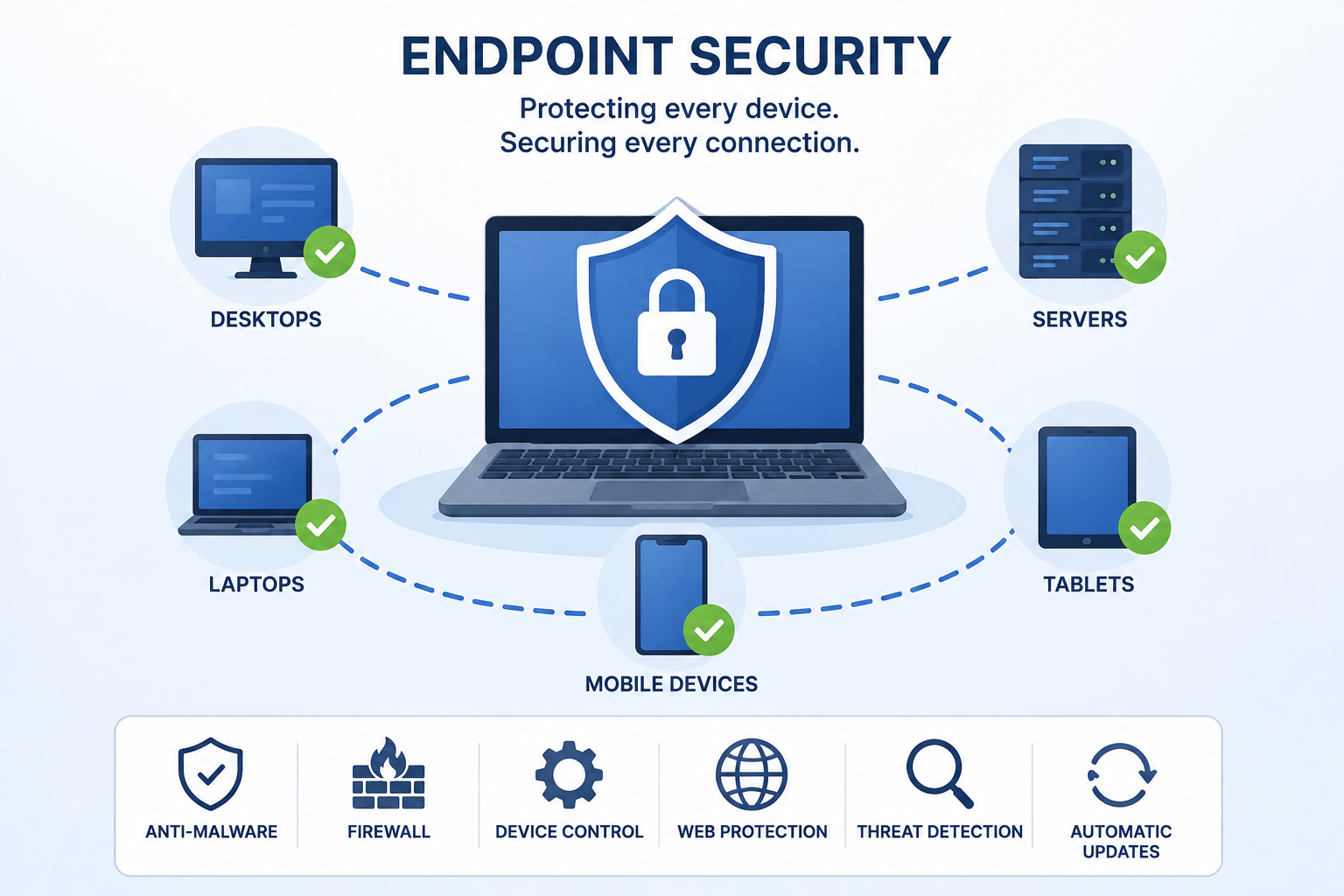
Every laptop an employee uses at home, every smartphone connecting to a corporate email account, every tablet accessing a company database, and every IoT sensor on a factory floor represents a potential entry point for cybercriminals. Organizations today manage hundreds or even thousands of these connected devices simultaneously, and every single one carries its own unique security risk. Understanding what is endpoint security has become one of the most critical priorities for businesses of every size, IT professionals, and increasingly for individual home users who want to protect their personal devices and sensitive data from the growing wave of modern cyber threats.
Quick Answer
What is endpoint security? Endpoint security is the practice of protecting individual devices, called endpoints, that connect to a network. These include laptops, desktops, smartphones, tablets, and IoT devices. Endpoint security solutions detect threats, prevent malware, monitor device activity, and respond to incidents in real time. It forms a critical layer of any comprehensive cybersecurity strategy for both businesses and individuals.
What Is Endpoint Security?
Endpoint security is a cybersecurity approach focused on protecting the individual devices that connect to organizational or home networks. An “endpoint” is any device that serves as an entry point to a network, including laptops, desktop computers, smartphones, tablets, servers, printers, and Internet of Things devices. Each endpoint represents a potential vulnerability that cybercriminals can target to gain unauthorized access to broader network resources and sensitive data.
Think of endpoint security as a personal security guard assigned to every single device connected to your network. Just as a security guard monitors who enters and exits a building, endpoint security software monitors all activity on each device, identifies suspicious behavior, blocks threats, and alerts security teams when something dangerous occurs. Without this device-level protection, attackers who compromise even a single employee’s laptop could potentially reach every connected system in an organization.
The scope of endpoint security extends far beyond simply installing antivirus software on a computer. Modern endpoint security platforms combine threat detection, behavioral analysis, data protection, device management, and incident response capabilities into comprehensive solutions that address the full spectrum of risks facing connected devices. As organizations become more distributed and employees connect from home offices, coffee shops, and remote locations around the world, securing every individual endpoint has never been more complex or more critical.
A practical example illustrates why this matters so much. In 2020, a major corporation suffered a significant breach when a cybercriminal compromised a single remote worker’s laptop through a phishing email. Because the laptop lacked proper endpoint security controls, the attacker moved from that device through the corporate VPN connection into internal systems, eventually accessing financial records affecting thousands of customers. Proper endpoint security with behavioral monitoring and network isolation capabilities could have detected and contained the threat at the compromised laptop before the attacker reached any internal systems.
Why Is Endpoint Security Important?
The importance of endpoint security has grown dramatically over the past several years, driven by fundamental shifts in how organizations operate and how cybercriminals attack.
Rise of Remote Work
The widespread adoption of remote and hybrid work models has transformed the endpoint security landscape permanently. Before 2020, most employees worked within corporate offices where their devices remained inside a relatively controlled network perimeter protected by enterprise firewalls and network security tools. Today, those same employees connect from home networks, public Wi-Fi hotspots, and personal devices that exist entirely outside traditional corporate security perimeters.
This shift means organizations can no longer rely primarily on network-level security to protect their data. Every remote device becomes its own security boundary that must be independently protected against the full range of cyber threats. Endpoint security solutions provide that device-level protection regardless of where the device is located or what network it connects through.
Increasing Cyber Attacks
Cybercriminals have recognized that endpoints represent the weakest links in modern organizational security. Attack volumes targeting individual devices have increased substantially year over year. Ransomware attacks increasingly begin with a compromised endpoint before spreading across organizational networks. Phishing campaigns targeting employees on personal devices exploit the reduced vigilance that comes with working outside formal office environments.
Data Protection
Endpoints frequently store, process, and transmit some of an organization’s most sensitive data including customer records, financial information, intellectual property, and employee personal data. Without proper endpoint security, a compromised device can expose this sensitive information directly to attackers. Strong endpoint protection prevents unauthorized data access, blocks data exfiltration attempts, and ensures sensitive information remains protected even when devices are lost or stolen.
Regulatory Compliance
Many industries face strict regulatory requirements for protecting sensitive data including HIPAA for healthcare, PCI DSS for payment card data, GDPR for European personal data, and numerous sector-specific standards. These regulations frequently mandate specific endpoint security controls including encryption, access management, and security monitoring. Organizations that fail to implement adequate endpoint security face significant regulatory fines and legal consequences.
Business Continuity
A successful endpoint attack can disrupt business operations significantly. Ransomware delivered through an endpoint can encrypt critical business files across an entire network, halting operations for days or weeks. Proper endpoint security reduces the likelihood of successful attacks and enables faster detection and response when incidents do occur, minimizing operational disruption and financial losses.
How Does Endpoint Security Work?
Modern endpoint security solutions operate through several interconnected mechanisms that work together to provide comprehensive device protection.
Threat Detection
Endpoint security software uses multiple detection methods to identify threats before they cause damage. Traditional signature-based detection compares files and processes against databases of known malware signatures. More importantly, modern solutions use behavioral analysis to identify suspicious activity patterns that suggest malicious intent, even from previously unknown threats that have no existing signatures.
Machine learning algorithms analyze vast amounts of data about normal device behavior and flag deviations that may indicate an attack in progress. For example, if a word processing application suddenly begins attempting to access the Windows registry, contact external servers, or encrypt large numbers of files, behavioral detection identifies this activity as abnormal and raises an alert immediately.
Device Monitoring
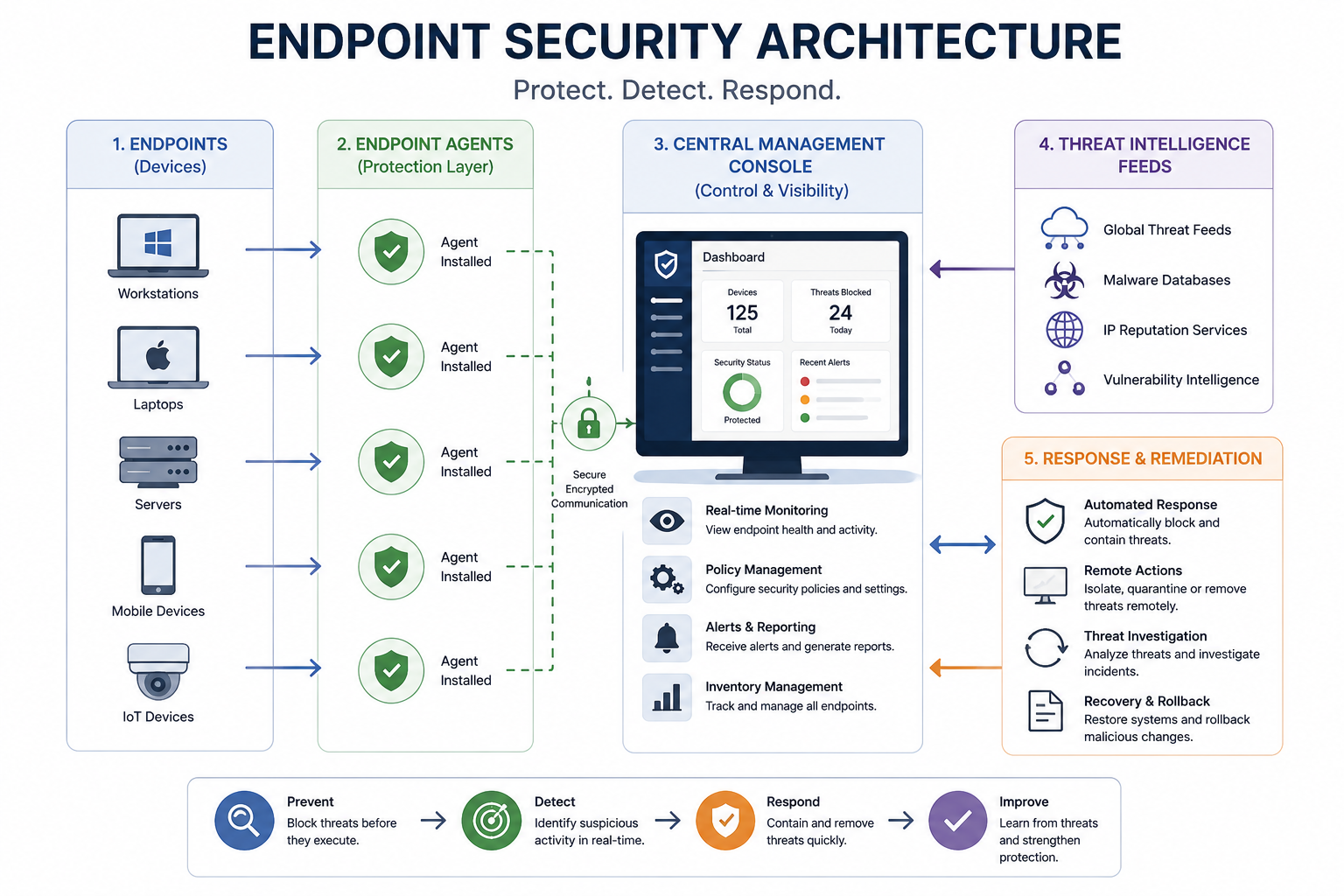
Continuous device monitoring provides security teams with complete visibility into everything happening on every endpoint. Endpoint agents collect detailed telemetry data including running processes, network connections, file system changes, user login events, application activity, and registry modifications. This data flows to a central management console where security analysts can review it in real time and investigate suspicious events.
Effective device monitoring is particularly valuable for detecting stealthy, slow-moving attacks that might not trigger immediate alerts. By maintaining complete visibility into endpoint activity over time, security teams can identify patterns that reveal attacker presence even when individual actions appear innocuous in isolation.
Malware Prevention
Modern endpoint security uses multiple technical mechanisms to prevent malware from executing on protected devices. Application control restricts which programs can run, preventing unauthorized executables from launching. Script blocking prevents malicious PowerShell or other scripting language commands from executing. Web filtering blocks connections to known malicious websites before malware can be downloaded. Email scanning identifies and quarantines malicious attachments before users can open them.
These preventive controls work alongside detection capabilities to create a layered defense that stops many threats before they ever execute, while ensuring that any threat that does penetrate initial defenses is quickly detected and contained.
Real-Time Protection
Real-time protection means the endpoint security solution actively monitors device activity at all times rather than performing periodic scans. Every file accessed, every process launched, every network connection attempted, and every script executed passes through real-time protection filters that evaluate it against threat intelligence and behavioral baselines before allowing it to proceed.
This continuous, real-time approach is essential for stopping modern threats that execute quickly and cause damage within seconds of activation. A ransomware attack that begins encrypting files can cause enormous damage if detection only occurs during a scheduled scan hours later. Real-time protection stops ransomware within milliseconds of detecting the characteristic rapid-fire file encryption behavior.
Incident Response
When endpoint security detects a confirmed threat, automated incident response capabilities activate to contain the damage immediately. These may include automatically isolating the affected device from the network to prevent the attack from spreading, terminating malicious processes, quarantining or deleting malicious files, and rolling back file system changes made by malware.
Simultaneously, the system generates detailed alerts and incident reports that help security teams understand exactly what happened, how the attack entered the system, what it attempted to do, and what remediation steps have already been taken automatically. This information is essential for both immediate response and for improving defenses against future similar attacks.
Continuous Updates
The cyber threat landscape evolves constantly as attackers develop new malware variants, novel attack techniques, and previously unknown vulnerabilities. Endpoint security solutions must continuously receive updates to remain effective against emerging threats. These updates include new malware signatures, updated behavioral detection rules, patched vulnerabilities in the security software itself, and refined machine learning models trained on the latest threat data.
Reputable endpoint security vendors maintain dedicated threat intelligence operations that monitor global attack activity around the clock and push updates to protected endpoints continuously. This ongoing intelligence cycle ensures that endpoint protection stays current against the most recently observed threats.
Types of Endpoint Security
Endpoint security encompasses several distinct solution categories, each addressing different aspects of device protection.
Types of Endpoint Security Comparison Table
| Type | Primary Function | Best For | Complexity | Cost Range |
|---|---|---|---|---|
| Antivirus Protection | Detect and remove known malware | Home users, small businesses | Low | Low-Free |
| EDR | Behavioral detection and incident response | Mid to large businesses | Medium-High | Medium-High |
| XDR | Cross-platform integrated threat detection | Large enterprises | High | High |
| MDM | Mobile device management and policy enforcement | Organizations with mobile workforces | Medium | Medium |
| DLP | Prevent unauthorized data transfer | Data-sensitive industries | Medium-High | Medium-High |
| Device Encryption | Protect data on lost or stolen devices | Everyone | Low-Medium | Low-Free |
Antivirus Protection
Antivirus software is the most foundational form of endpoint security. It scans files, emails, and downloads for known malware signatures and blocks or removes identified threats. Modern antivirus tools have evolved significantly beyond simple signature scanning to include heuristic analysis, cloud-based threat intelligence, and basic behavioral monitoring.
How it works: Antivirus compares files and processes against databases of known malware signatures and uses heuristic rules to identify files that behave like malware even without an exact signature match.
Benefits: Affordable, widely available, easy to deploy and manage, effective against known malware threats.
Limitations: Less effective against new zero-day malware without known signatures, limited incident response capabilities, and insufficient visibility for complex threat investigations.
Best use cases: Home users, very small businesses with limited security budgets, and as a baseline protection layer within a broader security stack.
Endpoint Detection and Response (EDR)
EDR represents a significant advancement beyond traditional antivirus. EDR solutions continuously collect and analyze endpoint telemetry data, use behavioral analytics and machine learning to detect sophisticated threats, provide detailed forensic investigation capabilities, and enable automated or analyst-guided incident response.
How it works: An EDR agent running on each endpoint collects comprehensive activity data and sends it to a central analysis platform. Advanced analytics identify suspicious behavioral patterns, trigger alerts, and enable security analysts to investigate incidents thoroughly using detailed forensic timelines.
Benefits: Detects sophisticated threats including fileless malware and advanced persistent threats, provides rich forensic data for investigations, enables rapid containment and response, and offers complete visibility into endpoint activity.
Limitations: Requires skilled security analysts to maximize effectiveness, generates high volumes of data requiring significant storage, and carries higher cost and complexity than basic antivirus solutions.
Best use cases: Organizations with dedicated security teams or managed security service providers, any business handling sensitive data or facing sophisticated threat actors.
Extended Detection and Response (XDR)
XDR extends EDR capabilities beyond individual endpoints to correlate threat data across multiple security layers including endpoints, networks, email systems, cloud environments, and identity platforms. XDR creates a unified threat detection and response platform that eliminates the visibility gaps that exist when different security tools operate in isolation.
How it works: XDR collects telemetry from endpoints, networks, email gateways, cloud services, and other security tools. A centralized analytics engine correlates this cross-domain data to detect sophisticated attacks that span multiple vectors and would be invisible to any single-layer security tool.
Benefits: Provides comprehensive visibility across the entire attack surface, reduces the alert volume through intelligent correlation, enables faster and more effective incident response, and eliminates security tool silos.
Limitations: Significantly more complex and expensive than EDR solutions, requires integration with existing security infrastructure, and demands experienced security personnel to manage effectively.
Best use cases: Large enterprises with complex multi-platform environments, organizations with mature security operations centers, and any organization facing advanced, multi-stage cyberattacks.
Mobile Device Management (MDM)
MDM solutions manage and secure the smartphones, tablets, and other mobile devices used by an organization’s workforce. As mobile devices increasingly access corporate email, applications, and data, managing their security and configuration has become a critical endpoint security requirement.
How it works: MDM platforms deploy management profiles to enrolled mobile devices, enabling IT administrators to enforce security policies, push software updates, configure device settings, remotely wipe lost or stolen devices, and control which applications can be installed and used.
Benefits: Enforces consistent security policies across all mobile devices, enables remote management and data wipe, separates personal and corporate data on employee-owned devices, and provides visibility into mobile device health and compliance.
Limitations: Requires employee enrollment and can raise privacy concerns on personal devices, may not provide deep behavioral threat detection, and requires careful policy design to balance security with user experience.
Best use cases: Organizations with significant mobile workforces, companies implementing bring-your-own-device (BYOD) policies, and any business where employees access corporate data on mobile devices.
Data Loss Prevention (DLP)
DLP solutions prevent sensitive data from leaving controlled environments through unauthorized channels. They monitor data in use on endpoints, data in motion across networks, and data at rest in storage systems, applying policy-based controls to prevent accidental or intentional data exfiltration.
How it works: DLP agents on endpoints monitor file access, email composition, web uploads, removable media transfers, and other data movement activities. When a user attempts to transfer data that matches sensitive data patterns such as credit card numbers, social security numbers, or classified document categories, the DLP solution blocks the transfer, alerts security teams, and logs the incident.
Benefits: Prevents accidental and intentional data breaches, helps meet regulatory compliance requirements, provides visibility into how sensitive data flows within and outside the organization, and protects intellectual property from insider threats.
Limitations: Can generate significant false positives that disrupt legitimate work, requires careful policy configuration to be effective, and does not detect threats that do not involve data movement.
Best use cases: Healthcare organizations, financial institutions, law firms, and any organization handling regulated or highly sensitive data where data exfiltration is a primary concern.
Device Encryption
Device encryption protects all data stored on an endpoint by converting it into an unreadable format that requires an encryption key to access. If a device is lost, stolen, or physically accessed by an unauthorized person, encrypted data remains completely inaccessible without the correct credentials.
How it works: Full-disk encryption software encrypts the entire storage drive of a device at the hardware or operating system level. Users must authenticate with their password or biometric credentials when the device boots, which unlocks the encryption key and makes the data accessible during normal use. If the device powers off or the authentication fails, the data remains encrypted and unreadable.
Benefits: Protects data on lost or stolen devices completely, requires no change in user behavior after initial setup, meets many regulatory compliance requirements, and provides strong protection against physical access attacks.
Limitations: Cannot protect against threats from authenticated users on the device, has minimal impact on active network-based attacks, and recovery can be complex if encryption keys are lost.
Best use cases: All laptops and mobile devices, especially those used by remote workers or employees who travel regularly with devices containing sensitive information.
Common Endpoint Security Threats
Understanding the threats that endpoint security defends against helps you appreciate why comprehensive protection is necessary.
Malware
Malware encompasses all malicious software including viruses, worms, trojans, spyware, and adware. Endpoints are the primary delivery targets for malware through email attachments, malicious downloads, infected websites, and USB devices. Once malware executes on an endpoint, it can steal data, damage files, establish persistent access, or serve as a launching pad for further attacks. For a comprehensive overview,
see our guide on What Is Malware?.
Ransomware
Ransomware encrypts all files on an infected endpoint and often spreads laterally to network-connected storage and other endpoints before demanding payment. A single compromised endpoint can serve as the entry point for a ransomware attack that cripples an entire organization within hours. Endpoint security with behavioral detection that identifies rapid file encryption activity is one of the most effective defenses against ransomware.
Learn more in our guide on What Is Ransomware?.
Phishing
Phishing attacks targeting endpoint users deliver malware, steal credentials, or trick employees into transferring funds or sensitive information. Modern phishing attacks are highly sophisticated and increasingly personalized. Email security integrated with endpoint protection provides overlapping defenses against phishing-delivered threats.
Our guide on What Is Phishing? covers this threat comprehensively.
Insider Threats
Insider threats involve current or former employees, contractors, or business partners who intentionally or accidentally misuse their authorized access to cause harm. Endpoint security monitoring provides visibility into unusual user behavior, unauthorized data access, and policy violations that may indicate malicious or negligent insider activity. DLP solutions are particularly valuable for detecting and preventing insider-driven data exfiltration.
Fileless Attacks
Fileless attacks execute malicious code entirely in memory without writing any files to the endpoint’s storage drive. Because traditional antivirus tools look for malicious files on disk, fileless attacks frequently evade detection. EDR solutions with behavioral monitoring detect fileless attacks by identifying suspicious activity from legitimate system processes being used maliciously, such as unusual PowerShell script execution or abnormal system administration tool behavior.
Zero-Day Exploits
Zero-day exploits target previously unknown vulnerabilities in software or operating systems for which no patch yet exists. Because signature-based security tools have no signatures for zero-day threats, behavioral detection and machine learning capabilities in advanced endpoint security solutions are essential for identifying attacks that exploit these unknown vulnerabilities through abnormal behavior patterns.
USB Attacks
USB attacks deliver malware through infected flash drives, external hard drives, and even charging cables. Employees who plug unknown or untrusted USB devices into work computers can inadvertently introduce malware that bypasses network-based security controls entirely. Endpoint security policies that restrict or monitor USB device usage provide essential protection against this physical attack vector.
Credential Theft
Attackers target endpoints specifically to steal user credentials that provide access to corporate systems, cloud services, and financial accounts. Keyloggers capture passwords as they are typed. Browser-based credential stealers extract saved passwords from browser storage. Credential theft enablers extensive account takeover and lateral movement within organizational networks. Endpoint security combined with multi-factor authentication provides layered defense against credential-based attacks.
Endpoint Security vs Antivirus
Many people use the terms “endpoint security” and “antivirus” interchangeably. Understanding their important differences helps organizations choose the right level of protection for their needs.
Endpoint Security vs Antivirus Table
| Factor | Antivirus | Endpoint Security |
|---|---|---|
| Scope | Protects against known malware | Comprehensive device and data protection |
| Detection Method | Primarily signature-based | Signature, behavioral, AI, and machine learning |
| Threat Coverage | Known viruses and malware | Known and unknown threats including zero-days |
| Incident Response | Limited or manual | Automated containment and response |
| Forensic Capability | Minimal | Detailed forensic investigation tools |
| Management | Device-by-device | Centralized management console |
| Visibility | Individual device, limited | Complete visibility across all endpoints |
| Best For | Home users, very small businesses | Businesses of all sizes, regulated industries |
| Integration | Standalone | Integrates with broader security ecosystem |
| Cost | Low to free | Medium to high |
The key takeaway is straightforward. Antivirus is a component within endpoint security, not a replacement for it. Modern endpoint security platforms include antivirus capabilities but layer them with significantly more sophisticated detection, response, and management tools that address the full spectrum of modern threats.
Endpoint Security vs Network Security
Endpoint security and network security are complementary disciplines that together create comprehensive organizational protection. They address different aspects of the same security challenge.
Endpoint Security vs Network Security Table
| Factor | Endpoint Security | Network Security |
|---|---|---|
| Protection Focus | Individual devices and their data | Network infrastructure and traffic |
| Where It Operates | On each individual device | At network boundaries and within network infrastructure |
| Threats Addressed | Device-level malware, data theft, device compromise | Network intrusions, traffic-based attacks, lateral movement |
| Key Technologies | EDR, antivirus, DLP, encryption | Firewalls, IDS/IPS, network monitoring |
| Visibility | Deep visibility into device-level activity | Visibility into network traffic and connections |
| Remote Work Coverage | Protects devices anywhere | Limited to defined network boundaries |
| Insider Threat Detection | Strong through behavioral monitoring | Moderate through network behavior analysis |
| Compliance Support | Device encryption, access control | Network access control, traffic monitoring |
Neither endpoint security nor network security alone provides complete protection. Organizations need both working together, as attackers routinely chain network-level and endpoint-level techniques in the same attack campaign. For more on network-level protection,
see our guide on Network Security .
Benefits of Endpoint Security
Implementing comprehensive endpoint security delivers substantial security and business benefits beyond simply preventing individual device infections.
Endpoint Security Benefits Checklist
| Benefit | Impact Level | Applies To |
|---|---|---|
| Protects against malware and ransomware | Critical | All organizations |
| Provides centralized device visibility | High | Businesses |
| Enables faster incident response | Critical | All organizations |
| Supports regulatory compliance | High | Regulated industries |
| Protects remote and mobile workers | Critical | Organizations with distributed workforces |
| Reduces risk of data breaches | Critical | All organizations |
| Detects insider threats | High | Businesses |
| Prevents data exfiltration | High | Data-sensitive organizations |
| Reduces financial losses from attacks | Critical | All organizations |
| Provides forensic investigation capabilities | High | Businesses with security teams |
| Protects lost and stolen devices | High | All organizations |
| Enables automated threat response | High | Businesses |
| Improves security policy enforcement | Medium | Businesses |
| Integrates with broader security ecosystem | High | Enterprises |
| Enhances employee security awareness | Medium | All organizations |
- Endpoint security dramatically reduces the risk of successful malware and ransomware attacks by combining multiple detection and prevention layers on every protected device.
- Centralized management consoles provide IT and security teams with complete visibility across every endpoint in the organization simultaneously, regardless of device location.
- Faster incident response through automated threat containment prevents attacks from spreading from initial compromised endpoints to broader organizational networks.
- Comprehensive logging and forensic data collection supports regulatory compliance requirements and provides the detailed audit trails that regulations like HIPAA and GDPR mandate.
- Remote and mobile workers receive consistent, strong protection regardless of what network they connect through, eliminating the security gap created by remote work.
- Data loss prevention capabilities within endpoint security platforms significantly reduce the risk of sensitive data breaches through both accidental and intentional exfiltration.
- Behavioral monitoring detects insider threats through identification of unusual data access patterns, policy violations, and anomalous user behavior on protected devices.
- Endpoint encryption ensures that data on lost or stolen devices remains completely inaccessible to unauthorized parties, eliminating one of the most common breach scenarios.
- Reduced financial losses from prevented attacks, faster response times, and lower breach recovery costs provide measurable return on endpoint security investment.
- Detailed forensic investigation capabilities help security teams understand exactly how attacks occurred, what data was affected, and what remediation steps are necessary.
- Automated threat response reduces the burden on security teams by handling routine containment actions without requiring manual analyst intervention for every detected event.
- Consistent security policy enforcement across all endpoints ensures every device meets organizational security standards regardless of individual user behavior or preferences.
- Integration with network security, identity management, and cloud security tools creates a unified security ecosystem with dramatically improved threat detection across all vectors.
- Endpoint security solutions frequently include employee-facing security awareness features that educate users about threats and reinforce safe behaviors during normal device use.
- Reduced dwell time for undetected threats means attackers spend less time inside organizational systems before being discovered and removed, limiting potential damage significantly.
Endpoint Security Best Practices
Following consistent endpoint security best practices maximizes the effectiveness of your security tools and reduces the risk of successful attacks.
Endpoint Security Best Practices Checklist
| Best Practice | Priority | Frequency |
|---|---|---|
| Keep all software updated | Critical | As released |
| Enable automatic updates | Critical | Always |
| Use strong unique passwords | Critical | Always |
| Enable multi-factor authentication | Critical | Always |
| Encrypt all endpoint devices | Critical | Always |
| Install trusted endpoint security software | Critical | Always |
| Limit administrative privileges | High | Ongoing |
| Monitor all endpoints centrally | High | Continuous |
| Back up data regularly | Critical | Daily minimum |
| Train employees on security | High | Regularly |
| Remove unused applications | Medium | Quarterly |
| Enforce USB device policies | High | Always |
| Segment network to limit breach spread | High | During design |
| Conduct regular endpoint audits | High | Quarterly |
| Implement application whitelisting | Medium | Ongoing |
| Use VPN for remote connections | High | Always for remote work |
| Enable firewall on all devices | Critical | Always |
| Develop an incident response plan | High | Ongoing |
| Test backups regularly | High | Monthly |
| Review security logs regularly | High | Weekly minimum |
- Keep all operating systems, applications, and endpoint security software updated with the latest patches immediately after they are released. Unpatched vulnerabilities are among the most common ransomware and malware entry points.
- Enable automatic updates on all managed endpoints to ensure security patches install without depending on manual action from employees or administrators who may delay updates.
- Enforce strong, unique password requirements for all endpoint login credentials and every application account accessed from organizational devices.
- Enable multi-factor authentication on every account accessible from organizational endpoints, particularly email, VPN, cloud services, and administrative consoles.
- Encrypt the full storage drives of every laptop, tablet, and mobile device in the organization. This single step eliminates the data breach risk from lost or stolen devices entirely.
- Install reputable, enterprise-grade endpoint security software on every device rather than relying on basic antivirus tools. Ensure solutions include behavioral detection and real-time monitoring capabilities.
- Limit administrative privileges to only those users who genuinely require them for their roles. Standard users should not have local administrator access, as this significantly limits what malware can do if it executes.
- Implement centralized endpoint monitoring that provides real-time visibility into the status, activity, and security posture of every device in the organization.
- Maintain regular automated backups of all endpoint data and store at least one copy in an offline or immutable location that malware cannot reach. Test backup restoration regularly to confirm recoverability.
- Provide regular cybersecurity awareness training to all employees covering phishing recognition, safe browsing habits, password security, and specific endpoint security policies.
- Quarterly, review all installed applications on managed endpoints and remove any unused or unauthorized software that represents unnecessary attack surface.
- Enforce strict USB and removable media policies that prevent or control the use of unauthorized external storage devices on organizational endpoints.
- Segment your network so that a compromised endpoint in one area cannot freely communicate with endpoints and servers in other sensitive network zones, limiting breach spread.
- Conduct quarterly endpoint security audits that assess configuration compliance, installed software currency, security tool health, and policy adherence across all managed devices.
- Implement application whitelisting in environments handling particularly sensitive data, allowing only specifically approved applications to execute on protected endpoints.
- Require VPN usage for all remote connections to organizational systems, ensuring that traffic from endpoints outside the office perimeter is encrypted and routed through controlled security infrastructure.
- Ensure the operating system firewall is enabled on every endpoint and configured with appropriate rules that restrict unnecessary inbound and outbound connections.
- Develop and regularly test a formal endpoint security incident response plan so your team knows exactly how to respond when a device is compromised, including isolation, investigation, and recovery procedures.
- Regularly test backup restoration processes rather than simply assuming backups are working correctly. Discovering a backup failure during an active ransomware recovery is a devastating and avoidable situation.
- Establish regular security log review processes to identify suspicious patterns, policy violations, and potential indicators of compromise before they develop into serious incidents.
Best Endpoint Security Solutions
The endpoint security market offers several distinct categories of solutions suited to different organizational needs, sizes, and security maturity levels.
Endpoint Protection Platforms (EPP)
Endpoint Protection Platforms represent the foundational layer of endpoint security. EPP solutions combine traditional antivirus, anti-malware, device control, web filtering, and basic behavioral protection into a unified platform with centralized management. EPP is appropriate for organizations that need comprehensive baseline protection across a large device fleet without requiring advanced forensic investigation capabilities. EPP solutions are widely available from established security vendors and scale well from small businesses to large enterprises.
Endpoint Detection and Response (EDR)
EDR solutions go significantly beyond EPP by adding continuous telemetry collection, advanced behavioral analytics, threat hunting capabilities, and sophisticated incident response tools. Organizations with dedicated security operations center teams or managed security service provider relationships benefit most from EDR. These platforms enable security analysts to investigate complex incidents thoroughly, hunt for hidden threats proactively, and respond to confirmed incidents with granular control over affected endpoints.
XDR Platforms
Extended Detection and Response platforms represent the current evolution of endpoint security toward integrated, cross-domain threat detection and response. XDR platforms ingest data from endpoints, networks, email systems, cloud environments, and identity platforms, correlating signals across all these sources to detect sophisticated attacks that span multiple vectors. XDR is particularly valuable for large organizations with complex security environments where attack correlation across different security domains is essential for effective detection.
Mobile Endpoint Security
Dedicated mobile endpoint security solutions address the specific security challenges of smartphones and tablets that traditional EPP and EDR tools were not designed to handle. Mobile security platforms combine MDM capabilities with threat detection, app security scanning, network protection, and phishing defense tailored for mobile operating systems including iOS and Android. As mobile devices increasingly serve as primary work tools, dedicated mobile security solutions have become essential components of enterprise endpoint security strategies.
When evaluating endpoint security solutions, organizations should assess their specific threat environment, security team capabilities, existing infrastructure, compliance requirements, budget, and the number and types of devices requiring protection. A combination of solution categories working together typically provides stronger protection than any single platform alone.
Common Myths About Endpoint Security
Several persistent misconceptions about endpoint security lead organizations to underinvest in device protection or deploy inadequate solutions.
Myth 1: Antivirus Software Is Sufficient for Complete Endpoint Protection
Traditional antivirus provides valuable but fundamentally limited protection. Modern threats including fileless malware, zero-day exploits, and advanced persistent threats routinely evade signature-based antivirus detection. Comprehensive endpoint security requires behavioral detection, continuous monitoring, and incident response capabilities that antivirus alone cannot provide.
Myth 2: Small Businesses Do Not Need Endpoint Security
Cybercriminals actively target small businesses precisely because they typically have fewer security resources and controls than larger organizations. Small businesses represent attractive targets for ransomware operators, credential thieves, and fraudsters. Affordable endpoint security solutions scaled for small business environments provide essential protection that matches the real threat level these organizations face.
Myth 3: Endpoint Security Significantly Slows Down Devices
Modern endpoint security solutions are engineered to operate efficiently with minimal impact on device performance. While older or poorly optimized security tools sometimes caused noticeable performance degradation, current EPP and EDR solutions run efficiently in the background on modern hardware without meaningfully affecting user productivity.
Myth 4: Macs Do Not Need Endpoint Security
macOS faces a growing volume of targeted malware, ransomware, and spyware as Apple’s market share increases. Endpoint security solutions for macOS are essential in organizational environments. Assuming Mac devices are inherently secure and require no endpoint protection is an increasingly dangerous misconception.
Myth 5: Endpoint Security Only Protects Against External Threats
Endpoint security’s behavioral monitoring and DLP capabilities provide significant protection against insider threats, including both malicious and accidental data exfiltration by authorized users. Monitoring unusual access patterns, unauthorized data transfers, and policy violations is equally important as blocking external attackers.
Myth 6: Cloud-Based Applications Do Not Require Endpoint Security
Moving applications to the cloud does not eliminate the need for endpoint security on the devices accessing those applications. Compromised endpoints can steal cloud service credentials, intercept browser sessions, and exfiltrate data downloaded from cloud applications to local device storage. Endpoint security remains essential regardless of where applications are hosted.
Myth 7: Installing Endpoint Security Once Is Sufficient
Endpoint security requires ongoing management, continuous updates, regular policy reviews, and consistent monitoring to remain effective. Threat landscapes evolve constantly, and endpoint security configurations must evolve alongside them. A solution that was appropriate eighteen months ago may have significant gaps against current threats.
Myth 8: Endpoint Security Is Too Complex for Small IT Teams
Many modern endpoint security solutions are specifically designed for small to medium businesses with limited IT resources. Cloud-managed platforms with simplified interfaces, automated responses, and pre-configured security policies make effective endpoint security accessible without requiring a dedicated security operations team.
Myth 9: A VPN Provides Adequate Endpoint Protection for Remote Workers
VPNs encrypt network traffic between remote devices and organizational systems but do not protect against threats that originate on the endpoint itself. A compromised remote device connected through VPN carries threats directly into the organizational network. Endpoint security is essential alongside VPN for remote workers.
Myth 10: All Endpoint Security Solutions Provide Equal Protection
Endpoint security solutions vary enormously in their detection capabilities, response features, performance impact, management quality, and threat intelligence depth. Independent testing organizations regularly publish comparative evaluations that reveal significant performance differences between products. Choosing the right solution requires careful evaluation against specific organizational requirements and threat environments.
Future of Endpoint Security
The endpoint security landscape is evolving rapidly in response to changing threats, new technologies, and expanding attack surfaces.
Artificial Intelligence
AI is fundamentally transforming endpoint security’s detection and response capabilities. AI-powered endpoint security analyzes massive volumes of behavioral data to identify subtle threat patterns that human analysts and rule-based systems miss. AI enables security tools to detect previously unknown threats based on behavioral similarities to known attack patterns, dramatically improving protection against zero-day exploits and novel malware variants.
Machine Learning
Machine learning models continuously improve their threat detection accuracy as they process more endpoint telemetry data from across large customer bases. These models learn to distinguish between genuinely suspicious behavior and benign activity that resembles threats, progressively reducing false positive rates while maintaining strong detection accuracy. The collective intelligence gathered from millions of protected endpoints globally makes machine learning-powered endpoint security increasingly effective over time.
Zero Trust Security
The Zero Trust security model, which operates on the principle of verifying every user and device continuously rather than trusting based on network location, is increasingly influencing endpoint security design. Endpoint security solutions are integrating with identity platforms and network access controls to enforce continuous verification that any endpoint attempting to access resources meets current security posture requirements.
Cloud-Based Endpoint Security
Cloud-delivered endpoint security platforms offer significant advantages over traditional on-premises security infrastructure. Cloud platforms update instantly with the latest threat intelligence, scale automatically with organizational growth, enable management of distributed device fleets from anywhere, and eliminate the hardware and maintenance costs of on-premises security infrastructure. Cloud-based endpoint security is becoming the standard deployment model for organizations of all sizes.
XDR Evolution
XDR continues to mature as vendors integrate more data sources, improve cross-domain correlation capabilities, and add increasingly automated response features. As XDR platforms mature, they will provide increasingly comprehensive protection against sophisticated multi-stage attacks with less analyst effort, making enterprise-grade threat detection capabilities accessible to organizations with smaller security teams.
Automation
Security automation in endpoint security is reducing response times from hours or days to milliseconds. Automated playbooks execute consistent, pre-approved response actions immediately when specific threat conditions are detected. This automation handles routine threat containment tasks reliably and at scale, freeing security analysts to focus on complex investigation and strategic security improvement activities.
Frequently Asked Questions
What is endpoint security?
Endpoint security is the practice of protecting individual devices, called endpoints, that connect to networks. It encompasses the technologies, processes, and practices used to secure laptops, desktops, smartphones, tablets, servers, and IoT devices against cyber threats including malware, ransomware, data theft, and unauthorized access.
Why is endpoint security important?
Endpoint security is important because every connected device represents a potential entry point for cybercriminals. With remote work, mobile devices, and IoT proliferation expanding the number of endpoints organizations must protect, securing individual devices has become essential for preventing data breaches, ransomware attacks, and regulatory violations.
What is EDR?
Endpoint Detection and Response (EDR) is an advanced endpoint security capability that continuously collects device telemetry, uses behavioral analytics and machine learning to detect sophisticated threats, provides forensic investigation tools, and enables automated or analyst-guided incident response. EDR addresses threats that traditional antivirus tools cannot detect.
What is the difference between antivirus and endpoint security?
Antivirus is a component within endpoint security that primarily detects known malware through signature comparison. Endpoint security is a much broader discipline encompassing antivirus plus behavioral detection, continuous monitoring, incident response, data loss prevention, device encryption, and centralized management. Endpoint security addresses the full spectrum of modern threats rather than just known malware.
What devices need endpoint security?
Every device that connects to a network needs some form of endpoint security. This includes laptops, desktop computers, smartphones, tablets, servers, printers, and IoT devices. Any device that can access organizational data or serve as an entry point to organizational networks requires appropriate endpoint protection controls.
Is endpoint security necessary for home users?
Yes. Home users face real threats from malware, ransomware, phishing, and credential theft targeting personal devices. While enterprise-grade EDR solutions are typically unnecessary for home use, robust endpoint security including antivirus, device encryption, automatic updates, and multi-factor authentication is essential for protecting personal data and financial accounts.
What is XDR?
Extended Detection and Response (XDR) is an evolution of EDR that integrates threat detection and response capabilities across multiple security domains including endpoints, networks, email systems, cloud environments, and identity platforms. XDR correlates data across all these sources to detect sophisticated attacks that span multiple vectors and would be invisible to any single-layer security tool.
Can endpoint security stop ransomware?
Modern endpoint security with behavioral detection capabilities is highly effective against ransomware. By identifying the characteristic behavioral patterns of ransomware such as rapid file encryption, shadow copy deletion, and unusual process activity, behavioral endpoint security can stop ransomware attacks within seconds of their initiation, before significant file encryption occurs.
How does endpoint security work?
Endpoint security agents installed on each device continuously monitor activity, collect telemetry, and apply threat detection rules to identify suspicious behavior. When threats are detected, automated responses contain the incident while security teams are alerted. Central management consoles provide visibility across all protected endpoints and enable policy management and investigation.
What are endpoint security best practices?
Key best practices include keeping all software updated, using strong passwords with MFA, encrypting all devices, limiting administrative privileges, conducting regular employee security training, maintaining offline backups, monitoring all endpoints centrally, enforcing USB device policies, and developing a formal incident response plan.
What is mobile endpoint security?
Mobile endpoint security combines MDM device management with threat detection, application security, phishing protection, and network security capabilities specifically designed for smartphones and tablets. It manages security policies, enforces encryption, enables remote device wipe, and protects mobile devices against the threats specifically targeting iOS and Android platforms.
What is device encryption?
Device encryption converts all data stored on a device’s storage drive into an unreadable format that requires authentication to access. Full-disk encryption ensures that if a device is lost, stolen, or physically accessed without proper credentials, all stored data remains completely inaccessible to unauthorized parties.
Can small businesses benefit from endpoint security?
Absolutely. Small businesses face significant cybersecurity risks and often suffer disproportionate impact from successful attacks due to limited recovery resources. Cloud-managed endpoint security solutions designed for small and medium businesses provide enterprise-grade protection with simplified management interfaces and pricing scaled appropriately for smaller organizations.
How often should endpoint security software be updated?
Endpoint security software should update automatically and continuously as vendors release new threat intelligence and software improvements. Administrators should verify that automatic updates are functioning correctly on all endpoints and apply any major platform updates promptly. Security policies and configurations should be reviewed quarterly at minimum.
What is the future of endpoint security?
The future of endpoint security involves AI and machine learning-powered detection that identifies previously unknown threats, deeper Zero Trust integration requiring continuous endpoint verification, cloud-delivered platforms that scale dynamically, XDR correlation across all security domains, and increasing automation that reduces response times while requiring less manual analyst effort.
People Also Ask
What is endpoint security?
Endpoint security is the practice of protecting individual network-connected devices including laptops, smartphones, tablets, and desktops from cyber threats through detection, prevention, monitoring, and incident response capabilities.
Why is endpoint security important?
Every connected device represents a potential breach entry point. With remote work and mobile devices expanding attack surfaces dramatically, endpoint security is essential for preventing data breaches, ransomware infections, and regulatory violations.
What is EDR?
EDR (Endpoint Detection and Response) provides continuous device monitoring, behavioral threat detection using AI and machine learning, forensic investigation capabilities, and automated incident response beyond what traditional antivirus offers.
What is XDR?
XDR (Extended Detection and Response) integrates threat detection across endpoints, networks, email, cloud, and identity platforms, correlating data from all sources to detect sophisticated multi-vector attacks invisible to single-layer tools.
What is the difference between antivirus and endpoint security?
Antivirus detects known malware through signature matching. Endpoint security is a broader discipline adding behavioral detection, continuous monitoring, incident response, DLP, encryption, and centralized management to address the full spectrum of modern threats.
What devices require endpoint security?
All network-connected devices require endpoint security including laptops, desktops, smartphones, tablets, servers, printers, and IoT devices. Any device accessing organizational data or connecting to organizational networks needs appropriate protection.
Can endpoint security stop ransomware?
Yes. Modern endpoint security with behavioral detection identifies ransomware’s characteristic file-encryption activity patterns and stops attacks within seconds, before significant damage occurs. This behavioral approach is effective even against new ransomware variants without existing signatures.
Is endpoint security necessary for small businesses?
Yes. Small businesses are actively targeted by cybercriminals and face significant risk from ransomware, data theft, and fraud. Affordable, cloud-managed endpoint security solutions provide essential protection scaled appropriately for small business environments and budgets.
How does endpoint security work?
Endpoint security agents monitor device activity continuously, detect threats through behavioral analysis and threat intelligence, contain incidents automatically, and report to centralized management consoles that provide visibility and control across all protected devices.
What are endpoint security best practices?
Key practices include keeping software updated, enabling MFA, encrypting devices, limiting admin privileges, training employees, maintaining tested backups, monitoring all endpoints centrally, enforcing USB policies, and developing formal incident response procedures.
Final Thoughts
Understanding what is endpoint security and implementing it effectively across every connected device is one of the most important and impactful steps any organization or individual can take toward genuine cybersecurity resilience in 2026. The days when protecting a corporate office network perimeter was sufficient to secure organizational data are long gone. Today, every laptop in a home office, every smartphone checking corporate email, every tablet connecting to a business application, and every IoT device on a corporate network represents its own security boundary that requires dedicated protection.
The good news is that endpoint security has never been more capable, more accessible, or more cost-effective than it is today. Cloud-managed platforms make enterprise-grade protection available to small businesses without requiring large IT teams. AI and machine learning-powered detection identifies sophisticated threats that evade traditional tools. Automated response capabilities contain incidents in seconds rather than hours. The technology available to defenders has advanced dramatically alongside the evolution of threats.
Start by assessing every device in your environment that connects to networks or handles sensitive data. Deploy appropriate endpoint security solutions to protect every one of those devices. Follow the twenty best practices outlined in this guide consistently. Keep every component of your endpoint security ecosystem updated and actively monitored.
Build your broader security strategy by exploring our guides on What Is Cybersecurity?,
References
- Cybersecurity and Infrastructure Security Agency (CISA). Endpoint Security Guidance and Cybersecurity Resources. Available at: https://www.cisa.gov
- National Institute of Standards and Technology (NIST). Guidelines for Managing the Security of Mobile Devices in the Enterprise. SP 800-124. Available at: https://www.nist.gov
- Microsoft Security. Endpoint Detection and Response and Endpoint Protection Resources. Available at: https://www.microsoft.com/security
- Cisco Security. Endpoint Security and Threat Defense Resources. Available at: https://www.cisco.com/security
- CrowdStrike. Endpoint Detection and Response and Threat Intelligence Resources. Available at: https://www.crowdstrike.com
- SentinelOne. Endpoint Security Platform and EDR Documentation. Available at: https://www.sentinelone.com
Disclaimer
This article is for educational and informational purposes only. It explains endpoint security concepts and defensive cybersecurity practices. It does not provide instructions for unauthorized access, exploitation, or malicious activities. Always follow legal cybersecurity practices and use trusted security solutions.
Author Bio
TechOriginHub Editorial Team is a team of cybersecurity researchers and technology writers dedicated to creating accurate, easy-to-understand, and up-to-date content on cybersecurity, AI, cloud computing, and emerging technologies.
 saman zahra