
 By TechOriginHub Editorial Team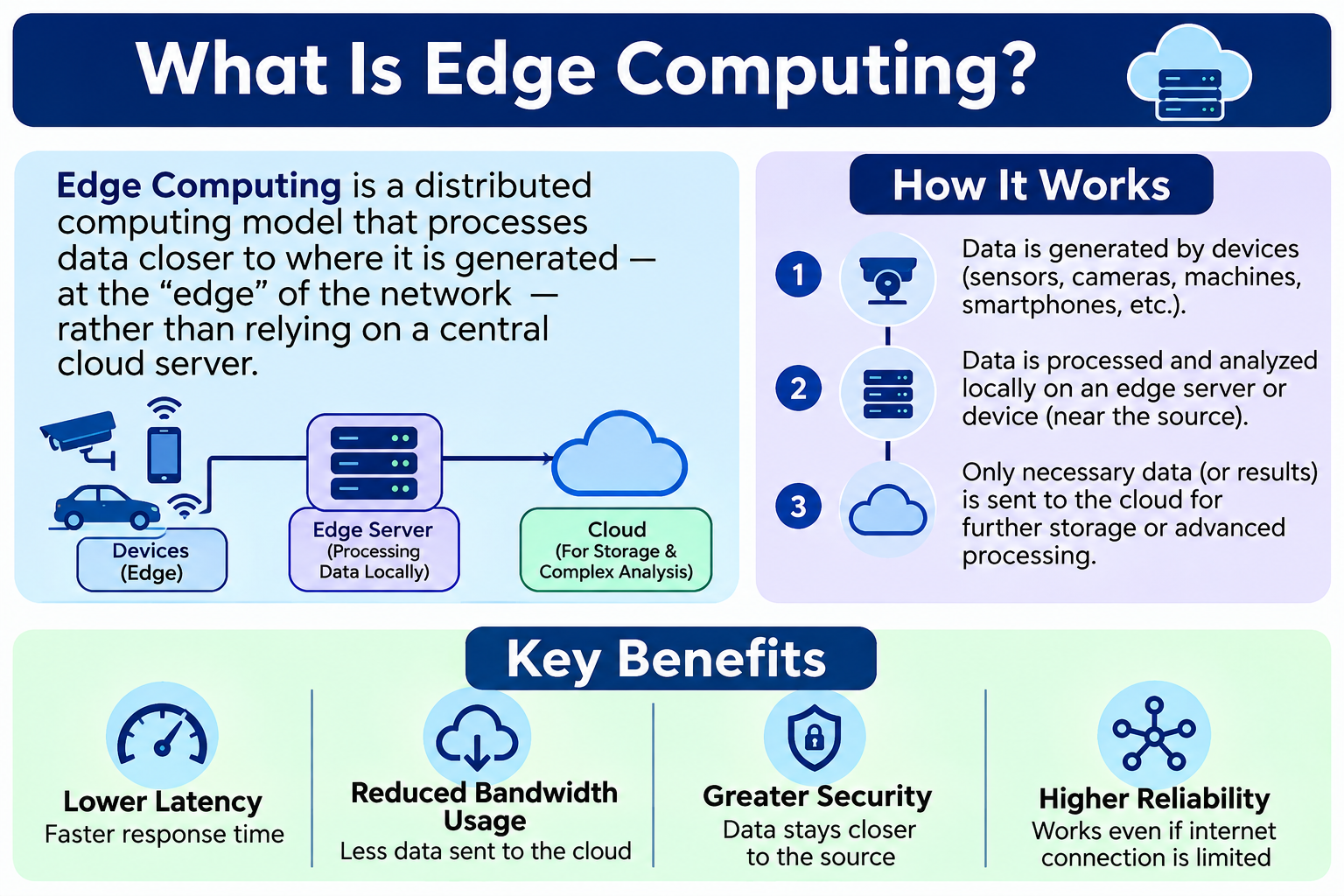
Every time a device sends data to a distant cloud server for processing, it takes time. For many applications, that delay is acceptable. For others, even a fraction of a second can matter. A self-driving vehicle making a split-second safety decision, an industrial machine detecting a fault mid-operation, or a hospital monitor responding to a patient’s vital signs cannot wait for data to travel to a data center and back. Edge computing addresses this by moving computation and data processing closer to where data is generated or where users consume services. Understanding what is edge computing, how it works, and where it fits alongside cloud computing helps technology professionals, developers, and business leaders make better infrastructure decisions. For foundational context on cloud computing, begin with [What Is Cloud Computing? A Beginner’s Guide].
Quick Answer: What Is Edge Computing?
Edge computing is a distributed computing approach that processes data closer to where it is generated or consumed, rather than sending everything to a centralized cloud or data center. By moving computation nearer to the data source or end user, edge computing can reduce latency, lower bandwidth usage, and support real-time applications. Edge and cloud computing often work together rather than replacing each other.
What Is Edge Computing?
Edge computing is a distributed computing model that brings data processing, storage, or computation closer to the point where data originates or where users need results. Instead of sending all data to a centralized cloud or data center for processing, edge computing performs some or all of that work at or near the data source.
The concept becomes concrete with a practical example. Consider a smart security camera installed at a building entrance. In a purely cloud-dependent setup, the camera would stream video continuously to a distant cloud server, which would then analyze the footage for events such as motion detection or face recognition. In an edge computing model, the analysis happens on the camera itself or on a nearby edge server. Only relevant alerts or selected data travel to the cloud. This reduces bandwidth consumption and can enable faster local responses.
The word “edge” in this context refers to the edge of a network, meaning the boundary between devices generating or consuming data and the broader network infrastructure connecting them. An edge device might be a sensor on a factory floor, a gateway in a retail store, a server in a telecommunications facility, or a computing unit in a vehicle. The specific meaning of “edge” varies by architecture and deployment.
Edge computing does not operate in isolation from cloud computing. In most practical deployments, edge and cloud infrastructure work together. Edge handles time-sensitive local processing, and cloud handles centralized storage, large-scale analytics, and management. [What Is Cloud Computing? A Beginner’s Guide] explains cloud computing comprehensively, providing useful context for understanding how edge computing relates to and differs from it.
Why Is Edge Computing Important?
Several practical challenges with purely centralized cloud architectures have driven interest in edge computing.
Lower latency is one of the most commonly cited motivations. When data must travel from a device to a distant cloud server and back, the round-trip time adds delay. For applications where decisions need to happen in milliseconds, such as industrial automation or vehicle safety systems, that delay can be problematic. Processing data locally or nearby can reduce that delay meaningfully, though the actual improvement depends on the network architecture and the distance to the nearest processing resource.
Reduced bandwidth usage can be significant for applications that generate large volumes of data. A factory with hundreds of sensors continuously generating readings, or a retail location with multiple cameras recording at high resolution, would consume substantial network bandwidth sending all that data to a cloud for processing. Processing locally and sending only relevant results or summaries reduces that load considerably.
Faster local processing enables immediate decisions without depending on network connectivity to a centralized system. A machine can respond to a detected fault, a camera can trigger an alarm, or a medical device can alert a caregiver based on local analysis rather than waiting for a cloud response.
Better support for real-time applications means edge computing is particularly relevant for workloads where the value of a decision depends on its timeliness. Monitoring systems, safety controls, and interactive applications all benefit from reduced processing delay.
Potential resilience during network interruptions is another consideration. An edge system that processes data locally can continue operating if its connection to the central cloud is temporarily unavailable, depending on how the application is designed. This does not mean edge computing provides automatic fault tolerance, but local processing capability can reduce dependency on continuous connectivity.
Data processing near the source can also have privacy and regulatory implications. Processing data locally and sending only necessary information to the cloud can reduce the volume of personal or sensitive data transmitted over networks and stored in centralized systems.
How Does Edge Computing Work?
Edge computing involves several steps that move data processing closer to the source while maintaining a connection to centralized infrastructure where appropriate.
- A device or system generates data. This might be a sensor recording temperature, a camera capturing video, a vehicle collecting navigation data, or a medical device measuring patient readings.
- That data is sent to a nearby edge device, gateway, or node rather than directly to a distant cloud server.
- The edge environment processes some or all of the data locally. This might mean running an analysis algorithm, filtering out irrelevant data, detecting patterns, or making a real-time decision.
- Immediate decisions can be made based on local processing results without waiting for network round trips. A machine can be stopped, an alert can be triggered, or a response can be generated locally.
- Important, selected, or summarized data may then be sent to a centralized cloud for further processing, long-term storage, or aggregation with data from other locations.
- The cloud can perform tasks that benefit from centralized resources, such as training analytical models, storing historical records, running large-scale analytics, or managing multiple edge deployments from a single interface.
- Results, configuration updates, or management instructions can be sent back to edge devices or users when necessary.
The balance between edge and cloud processing depends entirely on the application’s requirements. Some workloads benefit from processing everything at the edge with only minimal data reaching the cloud. Others use the edge primarily for filtering and preprocessing before sending data to cloud systems for deeper analysis.
For a comprehensive explanation of how cloud infrastructure processes data and delivers services, visit [How Does Cloud Computing Work?].
Edge Computing Architecture
A typical edge computing architecture connects multiple layers between data sources and centralized cloud infrastructure. Understanding each layer helps clarify where processing happens and why.
Data sources sit at the base of the architecture, generating the raw information that flows through the system. Above them, edge devices perform local processing or collect and forward data. Edge gateways aggregate and route data from multiple devices. Edge servers provide more substantial computing resources nearby. At the top, centralized cloud or data center infrastructure handles large-scale storage, analytics, and management.
Edge Devices
Edge devices are the endpoints of the architecture, closest to the physical world. They include cameras that capture visual information, sensors that measure temperature, humidity, pressure, or motion, industrial machines equipped with monitoring hardware, smartphones that collect user interactions, connected vehicles gathering navigation and environmental data, medical devices monitoring patient health, and IoT devices of all types. These devices may have limited computing capacity themselves, or they may include processing capability that allows them to perform initial analysis locally.
Edge Gateways
Edge gateways sit between edge devices and edge servers or the cloud. They collect data from multiple devices in an area, apply filtering or preprocessing, aggregate information, and route data to appropriate destinations. A gateway in a factory might collect readings from dozens of sensors, apply initial quality checks, and send only anomalies or summary statistics onward rather than every individual reading.
Edge Servers
Edge servers provide more substantial computing power than individual devices or gateways. They might be housed in a local facility, a telecommunications infrastructure point, or a small data center close to the devices they serve. Edge servers can run more complex workloads including local analytics, inference from trained models, video processing, or application logic that requires more resources than individual devices can provide.
Cloud Data Centers
Centralized cloud infrastructure continues to play important roles in edge computing architectures. Long-term storage of historical data, training of analytical models using aggregated data from many edge locations, centralized management and monitoring of edge deployments, large-scale analytics across data from multiple sites, and coordination between different edge deployments all benefit from centralized cloud resources. [What Is Cloud Storage?] provides context on how data storage works in cloud environments, including the types of storage that edge-cloud architectures typically rely on.
What Are Edge Nodes?
An edge node is any computing resource located near the data source or user that participates in processing, routing, or storing data within an edge architecture. The term is used broadly and can refer to different things depending on context.
An edge node might be a small computing device embedded in a machine, a gateway that aggregates data from nearby sensors, a server located in a telecommunications facility close to users, or a processing unit in a vehicle. What makes a resource an edge node is its position in the network relative to the data source or the user it serves, not a specific hardware or software specification.
The exact definition of an edge node varies between vendors, platforms, and architectural frameworks. Some use the term to describe any computing resource that is not in the central cloud. Others apply it specifically to intermediate processing nodes between devices and the cloud. Understanding the intended meaning in a specific architecture or product documentation is important.
Edge Computing vs Cloud Computing
Edge computing and cloud computing are complementary technologies designed to handle different aspects of modern computing workloads. Framing them as competitors misses the most important point about how they are used in practice.
| Feature | Edge Computing | Cloud Computing |
|---|---|---|
| Processing location | Near data source or user | Usually centralized cloud infrastructure |
| Latency | Can be lower | Depends on network distance |
| Bandwidth | Can reduce data sent to cloud | May send more data to centralized systems |
| Local processing | Strong focus | Usually less local |
| Scalability | Depends on edge infrastructure | Typically large-scale cloud resources |
| Central management | Limited or local | Strong centralized management |
| Best for | Real-time and local workloads | Large-scale storage and processing |
Cloud computing excels at centralized storage, large-scale data processing, global accessibility, and managing resources across many users and applications from a single infrastructure. Edge computing excels at processing data quickly where it is generated, reducing the volume of data that must travel to the cloud, and supporting real-time decisions.
Most sophisticated modern systems use both. Edge handles time-sensitive local work. Cloud handles scale, history, and centralized management. Understanding how cloud deployment models work more broadly is covered in [Cloud Computing vs Traditional Computing].
Edge Computing vs Traditional Computing
Traditional computing concentrates processing in central servers or data centers where applications run and data is stored. Users and devices connect to those central resources over a network to access services and retrieve results.
| Feature | Edge Computing | Traditional Computing |
|---|---|---|
| Processing location | Distributed near data source | Centralized servers or data centers |
| Latency | Can be lower | Depends on network distance |
| Network dependency | Reduced for local tasks | Often higher for processing |
| Data flow | Local processing with selective cloud upload | Data typically travels to central systems |
| Scalability | Distributed scaling | Centralized scaling |
| Infrastructure management | Distributed, can be complex | Centralized management |
Edge computing distributes processing across many locations, which can improve responsiveness for local workloads but introduces management complexity that centralized computing avoids. Traditional centralized computing is simpler to manage but may not meet latency or bandwidth requirements for certain applications.
Edge Computing vs Fog Computing
Fog computing is a related concept that describes a distributed computing layer between edge devices and centralized cloud infrastructure. The term was developed to describe architectures where intermediate processing nodes, positioned between raw edge devices and the cloud, handle data aggregation, preprocessing, and local decision-making.
The distinction between edge and fog computing can be subtle and is not universally applied consistently. Edge computing generally emphasizes processing as close as possible to the data source, sometimes on the device itself. Fog computing tends to describe an intermediate distributed layer, positioned further from the device than on-device processing but closer than a centralized cloud.
In practical usage, many organizations and vendors use edge computing as a broader term that encompasses what others would call fog computing. Some architectural frameworks treat fog as a specific layer within a broader edge architecture. The terminology is not fully standardized, and the meaning often depends on the vendor or framework being used.
The key practical point is that both concepts address the same underlying challenge: how to distribute computing workloads appropriately between data sources and centralized cloud infrastructure.
Edge Computing vs CDN
A Content Delivery Network is a geographically distributed network of servers that caches and delivers web content, media files, and other static assets from locations close to users. By serving content from a nearby server rather than a distant origin server, CDNs reduce loading times for websites and streaming services.
Edge computing and CDNs share the principle of geographic distribution and proximity to users, but they serve different primary purposes.
CDNs are optimized for delivering pre-cached content quickly. They store copies of files, images, videos, and other assets at many locations so that users can retrieve them from a nearby server rather than the original hosting location.
Edge computing performs dynamic computation at or near the network edge. Rather than serving pre-stored files, edge computing runs application logic, processes data, and generates dynamic responses close to users or data sources.
Modern edge platforms can combine both capabilities. Some providers offer platforms that deliver content through CDN-like caching while also executing code at edge locations, enabling dynamic application logic to run close to users. However, a traditional CDN and a full edge computing platform are not the same thing. The distinction matters when evaluating which technology addresses a specific application requirement.
Benefits of Edge Computing
Edge computing offers genuine advantages for workloads and architectures where its characteristics align with application requirements.
Lower latency is achievable when processing happens nearby rather than requiring data to travel to a distant cloud and back. The actual latency reduction depends on the distance to the nearest cloud infrastructure, the network conditions, and how the application is designed.
Reduced bandwidth usage can result from processing data locally and sending only relevant results, summaries, or alerts to the cloud rather than raw data streams. This can be significant for data-intensive applications such as video surveillance or industrial sensor networks.
Faster response times for time-sensitive applications may be supported by local processing that eliminates the round-trip delay to centralized infrastructure.
Local decision-making enables systems to act on data without waiting for network responses. A machine can stop automatically when a fault is detected locally, without depending on a cloud system to process the data and issue a command.
Improved support for real-time applications such as industrial control systems, safety monitoring, and interactive experiences benefits from reduced processing delays.
Reduced dependence on distant cloud processing means edge deployments may continue functioning for local tasks even when connectivity to centralized systems is limited or interrupted.
Better handling of large data volumes is supported by processing or filtering data locally before transmission, reducing the volume that needs to travel across networks.
Potential resilience during connectivity issues allows some edge applications to continue basic operations locally when cloud connectivity is temporarily unavailable, depending on application design.
Local data processing can support privacy goals by limiting how much data leaves the local environment and travels to centralized systems.
Flexible distributed architecture allows organizations to distribute workloads across many locations, matching processing resources to where they are needed.
Improved user experience for latency-sensitive applications can result from reduced processing delays, though improvements depend on the specific architecture.
Support for IoT workloads at scale becomes more practical when processing is distributed across many edge points rather than funneling all IoT data to a central cloud.
Disadvantages and Challenges of Edge Computing
A balanced view of edge computing requires understanding the genuine challenges it introduces.
More distributed infrastructure means managing computing resources across many physical locations rather than in a centralized facility. Each edge location requires hardware, networking, power, and physical space.
Device management complexity increases significantly when an organization operates edge computing equipment at dozens, hundreds, or thousands of locations. Software updates, configuration changes, and troubleshooting must be handled at scale.
Security challenges are more extensive in distributed edge architectures. Each edge location and device represents a potential attack surface, and physical security of edge hardware is harder to guarantee than security in a controlled data center.
Hardware maintenance at distributed edge locations requires either local technical staff or remote management capabilities, both of which add operational burden.
Software updates must be reliably deployed to edge devices and servers across many locations. Failed or inconsistent updates can create security vulnerabilities or operational problems.
Monitoring difficulties arise because observing the health and behavior of distributed edge infrastructure requires tools and processes that span many locations rather than a single centralized dashboard.
Limited computing resources at some edge locations, particularly on small devices or gateways, constrain which workloads can run locally.
Data synchronization between edge locations and the central cloud requires careful design to ensure data consistency and to handle situations where connectivity is interrupted during synchronization.
Network complexity increases when managing traffic flows between devices, edge nodes, gateways, and cloud infrastructure across many locations.
Higher deployment complexity means designing, deploying, and operating edge computing infrastructure requires more expertise than managing a purely cloud-based architecture.
Physical security risks apply to edge hardware deployed in locations that may not have the same controlled access as a data center. Equipment in remote or unsecured locations can be physically accessed, tampered with, or stolen.
Cost of managing many edge locations includes hardware purchase, maintenance, networking, power, and the staffing required to operate distributed infrastructure effectively.
Organizations can manage these challenges through centralized device management platforms, automated software update systems, remote monitoring tools, standardized hardware configurations, and robust security policies designed for distributed environments.
Edge Computing Security
Security in edge computing requires attention across multiple layers and cannot be assumed from the architecture alone. Moving processing closer to users or devices does not automatically make a system more secure. In many ways, distributed edge infrastructure introduces additional security challenges compared to centralized cloud deployments.
Device authentication ensures that only authorized devices can connect to and communicate within the edge architecture. Each device and edge node should have a verified identity before being trusted to exchange data or receive configuration updates.
Encryption protects data in transit between devices, edge nodes, and cloud infrastructure. Data at rest on edge devices and servers should also be encrypted, particularly when the physical security of edge hardware cannot be fully guaranteed.
Access control determines which systems and users can read data, modify configurations, or invoke functions across the edge architecture. Applying least-privilege principles limits the potential impact of a compromised device or account.
Secure software updates are essential for maintaining edge device security over time. A poorly secured update mechanism can allow attackers to deploy malicious software across an entire fleet of edge devices.
Network segmentation limits the potential spread of a security incident by separating different parts of the edge network from each other and from the broader internet.
Monitoring and logging at edge locations generate data that supports security incident detection and investigation. Without visibility into what is happening at edge nodes, attacks or anomalies may go undetected.
Device identity management through certificate-based or hardware-based identity systems ensures that each device can be reliably authenticated and that compromised devices can be identified and isolated.
Physical security of edge hardware deployed in facilities, vehicles, or outdoor locations requires consideration. Hardware that can be physically accessed can potentially be tampered with or have data extracted from it.
Zero-trust principles, which assume that no device or user should be automatically trusted based on its network location, apply particularly well to distributed edge architectures where devices span many different physical environments.
Vulnerability management requires keeping firmware, operating systems, and software on edge devices current to address known security weaknesses.
Edge Computing and IoT
The Internet of Things refers to the broad ecosystem of connected devices that collect and exchange data, including sensors, cameras, industrial equipment, smart home devices, connected vehicles, and medical monitoring devices. Edge computing and IoT are closely related because IoT deployments often create the data volumes and latency requirements that motivate edge processing.
Sensors in industrial environments can generate continuous streams of readings measuring temperature, pressure, vibration, and other variables. Sending all of that data to a centralized cloud for analysis would consume substantial network bandwidth and introduce latency that might make real-time responses impractical. Processing that data locally at an edge gateway or edge server allows immediate responses to detected anomalies while sending only relevant information to the cloud.
Smart cameras in retail environments can analyze customer traffic patterns locally, counting visitors and tracking movement without transmitting raw video footage to a central cloud. This both reduces bandwidth consumption and addresses privacy considerations around video data.
Industrial equipment monitored for predictive maintenance can have its sensor data analyzed locally to detect early signs of component wear or failure. An immediate alert can be generated on-site while summary data is sent to the cloud for trend analysis and planning.
Connected vehicles generate large volumes of sensor data used for navigation, safety systems, and performance monitoring. Processing critical safety data locally within the vehicle rather than depending on a cellular connection to a cloud server is essential for functions where milliseconds matter.
Healthcare monitoring devices worn by patients or placed in clinical settings can analyze vital signs locally and alert caregivers immediately when readings fall outside safe ranges, without depending on cloud connectivity for every critical decision.
Smart city infrastructure including traffic signals, environmental sensors, and public safety systems can process data locally to respond to real-time conditions while contributing aggregated data to centralized city management platforms.
[What Is Cloud Computing? A Beginner’s Guide] provides context on the cloud services that typically complement IoT and edge deployments at the centralized infrastructure level.
Edge Computing and Artificial Intelligence
Artificial intelligence and edge computing can work together in architectures where some AI processing happens locally rather than in a centralized cloud. Understanding how these technologies interact requires distinguishing between different phases of the AI workflow.
Training an AI model requires processing large datasets to adjust model parameters until the model learns to recognize patterns accurately. This phase typically demands substantial computing resources and large amounts of labeled data. Cloud infrastructure with powerful processors is commonly used for model training because local edge devices often lack sufficient resources for this computationally intensive process.
Inference is the process of using a trained model to analyze new data and produce results. Inference can often run on less powerful hardware than training, making it feasible on edge devices, edge servers, or nearby edge infrastructure in many cases.
Running inference at the edge means a trained model deployed on a local device or edge server can analyze data immediately without sending it to a cloud for processing. A camera with an embedded computing chip can classify objects or detect events in its video feed locally. An industrial inspection system can evaluate product quality on the production line in real time. A smart speaker can recognize voice commands without sending audio to a cloud server.
Edge AI is valuable when low-latency responses are required, when connectivity to a cloud is unreliable, when data privacy concerns limit sending raw data remotely, or when the volume of data makes cloud inference impractical or expensive.
However, not all AI models can run efficiently on edge hardware. Large complex models may require more memory and processing power than current edge devices provide. Model compression and optimization techniques can reduce model size to make edge inference more feasible, but this often involves trade-offs in accuracy or capability.
AI model training typically remains a centralized cloud task, while inference represents the most practical near-term opportunity for edge AI deployment.
Edge Computing and 5G
5G is the fifth generation of mobile network technology, designed to offer higher data speeds, lower latency, and greater capacity than previous generations. The relationship between 5G and edge computing is significant because 5G network infrastructure can support edge computing deployments and enable new use cases.
Lower network latency in well-designed 5G deployments can support applications that require faster communication between devices and nearby edge infrastructure. Combined with edge processing, 5G connectivity can support use cases such as remote industrial control, connected vehicles, and augmented reality applications.
High bandwidth in 5G networks can support devices that generate large volumes of data while maintaining connectivity to edge and cloud infrastructure. This is relevant for applications such as high-definition video processing, dense sensor networks, and real-time data-intensive workloads.
Mobile edge computing is a concept describing the deployment of computing resources within or adjacent to 5G network infrastructure. This places processing capabilities very close to users who are connected through 5G networks, potentially supporting applications that need both mobile connectivity and low-latency processing.
However, 5G does not automatically solve all latency challenges. Actual performance depends on the specific 5G deployment, the density and placement of network infrastructure, the network load, and how edge computing resources are integrated with the network. Claims about near-zero latency from 5G should be understood as potential characteristics of optimally deployed networks rather than guarantees across all deployments.
5G and edge computing complement each other for specific use cases, but each technology requires appropriate deployment and architecture to deliver the benefits commonly described.
Edge Computing Use Cases
Edge computing serves a wide range of practical applications where local processing provides genuine advantages.
Autonomous vehicles process sensor data from cameras, radar, lidar, and other instruments to make real-time navigation and safety decisions. Processing happens within the vehicle rather than depending on cloud connectivity for safety-critical functions.
Smart cities use edge processing to manage traffic signals based on real-time traffic conditions, monitor air quality, manage public lighting, and coordinate public safety systems without sending all sensor data to a centralized platform.
Smart factories use edge computing to monitor equipment, detect production quality issues, manage robotic systems, and respond to process deviations immediately on the factory floor.
Industrial automation uses edge processing to control manufacturing processes with precise timing that would be impractical if all control decisions required cloud round trips.
Healthcare monitoring enables continuous analysis of patient vital signs at or near the patient, supporting immediate alerts when readings indicate a medical concern.
Smart retail uses edge processing to analyze store traffic, monitor inventory levels, manage checkout systems, and deliver customer interactions without sending all store data to a central cloud.
Video analytics for security, operations, and business intelligence can run locally on cameras or nearby edge servers, reducing the bandwidth required to stream all footage to a central location.
Security cameras equipped with local processing can detect specific events, recognize objects, and trigger alerts based on local analysis rather than continuous cloud streaming.
Predictive maintenance for industrial equipment uses local sensor analysis to detect early signs of component wear or impending failure before it causes downtime.
Augmented reality applications benefit from low-latency processing that overlays digital information on real-world views in real time without perceptible delay.
Virtual reality experiences require very low latency to avoid motion sickness and deliver immersive experiences that cannot tolerate processing delays.
Gaming applications, particularly cloud gaming with edge server support, benefit from reduced latency between player inputs and game responses.
Connected vehicles share road condition information, coordinate with infrastructure, and deliver in-vehicle services using a combination of local processing and edge network connectivity.
Energy management systems in buildings and power grids can monitor and respond to consumption patterns locally, optimizing energy usage in real time.
Agriculture applications use sensors and cameras in fields to monitor crop conditions, soil moisture, weather, and irrigation systems, processing data locally to enable timely decisions without depending on continuous cloud connectivity.
Logistics operations use edge computing in warehouses, distribution centers, and delivery vehicles to track assets, optimize routing, and manage operations in real time.
Remote monitoring of infrastructure such as pipelines, power lines, and environmental systems uses edge processing at remote locations where connectivity to centralized systems may be limited.
Real-World Examples of Edge Computing
Several practical scenarios illustrate how edge computing works in current deployments.
Smart security cameras installed at building entrances or retail locations can analyze video footage locally to detect motion, count people, or identify specific events without streaming continuous video to a distant cloud server. Only relevant clips or alerts travel to centralized systems.
Industrial sensors monitoring machinery on a production floor can detect vibration, temperature, or acoustic patterns associated with component wear. A local edge server can analyze these patterns in real time and alert maintenance staff immediately when a problem is detected, while summary data goes to the cloud for long-term trend analysis.
Connected vehicles process input from cameras, radar, and sensors to make navigation and safety decisions inside the vehicle. Data about road conditions or traffic can be shared through network connections with nearby infrastructure and other vehicles.
Retail stores use edge servers to analyze camera footage of customer movement patterns, measuring how shoppers navigate the store and identifying popular areas without sending raw video to a central location.
Healthcare facilities deploy monitoring devices that analyze patient vital signs locally and can alert clinical staff immediately when readings fall outside safe ranges, without depending on network connectivity to a distant server for every alert.
Smart city traffic management systems process data from road sensors and cameras at intersections locally to adjust signal timing based on real-time traffic conditions.
Edge Computing for Businesses
Businesses across many industries are evaluating edge computing for applications where latency, bandwidth, reliability, or data processing requirements make purely cloud-dependent architectures insufficient.
Faster applications result when processing happens locally rather than requiring round trips to distant cloud infrastructure. For customer-facing or operational applications where response speed matters, this can improve both user experience and operational efficiency.
Reduced bandwidth costs in some scenarios occur when edge processing reduces the volume of data that must travel across wide-area networks or cellular connections to centralized cloud systems. The actual cost reduction depends on the volume of data involved and the pricing structures of network and cloud services in use.
Local analytics enable businesses to derive insights from operational data at the point where it is generated, supporting faster decision-making and more responsive operations.
Improved operational efficiency through real-time monitoring, predictive maintenance, and automated responses can reduce downtime, improve quality, and optimize resource usage in manufacturing, logistics, and infrastructure operations.
Real-time monitoring of equipment, environments, or customer behavior enables businesses to respond to conditions as they develop rather than analyzing historical data after the fact.
IoT management becomes more practical at scale when edge processing reduces the data volumes that IoT devices must transmit and enables local responses without cloud dependency.
Edge computing adoption should be driven by specific business requirements. Deploying edge infrastructure for workloads that would be adequately served by cloud computing adds cost and complexity without proportionate benefit.
Edge Computing for Small Businesses
Most small businesses do not need dedicated edge computing infrastructure. Traditional cloud services, cloud-hosted applications, and standard internet connectivity serve the vast majority of small business technology needs effectively.
Edge computing may be relevant for small businesses in specific circumstances. A small manufacturer using IoT sensors to monitor equipment might benefit from a local edge gateway that processes sensor data and alerts staff to maintenance needs. A small retail business using smart cameras for security or customer analytics might deploy a local edge server to process video footage.
Cost considerations matter for small businesses. Edge infrastructure requires hardware investment, ongoing maintenance, and technical expertise to manage. For workloads that can be adequately served by cloud services, the added cost and complexity of edge infrastructure is difficult to justify.
Small businesses exploring edge computing should start by clearly identifying the specific problem they are trying to solve and evaluating whether existing cloud services can address it before committing to edge infrastructure investment.
Edge Computing for Students
Students interested in edge computing can build relevant knowledge through a combination of foundational skills.
Cloud computing fundamentals provide essential context for understanding where edge computing fits in the broader technology landscape. [What Is Cloud Computing? A Beginner’s Guide] offers a strong starting point.
Networking fundamentals including how data flows between devices, how IP addressing works, and how networks are segmented and secured are directly relevant to edge architecture design and operation.
Linux administration skills are valuable for working with edge servers and gateways, many of which run Linux-based operating systems.
IoT concepts including how sensors, microcontrollers, and connected devices work provide practical context for understanding the data sources that edge computing serves.
Python programming is widely used for developing edge applications, data processing scripts, and IoT device software.
API design and consumption skills are relevant because edge applications frequently communicate with cloud services and other systems through APIs.
Containers and container orchestration concepts are important because containerized applications are commonly deployed on edge servers for portability and management efficiency. [What Is VMware?] and [What Is Oracle VirtualBox?] introduce virtualization concepts relevant to understanding edge computing environments. [Free Virtualization Software] covers options for building practice environments.
Basic cybersecurity knowledge including device security, network security, and encryption principles is essential for designing and operating edge systems safely.
[Best Software for Students] provides additional guidance on tools and resources for technology learners.
Edge Computing Architecture Example
A practical example from a smart factory environment illustrates how the components of an edge computing architecture work together.
Sensors distributed across production equipment continuously measure temperature, vibration, pressure, and other variables relevant to machine health and production quality. These sensors are the data sources at the base of the architecture.
An edge gateway collects readings from dozens of sensors in a factory zone. It applies initial filtering, discarding readings that fall within expected normal ranges and flagging readings that indicate potential anomalies.
An edge server located in the factory receives data from multiple gateways, runs more sophisticated analysis algorithms, and applies a trained inference model to detect patterns associated with component wear or impending failure.
Local analysis results in an immediate machine alert when a fault signature is detected. A maintenance notification is generated and dispatched to factory staff within seconds of the sensor readings that triggered it. The machine can be instructed to stop or reduce speed automatically based on the local analysis.
Selected data including alert records, anomaly details, and performance summaries is sent to a centralized cloud platform for long-term storage and trend analysis.
The cloud aggregates data from factories across multiple locations, supports the training of updated analytical models using historical data, and provides a management interface for monitoring all factory edge deployments from a centralized dashboard. Updated models are then deployed back to edge servers at each factory location.
How Much Does Edge Computing Cost?
Edge computing does not have a single price point. Costs vary considerably depending on the scale, complexity, and components of the specific deployment.
Edge hardware costs include computing devices, sensors, gateways, edge servers, networking equipment, and the physical enclosures or mounting systems required at each edge location.
Networking costs include the connections between edge locations and centralized cloud infrastructure, which might involve cellular connectivity, fiber links, or managed network services depending on the deployment.
Software licensing for edge management platforms, analytics software, and security tools adds to the total cost picture.
Cloud services for centralized storage, model training, and management of edge deployments continue as ongoing costs even in edge-heavy architectures.
Maintenance costs include hardware replacement, software updates, technical support, and the staffing required to manage distributed edge infrastructure at scale.
Security tools and services for device management, identity, encryption, and monitoring add to operational costs.
Data transfer costs between edge locations and cloud infrastructure may be reduced compared to fully cloud-dependent architectures in some scenarios, but they do not disappear entirely.
Physical infrastructure requirements at edge locations, including power supply, cooling, and physical space, vary by deployment environment and add to installation and operational costs.
Edge computing may reduce bandwidth or cloud processing costs for specific workloads, but it introduces hardware and management costs that must be weighed against those savings. For many applications, edge computing represents an additional investment that is justified by the operational requirements it serves rather than a cost reduction strategy.
Edge Computing vs Cloud Computing: Which Is Better?
Neither edge computing nor cloud computing is universally better. The right choice for a specific workload depends on its technical requirements, data volumes, latency sensitivity, and operational context.
| Need | Better Fit |
|---|---|
| Real-time local processing | Edge |
| Large-scale centralized analytics | Cloud |
| Long-term storage | Cloud |
| Very low-latency decisions | Edge |
| Centralized management | Cloud |
| IoT data processing | Edge and Cloud |
| AI model training | Often Cloud |
| Local AI inference | Edge can be useful |
| Global accessibility | Cloud |
| Physical resilience for local operations | Edge |
The most common and practical answer is that modern applications benefit from combining both. Edge handles time-sensitive local processing. Cloud handles scale, storage, and management. Hybrid architectures connecting edge and cloud are the standard approach for sophisticated IoT and real-time applications.
For a broader understanding of different cloud deployment models, [What Is Hybrid Cloud?] explains how organizations combine different infrastructure environments effectively.
How Edge and Cloud Computing Work Together
The relationship between edge and cloud computing in practice is collaborative rather than competitive. A complete modern application might use edge infrastructure for real-time local decisions and cloud infrastructure for everything that benefits from centralized resources.
Devices at the edge generate data continuously. Edge nodes or gateways process that data locally, making immediate decisions and filtering what gets sent onward. Edge servers run more sophisticated analysis close to the data source. The cloud receives selected data, stores it long-term, analyzes trends across many edge locations, trains models that are then deployed to edge servers, and provides a management interface for the entire distributed system.
This combined architecture allows each layer to do what it does best. Edge computing brings responsiveness and local autonomy. Cloud computing brings scale, centralized management, and the analytical power that benefits from large datasets. Together, they enable applications that would be impractical with either approach alone.
Understanding different cloud models helps clarify how centralized cloud resources can complement edge deployments. [What Is Public Cloud?] explains public cloud infrastructure. [What Is Private Cloud?] covers dedicated private cloud environments that some organizations use as the centralized component of hybrid edge-cloud architectures.
Common Edge Computing Mistakes
Organizations and developers beginning with edge computing often encounter predictable challenges that careful planning can avoid.
Assuming edge replaces cloud leads organizations to underinvest in centralized infrastructure that remains essential for storage, model training, and management.
Ignoring security in edge deployments, particularly for devices deployed in physically accessible locations, creates vulnerabilities that can be exploited to compromise broader systems.
Deploying hardware without management plans leaves organizations unable to update software, respond to failures, or monitor the health of distributed edge equipment at scale.
Underestimating maintenance requirements for distributed edge hardware leads to accumulated technical debt and security vulnerabilities as software falls out of date and hardware components age.
Ignoring data synchronization between edge locations and centralized cloud systems creates inconsistencies that can affect analytics and management.
Failing to monitor edge devices means that failures, performance degradation, or security incidents at edge locations go undetected until they cause visible operational problems.
Choosing hardware without considering workload requirements results in either underpowered edge devices that cannot run necessary applications or oversized hardware that adds unnecessary cost.
Assuming 5G solves every latency problem leads to disappointment when network deployments or application architectures do not deliver the latency improvements expected.
Assuming edge is always cheaper misses the hardware, management, and staffing costs that edge deployments introduce alongside any bandwidth or cloud processing savings they might generate.
Ignoring physical security of edge hardware deployed in uncontrolled environments creates risks of tampering, theft, and unauthorized data access.
Frequently Asked Questions
What is edge computing?
Edge computing is a distributed computing approach that moves processing, storage, or computation closer to where data is generated or consumed, rather than sending everything to a centralized cloud or data center.
What is edge computing in simple words?
Edge computing means doing some computer processing close to where the data comes from, instead of sending all that data to a distant server. A smart camera that analyzes video locally is an example.
How does edge computing work?
Devices generate data. Nearby edge nodes or servers process that data locally. Immediate decisions can be made without cloud round trips. Selected data is sent to the cloud for storage, analytics, and management.
Why is edge computing important?
Edge computing can reduce latency, lower bandwidth usage, support real-time decisions, and enable applications that cannot tolerate the delay of sending data to a distant cloud for processing.
What are examples of edge computing?
Examples include smart security cameras analyzing video locally, industrial sensors detecting machine faults in real time, connected vehicles processing safety data on-board, and smart city traffic systems adjusting signals based on local conditions.
What are the benefits of edge computing?
Key benefits can include lower latency, reduced bandwidth usage, faster local response times, local decision-making, support for real-time applications, and reduced dependence on cloud connectivity for local operations.
What are the disadvantages of edge computing?
Key disadvantages include distributed infrastructure complexity, device management challenges, security risks across many locations, hardware maintenance requirements, monitoring difficulties, and higher deployment complexity.
Is edge computing better than cloud computing?
Neither is universally better. Edge suits real-time local workloads. Cloud suits large-scale storage, analytics, and management. Most sophisticated applications use both together.
What is the difference between edge and cloud computing?
Edge computing processes data near its source or the user. Cloud computing processes data in centralized infrastructure. Edge reduces latency for local workloads. Cloud provides scale and centralized management.
What is an edge device?
An edge device is hardware at or near the data source, such as a sensor, camera, industrial machine, vehicle, or IoT device, that can generate or collect data and may also perform local processing.
What is an edge node?
An edge node is any computing resource located near a data source or user that participates in data processing, routing, or storage within an edge architecture. The definition varies by architecture and context.
What is an edge server?
An edge server is a more powerful computing resource located close to edge devices or users, providing greater processing capability than individual devices while still being positioned near the data source rather than in a distant cloud.
What is edge computing in IoT?
In IoT, edge computing processes data from connected devices locally rather than sending all sensor data to a centralized cloud. This reduces bandwidth usage, enables faster responses, and supports continuous operation when cloud connectivity is limited.
How does 5G support edge computing?
5G can support edge computing through higher bandwidth and potentially lower network latency, enabling faster communication between devices and nearby edge infrastructure. Actual performance depends on network deployment and architecture.
Is edge computing secure?
Edge computing can be made secure, but it introduces security challenges including physical security of distributed hardware, device authentication, secure update mechanisms, and monitoring across many locations. Security depends on design and management practices.
Is edge computing expensive?
Edge computing involves hardware, networking, software, maintenance, and staffing costs. It may reduce bandwidth or cloud costs in some scenarios but introduces new costs. Total expense depends on scale, architecture, and workload requirements.
What is fog computing?
Fog computing describes an intermediate distributed layer between edge devices and centralized cloud infrastructure. It often involves gateways and local servers that aggregate and process data from many edge devices before passing selected data to the cloud.
What is the difference between edge and fog computing?
Edge computing emphasizes processing close to or on the data source. Fog computing typically describes an intermediate distributed layer between devices and the cloud. The terms are sometimes used interchangeably, and definitions vary between vendors and frameworks.
What is the difference between edge computing and CDN?
A CDN caches and delivers pre-stored content from locations close to users. Edge computing performs dynamic computation near users or data sources. Modern platforms can combine both capabilities, but traditional CDNs and edge computing platforms serve different primary purposes.
Can edge computing replace cloud computing?
No. Edge computing complements cloud computing rather than replacing it. Cloud infrastructure provides centralized storage, large-scale analytics, model training, and management that edge deployments depend on. Most practical deployments use both together.
Is edge computing useful for AI?
Yes, particularly for inference, where trained AI models analyze new data to produce results. Running inference at the edge enables real-time local analysis without cloud round trips. AI model training typically still requires centralized cloud resources with substantial computing power.
Final Thoughts
Edge computing represents a meaningful evolution in how data is processed and acted upon in modern technology systems. Rather than treating centralized cloud infrastructure as the only destination for all computation, edge computing distributes processing to locations where it can deliver the most value for specific workloads.
The definition of what is edge computing is straightforward at its core: it brings computation closer to where data is generated or where users need results. The implementation varies enormously, from processing on individual IoT devices to sophisticated edge servers deployed within telecommunications infrastructure, but the underlying purpose remains consistent.
The architecture connecting edge devices, gateways, edge servers, and centralized cloud infrastructure reflects how different components contribute different capabilities. Edge handles immediate, local, time-sensitive processing. Cloud handles scale, history, and centralized management. Together they enable applications that neither approach could support as effectively alone.
The benefits of edge computing, including lower latency, reduced bandwidth usage, local decision-making, and support for real-time applications, are real and practically significant for the right workloads. The challenges, including distributed infrastructure complexity, security across many locations, device management at scale, and deployment costs, are equally real and must be planned for carefully.
Security in edge environments requires more deliberate effort than in centralized cloud deployments. Each edge location and device represents a potential vulnerability. Physical security, device authentication, encrypted communications, and centralized management of distributed updates all contribute to a secure edge deployment.
Edge computing and IoT, AI inference, and 5G connectivity are naturally complementary technologies that together enable applications ranging from smart factories and connected vehicles to healthcare monitoring and smart city infrastructure.
What is edge computing in its most essential form? It is the recognition that not every computation belongs in a distant data center. By bringing processing closer to where it is needed, edge computing enables a new range of applications and experiences that depend on speed, local intelligence, and reduced network dependency, while remaining connected to the broader cloud infrastructure that provides scale, storage, and centralized management.
References
National Institute of Standards and Technology. “The NIST Definition of Cloud Computing.” NIST Special Publication 800-145. https://nvlpubs.nist.gov/nistpubs/Legacy/SP/nistspecialpublication800-145.pdf
Amazon Web Services. “What Is Edge Computing?” AWS Documentation. https://aws.amazon.com/what-is/edge-computing/
Microsoft Azure. “What Is Edge Computing?” Microsoft Azure Documentation. https://azure.microsoft.com/en-us/resources/cloud-computing-dictionary/what-is-edge-computing/
Google Cloud. “Edge Computing.” Google Cloud Documentation. https://cloud.google.com/learn/what-is-edge-computing
Cloudflare. “What Is Edge Computing?” Cloudflare Learning Center. https://www.cloudflare.com/learning/serverless/glossary/what-is-edge-computing/
IBM. “Edge Computing.” IBM Think Topics. https://www.ibm.com/topics/edge-computing
CNCF. “Cloud Native Edge Computing.” Cloud Native Computing Foundation. https://www.cncf.io/
Linux Foundation. “LF Edge.” Linux Foundation Edge Computing. https://www.lfedge.org/
Technology Disclaimer
This article is for educational and informational purposes only. Cloud computing technologies, platforms, hardware, networking standards, pricing, and provider features can change over time. Always verify current technical information through official documentation before making technology or business decisions.
Published by the TechOriginHub Editorial Team, covering practical technology, software, cybersecurity, and cloud computing topics with a focus on clear and useful guidance.