
 By saman zahra
Introduction
Prompt engineering is quickly becoming one of the most practical skills anyone can develop for working with AI tools. It does not require programming knowledge, a technical degree, or years of experience. It requires clear thinking, deliberate communication, and a willingness to refine your approach. Whether you are a writer, a student, a marketer, or simply someone who uses AI tools occasionally, understanding prompt engineering will help you get dramatically better results from the same tools you are already using. This guide explains what prompt engineering is, how it works, which techniques matter most, and how you can start applying them today.
What Is Prompt Engineering?
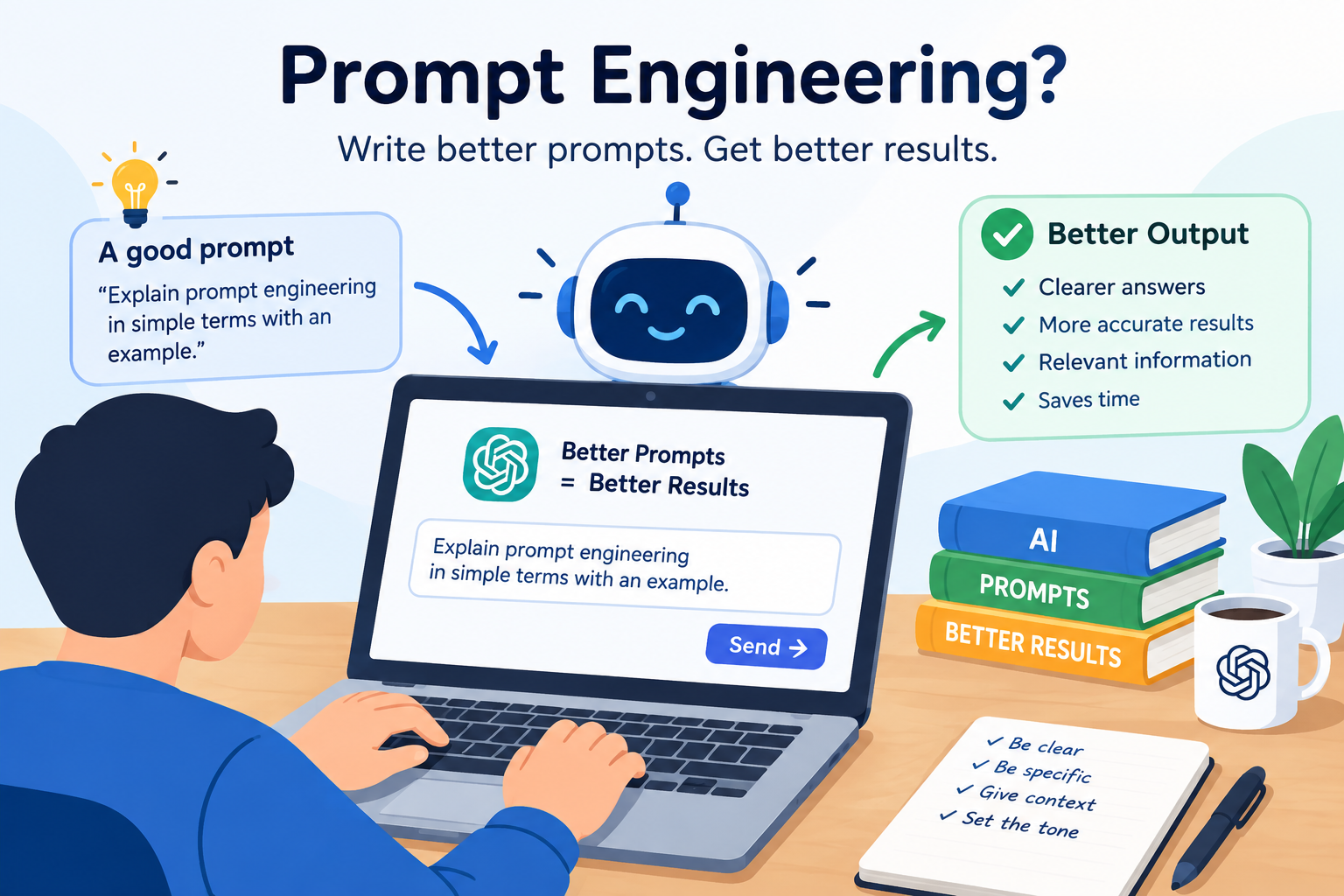
Prompt engineering is the practice of designing, structuring, and refining the inputs provided to an AI tool in order to get the most accurate, relevant, and useful outputs possible. Rather than typing instructions randomly and hoping for the best, prompt engineering means approaching your inputs deliberately and strategically.
A prompt is the instruction or question you give to an AI tool. If you are not familiar with what a prompt is, the guide on what is an AI prompt covers this foundational concept in detail. Prompt engineering is the skill of crafting those prompts thoughtfully, using specific techniques, to direct the AI toward the output you actually need.
Importantly, prompt engineering does not require coding skills or technical knowledge. It is a communication skill rooted in clarity, precision, and understanding of how AI tools interpret language. Anyone can learn it with practice.
A useful analogy: if an AI model is an incredibly capable assistant, prompt engineering is the skill of giving that assistant clear, precise, and well-structured instructions so they deliver exactly what you need, rather than a generic or misunderstood result.
Here is what this looks like in practice:
-
Instead of asking “Write something about marketing,” a prompt engineer asks: “Write a 200-word introduction for a blog post about social media marketing for small business owners, using a friendly and encouraging tone.”
-
Instead of asking an AI image tool “Draw a city,” a prompt engineer specifies: “A photorealistic aerial view of a futuristic smart city at night with glowing blue lights reflected on wet streets, dramatic atmospheric lighting.”
-
Instead of asking “Help me with my email,” a prompt engineer says: “Rewrite this email to be more concise and professional while keeping a warm tone. Here is the original: [paste text].”
In each case, the task is the same. The difference is the thought, structure, and specificity applied to the prompt before it is submitted.
Why Is Prompt Engineering Important?
AI tools are only as useful as the instructions they receive. The same AI model can produce mediocre results from a vague prompt and genuinely impressive results from a well-engineered one. Prompt engineering closes the gap between what an AI tool could do and what it actually delivers for a specific user in a specific situation.
As AI tools become more integrated into work, education, and everyday life, the ability to use them effectively becomes increasingly valuable. The guide on how AI is changing education, business, and healthcare illustrates just how broadly AI tools are now being adopted across professional contexts, which makes the skill of directing them well more relevant than ever.
Prompt engineering matters for several practical reasons:
- It saves time by reducing the number of attempts needed to get a useful result. A well-engineered prompt often produces a usable output on the first or second try.
- It helps users get consistent, repeatable outputs for recurring tasks by developing reliable prompt templates.
- It unlocks advanced capabilities of AI models that basic, unstructured prompting would never surface.
- It allows users to direct AI tools toward specific audiences, formats, tones, and constraints rather than accepting generic defaults.
- It is transferable across AI tools, meaning the principles apply broadly even though the specific responses vary between models.
Prompt engineering is especially important in the context of generative AI tools, where the prompt is the primary mechanism through which users shape and control what the AI creates. In generative AI applications, a poorly constructed prompt often produces content that misses the mark entirely, while a well-engineered one produces something immediately useful.
Prompt Engineering vs Writing a Prompt: What Is the Difference?
Every person who uses an AI tool writes prompts. Not everyone engineers them deliberately. The distinction is about intent, strategy, and iteration.
Writing a prompt means providing any input to an AI tool, whether carefully crafted or typed spontaneously without much thought. Prompt engineering means applying deliberate techniques and a structured approach to design prompts that consistently produce better results.
| Dimension | Writing a Prompt | Prompt Engineering |
|---|---|---|
| Definition | Providing any input to an AI tool | Deliberately designing and optimizing the input |
| Approach | Often spontaneous or unstructured | Strategic, structured, and intentional |
| Skill level | Basic, no training needed | Learned skill developed through practice |
| Output quality | Variable and often generic | More targeted, relevant, and consistent |
| Iteration | May not refine after the first result | Systematically refines until the output is optimal |
| Example | “Write a blog post.” | “Write a 500-word introductory blog post for first-time homebuyers explaining mortgage basics in simple, jargon-free language.” |
The difference is not about the tools used. It is entirely about the thought and strategy applied to the prompt before it is submitted and the willingness to refine it based on the results received.
If you want to build the foundational skills before developing the engineering layer on top, the guide on what is an AI prompt covers the basics of what prompts are, how they work, and what makes them effective.
How Does Prompt Engineering Work?
Prompt engineering works by understanding how AI models interpret language and using that understanding to construct inputs that guide the model toward the desired output. It is a process of deliberate design followed by evaluation and refinement.
The core process follows these steps:
- Define the goal clearly before writing anything. Know what a successful output looks like.
- Craft a structured prompt that includes the task, context, format, tone, and relevant constraints.
- Submit the prompt and evaluate the output against your goal.
- Identify what worked, what did not, and why. Be specific about the gap between what you received and what you needed.
- Refine the prompt based on that evaluation, adding clarity, adjusting constraints, or providing examples.
- Repeat until the output meets the desired standard.
Understanding how the underlying AI model processes language is genuinely helpful for prompt engineers. The article on AI models explains clearly how AI models interpret inputs and generate outputs, which is directly relevant to understanding why certain prompt structures produce better results than others.
At a foundational level, how artificial intelligence works explains the underlying technology that makes all of this possible. Understanding that AI models do not think the way humans do, but instead work by recognizing patterns in training data, helps prompt engineers understand why specific word choices, structure, and context matter as much as they do.
Core Elements of a Well-Engineered Prompt
A well-engineered prompt is not simply a longer prompt. It is a more complete and deliberate one. These are the key elements that distinguish a well-engineered prompt from a basic one.
The Task or Instruction
Every effective prompt begins with a clear statement of what you want the AI to do. Using specific action verbs prevents ambiguity.
Useful action words include: write, summarize, explain, compare, list, translate, rewrite, analyze, evaluate, create, identify, or suggest.
- Weak: “Marketing stuff.”
- Strong: “Write three variations of a Facebook ad headline for a summer sale on outdoor furniture targeting homeowners aged 35 to 55.”
The strong version tells the AI exactly what type of content to produce, the format, the purpose, and who it is for.
The Context
Context tells the AI who the audience is, what the purpose is, and any relevant background information the model needs to produce an appropriate response.
- Without context: “Explain machine learning.”
- With context: “Explain machine learning to a group of high school students with no prior knowledge of computer science. Use everyday analogies and avoid technical terms.”
Without context, the AI defaults to a general register that may be too technical, too simple, or simply misaligned with your actual need.
The Format
Specifying the output format ensures the AI structures its response in a way that is immediately useful to you rather than choosing its own default structure.
- Example: “Present your answer as a numbered list of five points, each no longer than two sentences, with a bolded heading for each point.”
Format instructions can include requests for bullet points, numbered lists, tables, specific word counts, headings, a document outline, or a particular template structure.
The Tone and Style
Tone determines how the output reads and whether it suits its intended audience and purpose.
- Example: “Use a conversational, friendly tone suitable for a lifestyle blog targeting people in their early thirties who are new to personal finance.”
Without tone guidance, AI tools typically produce a neutral, default register that may feel generic or mismatched to the context.
Constraints and Boundaries
Constraints tell the AI what to avoid, what limits to stay within, and what to exclude from its response.
- Example: “Do not use technical jargon. Keep the total response under 150 words. Do not include a call to action at the end.”
Constraints are particularly valuable when you have specific requirements that the AI would not infer from the task instruction alone.
Examples
Including examples of the style, format, or type of output you want is one of the most effective techniques in prompt engineering. Examples show the AI precisely what you are aiming for in a way that descriptions alone often cannot.
- Example: “Write product descriptions in this format: [Product Name]: [One-sentence key benefit]. Features: [Three bullet points.] Now write one for a wireless charging pad.”
Key Prompt Engineering Techniques
These are the core techniques that prompt engineers use deliberately and repeatedly. Understanding each one gives you a practical toolkit for approaching different types of tasks.
Zero-Shot Prompting
Zero-shot prompting means giving the AI a task without providing any examples of the desired output. The AI relies entirely on its training to interpret and complete the task. This approach works well for straightforward tasks where the expected output is clear from the instruction alone.
- Example: “Translate the following sentence into French: ‘The meeting starts at nine o’clock and will last approximately one hour.'”
Zero-shot prompting is the most common approach for simple, well-defined tasks that do not require a specific style or unusual format.
Few-Shot Prompting
Few-shot prompting means including one or more examples of the desired output within the prompt before asking the AI to complete the task. Documented in research from Google and other AI organizations, this technique helps the model understand exactly the style, structure, or format you want, especially for unusual or highly specific requests that the AI might otherwise interpret differently.
- Example:
“Here are two product taglines I like:
Example 1: ‘Sleep better, live fuller.’
Example 2: ‘Every step, your way.’
Now write three taglines for a premium running shoe brand targeting marathon runners.”
By providing examples, you give the model a clear target to match rather than leaving the interpretation open.
Chain of Thought Prompting
Chain of thought prompting asks the AI to work through a problem step by step rather than jumping directly to a final answer. This technique, documented in research from Google, is particularly effective for complex reasoning, problem-solving, or multi-step analytical tasks where the quality of the reasoning process directly affects the quality of the conclusion.
- Example: “A store sells apples for one dollar each and offers a buy-three-get-one-free deal. How much would eight apples cost? Think through this step by step before giving your final answer.”
Asking the AI to reason step by step reduces the chance of it skipping steps and producing an incorrect conclusion through flawed shortcut reasoning.
Role Prompting
Role prompting assigns the AI a specific persona or professional role and asks it to respond from that perspective. This technique shapes the tone, vocabulary, depth, and framing of the response significantly.
- Example: “You are an experienced career coach who has worked with technology professionals for over fifteen years. Give me three specific pieces of advice for someone applying for their first software developer role, focusing on what hiring managers actually look for.”
Role prompting is particularly useful when you need a response that reflects domain expertise, a specific professional perspective, or a particular communication style.
Iterative Refinement
Iterative refinement means treating the initial prompt as a starting point and progressively improving it based on the outputs received. Each iteration adds clarity, adjusts constraints, or incorporates specific feedback from the previous result.
- First prompt: “Write a product description for a smartwatch.”
- After reviewing output: “Good start. Now focus the description on health monitoring features rather than general features. Make it more concise, target it at fitness enthusiasts, and end with a one-sentence call to action.”
- After second output: “That works well. Now reduce the word count to under 80 words without losing the health tracking emphasis.”
This back-and-forth approach is often faster and more effective than attempting to write one perfect prompt from scratch.
Contextual Prompting
Contextual prompting provides the AI with relevant background information it needs to produce an informed, appropriate, and accurate response. This is particularly useful for specialized topics, document-specific tasks, or situations where the AI needs to understand your specific circumstances.
- Example: “Here is the background information for my article: [paste background]. Based on this context, write an introductory paragraph that accurately sets the scene for a general audience with no prior knowledge of the topic.”
Negative Prompting
Negative prompting explicitly tells the AI what to avoid or exclude from its output. This technique is widely used in AI image generation, where users can specify visual elements they do not want to appear, but it is equally effective for text outputs.
- Text example: “Explain the benefits of regular physical exercise for mental health. Do not mention weight loss, calorie burning, or physical appearance. Focus only on cognitive and emotional benefits.”
- Image example: “A peaceful countryside landscape with rolling hills and wildflowers. [Avoid: people, buildings, power lines, vehicles.]”
Negative prompting is particularly effective for keeping outputs within defined boundaries and avoiding unwanted content the AI might otherwise include by default.
Structured Output Prompting
Structured output prompting asks the AI to return its response in a specific, defined format such as a table, a numbered list with headings, a JSON-formatted response, or a custom template. This is especially useful when the output needs to be used in a particular way or integrated directly into another document.
- Example: “Compare these three project management tools in a table with the following columns: Tool Name, Key Features, Pricing Model, Best For, and Main Limitation. Present the information concisely in each cell.”
Prompt Engineering Techniques Comparison Table
| Technique | What It Does | Best Used For | Example Use |
|---|---|---|---|
| Zero-Shot Prompting | Gives the AI a task without examples | Simple, clearly defined tasks | Translation, basic Q&A, straightforward explanations |
| Few-Shot Prompting | Provides examples before the task | Style-specific, unusual, or custom formats | Tagline writing, custom content formats |
| Chain of Thought | Asks AI to reason step by step | Complex reasoning or multi-step problem solving | Math problems, strategic analysis, logic tasks |
| Role Prompting | Assigns AI a specific persona or role | Tone-specific or domain-expert content | Career advice, technical explanations, creative voice |
| Iterative Refinement | Progressively improves based on output | Any task requiring fine-tuning | Long-form writing, nuanced or complex outputs |
| Contextual Prompting | Provides background information | Specialized, document-specific, or niche tasks | Summarizing reports, working with proprietary context |
| Negative Prompting | Specifies what to exclude | Controlling scope and excluding defaults | Avoiding jargon, image generation, focused explanations |
| Structured Output | Requests a specific response format | Data organization, templates, integrations | Tables, structured lists, formatted reports |
Prompt Engineering Examples Across Real-World Use Cases
Seeing before and after comparisons is the most effective way to understand what prompt engineering actually produces.
Content Writing and Marketing
Before:
“Write a blog post about healthy eating.”
After:
“Write a 600-word blog post introduction targeting busy working parents who want to eat healthier with limited time and budget. Use a warm, encouraging, and non-judgmental tone. Include three practical tips that can be implemented in under ten minutes. End with a transitional sentence that leads naturally into a section about weekly meal planning.”
The engineered version gives the AI a specific word count, a defined audience, a tone, practical content requirements, and a structural direction. For content creators looking to apply prompt engineering across their writing workflows, the guide on how to use AI for content writing provides directly applicable guidance.
Education and Learning
Before:
“Explain the French Revolution.”
After:
“Explain the key causes and outcomes of the French Revolution in simple language suitable for a fifteen-year-old student with no prior knowledge of European history. Use three clear sections labeled Causes, Key Events, and Outcomes. Keep each section to three concise bullet points and avoid academic jargon.”
The engineered version defines the audience, the knowledge level, the structure, the format, and the language requirements clearly. Prompt engineering is transforming how students and educators use AI tools across every subject area, a development covered in depth in the guide on how AI is changing education, business, and healthcare.
Business and Professional Tasks
Before:
“Write me an email.”
After:
“Write a professional but warm follow-up email to a potential client who attended our software product demo last week. Thank them for their time, briefly highlight the one feature they seemed most interested in during the demo, which was the automated reporting dashboard, and suggest scheduling a fifteen-minute call to answer any remaining questions. Keep the email under 150 words and avoid a hard sales tone.”
Customer Service
Before:
“Write a customer service response.”
After:
“Write a polite and empathetic customer service response to a customer who received the wrong item in their online order. Open with a genuine apology, clearly explain the steps they should take to return the incorrect item and receive the right one within three business days, and close by offering a ten percent discount on their next purchase as a goodwill gesture. Keep the tone warm, professional, and solution-focused.”
AI Image Generation
Before:
“A cat.”
After:
“A highly detailed photorealistic close-up portrait of an orange tabby cat sitting on a wide wooden windowsill. Soft, warm morning light streams through a rain-streaked window in the background. Shallow depth of field with the cat’s eyes sharply in focus. Warm amber and brown color tones throughout.”
Data Analysis and Summarization
Before:
“Summarize this report.”
After:
“Summarize the following quarterly business report in a maximum of five concise bullet points for a senior executive audience. Focus on key financial findings, primary risks identified, and the top two recommended actions. Omit technical methodology details.”
Who Uses Prompt Engineering?
Prompt engineering is relevant across a remarkably wide range of roles and contexts. Understanding who benefits from these skills helps you identify how they apply to your own work.
Content Creators and Writers
Writers, bloggers, and content creators use prompt engineering to generate first drafts, outlines, creative variations, and research summaries more efficiently. Well-engineered prompts allow creators to direct AI tools precisely toward their intended style, tone, and audience rather than spending time editing generic outputs. The guide on how to use AI for content writing covers these applications in practical detail for writers at any level.
Marketers and Business Professionals
Marketing teams use prompt engineering to generate ad copy, social media content, email campaign variations, and product descriptions at a scale and speed that manual writing cannot match. Business professionals use it to draft reports, summarize lengthy documents, prepare presentation content, and manage repetitive written communications more efficiently.
Educators and Students
Educators use prompt engineering to create differentiated lesson materials, generate quiz and assessment questions at different difficulty levels, and produce customized explanations for students with different learning needs. Students use it to get clear explanations of complex topics, generate study materials, and explore different perspectives on subjects they are working through.
The broader transformation of education through AI tools is explored in the guide on how AI is changing education, business, and healthcare, which provides context for why these skills are growing in relevance for both teachers and students.
Developers and Technical Teams
Developers use prompt engineering with AI coding tools to generate, review, debug, and explain code more effectively. Technical teams use structured output prompts to extract specific data formats, generate documentation, and build content automation workflows. Few-shot and structured output techniques are particularly useful in technical contexts where precise formatting is essential.
Researchers and Analysts
Researchers use prompt engineering to summarize large volumes of text efficiently, generate hypotheses from background literature, and explore data insights through AI tools. Contextual prompting, chain of thought, and structured output techniques are especially relevant for research applications.
Everyday Users
Anyone who uses AI tools regularly benefits from learning basic prompt engineering skills, even without a specific professional context. Better prompts produce better results for everyday tasks including drafting emails, planning meals, getting explanations of complex topics, writing personal communications, or exploring creative ideas.
Prompt Engineering and AI Models: Understanding the Connection
Prompt engineering is fundamentally about communicating effectively with the AI model that processes the prompt. This means that understanding the model you are working with, even at a basic level, makes you a more effective prompt engineer.
Different AI models have different strengths, limitations, and ways of interpreting prompts based on how they were trained and what they were designed to do. A model trained primarily on creative writing tasks may respond differently to the same prompt as a model designed for analytical reasoning or factual question answering. A model fine-tuned for customer service interactions will have different defaults than a general-purpose language model.
The article on AI models explains how AI models are trained, what parameters and fine-tuning mean, and why different models respond differently to similar inputs. This foundational understanding directly informs better prompt engineering decisions.
At a deeper level, how artificial intelligence works explains the underlying technology that determines how AI systems interpret language and generate responses. Understanding that AI models work by recognizing statistical patterns rather than comprehending meaning the way humans do explains why precise, specific, and structured prompts consistently outperform vague or ambiguous ones.
Prompt Engineering and Generative AI
Prompt engineering is especially central to generative AI because in generative AI applications the prompt is the primary mechanism through which users direct what the AI creates. The AI does not have its own creative agenda. It produces what the prompt directs, shaped by its training.
In generative AI applications, the prompt determines not just the subject of the content but its style, format, tone, length, visual characteristics, and level of detail. Whether you are generating text, images, video, audio, or code, the quality of your prompt engineering directly shapes the quality of the output.
This is why prompt engineering matters so much in the generative AI context specifically. A well-engineered prompt for an image generator produces a visually compelling and precisely composed result. A vague one produces something generic that may not resemble what you had in mind at all. The same principle applies across every category of generative AI output.
For a comprehensive understanding of how generative AI uses prompts to create content across different media types, the guide on generative AI is the recommended resource.
Prompt engineering also fits into the broader picture of how AI is being used and developed across society. For readers who want to understand where prompt engineering sits within the larger landscape of AI development and adoption, the beginner’s guide to artificial intelligence provides that broader context clearly.
Common Prompt Engineering Mistakes and How to Fix Them
Recognizing common mistakes is one of the fastest ways to improve your prompt engineering practice.
Being Too Vague
Mistake:
“Write something about finance.”
Fix:
“Write a 300-word beginner-friendly explanation of compound interest for a personal finance blog targeting people in their twenties who are just starting to save money. Use a relatable analogy and avoid financial jargon.”
Overloading the Prompt
Mistake:
“Write a blog post and also summarize it and also create five social media captions and also suggest five email subject lines.”
Fix:
Break this into four separate, focused prompts. Submit them individually and evaluate each result independently.
Not Providing Context
Mistake:
“Make this email better.”
Fix:
“This email is going to a client who is frustrated about a delayed software delivery. The delay is three weeks and was caused by an unexpected technical issue. Rewrite the email to be more empathetic, clear about the revised delivery timeline, and include a concrete next step we are taking to prevent further delays.”
Forgetting to Specify Format
Mistake:
“Give me marketing ideas.”
Fix:
“Give me ten marketing campaign ideas for a new fitness app targeting women aged 25 to 40. Present them as a numbered list. For each idea, include the campaign concept in one sentence and the primary channel it would use.”
Not Iterating on Poor Results
Mistake:
Accepting the first output even when it does not meet the actual need.
Fix:
Identify specifically what missed the mark. Was it the tone? The length? The focus? The format? Then add that specific clarification to a follow-up prompt. For example: “The last response was too formal. Rewrite it with a more conversational tone, as if you are explaining it to a friend.”
Including Sensitive Personal Information
Never include genuinely sensitive personal, financial, medical, or confidential business information in prompts submitted to public AI tools. Always review the privacy policy of any AI platform before submitting data that could be sensitive or proprietary. This is a core cybersecurity practice that applies to all online tools, not just AI platforms.
How to Learn and Improve Your Prompt Engineering Skills
Prompt engineering improves with deliberate practice. These are the most effective ways to build this skill.
- Practice regularly with the AI tools you actually use. The more you prompt, the more you develop an intuitive feel for how specific tools interpret different types of instructions.
- Experiment deliberately. Change one element of a prompt at a time, such as the format, the context, or the tone, and compare the results. This systematic experimentation builds understanding quickly.
- Keep a personal prompt library. Save prompts that produce consistently good results. Organize them by task type so you can reuse and adapt them. This saves significant time on recurring tasks.
- Analyze effective prompts. When you encounter a prompt that produced a great result, study what made it work. Identify which elements, the task clarity, the context, the format, or the constraints, contributed most to the quality of the output.
- Start with the core elements covered in this guide: task, context, format, tone, constraints, and examples. Apply them systematically to every prompt you write.
- Build on the fundamentals. The guide on what is an AI prompt provides the foundational layer that prompt engineering builds on. Having a strong grasp of what prompts are and how they work makes the engineering layer much easier to develop.
- Follow developments in AI research. As new model capabilities emerge, effective prompting approaches may shift. Staying reasonably current with AI developments helps you adapt your techniques accordingly.
Is Prompt Engineering a Valuable Career Skill?
Prompt engineering has emerged as a genuinely valued skill as organizations across industries integrate AI tools into their workflows. The ability to use AI tools effectively, consistently, and at a high level is increasingly what differentiates workers who benefit from AI from those who do not.
Roles that benefit directly from prompt engineering skills include content creation, marketing, data analysis, customer service, software development, education, research, human resources, and business operations. This breadth means the skill is relevant across professional backgrounds and industries.
What makes prompt engineering particularly accessible as a career skill is that it does not require programming knowledge. This puts it within reach of professionals in non-technical roles who want to develop a meaningful and transferable AI-related competency.
As AI adoption accelerates across workplaces, the ability to direct AI tools effectively through well-engineered prompts is becoming a standard professional expectation rather than a specialist advantage. The guide on how AI is changing education, business, and healthcare illustrates how deeply AI tools are now embedded across these sectors, which underscores why the skill of using them well has tangible professional value.
For readers who want to understand how prompt engineering fits into the broader trajectory of AI development and adoption, the guide to artificial intelligence for beginners provides the wider context that makes this skill’s growing relevance clear.
Limitations of Prompt Engineering
A balanced understanding of prompt engineering includes an honest view of what it cannot do.
- Prompt engineering cannot guarantee factual accuracy. Even carefully engineered prompts can produce confident-sounding but incorrect outputs. AI models generate responses based on patterns in training data, not from verified knowledge. Always verify important factual claims independently regardless of how well the prompt was constructed.
- Prompt engineering cannot exceed model capabilities. A well-engineered prompt cannot make an AI model do something it was not trained to do. The ceiling of what prompt engineering can achieve is determined by the underlying model. The article on AI models explains these model-level limitations clearly.
- Techniques are somewhat model-specific. A prompting approach that works exceptionally well on one AI tool may produce mediocre results on another because different models were trained differently and interpret language differently.
- Models change over time. As AI models are updated, their responses to specific prompting techniques can shift. Prompt engineers need to revisit and adapt their approaches when the tools they use are significantly updated.
- There is no single correct approach. What constitutes an effective prompt depends on the specific task, the specific model, and the specific desired output. Prompt engineering is a skill of judgment and adaptation rather than a fixed formula.
Understanding these limitations helps prompt engineers use their skills with appropriate expectations and avoids overreliance on AI outputs for decisions that require verified accuracy.
Frequently Asked Questions
What is prompt engineering?
Prompt engineering is the practice of deliberately designing, structuring, and refining inputs provided to an AI tool to get more accurate, relevant, and useful outputs. It applies specific techniques and strategies to prompts rather than writing them randomly.
How is prompt engineering different from just writing a prompt?
Writing a prompt means providing any input to an AI tool. Prompt engineering means doing so deliberately and strategically, using specific techniques, evaluating the results, and refining iteratively until the output meets the desired standard.
Do I need coding skills for prompt engineering?
No. Prompt engineering is a communication skill, not a programming skill. It does not require any technical or coding knowledge and is accessible to anyone willing to learn and practice.
Why is prompt engineering important?
The same AI tool can produce very different results depending on how the prompt is constructed. Prompt engineering closes the gap between what an AI tool could produce and what it actually delivers, saving time and unlocking more useful outputs.
What are the main prompt engineering techniques?
The main techniques are zero-shot prompting, few-shot prompting, chain of thought prompting, role prompting, iterative refinement, contextual prompting, negative prompting, and structured output prompting.
What is zero-shot prompting?
Zero-shot prompting means giving the AI a task with no examples of the desired output. The model relies on its training to complete the task. It works well for clear, straightforward tasks.
What is few-shot prompting?
Few-shot prompting means providing one or more examples of the desired output style within the prompt before asking the AI to complete the task. This helps the model understand the specific format or style you want.
What is chain of thought prompting?
Chain of thought prompting asks the AI to work through a problem step by step before reaching a conclusion. It is particularly effective for complex reasoning or analytical tasks where the reasoning process matters as much as the final answer.
What is role prompting?
Role prompting assigns the AI a specific persona or professional role and asks it to respond from that perspective. This shapes the tone, depth, and framing of the response significantly.
How do I get better at prompt engineering?
Practice regularly, experiment deliberately by changing one element at a time, keep a library of prompts that work well, analyze what makes effective prompts effective, and build on the foundational techniques covered in this guide.
Is prompt engineering a career skill?
Yes. Prompt engineering has become a valued skill across many professional roles and industries as AI tools become more widely used in the workplace. It is particularly accessible because it does not require technical or programming knowledge.
Does prompt engineering work differently on different AI tools?
Yes. Different AI models interpret prompts differently based on their training and design. A technique that produces excellent results on one tool may produce different results on another. Experimentation with each tool you use is important.
Can good prompt engineering guarantee accurate AI outputs?
No. Even carefully engineered prompts cannot guarantee factual accuracy. AI models can produce confident-sounding but incorrect information. Always verify important factual claims independently before relying on AI outputs.
What should I never include in an AI prompt?
Avoid including sensitive personal information, confidential business data, private financial details, medical records, or any information that could be harmful or inappropriate if processed by a third-party platform. Review the platform’s privacy policy before submitting any sensitive information.
How is prompt engineering related to generative AI?
In generative AI applications, the prompt is the primary mechanism through which users direct what the AI creates. The quality of prompt engineering directly shapes the quality, style, format, and accuracy of the generated content.
What is negative prompting?
Negative prompting explicitly tells the AI what to avoid or exclude in its output. This technique helps control the scope of responses and is widely used in both text and AI image generation.
How long should an engineered prompt be?
A prompt should be as long as it needs to be to communicate the task, context, format, tone, and constraints clearly. Simple tasks need shorter prompts. Complex or nuanced tasks benefit from more detailed prompts. There is no universal ideal length.
Where can I learn more about AI and prompt engineering?
Start with the foundational guide on what is an AI prompt for the basics, then explore how artificial intelligence works and generative AI for the broader technology context. The beginner’s guide to artificial intelligence provides a comprehensive starting point for anyone new to the field.
Disclaimer
This article is intended for educational purposes and provides a general overview of prompt engineering for beginners and everyday users. Prompt engineering techniques and best practices vary between AI platforms, models, and versions. A technique that works well on one AI tool may produce different results on another. AI outputs, including those produced through carefully engineered prompts, can still contain errors, inaccuracies, or biases. Always review AI-generated content carefully before use. The examples in this article are for illustration purposes. Actual results will vary depending on the specific AI tool and model being used. This article does not constitute an endorsement of any specific AI tool, platform, or product.
About the Author
Zahra is a technology writer and research contributor covering AI, programming, software, cybersecurity, cloud computing, and the latest developments in technology. She focuses on creating clear, practical, and well-researched content that makes complex tech topics easy to understand.