
 By saman zahra
Introduction
The phrase AI model comes up constantly in technology discussions, news articles, and everyday conversations about artificial intelligence. But for many people, what an AI model actually is remains unclear. This guide explains what an AI model is, how it learns, what different types exist, and where you encounter AI models in everyday life, in plain language designed for anyone approaching the topic for the first time.
What Is an AI Model?
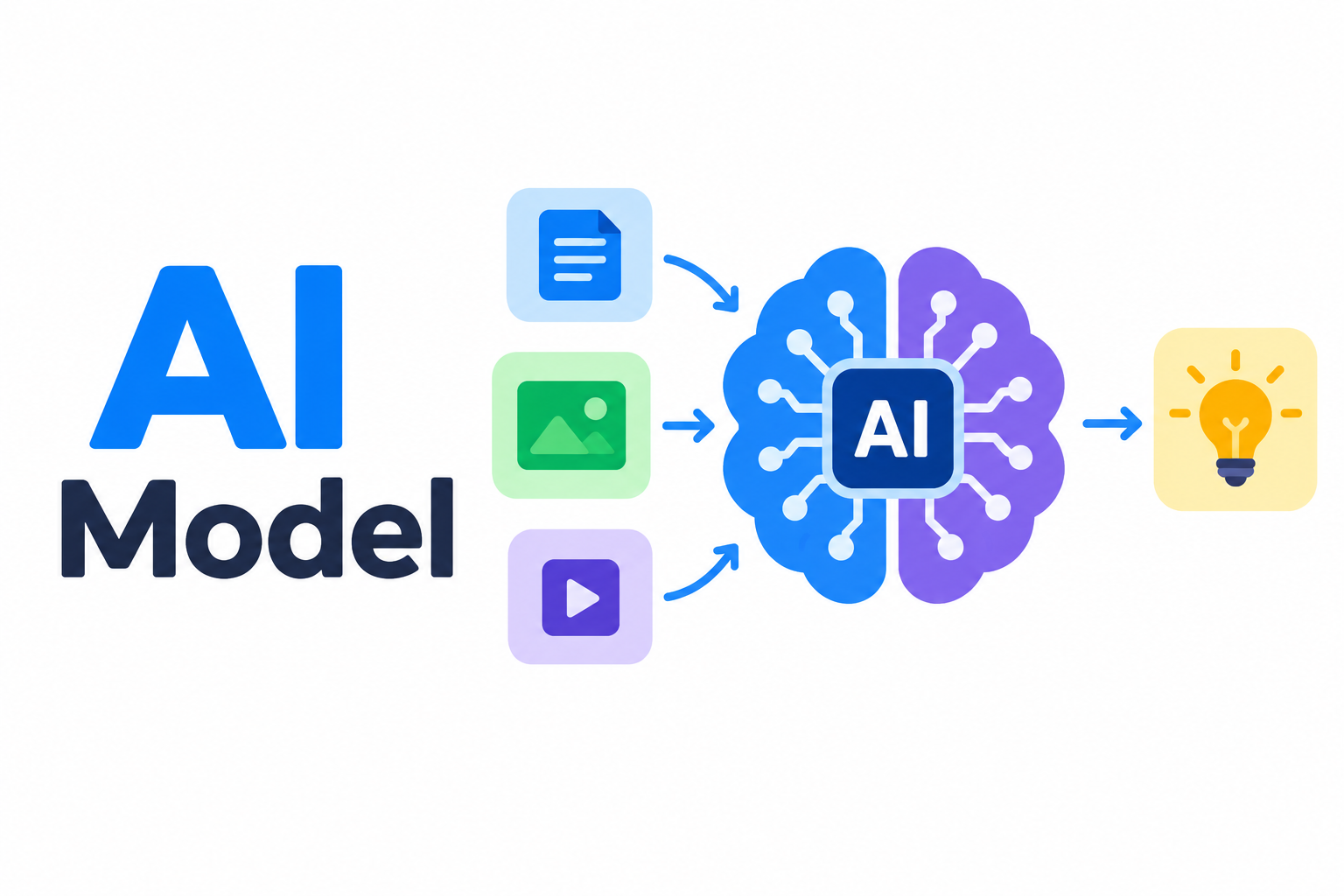
An AI model is a mathematical system that has been trained on data to recognize patterns, make predictions, generate content, or perform specific tasks without being explicitly programmed with step-by-step instructions for every possible situation it might encounter.
The word model in this context refers to a representation of knowledge and patterns that the system has built by analyzing large amounts of training data. The AI model does not contain a list of rules written by a programmer. Instead, it has developed its own internal structure through exposure to examples.
A simple analogy helps here. Think about how a child learns to recognize dogs. They do not study a rulebook that says “four legs plus fur plus a tail equals a dog.” They see many dogs over many years, and gradually they develop an intuitive sense of what makes something a dog. An AI model learns in a somewhat similar way. It processes many thousands or millions of examples and builds an internal representation of the patterns it finds.
Here are some everyday examples of what AI models do:
-
A model that listens to spoken words and converts them into written text
-
A model that generates a written answer in response to a typed question
-
A model that creates an image from a text description provided by a user
-
A model that recommends products based on what a user has browsed or purchased before
-
A model that decides whether an incoming email is spam or a legitimate message
-
A model that translates a sentence written in English into French, Spanish, or another language
In each of these cases, no programmer wrote a rule for every possible input. The model learned how to handle new inputs by studying patterns in training data.
How Are AI Models Different from Traditional Software?
Traditional software operates by following a fixed set of rules and instructions written explicitly by human programmers. Every situation the software might encounter must be anticipated and handled by a specific rule in the code. A calculator follows precise arithmetic rules. A word processor follows explicit formatting instructions. If a situation arises that was not anticipated when the software was written, the program does not know how to handle it.
An AI model does not rely on explicitly programmed rules for every scenario. It learns patterns from large amounts of training data and uses those learned patterns to handle new situations it was never specifically programmed for. This is the fundamental distinction that makes AI models capable of tasks that would be practically impossible to address through traditional rule-based programming, such as understanding natural language in all its variety or recognizing objects in photographs taken under countless different conditions.
| Dimension | Traditional Software | AI Model |
|---|---|---|
| How it works | Follows explicit programmed rules | Learns patterns from training data |
| Handles new situations | Only if explicitly programmed for them | Can generalize to new situations based on learned patterns |
| Development process | Programmer writes the rules directly | Model trains on data to develop internal patterns |
| Output type | Predictable and rule-based | Variable based on learned patterns and the input provided |
| Example | A calculator applying arithmetic rules | A model that understands and answers questions in natural language |
| Flexibility | Limited to what was explicitly programmed | Can adapt to varied inputs within its trained domain |
This fundamental difference is why AI models can handle tasks like understanding a question asked in many different ways, recognizing a face under different lighting conditions, or generating creative text in a requested style. Writing explicit rules to handle the full variety of human language or the infinite variations in a photograph would be practically impossible. Learning from examples makes these tasks tractable.
How Do AI Models Work?
Building and using an AI model involves a series of stages. Understanding these stages in sequence makes the overall process much clearer.
Step 1: Collecting Training Data
Before an AI model can do anything useful, it needs to learn from data. Training data is a large collection of examples relevant to the task the model is being built to perform.
For a model that recognizes images of cats, the training data would include thousands or millions of images labeled as either containing or not containing a cat. For a model that generates text responses to questions, the training data would include vast amounts of written text from books, websites, articles, academic papers, and other sources.
The quality, diversity, and size of the training data significantly affect the quality of the resulting model. A model trained on limited or unrepresentative data will have limited and potentially unreliable capabilities.
Step 2: Training the Model
During training, the AI model processes the training data and adjusts its internal parameters to minimize the difference between its predictions and the correct answers contained in the data.
Parameters are the internal numerical values within the model. Think of them as the adjustable dials the model uses to fine-tune its understanding. During training, these dials are adjusted repeatedly and progressively until the model’s outputs consistently match the correct answers in the training data as closely as possible.
Large and complex AI models can contain billions of parameters. Training a model of this scale requires significant computational resources and can take days or weeks to complete. The process is iterative, meaning the model reviews the training data many times, improving incrementally with each pass.
Step 3: Validating and Testing the Model
After training, the model is tested on data it has not previously encountered. This testing phase is important because it reveals whether the model has genuinely learned useful, generalizable patterns or whether it has simply memorized the training examples without developing the ability to handle new inputs effectively.
Performance during this validation phase is measured using metrics appropriate to the task, such as accuracy, error rate, precision, or recall. If performance is insufficient, the model may need to be retrained with adjustments to the training data, the model architecture, or the training process.
Step 4: Deploying the Model
Once a model performs well enough on validation data, it is deployed, meaning it is made available for actual use. Users interact with the deployed model through an interface such as a website, an application, or an API by providing inputs. The model processes those inputs and generates outputs based on the patterns it learned during training.
Most AI model-powered tools that everyday users interact with are deployed on cloud computing infrastructure, which means the computation happens on remote servers rather than on the user’s own device.
Step 5: Updating and Improving the Model
AI models are frequently updated and retrained over time as new data becomes available, as performance limitations become apparent in real-world use, or as the task requirements change. Some models are updated continuously. Others are released as fixed versions with periodic update releases. User interactions and real-world performance data often inform improvements to future versions.
What Are Parameters in an AI Model?
Parameters are the internal numerical values within an AI model that are adjusted during training to improve the model’s ability to recognize patterns and generate accurate outputs.
Think of parameters as the learned settings that the model develops through experience with training data. Before training begins, parameters start at initial values. Through the training process, these values are adjusted incrementally until the model performs well on its task.
A model with more parameters can potentially learn more complex and subtle patterns, but it also requires larger amounts of training data and significantly more computational resources to train effectively. When you hear that a large language model contains tens of billions or hundreds of billions of parameters, this refers to the total number of these internal numerical values that were adjusted during the model’s training.
It is important to understand that more parameters do not automatically produce a better model. The quality of the training data, the design of the model architecture, and the training process all contribute significantly to how well a model ultimately performs.
Types of AI Models
AI models are built for many different tasks. The table below summarizes the main categories of AI models, what they do, how they learn, and where they are commonly used.
| Model Type | What It Does | How It Learns | Common Uses |
|---|---|---|---|
| Classification Models | Assigns inputs to predefined categories | Trains on labeled examples of each category | Spam detection, image recognition, sentiment analysis |
| Regression Models | Predicts a numerical value | Trains on historical data with known outcomes | Price prediction, sales forecasting, risk scoring |
| Large Language Models (LLMs) | Understands and generates human language | Trains on vast text datasets | Conversational AI, text generation, translation, code writing |
| Image Generation Models | Creates images from text or other inputs | Trains on image and text pairs | AI art generation, product visualization, design tools |
| Recommendation Models | Suggests relevant items to users | Trains on user behavior and preference data | Product recommendations, content suggestions, playlist generation |
| Object Detection Models | Identifies and locates objects in images or video | Trains on labeled image datasets | Autonomous vehicles, security systems, medical imaging |
| Speech Recognition Models | Converts spoken audio to text | Trains on audio recordings paired with transcriptions | Voice assistants, transcription tools, accessibility features |
| Translation Models | Converts text between languages | Trains on parallel text datasets in multiple languages | Language translation services, multilingual content tools |
| Generative Models | Creates new content including text, images, audio, and video | Trains on large content datasets | AI writing tools, image creation, video generation, music composition |
Many modern AI applications combine multiple model types working together within a single system. A voice assistant, for example, uses a speech recognition model to convert the user’s spoken words into text, and then a large language model to understand that text and generate an appropriate response. The user experiences this as a single seamless interaction while multiple models work together behind the scenes.
For readers who want to understand generative models in depth, the dedicated guide on generative AI covers that category of AI models comprehensively.
What Is a Large Language Model?
A large language model, commonly abbreviated as LLM, is a type of AI model trained on enormous amounts of text data to understand and generate human language. The word large refers both to the scale of the training data and to the number of parameters in the model.
During training, LLMs learn the statistical patterns of language, including which words and concepts tend to appear together, how sentences are structured, how meaning is conveyed, and how different styles of writing are organized. This learning happens by processing vast quantities of text repeatedly.
Once trained, an LLM can perform a wide range of language-related tasks from a single underlying model. This versatility is one of the characteristics that makes LLMs distinctive compared to earlier AI models that were typically trained for one specific and narrow task.
What LLMs can do:
- Answer factual questions on topics represented in their training data
- Generate coherent, contextually appropriate text in response to prompts
- Summarize long documents into concise key points
- Translate text between languages
- Write, explain, and debug computer code
- Engage in extended multi-turn conversations
- Adapt writing style and tone to different specified contexts
What LLMs cannot do reliably:
- Always provide factually accurate information. LLMs can generate confident-sounding but incorrect statements, a problem commonly called a hallucination.
- Access real-time information beyond their training data cutoff date unless connected to external tools or databases.
- Perform precise arithmetic and complex mathematical calculations without additional support tools.
- Understand the world through direct sensory experience as humans do.
LLMs are a major category within generative AI. For a deeper understanding of how LLMs relate to the broader field of AI content generation, the guide on generative AI provides that broader context.
What Is a Machine Learning Model?
Machine learning is a branch of artificial intelligence in which systems learn from data rather than being explicitly programmed with rules for every situation they might encounter.
A machine learning model is an AI model developed using machine learning techniques, meaning it was trained on data to learn patterns and make decisions or predictions based on new inputs. This description covers almost all modern AI models, from simple spam filters to large language models.
The terms AI model and machine learning model are often used interchangeably in general conversation, and for most practical purposes this is acceptable. Technically, machine learning is one approach within the broader field of AI, but it is the dominant approach underlying the vast majority of AI systems that people interact with today.
What Is a Deep Learning Model?
Deep learning is a subset of machine learning that uses neural networks with many layers to learn progressively more complex patterns from data.
A deep learning model is an AI model built using this multi-layered neural network architecture. The word deep refers to the many layers in the network. As information passes through these layers, each layer learns to recognize increasingly abstract patterns in the data.
Consider an image recognition model as an example. The first layers of the network might learn to detect simple visual features like edges and color gradients. Subsequent layers combine these simple features into more complex shapes. Later layers recognize combinations of shapes that correspond to recognizable objects. By the time information reaches the final layers, the network has built up a sophisticated, multi-level representation of the visual content.
Deep learning models power many of the most capable modern AI applications, including image recognition systems, speech processing tools, and large language models. They generally require very large amounts of training data and significant computational resources compared to simpler machine learning approaches.
What Is a Neural Network?
A neural network is the computational architecture that underlies most modern AI models, loosely inspired by the structure of the human brain. It consists of layers of interconnected nodes, sometimes called neurons, that process and transform information as it passes through the network.
Each node in a neural network receives numerical inputs, applies a mathematical transformation to those inputs, and passes its output to nodes in the next layer. The strength of the connections between nodes, called weights, determines how much influence one node’s output has on the nodes connected to it. These weights are the parameters that are adjusted during training.
During training, connections that contribute to correct outputs are strengthened while connections that contribute to errors are weakened. Over many iterations, this adjustment process develops the network’s ability to recognize complex patterns and relationships in data.
A simple analogy makes this clearer. Think of a neural network as a series of filters arranged in sequence. Each filter processes the input and passes a refined version of it to the next filter. An image recognition network might use its first filter layer to detect edges, its next layers to detect shapes formed by those edges, and its later layers to recognize that certain combinations of shapes form recognizable objects. By the time the input has passed through all the filters, the network has built a rich, layered understanding of what it is looking at.
AI Model vs AI Tool: What Is the Difference?
This is one of the most common points of confusion for people new to the topic, and it is worth explaining clearly.
An AI model is the underlying trained system that has learned patterns from data and can generate outputs or make predictions based on new inputs. It is the mathematical core of the system.
An AI tool is the application or interface built on top of one or more AI models that allows users to interact with the model’s capabilities without needing to work with the model directly through code or technical interfaces.
The relationship is similar to the difference between an engine and a car. The engine is the underlying mechanism that provides the power. The car is the complete vehicle built around that engine that people actually drive and interact with. The engine does the work. The car makes that work accessible and usable.
| Dimension | AI Model | AI Tool |
|---|---|---|
| What it is | The trained mathematical system | The application built on the model |
| Who interacts with it directly | Developers, researchers, and engineers | Everyday users |
| How it is accessed | Typically through code and APIs | Through a user interface such as a website or app |
| Example | A large language model | A conversational AI assistant built using that model |
| Visibility to the end user | Usually not directly visible | What the user sees and interacts with |
When you use an AI writing assistant, an AI image generator, or a conversational AI platform, you are interacting with an AI tool that is powered by one or more underlying AI models. The model does the learning and the generating. The tool, which is a piece of software built on that model, provides the interface that makes the model’s capabilities accessible to users who do not need to understand how the model works internally.
What Is AI Model Training?
AI model training is the process of exposing a model to large amounts of data so that it can adjust its internal parameters to improve its performance on a specific task. Training is not a single event but an iterative process in which the model processes the training data many times, making incremental improvements with each pass.
The goal of training is to minimize the model’s errors on the training data while also ensuring that the patterns the model learns are general enough to apply to new data it has not seen before.
Training Data
Training data is the collection of examples the model learns from. For supervised learning tasks, the training data includes both the inputs and the correct answers, allowing the model to learn the relationship between them. The quality, diversity, and size of the training data all significantly affect the performance of the trained model. A model trained on narrow or unrepresentative data will reflect those limitations in its outputs.
Loss Function
A loss function is a mathematical measurement of how wrong the model’s predictions are during training. The training process works to minimize the loss function by adjusting the model’s parameters. Think of it as a score that measures how far off the model’s answers are from the correct answers. The lower the loss, the better the model is performing. Training continues until the loss reaches an acceptable level or stops improving significantly.
Overfitting
Overfitting occurs when a model performs very well on its training data but poorly on new data it has not encountered before. This happens when the model has essentially memorized the training examples rather than learning general patterns that apply broadly to new inputs. A model that has overfit its training data is like a student who memorized specific practice exam questions without understanding the underlying concepts. They perform well on those exact questions but struggle when presented with new problems. Avoiding overfitting is one of the central challenges in building reliable and useful AI models.
Fine-Tuning
Fine-tuning is the process of taking a pre-trained AI model and training it further on a smaller, more specific dataset to adapt it for a particular task or domain. Fine-tuning allows organizations and developers to customize a general-purpose AI model for their specific use case without training an entirely new model from scratch, which would require enormous data and computational resources. A general-purpose language model might be fine-tuned on medical literature to make it more useful and accurate for healthcare applications, for example.
How AI Models Generate Outputs
When you provide an input to an AI model, whether that is a typed question, an uploaded image, or a spoken command, the model enters what is called the inference phase. During inference, the model uses the patterns it learned during training to process your input and generate an appropriate output.
For a text-generating model, inference typically works by predicting the most appropriate next word or token given the input and the words already generated, repeating this process sequentially until the response is complete. For an image-generating model, inference involves using learned visual patterns to construct an image that matches the provided text description.
The quality of the output you receive depends on several factors working together:
- The quality and diversity of the data the model was trained on
- The size and design of the model architecture
- The clarity and specificity of the input or prompt you provided
- Whether the model was trained or fine-tuned specifically for the type of task you are using it for
This is why a vague or ambiguous prompt tends to produce less useful outputs than a clear and specific one. The model has more to work with when you give it detailed context and clear direction.
What Are Multimodal AI Models?
A multimodal AI model is one that can process and generate multiple types of content, such as text, images, audio, and video, within a single model rather than requiring separate specialized models for each content type.
Earlier AI models were typically designed for a single content type. A text model worked with text. An image model worked with images. These models could not understand or reason across different content types simultaneously.
Multimodal models change this. A multimodal model might accept both a text question and a photograph as combined input and generate a text response that addresses the content of both. Or it might accept a text description and generate an image, and then accept a follow-up text question about that image.
Multimodal capabilities represent an active and significant area of development in AI research, as documented by research organizations including Google DeepMind and others working on advanced AI systems. These capabilities are making AI models more versatile and better suited to handling complex real-world tasks that naturally involve multiple types of information at once.
For readers interested in how multimodal capabilities relate to content generation, the guide on generative AI covers this in the context of generative AI systems in greater depth.
Real-World Applications of AI Models
AI models are embedded in a remarkable range of products and services that many people use every day, often without realizing that AI models are involved.
AI Models in Everyday Consumer Products
- Voice assistants on smartphones use speech recognition models combined with language models to understand and respond to spoken commands.
- Email clients use classification models to filter spam and surface priority messages.
- Streaming services use recommendation models to suggest films, shows, or music based on your history and preferences.
- Keyboard autocomplete features use language models to predict and suggest the next word as you type.
- Photo applications use object detection and image recognition models to identify faces, scenes, and objects within your photos automatically.
AI Models in Business
- Customer service chatbots use language models to respond to common queries and route complex issues appropriately.
- Marketing teams use AI models to draft content, generate images for campaigns, and personalize communications at scale.
- Financial institutions use classification and anomaly detection models to identify potentially fraudulent transactions in real time.
- Sales teams use predictive models to score leads and forecast revenue based on historical patterns.
AI Models in Healthcare
- Medical imaging models assist clinicians in analyzing X-rays, MRI scans, and other diagnostic images to identify potential abnormalities.
- Drug discovery researchers use generative models to propose candidate molecular structures for new compounds.
- Clinical documentation tools use speech recognition and language models to generate structured notes from medical consultations, reducing administrative work for healthcare providers.
Healthcare AI applications are subject to strict regulatory and safety standards. The NIST AI Risk Management Framework identifies healthcare as one of the high-stakes domains where AI model reliability and safety require particularly careful attention.
AI Models in Content Creation
Generative AI models power the tools used by content creators for writing assistance, custom image creation, video generation, and audio production. These tools are increasingly accessible to everyday users through web-based interfaces and applications. For a comprehensive understanding of how generative AI models power content creation tools, the guide on generative AI covers this area in detail.
AI Models in Science and Research
Researchers across many fields use AI models to analyze large scientific datasets, identify patterns in genomic and biological data, model complex systems like climate and weather, and accelerate discoveries that would take much longer using traditional analytical approaches alone.
Limitations of AI Models
A realistic understanding of what AI models cannot do reliably is just as important as understanding their capabilities.
Hallucinations and Factual Errors
AI models, particularly large language models, can generate confident-sounding outputs that are factually incorrect. This is called a hallucination. It happens because the model generates outputs based on statistical patterns in its training data rather than from a verified database of facts. The model has no way to check whether its output is true. Users must independently verify factual claims produced by AI models before relying on them for decisions that matter.
Bias
AI models learn from human-generated data, and human-generated data contains existing biases, imbalances, and cultural assumptions. These can be reflected in model outputs, sometimes in ways that are subtle or difficult to detect without careful analysis. Identifying, measuring, and reducing bias in AI models is an active area of research and a significant concern in responsible AI development.
Data Limitations
An AI model can only learn from the data it was trained on. If the training data has gaps, errors, or significant imbalances, those limitations appear in the model’s performance. Models trained primarily on data from certain languages, cultures, or time periods may perform less effectively on inputs from underrepresented contexts.
Knowledge Cutoff
Most AI models have a training data cutoff date after which they have no knowledge of new events, publications, or developments. Asking an AI model about recent events or newly published research may produce outdated information or an acknowledgment that the information is unavailable.
Computational Requirements
Training large AI models requires enormous amounts of computational power, specialized hardware, and energy. This creates significant barriers for smaller organizations and raises environmental considerations around energy consumption and carbon emissions that are part of ongoing discussions in the research and policy communities.
Explainability
Understanding exactly why an AI model produced a specific output is often difficult, even for the researchers who built it. This is sometimes called the black box problem. The internal workings of a large neural network are complex enough that tracing the path from input to output in a meaningful way remains challenging. This lack of explainability can make it difficult to identify the source of errors and to build confidence in model reliability for high-stakes decisions.
AI Model Safety and Responsible Use
As AI models become more capable and more widely embedded in products and services, questions of safety, fairness, transparency, and accountability have become central concerns for developers, policymakers, and users alike.
Responsible AI development generally involves testing models thoroughly for bias and harmful outputs before deployment, providing users with clear information about what the model can and cannot do reliably, implementing safeguards that reduce the risk of misuse, and continuously monitoring model behavior after deployment to identify and address issues as they emerge.
The NIST AI Risk Management Framework provides a structured approach for organizations thinking about how to develop and deploy AI models responsibly. Regulatory frameworks governing AI model development and deployment are developing in many jurisdictions, reflecting growing recognition that oversight of this technology serves important public interests.
Users of AI model-powered tools also have practical responsibilities. Reviewing outputs before using them, avoiding submitting sensitive or confidential personal data unnecessarily, and using AI tools within their intended and ethical purpose are all reasonable and important practices. Understanding good cybersecurity practices is relevant here, particularly when it comes to understanding how platforms handle data submitted to AI models.
How to Evaluate an AI Model
When choosing or evaluating an AI model or an AI-powered tool for a specific use case, the following considerations are worth working through carefully.
Task Suitability
Is the model specifically designed and trained for the task you need it for? A general-purpose language model may be less effective for highly specialized tasks than a model that has been fine-tuned specifically for that domain. Check whether the model’s stated purpose aligns with what you actually need.
Accuracy and Reliability
How accurately does the model perform on inputs representative of your actual use case? Published benchmark scores are useful context but are not a substitute for testing the model with real examples from your own work. Performance on general benchmarks does not always translate to performance on specific professional or specialized tasks.
Transparency
Does the provider offer clear information about what the model was trained on, its known limitations, and how it handles errors or edge cases? Transparency about model capabilities and limitations is a positive indicator of responsible development practice and helps users set appropriate expectations.
Data Privacy
How does the platform handle the data you submit to the model? Review the privacy policy and data handling terms carefully before submitting sensitive, personal, or confidential information. Understanding how your inputs are stored, used, and potentially used for further model training is important before deciding what information to provide.
Update and Improvement Practices
How frequently is the model updated, and how does the provider communicate changes in model behavior or capability? Regular updates that address known limitations and improve performance, accompanied by clear release notes, are a positive sign of an actively maintained and responsibly developed model.
Frequently Asked Questions
What is an AI model?
An AI model is a mathematical system trained on data to recognize patterns, make predictions, generate content, or perform specific tasks without being explicitly programmed with rules for every possible scenario. It learns from examples in training data rather than following a fixed rulebook.
How does an AI model work?
An AI model works by processing large amounts of training data to adjust its internal parameters until it can accurately recognize patterns and generate useful outputs. When given a new input, the model applies the patterns it learned during training to produce an appropriate response.
What is the difference between an AI model and traditional software?
Traditional software follows explicit rules written by programmers. An AI model learns patterns from data and can handle new situations based on those learned patterns, even if those exact situations were not anticipated during development.
What are parameters in an AI model?
Parameters are the internal numerical values within an AI model that are adjusted during training to improve performance. A model with more parameters can potentially learn more complex patterns, though parameter count alone does not determine model quality.
What are the main types of AI models?
The main types include classification models, regression models, large language models, image generation models, recommendation models, object detection models, speech recognition models, translation models, and generative models. Many modern AI systems combine multiple types working together.
What is a large language model?
A large language model is an AI model trained on enormous amounts of text data to understand and generate human language. It can answer questions, write text, summarize documents, translate languages, write code, and engage in conversation. LLMs are a major category within generative AI.
What is a machine learning model?
A machine learning model is an AI model developed using machine learning techniques, meaning it learned from data rather than following explicit rules. Almost all modern AI models are machine learning models in this broad sense.
What is a deep learning model?
A deep learning model uses a neural network with many layers to learn progressively more complex patterns from data. Deep learning models power many modern AI applications including image recognition, speech processing, and large language models.
What is a neural network?
A neural network is a computational architecture consisting of layers of interconnected nodes that process and transform information. During training, the connection strengths between nodes are adjusted to improve the network’s ability to recognize patterns. Deep learning models use neural networks with many layers.
What is the difference between an AI model and an AI tool?
An AI model is the underlying trained system that does the learning and generating. An AI tool is the application built on top of the model that gives users an accessible interface to interact with the model’s capabilities. The model is the engine. The tool is the vehicle built around it.
What is AI model training?
AI model training is the process of exposing a model to large amounts of data so it can adjust its internal parameters to improve performance. Training is iterative and may take hours, days, or weeks depending on model size and data volume.
What is fine-tuning an AI model?
Fine-tuning is the process of taking a pre-trained AI model and training it further on a smaller, task-specific dataset to adapt it for a particular use case or domain, without training an entirely new model from scratch.
What is overfitting in an AI model?
Overfitting occurs when a model performs well on its training data but poorly on new data it has not seen before, because it has memorized the training examples rather than learning general patterns that apply broadly.
What is a multimodal AI model?
A multimodal AI model can process and generate multiple types of content, such as text, images, and audio, within a single model. This allows it to understand and reason across different content types simultaneously rather than being limited to one.
Can AI models make mistakes?
Yes. AI models can produce incorrect, biased, or otherwise flawed outputs. This is particularly notable in large language models, which can generate confident-sounding but factually incorrect information. All AI model outputs should be reviewed before being relied upon for important decisions.
What is an AI hallucination?
An AI hallucination is when an AI model, particularly a language model, generates a confident-sounding output that is factually incorrect. It happens because the model generates text based on statistical patterns rather than verified factual knowledge. It is one of the most important limitations for users to understand.
What are the limitations of AI models?
Key limitations include hallucinations and factual errors, bias reflecting imbalances in training data, knowledge cutoff dates, high computational requirements for training, and limited explainability of why specific outputs were produced.
How do I know if an AI model is reliable for my use case?
Test the model with real examples from your actual use case rather than relying solely on general benchmark scores. Check the provider’s transparency about training data and known limitations, review how the platform handles your data, and verify outputs independently for factual accuracy.
What is the difference between an AI model and generative AI?
Generative AI refers specifically to AI models designed to create new content such as text, images, audio, and video. It is a category within the broader set of AI models. Not all AI models are generative. Classification models, regression models, and recommendation models are AI models that are not generative in this sense. For a full explanation of generative AI, the dedicated guide on generative AI covers this in depth.
Are AI models biased?
AI models can reflect biases present in their training data. Since training data is created by humans and collected from human-generated sources, it inherits existing societal biases and imbalances. Identifying and mitigating these biases is an active area of research in responsible AI development.
Disclaimer
This article is intended for educational purposes and provides a general overview of AI models for beginners and everyday users. The field of artificial intelligence and AI model development is evolving rapidly. Specific capabilities, model types, and applications described in this article reflect current general understanding and may change as the technology develops. AI model outputs including text, images, predictions, and decisions can contain errors, biases, or inaccuracies. Always review AI outputs carefully before relying on them for important decisions. This article does not constitute an endorsement of any specific AI model, platform, or product. Always review the terms of service and acceptable use policies of any AI platform or model before use.
About the Author
Zahra is a technology writer and research contributor covering AI, programming, software, cybersecurity, cloud computing, and the latest developments in technology. She focuses on creating clear, practical, and well-researched content that makes complex tech topics easy to understand.