
 By TechOriginHub Editorial Team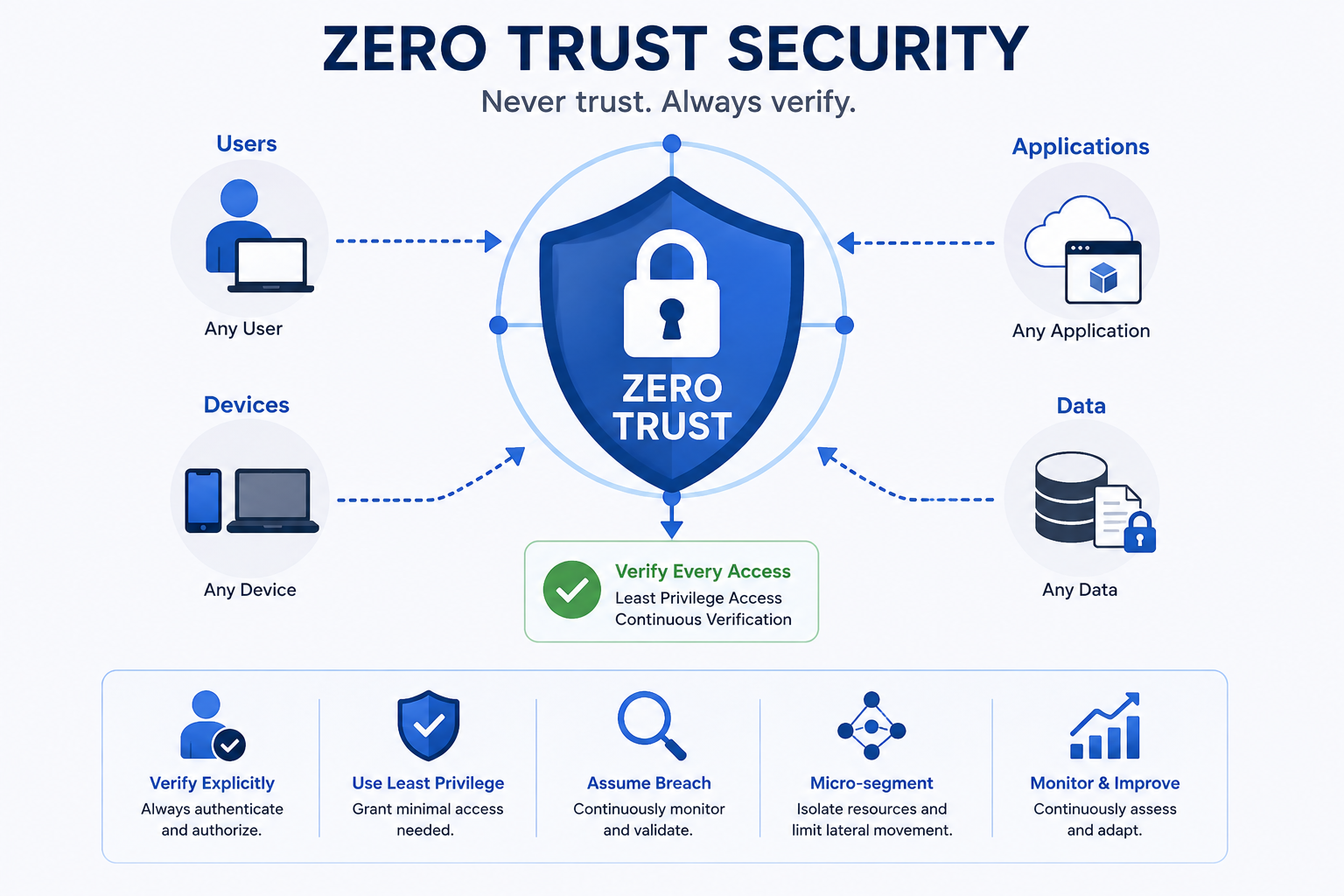
For decades, most organizations built their cybersecurity strategy around a simple assumption: everything inside the corporate network is safe, and everything outside is dangerous. This “castle and moat” approach worked reasonably well when employees worked in offices, data lived on local servers, and the network perimeter was clearly defined. Today, that approach is dangerously outdated. Employees work from home networks and coffee shops. Applications live in multiple clouds. Sensitive data moves across dozens of connected services. Attackers breach perimeter defenses and then roam freely inside networks for months. Understanding what is Zero Trust Security, why it has become the defining cybersecurity model for modern organizations, and how to implement its principles is now essential knowledge for anyone responsible for protecting digital assets in 2026.
Quick Answer
What is Zero Trust Security? Zero Trust Security is a cybersecurity framework built on the principle of “Never Trust, Always Verify.” It assumes no user, device, or network connection is automatically trusted, even inside the corporate network. Instead, every access request is continuously verified based on user identity, device health, and behavior. Zero Trust significantly reduces the risk of data breaches and lateral movement by attackers.
What Is Zero Trust Security?
Zero Trust Security is a cybersecurity framework and architectural philosophy that operates on a single foundational principle: trust nothing and verify everything. Unlike traditional security models that grant broad network access to any user or device that successfully passes the perimeter boundary, Zero Trust requires continuous verification of every user, device, and connection before granting access to any resource, every single time access is requested.
The term “Zero Trust” was first coined by Forrester Research analyst John Kindervag in 2010. Kindervag observed that traditional security models made a fatal assumption: that everything inside the network perimeter was safe and could be trusted. This assumption proved catastrophically wrong as insider threats, compromised credentials, and sophisticated attackers who bypassed perimeter defenses demonstrated that the inside of a network could be just as dangerous as the outside.
In simple terms, Zero Trust works like a high-security facility where every single door requires its own badge scan, every person must verify their identity at each access point, and permission to enter one room does not automatically grant permission to enter any other. Even employees who have worked at the facility for years must verify who they are and why they need access every time they want to enter a new area. This continuous verification eliminates the concept of inherent trust based on location or previous authentication.
Real-world examples demonstrate why this approach matters. In 2020, the SolarWinds attack compromised the software update mechanism of a widely used IT management platform, allowing attackers to gain access to networks at thousands of organizations including multiple US government agencies. Once inside these networks, the attackers moved laterally across systems for months because traditional security models had no mechanism to question or restrict the movement of connections that appeared to come from inside the trusted network perimeter. A Zero Trust architecture, with its continuous verification and microsegmentation controls, would have dramatically limited the attackers’ ability to move freely between systems even after gaining initial access.
Why Is Zero Trust Security Important?
Several fundamental shifts in how organizations operate have made the traditional perimeter security model not just insufficient but actively dangerous. Zero Trust addresses each of these shifts directly.
Remote Work
The permanent shift toward remote and hybrid work arrangements has effectively eliminated the traditional corporate network perimeter as a meaningful security boundary. Employees now access corporate resources from personal home networks, public Wi-Fi connections, shared workspaces, and devices that may not meet corporate security standards. Traditional models that trusted connections simply because they came through the VPN provide dangerously insufficient protection for this reality. Zero Trust evaluates every connection based on its actual security characteristics rather than its network origin.
Cloud Computing
Organizations today typically use dozens of cloud services, multiple cloud platforms, and hybrid on-premises and cloud environments simultaneously. Data and applications are distributed across AWS, Microsoft Azure, Google Cloud, and numerous SaaS applications rather than residing safely within a corporate data center behind a hardware firewall. The concept of a definable network perimeter becomes almost meaningless in this environment. Zero Trust is cloud-native by design, applying consistent verification and access controls regardless of where resources are hosted.
Insider Threats
Insider threats, whether from malicious employees, compromised accounts, or negligent behavior, represent one of the most significant and underappreciated cybersecurity risks. Traditional perimeter security provides almost no protection against threats that originate from already-trusted insiders. Zero Trust’s principle of least privilege access and continuous behavioral monitoring addresses insider threats directly by ensuring that even authenticated users can only access the minimum resources necessary for their specific role and that unusual behavior triggers immediate investigation.
Ransomware
Modern ransomware attacks are sophisticated, multi-stage operations that begin with initial compromise of a single endpoint or account before spreading laterally across networks to maximize the number of systems encrypted. The lateral movement phase of these attacks depends heavily on the attacker’s ability to move from one system to another using compromised credentials and implicit trust between internal systems. Zero Trust’s microsegmentation and continuous verification requirements dramatically limit this lateral movement, containing ransomware infections to smaller portions of the environment.
See our guide on What Is Ransomware? for more context on this threat.
Identity-Based Attacks
Modern attackers increasingly target identities and credentials rather than systems directly. Phishing campaigns steal login credentials. Password spraying attacks guess common passwords at scale. Credential stuffing attacks use credentials stolen from one breach to access other services where the same password was reused. Zero Trust’s identity-centric verification model, combined with multi-factor authentication and continuous behavioral monitoring, makes credential-based attacks significantly harder to execute successfully even when attackers obtain valid usernames and passwords.
Hybrid Work Environments
Hybrid work environments where employees split time between offices and remote locations create particularly complex security challenges. Security controls that work well for office-based employees may not apply consistently to the same employees working remotely, and vice versa. Zero Trust applies identical verification requirements regardless of whether a user is sitting in the corporate office or working from a hotel room, ensuring consistent security policy enforcement across all work contexts.
How Does Zero Trust Security Work?
Zero Trust operates through several interconnected principles that work together to create a security architecture where no connection or user receives automatic trust.
Zero Trust Principles Table
| Principle | Core Concept | Key Action |
|---|---|---|
| Verify Every User | Authenticate identity continuously | MFA, identity verification, behavioral monitoring |
| Verify Every Device | Assess device health before granting access | Device compliance checks, endpoint security |
| Least Privilege Access | Grant minimum necessary permissions only | Role-based access, just-in-time access |
| Continuous Monitoring | Watch all activity in real time | Behavioral analytics, anomaly detection |
| Microsegmentation | Divide networks into small isolated zones | Limit lateral movement between segments |
| Assume Breach | Operate as though attackers are already present | Limit blast radius, isolate resources |
Verify Every User
The first and most fundamental Zero Trust principle requires verifying the identity of every user who requests access to any resource, every time they make that request. This verification goes far beyond simply entering a password. Zero Trust identity verification combines multiple authentication factors, evaluates the context of each access request including the time of day, geographic location, and device used, and assesses whether the access request matches the user’s established behavioral patterns.
A practical example illustrates this clearly. Under a Zero Trust model, if an employee who normally accesses systems from New York during business hours suddenly attempts to log in from an IP address in Eastern Europe at 3 AM, the system does not simply grant access because the correct password was entered. Instead, it triggers additional verification challenges, alerts security analysts, and may deny access entirely pending investigation. This contextual intelligence catches compromised credentials that password-based authentication alone would miss entirely.
Verify Every Device
Zero Trust requires verifying not just the identity of users but also the security posture and compliance status of every device they use to request access. A verified user identity does not automatically translate to secure access if the device they are using is compromised, unpatched, or non-compliant with organizational security policies.
Device verification checks confirm that the device has current security patches installed, that endpoint security software is active and updated, that device encryption is enabled, and that no signs of compromise exist. Devices that fail these checks may receive limited access to low-sensitivity resources or may be denied access entirely until compliance issues are remediated. This device-centric verification closes a significant gap in credential-only authentication systems where an attacker using stolen credentials on a compromised device might otherwise gain full access.
Least Privilege Access
The principle of least privilege is fundamental to Zero Trust and states that every user, application, and system should have access to only the minimum resources and capabilities strictly necessary to perform their specific function. Nothing more. No user should have broad access to all systems simply because their role might theoretically require access to any of them one day.
In practice, least privilege means carefully defining exactly what each role requires access to, granting only those specific permissions, regularly reviewing and revoking unnecessary access, and implementing just-in-time access for sensitive operations that require elevated privileges only temporarily. For example, a customer service representative needs access to customer records relevant to their support function but has no business need to access financial reporting systems or engineering development environments. Least privilege ensures they simply cannot access those systems regardless of how their credentials might be compromised.
Continuous Monitoring
Zero Trust does not treat authentication as a one-time event at the beginning of a session. Instead, it monitors user and device behavior continuously throughout every session, looking for deviations from established normal patterns that might indicate a compromised account, insider threat activity, or an attacker who has established persistence within the environment.
Continuous monitoring analyzes patterns like which files a user typically accesses, what applications they normally use, how much data they typically transfer, what times they normally work, and what administrative actions they usually take. When behavior deviates significantly from these established baselines, the monitoring system generates alerts and may automatically increase authentication requirements, reduce access privileges, or terminate the session pending security review.
Microsegmentation
Microsegmentation divides a network into many small, isolated zones rather than allowing a single flat network where all connected systems can communicate freely with each other. Each microsegment contains specific resources with defined rules about which other segments can connect to it and under what conditions. Even users and systems with legitimate access to the broader network cannot communicate with resources in segments for which they lack specific authorization.
The practical value of microsegmentation becomes clear in a ransomware scenario. If an attacker compromises a single workstation on a traditional flat network, they can potentially reach every other system on that network. With microsegmentation, the compromised workstation can only communicate with the specific resources it has authorization to reach. The attacker cannot move laterally to other segments, dramatically containing the potential damage from the initial compromise.
Assume Breach
The “assume breach” principle represents a fundamental philosophical shift from traditional security thinking. Rather than designing security systems around the goal of keeping attackers completely out, Zero Trust designs security systems on the assumption that determined attackers will eventually achieve some level of access, and therefore focuses on minimizing what they can do once inside.
This principle drives several important security design decisions including encrypting all data in transit and at rest so that accessing the data without decryption keys provides no value to the attacker, designing microsegmentation so that a breach in one segment cannot automatically spread to others, maintaining comprehensive logs that enable rapid detection and response when breach activity begins, and planning incident response procedures that assume some level of compromise has already occurred.
Core Components of Zero Trust Architecture
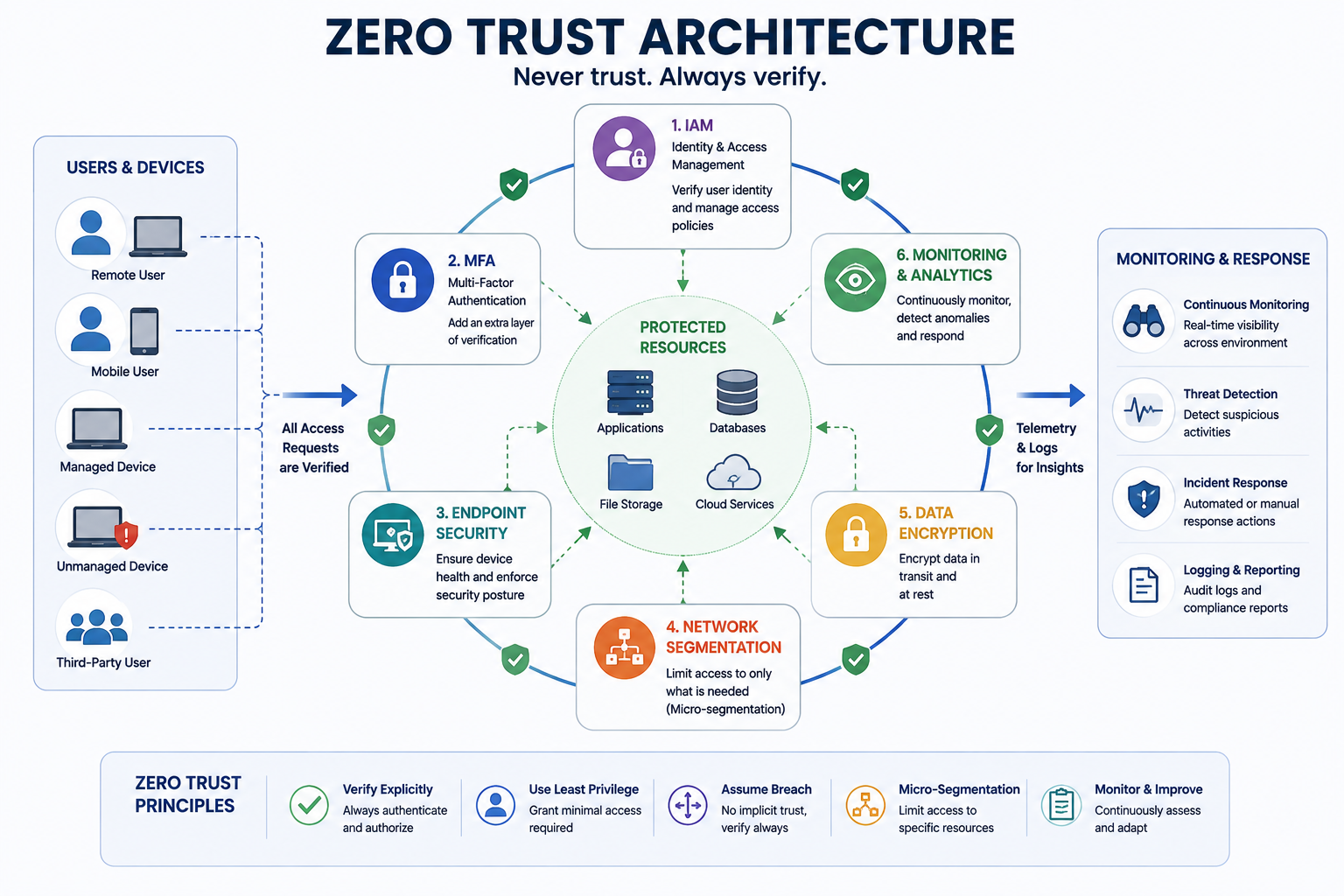
Implementing Zero Trust Security requires deploying and integrating several key technical components that together enforce the model’s principles.
Identity and Access Management (IAM)
Identity and Access Management is the foundation of any Zero Trust implementation. IAM systems manage the digital identities of all users, define what resources each identity can access, and enforce access policies consistently across all systems and applications. Without a strong IAM foundation, Zero Trust verification and least privilege principles cannot be enforced effectively.
Modern IAM for Zero Trust goes beyond basic user account management to include privileged access management for administrative accounts, service account management for automated processes, guest and contractor identity management, and just-in-time provisioning that grants elevated access temporarily when needed rather than permanently.
Multi-Factor Authentication (MFA)
MFA is a non-negotiable requirement for any genuine Zero Trust implementation. It requires users to provide multiple forms of identity verification before accessing protected resources, combining something they know such as a password, something they have such as an authentication app or hardware token, and potentially something they are such as a biometric factor.
MFA directly addresses credential theft attacks by ensuring that a stolen password alone cannot grant system access. Even when phishing, social engineering, or data breaches expose valid passwords, attackers cannot access protected resources without also possessing the additional authentication factor. For a comprehensive explanation of MFA technology.
see our guide on What Is Multi-Factor Authentication (2FA)?.
Endpoint Security
Zero Trust cannot function without comprehensive endpoint security on every device attempting to access organizational resources. Endpoint security agents assess device health, enforce compliance with security policies, detect and respond to threats on individual devices, and report device status to Zero Trust policy enforcement systems that use this information in access decisions.
A device running outdated software, missing encryption, or showing signs of compromise receives restricted or denied access under Zero Trust principles, regardless of the user’s valid credentials. This integration between endpoint security and access control creates a powerful feedback loop that incentivizes device hygiene while protecting resources from compromised devices.
Learn more in our guide on Endpoint Security.
Network Segmentation
Network segmentation in Zero Trust architecture divides the organizational network into many isolated zones with controlled communication pathways between them. This segmentation, implemented through software-defined networking, next-generation firewalls, and microsegmentation technologies, ensures that access to one network segment does not automatically grant visibility or connectivity to other segments.
Effective Zero Trust segmentation maps network zones to specific business functions, data sensitivity levels, and application groups. Inter-segment communication requires explicit authorization defined in policy, and all traffic between segments passes through inspection and logging controls that provide visibility into lateral movement attempts.
Device Security
Every device accessing organizational resources under Zero Trust must meet defined security requirements including current operating system and application patches, active and updated endpoint security software, enabled full-disk encryption, configured screen lock policies, and compliance with organizational configuration standards. Devices that fail these requirements cannot access protected resources until compliance is restored.
Device security management in Zero Trust typically involves Mobile Device Management (MDM) platforms for employee devices, Network Access Control (NAC) systems that verify device compliance before allowing network access, and continuous posture assessment that monitors device security status throughout connected sessions rather than only at initial connection.
Data Encryption
Consistent with the “assume breach” principle, Zero Trust requires encrypting all sensitive data both in transit across networks and at rest in storage systems. Encryption ensures that even if an attacker successfully accesses a system or intercepts network traffic, the data they obtain provides no value without the encryption keys required to decode it.
Zero Trust encryption strategies address data on endpoints through full-disk encryption, data in motion through TLS encryption for all network communications, data in cloud storage through cloud-native and customer-managed encryption, and highly sensitive data through additional application-layer encryption that protects information even from privileged system administrators.
Continuous Monitoring
Continuous monitoring in Zero Trust provides the visibility necessary to detect threats and verify that access controls are functioning correctly. Monitoring systems collect logs from all network traffic, user authentication events, access requests, data movements, administrative actions, and endpoint activity. Security information and event management (SIEM) platforms aggregate and correlate this data to identify suspicious patterns that may indicate active threats.
Effective continuous monitoring in Zero Trust generates actionable intelligence rather than overwhelming alert volumes. Machine learning-powered behavioral analytics distinguish between normal variations in user and system behavior and genuinely suspicious activity that warrants investigation, helping security teams focus their attention where it matters most.
Security Analytics
Security analytics applies advanced analysis techniques including behavioral analytics, machine learning, and threat intelligence integration to the vast amounts of security data collected across a Zero Trust environment. Analytics capabilities identify complex, multi-step attack patterns that simple rule-based monitoring misses, detect insider threats through behavioral deviation analysis, prioritize the most critical alerts for security analyst review, and provide the contextual intelligence necessary for rapid incident investigation and response.
Benefits of Zero Trust Security
Implementing Zero Trust Security delivers substantial, measurable improvements across multiple dimensions of organizational security and operational efficiency.
Zero Trust Benefits Checklist
| Benefit | Impact | Applicable To |
|---|---|---|
| Significantly reduces breach risk | Critical | All organizations |
| Limits lateral movement after compromise | Critical | All organizations |
| Protects against credential theft | High | All organizations |
| Enables secure remote work | Critical | Organizations with remote workers |
| Improves cloud security posture | High | Cloud-using organizations |
| Detects insider threats effectively | High | All organizations |
| Supports regulatory compliance | High | Regulated industries |
| Reduces attack surface | High | All organizations |
| Improves incident response speed | High | All organizations |
| Enables granular access control | High | All organizations |
| Protects sensitive data consistently | Critical | Data-sensitive organizations |
| Reduces ransomware impact | Critical | All organizations |
| Improves security visibility | High | All organizations |
| Scales with organizational growth | High | Growing organizations |
| Supports digital transformation | Medium | Organizations modernizing IT |
- Zero Trust dramatically reduces the risk of successful data breaches by eliminating the broad implicit trust that attackers exploit to move freely through compromised networks.
- Microsegmentation and least privilege access limit lateral movement after initial compromise, containing the impact of successful attacks to the smallest possible portion of the environment.
- Continuous identity verification and MFA requirements make credential theft attacks significantly less effective, since stolen passwords alone cannot grant access to protected resources.
- Zero Trust enables genuinely secure remote work by applying identical verification requirements regardless of where employees connect from, closing the security gaps created by traditional perimeter-centric models.
- Cloud-native Zero Trust principles protect distributed cloud resources consistently regardless of which cloud platform or SaaS service hosts the data or application.
- Behavioral monitoring and least privilege access make insider threats much easier to detect and much more difficult to execute without triggering security alerts.
- Zero Trust architectures support compliance with regulations including HIPAA, PCI DSS, GDPR, and NIST standards by providing the granular access controls, encryption, and audit logging these frameworks require.
- By granting only the minimum necessary access to each user and device, Zero Trust dramatically reduces the organization’s overall attack surface.
- Comprehensive logging and continuous monitoring in Zero Trust environments enables faster detection of attacks in progress and more thorough investigation of completed incidents.
- Granular, role-based access controls give security teams precise control over who can access which specific resources, enabling business-aligned security policies rather than broad network access permissions.
- Consistent data encryption requirements across the Zero Trust environment protect sensitive data even when other security controls fail or are bypassed.
- Microsegmentation and continuous verification requirements limit ransomware’s ability to spread laterally through organizational environments, significantly reducing the potential damage from any single ransomware infection.
- Centralized security policy enforcement and comprehensive logging across all users, devices, and access events provides security teams with unprecedented visibility into organizational security posture and active threats.
- Zero Trust architecture scales naturally with organizational growth, new cloud services, and expanding workforces without requiring fundamental architectural changes to accommodate new users, devices, or applications.
- Zero Trust provides the security foundation necessary for digital transformation initiatives, enabling organizations to adopt new cloud services, enable remote work, and deploy new applications without compromising security.
Zero Trust vs Traditional Security
Understanding the fundamental differences between Zero Trust and traditional security models helps clarify why the transition to Zero Trust is necessary rather than optional for modern organizations.
Zero Trust vs Traditional Security Table
| Factor | Traditional Security | Zero Trust Security |
|---|---|---|
| Core Assumption | Trust inside the network, distrust outside | Trust nothing and verify everything |
| Network Access | Broad access after passing perimeter | Granular access based on continuous verification |
| Authentication | One-time at network entry point | Continuous, context-aware at every access request |
| Lateral Movement | Largely unrestricted inside the network | Severely limited by microsegmentation |
| Risk Management | Perimeter-focused, reactive | Risk-based, proactive, continuous |
| Monitoring | Primarily at network perimeter | Continuous across all users, devices, and traffic |
| Remote Work Support | Requires VPN, security decreases | Native support with consistent security |
| Cloud Compatibility | Designed for on-premises, struggles with cloud | Cloud-native by design |
| Insider Threat Defense | Very limited | Strong through behavioral monitoring |
| Scalability | Difficult as perimeter expands | Scales naturally with identity-centric model |
| Incident Containment | Attack spreads freely inside perimeter | Contained by segmentation and least privilege |
The differences in this table reveal why organizations that have invested heavily in traditional perimeter security still experience significant breaches. Traditional security assumes the perimeter holds, but modern attacks specifically target perimeter defenses knowing that once inside, they will face minimal restrictions.
Zero Trust vs VPN
Virtual private networks and Zero Trust are frequently discussed in the context of replacing one with the other. The reality is more nuanced and practical.
Zero Trust vs VPN Table
| Factor | VPN | Zero Trust |
|---|---|---|
| Core Function | Encrypt traffic between device and network | Continuously verify and control all access |
| Access Granted | Broad network access after authentication | Specific resource access after continuous verification |
| Trust Model | Trusts authenticated connections | Trusts nothing without continuous verification |
| Lateral Movement Risk | High once VPN access is granted | Low due to microsegmentation |
| Performance | Can significantly impact connection speed | Typically less performance impact |
| User Experience | Can be complex, especially for cloud services | Designed for transparent, seamless access |
| Cloud Support | Designed for on-premises, awkward with cloud | Native cloud support |
| Security Granularity | Network-level, coarse-grained | Application and resource-level, fine-grained |
| Scalability | Challenges with large remote workforces | Scales effectively with identity-centric model |
| Works Together? | Yes, VPN can complement Zero Trust | Yes, especially during transition periods |
VPNs and Zero Trust can work together effectively, particularly during transition periods when organizations are moving toward a full Zero Trust architecture. VPN encryption provides valuable protection for data in transit, which aligns with Zero Trust’s data encryption requirements. However, VPN alone cannot provide the continuous verification, least privilege access, and microsegmentation that define genuine Zero Trust Security.
Many organizations implement Zero Trust Network Access (ZTNA) as a direct replacement for VPN, providing granular application-level access without the broad network access that makes VPN-connected sessions vulnerable to lateral movement. ZTNA gives users access only to the specific applications they are authorized for rather than the entire network behind the VPN.
Industries That Benefit from Zero Trust
While Zero Trust benefits every organization, certain industries face threat environments and regulatory pressures that make Zero Trust adoption particularly critical.
Healthcare
Healthcare organizations handle extraordinarily sensitive patient data subject to strict HIPAA regulations, operate life-critical systems that cannot tolerate operational disruption, and face an exceptionally high volume of ransomware and data breach attacks. Zero Trust provides the granular access controls, comprehensive audit logging, and breach containment capabilities that healthcare organizations need to protect patient data while maintaining the operational availability that patient care requires.
Banking and Financial Services
Financial institutions face sophisticated cybercriminal attacks targeting customer funds and financial data, strict regulatory requirements from frameworks like PCI DSS and SOX, and complex technology environments spanning legacy systems, modern applications, and numerous third-party integrations. Zero Trust’s continuous verification, transaction monitoring integration, and microsegmentation capabilities address the specific threat landscape and compliance needs of financial services organizations.
Government
Government agencies handle classified information, critical infrastructure systems, and sensitive citizen data while facing sophisticated state-sponsored threat actors with significant resources. The US government has formally mandated Zero Trust adoption for federal agencies through executive orders and CISA guidance, recognizing that traditional perimeter security is inadequate against modern nation-state adversaries.
Education
Educational institutions manage highly distributed environments with thousands of students, faculty, and staff accessing resources from personal devices across campus and remote locations. They also face significant ransomware targeting and must protect sensitive student and research data with limited security resources. Zero Trust helps education institutions apply consistent security policies across chaotic, decentralized device ecosystems.
Retail
Retail organizations protect customer payment data subject to PCI DSS requirements, manage complex supply chain and partner access relationships, and operate both physical and e-commerce environments with diverse technology stacks. Zero Trust provides the granular access controls and data protection capabilities necessary for PCI DSS compliance while managing the complex identity and access needs of retail operations.
Manufacturing
Manufacturing environments increasingly integrate operational technology (OT) systems with traditional IT networks, creating hybrid environments where a cybersecurity incident can cause physical operational consequences. Zero Trust’s segmentation capabilities are particularly valuable for isolating OT systems from IT networks while providing controlled, verified connectivity between them.
Cloud Service Providers
Cloud service providers must protect their infrastructure and customer data while enabling the broad connectivity that cloud services require. Zero Trust principles underpin the security architectures of major cloud platforms, and cloud-native Zero Trust tools make implementing the model progressively easier for organizations using cloud services.
Challenges of Implementing Zero Trust
Zero Trust implementation is a substantial undertaking that presents several genuine challenges organizations must address realistically.
Cultural and Organizational Resistance
Zero Trust requires fundamental changes to how security works and how users experience accessing systems. Employees accustomed to broad network access after a single login may resist the additional friction of continuous verification. Security teams accustomed to perimeter-centric thinking must develop new skills and mindsets. Overcoming this resistance requires strong executive sponsorship, clear communication about why the changes are necessary, and careful change management throughout the implementation process.
Complexity of Legacy Environments
Most organizations operate complex environments that mix modern applications with legacy systems that were never designed to support Zero Trust principles. These legacy systems may lack the ability to integrate with modern identity and access management platforms, may not support modern authentication methods, and may require significant remediation before they can operate within a Zero Trust architecture. Addressing legacy systems requires careful assessment and often phased migration strategies.
Cost and Resource Requirements
A full Zero Trust implementation requires investment in multiple technology platforms including identity management, endpoint security, network segmentation, and security analytics. It also requires skilled security professionals to design, implement, and operate the resulting architecture. Organizations with limited budgets and small IT teams may need to prioritize their Zero Trust implementations around their highest-risk assets while managing costs carefully.
Practical Solutions
The most effective approach to Zero Trust implementation challenges involves starting small and expanding progressively rather than attempting a complete transformation all at once. Begin by identifying the most sensitive data and critical systems, apply Zero Trust controls to these priority assets first, build operational experience and demonstrate value, then expand coverage progressively. Leverage cloud-based Zero Trust services that reduce infrastructure requirements, and work with experienced implementation partners who can accelerate the journey using established methodologies.
Zero Trust Security Best Practices
Implementing Zero Trust Security effectively requires following established best practices that address both technical and organizational dimensions of the model.
Zero Trust Implementation Checklist
| Best Practice | Priority | Implementation Phase |
|---|---|---|
| Enable MFA for all users | Critical | Immediate |
| Implement strong identity management | Critical | Phase 1 |
| Apply least privilege access | Critical | Phase 1 |
| Encrypt all sensitive data | Critical | Phase 1 |
| Deploy endpoint security on all devices | Critical | Phase 1 |
| Implement network microsegmentation | High | Phase 2 |
| Establish continuous monitoring | High | Phase 2 |
| Conduct regular access reviews | High | Ongoing |
| Train all employees on security | High | Ongoing |
| Update all systems regularly | Critical | Ongoing |
| Implement Zero Trust for privileged accounts first | Critical | Phase 1 |
| Establish security baselines for all devices | High | Phase 1 |
| Deploy behavioral analytics | High | Phase 2 |
| Implement data loss prevention | High | Phase 2 |
| Conduct regular security audits | High | Ongoing |
| Create an incident response plan | Critical | Phase 1 |
| Inventory all users and devices | Critical | Phase 1 |
| Define data classification policies | High | Phase 1 |
| Implement just-in-time privileged access | High | Phase 2 |
| Evaluate and reduce third-party access | High | Ongoing |
- Enable MFA immediately on all user accounts, starting with privileged administrative accounts and accounts with access to the most sensitive resources. MFA alone prevents the vast majority of credential-based attacks.
- Create a complete, accurate inventory of every user, device, application, and data asset in your environment. You cannot apply Zero Trust controls to resources you do not know exist.
- Implement a robust identity and access management platform that supports role-based access control, conditional access policies, and integration with all applications and systems requiring protection.
- Apply least privilege access rigorously by reviewing every user’s permissions and removing any access they do not actively require for their current role. Conduct these reviews quarterly at minimum.
- Encrypt all sensitive data both in transit and at rest, ensuring that data compromise through any attack vector provides no value to attackers without encryption keys.
- Deploy comprehensive endpoint security on every device accessing organizational resources, and integrate device health assessment into access control decisions.
- Begin implementing network microsegmentation by identifying your most critical assets and isolating them in separate network segments with strict communication controls between segments.
- Establish continuous monitoring across all users, devices, and network traffic using behavioral analytics that detect anomalous activity and alert security teams to potential threats in real time.
- Review all user access permissions quarterly and immediately revoke access for departing employees, contractors whose engagements have ended, and users who have changed roles with different access requirements.
- Provide regular security awareness training to all employees that includes Zero Trust-specific topics such as why additional verification requirements exist and how to recognize social engineering attacks targeting their credentials.
- Keep all operating systems, applications, and security tools updated with the latest security patches, as unpatched vulnerabilities provide attackers with the initial access that Zero Trust controls must then contain.
- Apply the strictest Zero Trust controls to privileged administrative accounts first, as these accounts represent the highest-value targets for attackers seeking maximum access to organizational systems.
- Define clear security baseline requirements for all devices accessing organizational resources, including minimum patch levels, required security software, and mandatory configuration settings.
- Deploy security analytics capabilities that use machine learning to distinguish between legitimate behavioral variations and genuinely suspicious activity, reducing false positive rates that overwhelm security teams.
- Implement data loss prevention controls that prevent sensitive data from leaving controlled environments through unauthorized channels, detecting and blocking exfiltration attempts across all endpoints and network connections.
- Develop and regularly test an incident response plan designed specifically for the Zero Trust environment, including procedures for isolating compromised accounts and devices while minimizing impact on legitimate users.
- Classify your organizational data by sensitivity level and apply access controls and protection measures proportional to the sensitivity of each data category, focusing strictest controls on the most sensitive assets.
- Implement just-in-time access provisioning for privileged administrative functions, granting elevated permissions temporarily when needed and automatically revoking them afterward rather than maintaining permanent privileged access.
- Regularly evaluate and reduce third-party access to your systems, ensuring that vendors, contractors, and partners have only the minimum access necessary and that their access is subject to the same Zero Trust verification requirements as employee access.
- Establish a formal Zero Trust governance program with clear ownership, regular progress reviews, defined metrics for measuring security improvement, and executive-level visibility into implementation status and outcomes.
Common Myths About Zero Trust
Several persistent misconceptions about Zero Trust prevent organizations from understanding and implementing the model effectively.
Myth 1: Zero Trust Means Trusting Nothing and Nobody, Ever
Zero Trust does not mean paranoid distrust of all users. It means that trust is not granted implicitly based on network location or previous authentication. Instead, access decisions are based on continuous, risk-proportionate verification of identity, device health, and behavioral context. Verified users access what they need effectively. The experience feels seamless when implemented well.
Myth 2: Zero Trust Is Only for Large Enterprises
While large enterprises often implement the most comprehensive Zero Trust programs, the core principles apply to organizations of every size. Many cloud-based identity and access management, endpoint security, and conditional access tools that enable Zero Trust are affordable and accessible to small and medium-sized businesses without requiring significant infrastructure investment.
Myth 3: Zero Trust Is a Product You Can Buy
Zero Trust is an architectural philosophy and framework, not a product. No single vendor sells a “Zero Trust box” that you can install to become Zero Trust compliant. Implementing Zero Trust requires integrating multiple technologies including identity management, endpoint security, network segmentation, and monitoring tools according to Zero Trust principles.
Myth 4: Zero Trust Eliminates All Cyber Threats
Zero Trust significantly reduces the risk and impact of successful cyberattacks but does not eliminate them entirely. Determined, sophisticated attackers may still find ways to compromise systems even within a well-implemented Zero Trust architecture. Zero Trust dramatically limits what attackers can do after initial compromise, reducing impact rather than guaranteeing prevention.
Myth 5: Zero Trust Implementation Is a One-Time Project
Zero Trust is an ongoing program rather than a project with a defined end date. Threat landscapes evolve, organizational environments change, new technologies emerge, and Zero Trust controls must continuously adapt to remain effective. Organizations that treat Zero Trust as completed after initial implementation quickly find their protections becoming outdated.
Myth 6: Zero Trust Destroys User Productivity
Well-implemented Zero Trust should be nearly invisible to users during normal operations. Modern Zero Trust tools use risk-based adaptive authentication that only triggers additional verification when the risk level of an access request warrants it. High-risk requests get additional challenges. Low-risk requests from known devices and locations proceed transparently.
Myth 7: Zero Trust Is Just Multi-Factor Authentication
MFA is one important component of Zero Trust but far from the complete picture. Zero Trust also requires microsegmentation, least privilege access, continuous monitoring, device security verification, data encryption, and behavioral analytics working together. Enabling MFA alone represents progress but does not constitute a Zero Trust implementation.
Myth 8: Zero Trust Requires Replacing All Existing Security Tools
Most organizations can build their Zero Trust architecture on top of existing security investments by integrating current tools into a Zero Trust framework. Existing firewalls, endpoint security solutions, and identity management platforms often support Zero Trust principles and can be extended and integrated rather than replaced entirely.
Myth 9: VPN Provides the Same Protection as Zero Trust
VPN and Zero Trust serve different purposes and provide very different security outcomes. VPN creates an encrypted tunnel that grants broad network access after authentication. Zero Trust provides granular, continuously verified access to specific resources with strict controls on lateral movement. The two technologies can complement each other but are not equivalent.
Myth 10: Zero Trust Is Too Complex for Organizations Without Large Security Teams
Cloud-managed Zero Trust platforms from major vendors have simplified implementation significantly, making Zero Trust principles achievable for organizations with smaller security teams. Starting with the highest-priority controls and expanding progressively allows even resource-constrained organizations to make meaningful Zero Trust progress without overwhelming their teams.
Future of Zero Trust Security
Zero Trust Security is evolving rapidly, incorporating new technologies and extending its reach across an expanding range of security domains.
Artificial Intelligence and Machine Learning
AI and machine learning are transforming Zero Trust’s continuous verification and behavioral monitoring capabilities. AI-powered systems can analyze billions of signals from across an organization’s environment in real time, detecting subtle behavioral anomalies that indicate compromised accounts, insider threats, or sophisticated attack campaigns. Machine learning models continuously improve their accuracy as they process more data, reducing false positives while catching genuinely malicious activity with increasing precision.
Cloud-Native Security
Cloud-native Zero Trust services are making implementation progressively simpler and more accessible. Cloud-delivered identity platforms, software-defined network segmentation, and cloud-native endpoint management tools eliminate much of the infrastructure complexity that made early Zero Trust implementations expensive and challenging. This cloud-native evolution makes Zero Trust accessible to organizations of all sizes.
Identity-First Security
The future of Zero Trust centers increasingly on identity as the primary security control plane. As networks become more distributed and complex, identity provides the consistent control point that enables Zero Trust verification regardless of where users, devices, or resources are located. Identity-first security integrates user identity, device identity, service identity, and data access governance into a unified control framework that applies consistently across hybrid and multi-cloud environments.
Passwordless Authentication
Passwordless authentication represents a significant evolution in Zero Trust identity verification. Using biometrics, hardware security keys, and cryptographic authentication methods instead of passwords eliminates the most commonly exploited credential vulnerability. As passwordless authentication becomes more widely available and user-friendly, it will dramatically strengthen the identity verification foundation on which Zero Trust depends.
Automation
Security automation is becoming increasingly central to Zero Trust operations. Automated policy enforcement, automated compliance checking, automated threat response, and automated access provisioning and deprovisioning all reduce the manual burden on security teams while improving the consistency and speed of Zero Trust controls. Future Zero Trust architectures will automate most routine security operations, allowing security professionals to focus on strategic improvements and complex threat analysis.
Frequently Asked Questions
What is Zero Trust Security?
Zero Trust Security is a cybersecurity framework built on the principle of “Never Trust, Always Verify.” It eliminates implicit trust based on network location and instead requires continuous verification of every user, device, and connection before granting access to any resource. Zero Trust significantly limits the damage from breaches by restricting lateral movement and applying least privilege access.
What are the principles of Zero Trust?
The core Zero Trust principles are: verify every user continuously rather than trusting after initial login, verify every device’s security posture before granting access, apply least privilege access so users can only reach what they need, monitor all activity continuously for behavioral anomalies, implement microsegmentation to limit lateral movement, and assume breach to design systems that contain rather than prevent all compromise.
Why is Zero Trust important?
Zero Trust is important because traditional perimeter-based security has proven inadequate for modern environments where employees work remotely, applications live in multiple clouds, and sophisticated attackers regularly breach perimeter defenses. Zero Trust addresses these realities by applying consistent verification regardless of network location and limiting what attackers can do even after initial access.
Is Zero Trust better than traditional security?
For modern environments, yes. Traditional perimeter security struggles with remote work, cloud computing, and insider threats in ways that Zero Trust addresses directly. Zero Trust provides stronger protection against the specific attack patterns that cause most major breaches today including credential theft, lateral movement, and ransomware spread.
What is least privilege access?
Least privilege access means granting every user, application, and system only the minimum permissions necessary to perform their specific function, nothing more. A customer service employee needs access to customer records but not financial systems. A developer needs access to development environments but not production databases. Least privilege limits how much damage an attacker can cause through a compromised account.
What is microsegmentation?
Microsegmentation divides a network into many small isolated zones with controlled communication pathways between them. Even users with network access cannot move freely between segments without specific authorization for each one. Microsegmentation is particularly valuable for limiting ransomware spread and containing the impact of compromised accounts or devices.
Does Zero Trust replace VPN?
Not necessarily in all cases. Zero Trust Network Access (ZTNA) can replace traditional VPN for remote access by providing granular application-level access with continuous verification rather than broad network access. However, VPN and Zero Trust can also coexist, with VPN providing traffic encryption that complements Zero Trust’s verification and access control capabilities during transition periods.
Is Zero Trust suitable for small businesses?
Yes. While full Zero Trust implementation at enterprise scale requires significant resources, the core principles and many enabling technologies are accessible and affordable for small businesses. Enabling MFA, implementing identity-based access controls, applying least privilege, and using cloud-based security tools represent meaningful Zero Trust progress that small businesses can achieve without large security teams or budgets.
How does Zero Trust improve cybersecurity?
Zero Trust improves cybersecurity by eliminating the implicit trust that attackers exploit to move laterally after initial access, making credential theft less effective through continuous multi-factor verification, enabling faster threat detection through behavioral monitoring, reducing breach impact through microsegmentation, and applying consistent security controls regardless of where users and resources are located.
What industries use Zero Trust?
Zero Trust is relevant to every industry but sees particularly strong adoption in healthcare, financial services, government, education, retail, and manufacturing due to their regulatory requirements, sensitive data handling, and sophisticated threat environments. The US federal government has formally mandated Zero Trust adoption for all federal agencies.
What are the challenges of implementing Zero Trust?
Primary challenges include organizational resistance to change, complexity of integrating Zero Trust controls with legacy systems, cost of required technology investments, and need for skilled security professionals to design and operate the resulting architecture. These challenges are best addressed through phased implementation starting with highest-priority assets.
Is MFA part of Zero Trust?
Yes. MFA is a foundational component of Zero Trust but not its totality. Zero Trust requires MFA as part of its continuous user verification principle, combined with device security verification, least privilege access, microsegmentation, and continuous monitoring to create a complete Zero Trust architecture.
Can Zero Trust prevent ransomware?
Zero Trust significantly reduces ransomware impact through two primary mechanisms. First, continuous verification and device security requirements make it harder for ransomware to gain initial access through compromised credentials or vulnerable devices. Second, microsegmentation dramatically limits ransomware’s ability to spread laterally through the environment, containing infections to smaller portions of the infrastructure.
How long does Zero Trust implementation take?
Full Zero Trust implementation is a multi-year journey for most organizations rather than a short-term project. Initial phases focusing on identity security, MFA, and priority asset protection can show significant security improvement within three to six months. Comprehensive microsegmentation, behavioral analytics, and full coverage typically develops over one to three years depending on organizational complexity and resources.
What is the future of Zero Trust?
The future of Zero Trust includes AI-powered behavioral analytics that detect threats with increasing precision, identity-first architectures that make identity the primary security control plane, passwordless authentication that eliminates password vulnerabilities, cloud-native delivery that makes implementation more accessible, and increasing automation that reduces the manual burden of operating Zero Trust controls at scale.
People Also Ask
What is Zero Trust Security?
Zero Trust Security is a cybersecurity framework based on “Never Trust, Always Verify,” requiring continuous verification of every user, device, and connection before granting access to any resource, regardless of network location.
How does Zero Trust work?
Zero Trust works by continuously verifying user identity and device health, applying least privilege access that grants only minimum necessary permissions, monitoring all activity for behavioral anomalies, and using microsegmentation to prevent lateral movement between network zones.
What are the principles of Zero Trust?
The six core principles are verify every user, verify every device, apply least privilege access, monitor continuously, implement microsegmentation to limit lateral movement, and assume breach to design systems that contain rather than simply prevent all compromise.
Is Zero Trust better than traditional security?
For modern environments, Zero Trust provides substantially stronger protection than traditional perimeter security against credential theft, lateral movement, insider threats, and ransomware because it does not rely on a perimeter that modern attacks routinely bypass.
Does Zero Trust replace VPN?
Zero Trust Network Access can replace traditional VPN for remote access by providing granular application-level access with continuous verification. However, VPN and Zero Trust can coexist, particularly during transitions, with VPN providing traffic encryption that complements Zero Trust verification.
What is least privilege access?
Least privilege access grants users and systems only the minimum permissions necessary for their specific function, limiting the damage an attacker can cause through a compromised account by restricting what that account can reach.
What is microsegmentation?
Microsegmentation divides networks into small isolated zones with controlled communication rules between them, preventing attackers and ransomware from moving freely through the network even after gaining initial access.
Can small businesses use Zero Trust?
Yes. Core Zero Trust principles including MFA, identity-based access, and least privilege are accessible and affordable for small businesses using cloud-based security tools without requiring large security teams or significant infrastructure investment.
Is MFA required for Zero Trust?
Yes. MFA is a foundational Zero Trust requirement for continuous user verification, but it is one component of a complete Zero Trust architecture that also includes device security, microsegmentation, least privilege, and behavioral monitoring.
Can Zero Trust stop ransomware?
Zero Trust significantly reduces ransomware impact by making initial access harder through continuous verification and containing spread through microsegmentation, but it does not guarantee prevention of all ransomware attacks.
Final Thoughts
What is Zero Trust Security in its most essential form? It is the recognition that the traditional perimeter-based security model has become fundamentally inadequate for the modern threat environment and the modern way of working. It is the adoption of a philosophy and a set of practices that treat every access request as potentially suspicious, verify every identity and device continuously, grant only the minimum necessary permissions, monitor all activity for threats, and design systems on the assumption that determined attackers will eventually find their way inside somewhere.
Zero Trust is not a single product, not a quick implementation, and not a guarantee against all possible cyberattacks. It is an ongoing commitment to a more mature, more realistic approach to security that acknowledges the limitations of perimeter defenses and compensates for them through comprehensive identity verification, granular access control, and continuous monitoring. Organizations that commit to this journey consistently emerge with dramatically stronger security postures, better visibility into their threat environments, and significantly reduced breach impact when attacks do occur.
The transition to Zero Trust Security is one of the most important cybersecurity investments any organization can make in 2026 and beyond. Start where your risk is highest. Enable MFA today. Apply least privilege to your most sensitive systems. Build from there progressively and systematically. The journey toward Zero Trust is also a journey toward genuine cybersecurity resilience. For supporting guidance on the technologies that underpin Zero Trust,
explore our comprehensive guides on Endpoint Security .
References
- Cybersecurity and Infrastructure Security Agency (CISA). Zero Trust Maturity Model and Implementation Guidance. Available at: https://www.cisa.gov
- National Institute of Standards and Technology (NIST). Zero Trust Architecture. Special Publication 800-207. Available at: https://www.nist.gov
- Microsoft Security. Zero Trust Security Model and Framework Resources. Available at: https://www.microsoft.com/security
- Google Cloud Security. Zero Trust Security Architecture and BeyondCorp Resources. Available at: https://cloud.google.com/security
- Cisco Security. Zero Trust Security Framework and Implementation Resources. Available at: https://www.cisco.com/security
- Palo Alto Networks. Zero Trust Enterprise Architecture and Security Resources. Available at: https://www.paloaltonetworks.com
Disclaimer
This article is for educational and informational purposes only. It explains Zero Trust Security concepts and defensive cybersecurity practices. It does not provide instructions for unauthorized access, exploitation, or malicious activities. Always follow legal cybersecurity practices and implement security controls with proper authorization.
Author Bio
TechOriginHub Editorial Team is a team of cybersecurity researchers and technology writers dedicated to publishing accurate, beginner-friendly, and up-to-date content on cybersecurity, cloud computing, AI, privacy, and emerging technologies.
 saman zahra