
 By TechOriginHub Editorial Team
Most people imagine hackers sitting in dark rooms typing complex code to break into computer systems. The reality is far more unsettling. The most successful cybercriminals today bypass technology almost entirely and attack something far more vulnerable, which is human psychology. Social engineering is the art of manipulating people into voluntarily handing over sensitive information, granting unauthorized access, or taking actions that serve the attacker’s goals. Through carefully crafted emails, convincing phone calls, deceptive social media messages, and elaborate fake websites, social engineering attacks cause identity theft, financial fraud, and devastating data breaches every single day. Understanding what is social engineering, how these attacks work, and how to protect yourself has become one of the most essential cybersecurity skills anyone can develop in 2026.
Quick Answer
What is social engineering? Social engineering is a cyberattack technique that manipulates human psychology rather than exploiting technical vulnerabilities. Attackers use deception, trust, urgency, and fear to trick people into revealing passwords, financial details, or sensitive information. Common methods include phishing emails, phone scams, fake websites, and physical manipulation. It is the leading cause of data breaches globally.
What Is Social Engineering?
Social engineering is a broad category of cyberattack that relies on human manipulation rather than technical exploitation to achieve the attacker’s objectives. Instead of spending days trying to crack encryption or find software vulnerabilities, a skilled social engineer simply calls an employee, pretends to be from the IT department, and asks for their password directly. Disturbingly often, it works.
The term “social engineering” in the cybersecurity context describes any attack that manipulates human behavior to bypass security controls. Security experts frequently describe it as “human hacking” because it exploits the weakest link in any security system, which is people. No firewall or antivirus software can protect against an employee who genuinely believes they are talking to a legitimate authority figure and willingly provides their login credentials.
What makes social engineering particularly dangerous is its scalability and adaptability. Attackers can run mass phishing campaigns targeting millions of people simultaneously while also conducting highly targeted, research-driven attacks against specific individuals within high-value organizations. The same fundamental manipulation principles work across email, phone calls, text messages, social media, and even physical in-person scenarios.
Real-world examples make this threat concrete and sobering. In 2020, a 17-year-old attacker used social engineering to compromise Twitter’s internal tools by convincing Twitter employees over the phone that he was a legitimate internal IT staffer. He gained access to high-profile verified accounts including Barack Obama, Elon Musk, and Apple’s official account, using them to promote a Bitcoin scam that netted over $100,000 in hours. No sophisticated hacking tools were required. A convincing phone call accomplished everything. In another case, the 2011 RSA Security breach began with a single employee opening a phishing email attachment that installed malware, ultimately compromising security tokens used by major defense contractors and government agencies worldwide.
How Does Social Engineering Work?
Social engineering attacks follow a structured process that skilled attackers refine constantly. Understanding each stage reveals the deliberate and calculated nature of these attacks.
Target Research
Every effective social engineering attack begins with research. Attackers gather as much information about their target as possible before making any contact. They mine social media profiles for personal details, examine LinkedIn for job titles and reporting structures, search company websites for names and contact information, and exploit data from previous breaches that may contain passwords and personal details.
This research phase directly determines how convincing the eventual attack will be. An attacker who knows that a financial controller named Sarah reports to a CFO named Michael, that the company uses a specific accounting software, and that the quarter-end reporting deadline is approaching this week can craft a deceptively convincing impersonation of Michael urgently requesting a financial transfer. Every specific detail the attacker incorporates makes the target more likely to believe the scenario is genuine.
Building Trust
Armed with research, the attacker makes initial contact and begins constructing a false sense of trust. This might involve sending several benign emails before the malicious one, calling multiple times with small legitimate-seeming requests to establish familiarity, or impersonating a trusted colleague, vendor, technical support representative, or authority figure whose identity the target will find difficult to question.
Trust building exploits natural human tendencies toward helpfulness and deference to authority. When someone who sounds convincingly like a bank fraud investigator calls to “help protect your account,” most people’s instinct is to cooperate rather than interrogate the caller’s legitimacy. Attackers understand these instincts deeply and craft their personas to maximize cooperative responses.
Manipulating the Victim
Once trust is established, the attacker introduces the core manipulation. They create a scenario that makes the target’s desired action seem not only reasonable but urgent and necessary. Common manipulation tactics include creating time pressure that discourages careful verification, invoking authority figures to discourage questioning, generating fear of negative consequences for non-compliance, or triggering curiosity or greed through attractive offers.
The manipulation stage often involves what psychologists call “commitment and consistency,” where the attacker gets the target to agree to small requests first before escalating to the actual goal. A target who has already confirmed their name, department, and general account information feels psychologically committed to the interaction and is more likely to comply with the subsequent request for a password or financial authorization.
Collecting Sensitive Information
The manipulation culminates in the attacker obtaining what they came for. This might be login credentials entered on a fake website, a password provided verbally over the phone, financial account details revealed to a convincing impersonator, or physical access granted to a restricted area. In digital attacks, credential harvesting happens automatically when victims interact with fake websites or malware-laden attachments.
Critically, the victim often does not realize anything inappropriate has occurred during or immediately after this stage. The attacker may thank them warmly, resolve the apparent issue they fabricated, and end the interaction in a way that leaves the victim feeling the encounter was completely normal and legitimate.
Using the Stolen Data
Attackers typically move quickly once they have obtained the information they need. Stolen credentials are used to access financial accounts, corporate systems, or email accounts that enable further attacks. Personal information fuels identity theft. Access to one corporate account enables lateral movement to more sensitive systems. Stolen data that is not immediately useful is packaged and sold on criminal marketplaces where other attackers will exploit it.
The victim may not discover the breach for days, weeks, or even months. By the time unauthorized access becomes apparent, attackers may have already extracted maximum value from the compromised accounts and moved on to their next targets entirely.
Common Types of Social Engineering Attacks
Social engineering encompasses a wide range of attack techniques adapted for different channels, targets, and objectives.
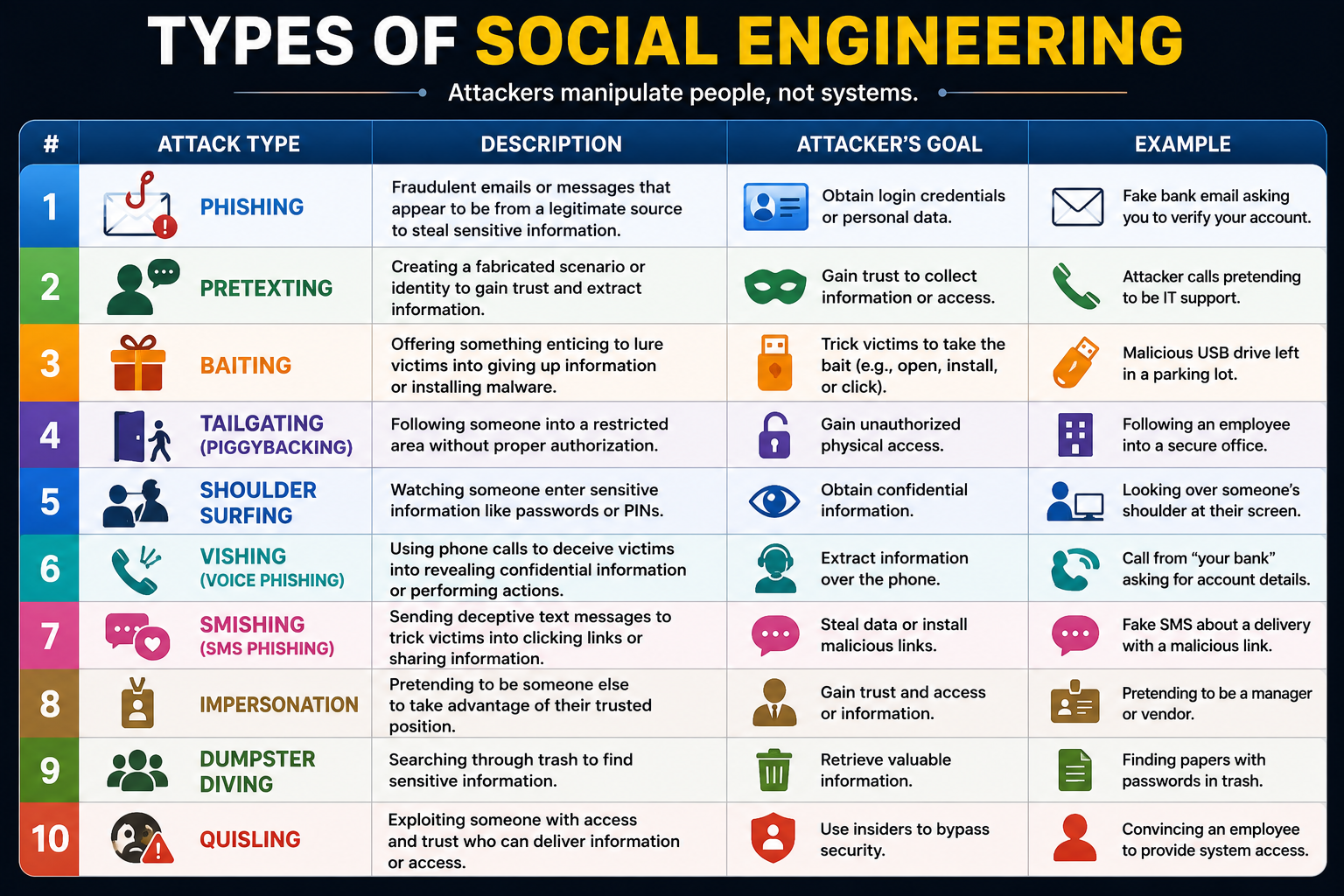
Types of Social Engineering Attacks Comparison Table
| Attack Type | Delivery Method | Primary Target | Technical Skill Needed | Main Goal |
|---|---|---|---|---|
| Phishing | Mass audiences | Low | Credential theft, malware | |
| Spear Phishing | Specific individuals | Medium | Targeted data access | |
| Whaling | Senior executives | High | Financial fraud, data access | |
| Smishing | SMS Text | Mobile users | Low | Credential theft, fraud |
| Vishing | Phone Call | Individuals, businesses | Medium | Financial fraud, data theft |
| Pretexting | Any channel | Specific individuals | Medium-High | Data extraction |
| Baiting | Physical or digital | Curious individuals | Low | Malware delivery |
| Quid Pro Quo | Phone or digital | Business employees | Low-Medium | Credential theft |
| Tailgating | Physical (in-person) | Business employees | None | Unauthorized physical access |
| Shoulder Surfing | Physical (in-person) | Public device users | None | Credential observation |
Phishing
Phishing uses deceptive emails that impersonate trusted organizations to trick recipients into clicking malicious links, opening dangerous attachments, or entering credentials on fake websites. It is the most prevalent social engineering technique globally and the starting point for the majority of serious data breaches.
How it works: Attackers craft emails replicating the visual design of trusted brands including banks, streaming services, government agencies, and technology companies. Recipients are directed to fake websites that harvest entered credentials or to attachments that install malware.
Common targets: Anyone with an email address. Mass campaigns target millions simultaneously.
Risks: Credential theft, financial fraud, malware infection, and identity theft with cascading account compromises when passwords are reused.
Prevention: Verify sender addresses carefully, never click email links for sensitive accounts, navigate directly to official sites, and enable MFA everywhere.
For a complete guide, see our article on What Is Phishing?.
Spear Phishing
Spear phishing directs the personalized precision of research-driven attacks at specific individuals. Unlike mass phishing campaigns, spear phishing incorporates personal details that make the message appear genuinely relevant and legitimate to the specific recipient.
How it works: After researching the target, attackers craft messages that reference their name, employer, role, recent activities, colleagues, or current projects. The resulting message feels completely authentic because it reflects genuine knowledge of the target’s professional context.
Common targets: Corporate employees with financial authority or system access, IT administrators, executives, and anyone whose compromise would provide significant organizational access.
Risks: Spear phishing produces some of the most damaging breaches because it specifically targets individuals with valuable access privileges.
Prevention: Be cautious about publicly sharing professional details, verify unexpected requests through separate channels, and participate in regular security awareness training that includes spear phishing simulation exercises.
Whaling
Whaling targets the most senior, highest-authority individuals within organizations. The name reflects the scale of the target. These attacks go after executives whose authorization can trigger significant financial transactions or access extremely sensitive organizational data.
How it works: Attackers research executives extensively, studying their communication style, business priorities, and organizational relationships. Whaling messages often impersonate regulatory bodies, legal counsel, business partners, or board members, requesting urgent authorization for financial transfers or access to sensitive records.
Common targets: CEOs, CFOs, board members, general counsel, and senior executives with financial authorization authority.
Risks: Individual whaling attacks have resulted in organizations losing millions of dollars in single fraudulent transactions, combined with severe reputational and regulatory consequences.
Prevention: Implement mandatory multi-person verification for all significant financial transactions, establish clear communication protocols for executive-level requests, and provide specialized security awareness training that addresses the specific threats executives face.
Smishing
Smishing delivers social engineering attacks through SMS text messages to mobile devices. The growing reliance on smartphones for banking, authentication, and business communications makes smishing an increasingly effective and widely deployed attack method.
How it works: Attackers send text messages impersonating banks, package delivery services, government agencies, or mobile carriers. Messages typically contain urgent warnings or attractive offers with shortened URLs that obscure the destination before directing victims to credential-harvesting sites.
Common targets: Smartphone users across all demographics, with particular effectiveness against individuals less familiar with digital security threats.
Risks: Financial fraud through stolen banking credentials, interception of SMS-based authentication codes, mobile malware installation, and identity theft.
Prevention: Never click links in unexpected text messages regardless of urgency. Navigate directly to official apps or websites to check any claimed account issue. Report suspicious texts to your mobile carrier.
Vishing
Vishing conducts social engineering attacks through live or recorded voice phone calls. Attackers impersonate bank security departments, tax agencies, technical support representatives, law enforcement, or social security officials using caller ID spoofing to make calls appear legitimate.
How it works: Vishing callers create convincing scenarios that generate fear or urgency, telling victims their account has been compromised, their tax return has triggered an audit, or their computer is sending error reports to a support center. Caller ID spoofing makes the call appear to come from official phone numbers, adding credibility.
Common targets: Individuals across all age groups, with older adults and people less familiar with digital threats being disproportionately targeted due to lower baseline suspicion of phone-based attacks.
Risks: Direct financial losses through fraudulent transfers or gift card purchases, disclosure of account credentials and personal identification information, and long-term identity fraud.
Prevention: Never provide sensitive information to callers who contact you unexpectedly. Hang up and call the organization back using a number obtained independently from their official website. Remember that legitimate agencies never demand immediate payment via gift cards or cryptocurrency.
Pretexting
Pretexting involves creating an elaborate fictional scenario, or pretext, to extract information or gain access that the target would not provide under normal circumstances. The attacker assumes a fabricated identity and backstory, maintaining a convincing false persona throughout the entire interaction.
How it works: An attacker might pose as a corporate auditor needing access to financial records, an insurance investigator requiring personal details for a claim, a new IT vendor requiring network access credentials, or a journalist researching a story that requires a source to verify certain information. The pretext provides a seemingly legitimate justification for every request the attacker makes.
Common targets: Business employees, customer service representatives who are trained to be helpful, and anyone who interacts regularly with external professionals in their work role.
Risks: Disclosure of sensitive organizational information, unauthorized access to systems and data, financial fraud, and supply chain compromises that can affect an organization’s partners and customers.
Prevention: Establish and enforce strict identity verification procedures before sharing any sensitive information with external parties. Train employees to be comfortably assertive about following verification protocols even when faced with impatient or authoritative callers.
Baiting
Baiting exploits human curiosity or greed by offering something attractive that leads victims into a trap. The “bait” might be a physical object like an infected USB drive left in a tempting location, or a digital lure like a free software download or premium content that conceals malware.
How it works: A classic physical baiting attack involves an attacker leaving USB drives labeled “Salary Information 2026” or “Confidential Executive Report” in a company parking lot, restroom, or lobby. Curious employees who pick them up and plug them into work computers unknowingly execute malware that gives the attacker network access. Digital baiting uses free movie downloads, game cracks, or premium software offers that deliver malware instead of promised content.
Common targets: Curious individuals in both workplace and public settings. Security researchers have repeatedly demonstrated that a significant percentage of people will plug in found USB drives without hesitation.
Risks: Malware delivery including ransomware, keyloggers, and backdoors. In corporate environments, a single compromised device can provide an entry point into the entire organizational network.
Prevention: Never plug in USB drives or other storage media from unknown sources, regardless of what labels they carry. Download software only from official developer websites and verified sources.
Quid Pro Quo
Quid pro quo attacks offer a service or benefit in exchange for information or access. The term means “something for something” in Latin, reflecting the transactional nature of this manipulation technique. Attackers position themselves as providing value to make their request for sensitive information seem like a fair exchange.
How it works: A common quid pro quo scenario involves an attacker calling businesses claiming to be from IT support. They offer to help fix a computer problem and ask for the employee’s credentials to connect remotely and resolve the issue. Another variant involves offering free technical support, gift cards, or other benefits in exchange for completing surveys that gather sensitive personal or organizational information.
Common targets: Business employees, small business owners who lack dedicated IT support and appreciate external help, and individuals seeking solutions to technical problems.
Risks: Direct credential theft, unauthorized remote access to organizational systems, malware installation during fake “support sessions,” and organizational data exposure.
Prevention: Verify the identity of anyone claiming to be from IT support through your organization’s official helpdesk number. Never provide credentials to anyone who contacts you offering unsolicited technical assistance, regardless of how legitimate they appear.
Tailgating
Tailgating, also called piggybacking, is a physical social engineering technique where an unauthorized person gains entry to a restricted area by following closely behind an authorized person who has legitimately accessed a secured door or gate.
How it works: An attacker dressed professionally approaches a secured building entrance carrying boxes or appearing to struggle with items, making it awkward for an authorized employee to let a secured door close in their face. Natural human courtesy causes the employee to hold the door, granting the attacker physical access to facilities they have no authorization to enter. Once inside, the attacker can access unattended computers, plant hardware keyloggers, steal physical documents, or move through the facility largely unchallenged.
Common targets: Organizations with physical security measures like key card access, data centers, corporate offices with sensitive areas, government facilities, and healthcare environments.
Risks: Physical access to sensitive areas leads to theft of physical assets, planting of surveillance or hacking hardware, theft of physical documents containing sensitive information, and access to unattended logged-in computers.
Prevention: Train all employees to follow physical security protocols consistently, ensure everyone entering secured areas uses their own credentials regardless of social pressure, install mantraps or turnstiles where high security is required, and create a culture where security awareness is valued over social comfort.
Shoulder Surfing
Shoulder surfing is a simple but effective physical observation attack where an attacker watches a victim enter passwords, PINs, or other sensitive information by looking over their shoulder, sometimes using magnification tools or cameras for attacks at greater distances.
How it works: In crowded public spaces like coffee shops, airports, public transit, and libraries, attackers position themselves near individuals using laptops, tablets, or smartphones and observe the screen and keyboard. In higher-sophistication variants, attackers use cameras or telescopic devices to capture login credentials, banking PINs at ATMs, or sensitive documents from greater distances.
Common targets: Individuals using devices in public spaces, people using ATMs and payment terminals, and employees working on sensitive materials in open or shared environments.
Risks: Theft of banking PINs enabling card fraud, capture of login credentials for corporate or personal accounts, and observation of sensitive business information on screens in public settings.
Prevention: Use privacy screen protectors on laptops and mobile devices in public spaces. Shield PIN entry at ATMs and payment terminals with your body. Be aware of your surroundings when working with sensitive information in public. Use multi-factor authentication so that an observed password alone cannot grant account access.
Common Signs of a Social Engineering Attack
Recognizing the warning signs of social engineering in real time gives you the opportunity to pause, verify, and protect yourself before any damage occurs.
Warning Signs Checklist
- Someone contacts you unexpectedly and creates extreme urgency, demanding immediate action without time for verification.
- A caller, emailer, or messenger claims authority and discourages you from verifying their identity through independent means.
- The communication requests sensitive information like passwords, banking details, or personal identification numbers.
- An unexpected email contains attachments you were not expecting or contains links that do not visually match the claimed destination.
- Someone offers you an unsolicited benefit, reward, or service in exchange for information or access.
- A message contains slightly unusual language, phrasing, or formatting that differs subtly from how the claimed sender normally communicates.
- A caller uses your name and some personal details but cannot answer specific verification questions that a legitimate representative would know.
- You receive a suspicious email from a colleague’s address but the message does not sound like something they would write or request.
- Someone in a public space positions themselves unusually close to your device screen or keyboard without apparent reason.
- An unfamiliar USB drive, device, or physical item appears in your workplace without clear explanation of its origin.
- Someone attempts to enter a secured physical area by following behind you rather than using their own credentials.
- A person you do not recognize seems familiar and helpful but asks questions that have no obvious legitimate reason in your environment.
- An offer, prize, or download seems too good to be true, which in cybersecurity contexts reliably means it is not legitimate.
- A technical support caller cannot explain specifically what problem they detected or why your account requires immediate attention.
- You feel pressured, rushed, or emotionally manipulated during an interaction in a way that makes careful thinking feel difficult.
Social Engineering vs Phishing
Many people use these terms interchangeably, but understanding their relationship helps clarify how these attacks operate at different levels.
Social Engineering vs Phishing Table
| Factor | Social Engineering | Phishing |
|---|---|---|
| Scope | Broad category of all human manipulation attacks | One specific technique within social engineering |
| Delivery Methods | Email, phone, SMS, in-person, social media, physical | Primarily email, also SMS and social media |
| Technical Component | May have none (purely psychological) | Often includes fake websites or malicious attachments |
| Relationship | Parent category containing all manipulation attacks | A subset of social engineering attacks |
| Target Approach | Mass or highly targeted depending on technique | Ranges from mass campaigns to targeted spear phishing |
| Attack Examples | Pretexting, baiting, tailgating, vishing, phishing | Email phishing, spear phishing, clone phishing |
| Prevention Focus | Broad awareness and verification culture | Email security tools plus user awareness |
| Requires Digital Channel | No, can be entirely physical | Yes, requires some digital communication element |
| Sophistication Range | From basic to highly sophisticated | From basic mass campaigns to highly targeted |
Phishing is a form of social engineering, but social engineering encompasses much more than phishing alone. All phishing attacks are social engineering, but social engineering also includes physical manipulation, voice-based attacks, in-person deception, and numerous other techniques that do not involve email at all. Building defenses against the full breadth of social engineering requires thinking beyond email security alone.
Why Social Engineering Attacks Are Successful
Understanding the psychological principles that make social engineering work helps you recognize manipulation attempts before they succeed.
Human Psychology
Social engineering works because it exploits consistent, predictable aspects of human psychology. Attackers study behavioral psychology to understand which triggers reliably produce desired responses in their targets. These psychological principles operate below the level of conscious awareness, which is precisely what makes them so effective even against intelligent, educated, and generally cautious individuals.
Trust
Humans are fundamentally social creatures who extend trust readily to perceived authority figures, familiar brands, helpful strangers, and people who demonstrate knowledge about our lives. Attackers exploit this natural trust by assuming trusted identities convincingly. When someone calls claiming to be from your company’s IT department and correctly names your manager, your current project, and your office location, your brain begins treating them as legitimate before any formal verification occurs.
Fear
Fear is one of the most powerful social engineering tools available. A message warning that your bank account has been compromised, your tax return is under investigation, or your computer is broadcasting errors to a support center creates immediate emotional alarm. Fear impairs rational decision-making and drives people toward quick, compliance-oriented responses rather than careful verification. Attackers deliberately engineer fear to bypass the critical thinking that would expose their deception.
Urgency
Artificial urgency prevents victims from taking the time needed to verify suspicious requests. “Your account will be permanently closed in 24 hours,” “This offer expires in the next ten minutes,” and “The wire transfer must be completed before close of business today” all create time pressure that makes careful verification feel dangerously slow. Legitimate organizations rarely require immediate action without any opportunity for verification. Urgency is therefore a reliable red flag for social engineering.
Curiosity
Human curiosity is a powerful force that attackers exploit through baiting, unexpected notifications, and intriguing messages. “See who viewed your profile,” “You have an unread message from a former colleague,” and “Your performance review has been uploaded” all trigger natural curiosity that drives people to click without adequate scrutiny. Attackers understand that the promise of interesting or personally relevant information reliably overcomes caution.
Lack of Awareness
Perhaps the most fundamental factor in social engineering success is simple lack of awareness. People who do not know that social engineering attacks exist, do not understand their specific techniques, or have not practiced recognizing manipulation attempts cannot defend against them effectively. Security awareness training dramatically reduces social engineering success rates in organizational environments by giving potential victims the knowledge they need to identify and respond appropriately to manipulation attempts.
How to Prevent Social Engineering Attacks
Preventing social engineering requires combining individual vigilance with organizational security controls and a culture that values verification over convenience.
Prevention Checklist
| Prevention Action | Priority | Applies To |
|---|---|---|
| Verify all unexpected contact independently | Critical | Everyone |
| Never share passwords verbally or in email | Critical | Everyone |
| Enable multi-factor authentication | Critical | All accounts |
| Use strong unique passwords | Critical | All accounts |
| Think critically before clicking links | Critical | Everyone |
| Limit personal information on social media | High | Everyone |
| Follow physical security protocols consistently | Critical | Business employees |
| Complete regular security awareness training | Critical | Business employees |
| Report suspicious communications immediately | High | Everyone |
| Never use found USB drives or storage media | Critical | Everyone |
| Use email security tools and filters | High | Everyone |
| Keep all software and systems updated | High | All devices |
| Verify financial requests through second channel | Critical | Businesses |
| Use privacy screens in public spaces | High | Mobile device users |
| Install reputable antivirus software | High | All devices |
| Establish clear IT support verification processes | Critical | Businesses |
| Conduct regular phishing simulation exercises | High | Businesses |
| Implement least-privilege access controls | High | Businesses |
| Create a security-first organizational culture | High | Businesses |
| Monitor accounts for unusual activity | High | Everyone |
- Always verify the identity of anyone requesting sensitive information through an independent channel. Call the organization back using a number from their official website, not a number the caller provides.
- Never share your passwords with anyone under any circumstances, including IT staff, managers, or colleagues. Legitimate IT departments never need your password to help you.
- Enable multi-factor authentication on every account that supports it. MFA ensures stolen passwords alone cannot grant attackers account access even when social engineering successfully captures credentials.
- Use strong, unique passwords for every account. A password manager makes this practical without requiring you to remember dozens of complex passwords.
- Think critically and pause before clicking any link or opening any attachment in unexpected communications, regardless of how familiar or legitimate the sender appears.
- Limit the personal and professional information you share publicly on social media and professional networking platforms. Attackers use publicly available details to craft convincing targeted attacks.
- Follow physical security protocols consistently in workplace environments. Never allow unfamiliar people to follow you through secured doors regardless of how polite, professional, or burdened they appear.
- Participate actively in regular cybersecurity awareness training. Organizations that conduct frequent, realistic training see dramatically lower rates of successful social engineering attacks against their employees.
- Report all suspicious communications, calls, emails, and in-person interactions to your security team or IT department immediately. Early reporting can prevent attacks from progressing further.
- Never plug in USB drives, charging cables, or other storage devices from unknown sources. The potential malware risk always outweighs any possible benefit from using found hardware.
- Use email security tools including spam filters, phishing detection software, and DMARC email authentication to reduce the volume of social engineering attempts that reach employee inboxes.
- Keep all operating systems, applications, and security software updated. Many social engineering attacks deliver malware through links and attachments that exploit known vulnerabilities in outdated software.
- Establish mandatory multi-person verification procedures for all significant financial transactions in business environments. No single employee should be able to authorize large transfers based on email or phone instruction alone.
- Use privacy screen protectors on laptops and mobile devices when working in public spaces to prevent shoulder surfing observation of sensitive information.
- Install reputable antivirus and anti-malware software that can detect and block malware delivered through social engineering attacks that successfully reach their targets.
- Create and communicate clear procedures for how your IT department contacts employees, what they will and will not ask for, and how employees should respond to unsolicited technical support calls.
- Conduct regular phishing simulation exercises across your entire organization, providing immediate training to employees who engage with simulated attacks while recognizing improvement over time.
- Implement least-privilege access controls so that a successfully compromised account can only access the minimum data and systems necessary for that role, limiting the damage from any single social engineering incident.
- Build a security-first organizational culture where employees feel comfortable questioning suspicious requests, reporting concerns without fear of embarrassment, and taking time to verify before complying.
- Monitor all accounts regularly for signs of unauthorized access including unfamiliar login locations, password change notifications you did not initiate, and unexpected account activity alerts.
Learn more in our guide on What Is Two-Factor Authentication (2FA)?.
What Should You Do If You Become a Victim?
Acting quickly and methodically after a social engineering attack significantly limits the damage and speeds up recovery.
Step 1: Stay Calm and Stop the Interaction
Your first priority is to stop any ongoing interaction with the attacker. If you are on the phone, hang up. If you are on a website, close the browser. Panic leads to further mistakes. Take a breath and shift into a deliberate, step-by-step response mode. Recognize that falling victim to a well-crafted attack does not reflect on your intelligence. These attacks are specifically designed to bypass normal judgment.
Step 2: Change Compromised Passwords Immediately
Change the passwords for any accounts whose credentials you may have revealed or that may have been accessed. Use a different, unaffected device to make these changes. Start with your email account, since email access enables attackers to reset passwords on many other accounts. Then address financial accounts, work systems, and any other sensitive services in order of potential impact.
Step 3: Enable Multi-Factor Authentication
If you have not already enabled MFA on affected accounts, do so immediately after changing passwords. MFA prevents attackers from accessing accounts with stolen credentials alone, providing a critical additional barrier even if your new password is somehow obtained through subsequent attacks.
Step 4: Contact Financial Institutions
If any banking credentials, credit card information, or financial account access was potentially compromised, contact your bank and card issuers immediately. Explain the situation clearly. Financial institutions can freeze accounts, cancel compromised cards, flag your account for enhanced monitoring, and work with you to reverse fraudulent transactions that have not yet cleared.
Step 5: Scan All Affected Devices
Run comprehensive malware scans on any device that was involved in the attack. If you opened an attachment, clicked a link, or plugged in an unknown device, malware may have been installed without your knowledge. Use reputable security software and consider engaging a professional cybersecurity service for serious suspected infections.
Step 6: Report the Incident
Report the attack to relevant authorities and organizations. In the United States, report to the FBI’s Internet Crime Complaint Center at ic3.gov and to CISA. Report phishing emails to your email provider and to the organization being impersonated. Notify your employer’s IT security team if any work systems or credentials were involved. Reporting contributes to tracking criminal activity and protecting others from the same campaign.
Step 7: Monitor All Accounts Continuously
Continue monitoring all potentially affected accounts for weeks after the incident. Set up transaction alerts on financial accounts, enable login notification features where available, and regularly review account activity for anything unfamiliar. Identity monitoring services provide ongoing alerts if your personal information appears in new data breaches or suspicious contexts.
Best Tools for Protection
Building effective defenses against social engineering requires deploying multiple complementary tools alongside strong security awareness.
Security Tools Comparison Table
| Tool Category | Primary Function | Examples | Best For |
|---|---|---|---|
| Password Managers | Store unique passwords and detect fake sites | Bitwarden, 1Password, Dashlane | All users |
| Multi-Factor Authentication | Block account access with stolen credentials | Google Authenticator, Microsoft Authenticator, hardware keys | All accounts |
| Email Security Solutions | Filter social engineering emails before delivery | Proofpoint, Mimecast, Microsoft Defender for Office 365 | Businesses |
| Antivirus Software | Block malware delivered through social engineering | Bitdefender, Malwarebytes, Windows Defender | All devices |
| Browser Protection | Warn about and block phishing and malicious sites | Built-in safe browsing, security extensions | All users |
| Identity Monitoring Services | Alert when personal data appears in breaches | HaveIBeenPwned, commercial identity protection services | All users |
Password Managers
Password managers generate and securely store unique, complex passwords for every account while also providing an important anti-phishing benefit. Because they associate stored credentials with specific domain names, they automatically refuse to fill credentials on fake phishing sites that impersonate the real domain. This technical verification catches convincing fake sites that might fool visual inspection entirely.
Multi-Factor Authentication
MFA is the single most impactful technical control against credential-based social engineering. Even when an attacker successfully obtains a password through a phishing site, pretexting call, or other technique, they cannot access the account without also possessing the second authentication factor. Hardware security keys provide the strongest MFA protection, particularly against sophisticated real-time phishing proxy attacks.
Email Security Solutions
Enterprise email security platforms use AI and threat intelligence to identify and quarantine social engineering emails including phishing, spear phishing, and business email compromise attempts before they reach employees. They also enforce email authentication standards like SPF, DKIM, and DMARC that make it significantly harder for attackers to impersonate organizational domains.
Antivirus Software
Modern antivirus and endpoint protection solutions detect and block many of the malware payloads that social engineering attacks attempt to deliver through malicious links, attachments, and infected media. Real-time protection, behavioral detection, and web filtering all contribute to reducing the damage from social engineering attacks that successfully reach their targets.
Browser Protection
Web browsers include built-in safe browsing databases that display warnings before loading known phishing and malicious websites. These protections stop many social engineering victims from reaching credential-harvesting sites even when they click malicious links. Additional browser security extensions from reputable vendors provide supplementary protection layers.
Identity Monitoring Services
Identity monitoring services track whether your personal information appears in data breaches, on dark web marketplaces, or in other suspicious contexts. Early notification allows you to change compromised credentials before attackers exploit them and to place fraud alerts on financial accounts before identity theft occurs.
Common Myths About Social Engineering
Misconceptions about social engineering create dangerous blind spots that attackers actively exploit.
Myth 1: Social Engineering Only Happens Online
Social engineering attacks occur through phone calls, in-person interactions, physical media like USB drives, and even physical mail campaigns. Limiting your awareness to digital threats leaves you vulnerable to equally effective physical and voice-based manipulation techniques.
Myth 2: Only Non-Technical People Fall for These Attacks
Security professionals, IT administrators, and senior cybersecurity experts regularly fall victim to sophisticated social engineering attacks. Highly targeted, well-researched spear phishing and pretexting attacks exploit psychological principles that affect everyone regardless of technical knowledge or general intelligence.
Myth 3: Strong Technical Security Makes Social Engineering Irrelevant
Technical security controls protect systems from technical attacks. Social engineering bypasses technical controls entirely by manipulating the people who legitimately use and administer those systems. A perfectly configured firewall cannot prevent an employee from willingly handing over their credentials to a convincing attacker on the phone.
Myth 4: Social Engineering Attacks Are Always Obvious
Modern social engineering attacks from professional criminal organizations are extraordinarily sophisticated. Highly personalized spear phishing emails, expertly crafted pretexting scenarios, and AI-generated voice impersonations can fool even careful, security-conscious individuals who are actively looking for warning signs.
Myth 5: Security Awareness Training Does Not Work
Research consistently demonstrates that regular, realistic security awareness training significantly reduces the success rate of social engineering attacks within organizations. Employees who have experienced realistic phishing simulations and received targeted training are substantially less likely to fall for actual attacks.
Myth 6: Attackers Always Have Complex Technical Motivations
Many social engineering attacks are financially motivated and relatively simple in concept. A criminal who calls a customer service representative and convinces them to reset an account password using fabricated personal details has accomplished their goal through a two-minute phone call without any technical hacking whatsoever.
Myth 7: Social Engineering Is a Minor Threat Compared to Technical Attacks
The Verizon Data Breach Investigations Report consistently identifies the human element, including social engineering, as a primary factor in the majority of significant data breaches globally. Social engineering is arguably the most impactful attack vector in modern cybersecurity.
Myth 8: Policies and Procedures Alone Prevent Social Engineering
Having documented security policies is necessary but insufficient. Policies are only effective when employees know them, understand why they exist, believe they are important, and feel empowered to follow them even under social pressure from authoritative or seemingly legitimate requesters.
Myth 9: Social Engineering Only Targets Large Organizations
Small businesses and individuals are targeted by social engineering attacks constantly. Smaller organizations often have fewer security controls, less trained staff, and smaller IT resources to respond to incidents, making them particularly attractive targets for attacks that require minimal technical sophistication.
Myth 10: If I Do Not Use Social Media, I Am Safe from Social Engineering
Social engineers gather information from many sources beyond social media including company websites, professional networking platforms, public records, previous data breaches, and even physical observation. Avoiding social media reduces your publicly available information but does not eliminate the research resources available to determined attackers.
Future of Social Engineering Attacks
Social engineering is evolving rapidly as new technologies provide attackers with unprecedented tools for manipulation and deception.
AI-Generated Phishing
Artificial intelligence is fundamentally changing the scale and quality of social engineering attacks. AI tools generate personalized phishing emails tailored to specific individuals using information gathered automatically from public sources, producing grammatically perfect, contextually relevant messages at industrial scale. The traditional warning signs of poor grammar and generic content are disappearing from AI-generated attacks, making awareness training that focuses purely on obvious indicators increasingly insufficient.
Deepfake Voice Scams
Voice cloning technology allows attackers to create convincing replicas of real individuals’ voices using short audio samples gathered from videos, podcast appearances, or voicemail recordings. Documented cases already exist of finance employees transferring large sums after receiving phone calls featuring convincing AI-generated voices of their executives. As voice cloning becomes more accessible and accurate, vishing attacks will become dramatically harder to identify through voice recognition alone.
Deepfake Video Scams
Deepfake video technology extends impersonation attacks into video calls, allowing attackers to impersonate executives, officials, and known individuals in real-time video conferences. Organizations are beginning to encounter incidents where employees participate in video calls with convincing deepfake impersonations of senior leaders authorizing fraudulent transactions or disclosing sensitive information.
QR Code Phishing (Quishing)
QR code phishing uses QR codes embedded in emails, physical mail, posters, and digital communications to direct victims to phishing sites. Because most people cannot inspect a QR code’s destination before scanning, and because many email security tools do not scan QR code images effectively, quishing bypasses significant portions of traditional phishing defenses. This technique is growing rapidly in frequency and sophistication.
AI-Powered Social Engineering
Looking further ahead, AI systems capable of conducting multi-turn conversations will enable fully automated social engineering attacks that can sustain convincing real-time interactions with targets across phone calls, chat systems, and email exchanges. These systems will adapt dynamically to target responses, applying appropriate psychological pressure and modifying their approach based on the target’s reactions in ways that surpass the capabilities of any individual human attacker working at scale.
Frequently Asked Questions
What is social engineering?
Social engineering is a cyberattack technique that manipulates human psychology to trick people into revealing sensitive information, granting unauthorized access, or taking actions that benefit the attacker. It exploits trust, fear, urgency, and curiosity rather than technical vulnerabilities, making it effective regardless of how strong an organization’s technical security controls are.
How do social engineering attacks work?
Social engineering attacks work through a structured process of target research, trust building, psychological manipulation, information collection, and data exploitation. Attackers research targets to craft convincing deceptions, build false trust through impersonation and familiar details, then apply psychological pressure to extract what they need before disappearing.
What are the common types of social engineering?
Common types include phishing through email, spear phishing targeting specific individuals, whaling targeting executives, smishing via SMS, vishing through phone calls, pretexting using fabricated scenarios, baiting with attractive lures, quid pro quo offering fake services for information, tailgating for physical access, and shoulder surfing to observe credentials.
How can I identify a social engineering attack?
Key indicators include unexpected contact creating urgency, requests for sensitive information, pressure that discourages verification, offers that seem too good to be true, slight inconsistencies in communication style or sender details, unfamiliar people attempting to enter secured areas, and anyone requesting credentials verbally or through email.
What is pretexting?
Pretexting is a social engineering technique where the attacker creates an elaborate fictional scenario and assumes a false identity to justify requests for sensitive information or access. Common pretexts include impersonating auditors, IT vendors, insurance investigators, or legal counsel who require specific information to complete fabricated official processes.
What is baiting?
Baiting exploits human curiosity or greed by offering something attractive that conceals a malicious payload. Physical baiting uses infected USB drives left in tempting locations. Digital baiting uses free software downloads, pirated content, or prize offers that deliver malware instead of the promised content when accessed.
What is tailgating?
Tailgating is a physical social engineering technique where an unauthorized person gains entry to a restricted area by following closely behind an authorized employee. Attackers typically exploit social courtesy by appearing to need assistance or carrying items that make it awkward for employees to let a secured door close in their face.
What is shoulder surfing?
Shoulder surfing is a physical attack where an attacker observes a victim entering passwords, PINs, or other sensitive information by watching their screen and keyboard from a nearby position. It is particularly effective in crowded public spaces like airports, coffee shops, and public transport where people use devices in close proximity to strangers.
Is phishing a type of social engineering?
Yes. Phishing is one specific technique within the broader category of social engineering. All phishing attacks are social engineering because they rely on psychological manipulation through deceptive communications. However, social engineering encompasses many additional techniques beyond phishing including pretexting, baiting, tailgating, vishing, and shoulder surfing.
Can businesses prevent social engineering?
Businesses can dramatically reduce social engineering risk through regular security awareness training, phishing simulation exercises, strict identity verification procedures, MFA enforcement, email security tools, physical security controls, clear financial authorization policies, and cultivating a security-conscious organizational culture where employees feel empowered to question suspicious requests.
What should I do if I become a victim?
Stay calm and stop the interaction. Change compromised passwords from a clean device. Enable MFA on affected accounts. Contact financial institutions if banking details were involved. Scan devices for malware. Report the incident to authorities and your organization’s security team. Monitor all accounts continuously for signs of ongoing unauthorized access.
How does MFA help against social engineering?
MFA means that stolen passwords alone cannot grant attackers access to protected accounts. Even when social engineering successfully captures credentials, the attacker cannot proceed without also possessing the second authentication factor. This protection dramatically limits the impact of credential-based social engineering attacks against MFA-protected accounts.
Can antivirus stop social engineering?
Antivirus software cannot prevent purely psychological manipulation. It can, however, detect and block malware delivered through social engineering attacks including malicious attachments and drive-by downloads triggered by phishing links. Antivirus is an important component of layered defense but cannot address the human vulnerability that social engineering fundamentally exploits.
Is social engineering illegal?
Yes. Social engineering attacks that involve fraud, identity theft, unauthorized computer access, or financial theft are criminal offenses in virtually every jurisdiction. Perpetrators face significant prison sentences, fines, and restitution orders. The international nature of many social engineering operations creates enforcement challenges, but law enforcement agencies successfully prosecute many social engineers each year.
What is the future of social engineering?
The future includes AI-generated personalized phishing that eliminates traditional warning signs, deepfake voice and video impersonation enabling convincing executive fraud, QR code phishing bypassing email security tools, and AI-powered automated social engineering systems capable of conducting real-time manipulative conversations at scale. Defenses must evolve through stronger verification procedures and technology-assisted detection.
People Also Ask
What is social engineering?
Social engineering is a cyberattack technique that uses psychological manipulation to trick people into revealing sensitive information or granting unauthorized access, exploiting trust, fear, urgency, and curiosity rather than technical vulnerabilities.
How do social engineering attacks work?
Attackers research targets, build false trust through impersonation, apply psychological pressure using fear or urgency, extract sensitive information or access, and then exploit what they obtained for financial gain or further attacks.
What are the different types of social engineering?
Main types include phishing, spear phishing, whaling, smishing, vishing, pretexting, baiting, quid pro quo, tailgating, and shoulder surfing, each adapted for different channels and objectives.
Is phishing a social engineering attack?
Yes. Phishing is one specific technique within the broader social engineering category. All phishing is social engineering, but social engineering includes many additional techniques beyond phishing.
What is pretexting?
Pretexting involves creating an elaborate fictional scenario and false identity to justify requests for sensitive information. Attackers might impersonate auditors, IT vendors, or investigators to extract credentials or organizational data.
What is baiting?
Baiting exploits curiosity or greed through attractive lures like labeled USB drives left in public spaces or free content downloads that deliver malware instead of promised content.
How can I protect myself from social engineering?
Verify unexpected contacts independently, never share passwords verbally, enable MFA on all accounts, limit personal information on social media, think critically before clicking links, and maintain consistent physical security practices.
What should I do if I become a victim?
Stop the interaction, change compromised passwords from a clean device, enable MFA, contact financial institutions, scan devices for malware, report to authorities, and monitor all accounts continuously for unauthorized activity.
Why are social engineering attacks successful?
They succeed because they exploit consistent human psychological principles including trust in authority, fear of consequences, urgency that impairs rational thinking, natural curiosity, and general lack of awareness about specific manipulation techniques.
Can businesses prevent social engineering attacks?
Yes. Regular awareness training, phishing simulations, strict verification procedures, MFA enforcement, email security tools, physical security controls, and a security-conscious organizational culture all significantly reduce successful social engineering attack rates.
Final Thoughts
Understanding what is social engineering and developing genuine awareness of how these attacks exploit human psychology is one of the most valuable and practical cybersecurity investments anyone can make in 2026. Technology continues to grow more sophisticated and more interconnected every year, but the human element remains the most consistently targeted vulnerability in any security system. No firewall, antivirus program, or encryption protocol can fully compensate for a person who has been successfully manipulated into willingly providing access or information.
The most effective defense combines knowledge with habit. Knowing what social engineering looks like allows you to recognize warning signs in the moment. Developing consistent verification habits ensures that even the most convincing manipulation attempt is met with a pause and an independent check rather than immediate compliance. Building organizations where security is genuinely valued rather than merely documented ensures that individual employees feel supported in questioning suspicious requests regardless of apparent authority.
References
- Cybersecurity and Infrastructure Security Agency (CISA). Social Engineering and Phishing Guidance. Available at: https://www.cisa.gov
- National Institute of Standards and Technology (NIST). Cybersecurity Awareness and Social Engineering Defense Guidelines. Available at: https://www.nist.gov
- Microsoft Security. Social Engineering Attack Detection and Protection Resources. Available at: https://www.microsoft.com/security
- Google Safety Center. Online Safety and Social Engineering Protection Resources. Available at: https://safety.google
- OWASP Foundation. Social Engineering Defense and Web Application Security Resources. Available at: https://owasp.org
Disclaimer
This article is for educational and informational purposes only. It explains social engineering attacks, cybersecurity risks, and defensive security practices. It does not provide instructions for carrying out scams, fraud, or unauthorized activities. Always follow legal cybersecurity practices and verify unexpected requests before sharing sensitive information.
Author Bio
TechOriginHub Editorial Team is a team of cybersecurity researchers and technology writers committed to publishing accurate, beginner-friendly, and up-to-date guides on cybersecurity, online safety, AI, and emerging technologies.
 saman zahra