
 By TechOriginHub Editorial Team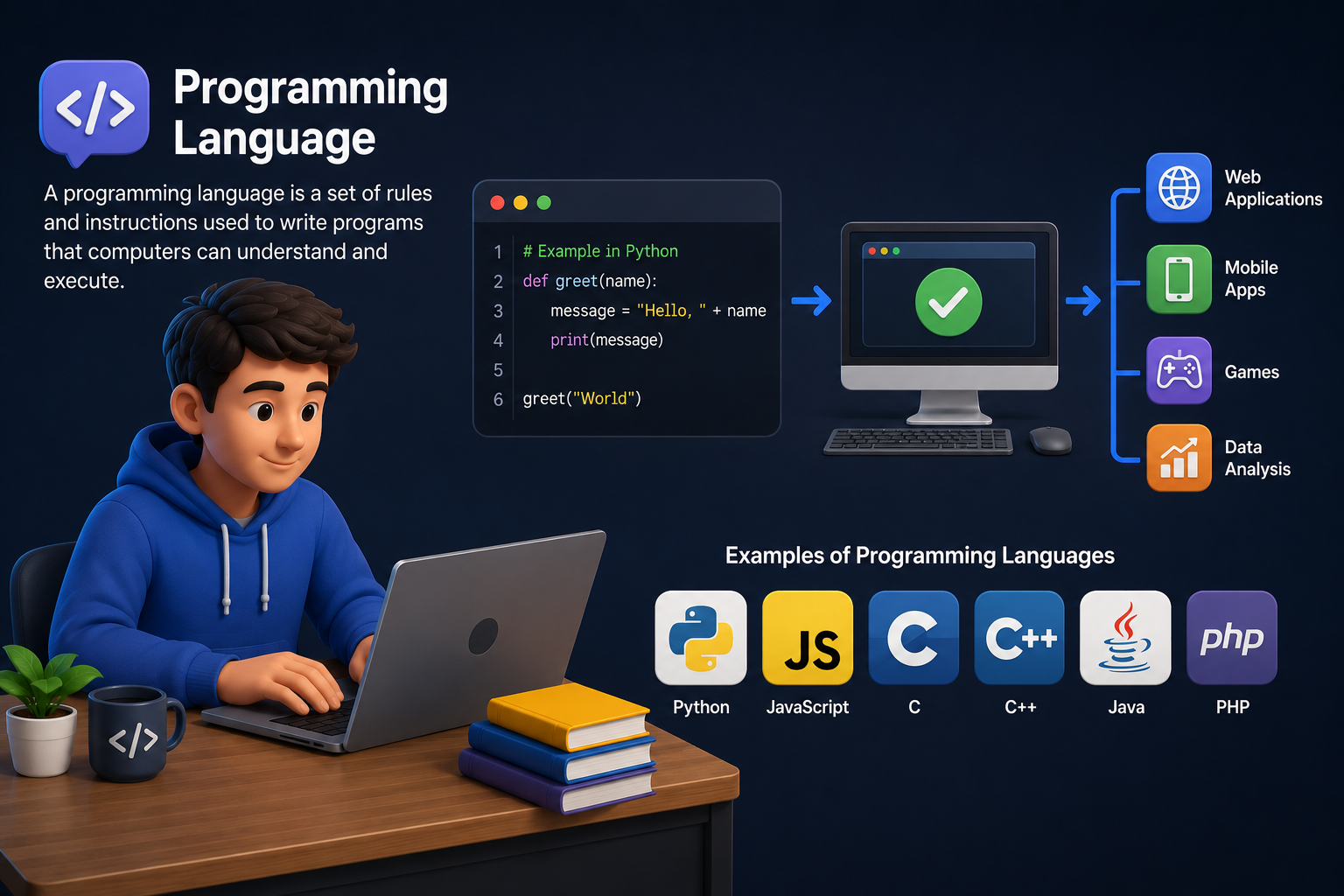
Introduction
A carpenter uses a saw, not a screwdriver, to cut wood. A surgeon uses a scalpel, not a hammer. Every profession uses tools designed for specific jobs, and the world of software development is no different. Programmers use programming languages to express the instructions that software tools can process and execute on a computer.
So what is a programming language, exactly? It is not simply a way to talk to a computer in plain English. Programming languages are formal languages with defined rules, structure, and meaning. They exist at a different level from both natural human languages and the binary machine code that computer hardware actually executes. Understanding this distinction is one of the most important starting points for anyone learning about software and technology.
This guide explains what programming languages are, why they exist, how they work, what types are available, and how to choose one. Whether you are completely new to the topic or building on some existing knowledge, you will find accurate and practical information here.
If you are also looking to understand the broader practice of writing software, the TechOriginHub guide to what is programming and how it works covers the full programming process from problem-solving through to debugging and maintenance.
Quick Answer: What Is a Programming Language?
A programming language is a formal language with defined syntax and semantics that programmers use to express instructions. Those instructions are then processed by software tools such as compilers or interpreters and ultimately executed by the computer. Programming languages exist at a higher level of abstraction than machine code, and different languages are designed or have evolved for different types of tasks and computing environments.
What Is a Programming Language?
A programming language is a formal language that provides a defined vocabulary and a structured set of grammatical rules, called syntax, that programmers use to write instructions. Those instructions describe what a program should do, how it should process data, and how it should respond to different conditions.
The key word here is formal. Unlike natural human languages such as English or Spanish, a programming language has precise and unambiguous rules. Every instruction must be written in exactly the way the language specifies. There is no room for the kind of loose interpretation that human conversation allows.
Programming languages also work at a level of abstraction above the hardware. A computer’s processor does not read Python or JavaScript. It executes machine code, which is a very low-level binary representation of instructions. Programming languages allow programmers to write instructions in a form that is closer to human thinking. Software tools then handle the translation into a form the hardware can actually process.
A helpful analogy: a recipe is written in human language and describes what a cook should do step by step. The cook reads the recipe and carries out the instructions. A program works similarly. A programmer writes the source code in a programming language, and software tools process that code so the computer can execute it.
Understanding the broader context of how programs are designed and built, from problem-solving through writing and testing code, is covered in depth in the TechOriginHub article on computer programming for beginners.
Why Do Programming Languages Exist?
Computers operate on machine code. Machine code consists of binary instructions, sequences of zeros and ones, that the processor can directly understand and execute. Every operation a computer performs, whether adding two numbers, displaying an image, or sending data across a network, ultimately comes down to machine code instructions.
Writing software directly in machine code is theoretically possible, but it is extraordinarily difficult. Machine code is tied to specific processor architectures, nearly impossible to read or maintain, and highly error-prone even for experienced engineers. Building a modern application directly in machine code would be impractical to the point of impossibility for most purposes.
Programming languages solve this problem by providing a higher level of abstraction. Instead of specifying every binary instruction manually, a programmer writes code using structured vocabulary and logical constructs that express what the program should do. Software tools, such as compilers and interpreters, then handle the work of translating that code into instructions the hardware can process.
This abstraction makes it possible to build complex software systems that would be completely unmanageable at the machine code level. It also makes programs more readable, maintainable, and portable across different hardware and operating systems.
How Does a Programming Language Work?
The general process of going from a programmer’s idea to a running program involves several steps.
First, the programmer writes source code in a chosen programming language. Source code is the human-readable form of the program, written according to the language’s syntax rules. For example, a line of Python source code might instruct the program to display a message or perform a calculation.
Second, software tools process that source code. The exact nature of this step depends on the language and the toolchain being used. Some languages use a compiler that translates the source code into another form before the program runs. Others use an interpreter that processes and executes the code through a runtime environment. Many modern languages use a combination of both approaches, along with bytecode, virtual machines, or just-in-time compilation.
Third, the processed instructions are executed on the computer. The result is the running program that performs the tasks it was written to carry out.
Throughout this process, two concepts are fundamental to how any programming language works: syntax and semantics. Syntax governs how the code must be written. Semantics governs what the code actually means and does.
What Is Syntax in a Programming Language?
Syntax is the set of rules that define how valid code must be written in a particular programming language. Every language has its own syntax, and code must follow those rules precisely for the tools to process it correctly.
The relationship between syntax and grammar is a useful analogy. In English, a sentence must follow certain grammatical rules to be understood. Similarly, code must follow a language’s syntax rules to be processed correctly. Break those rules, and the tools will not be able to interpret the code.
Different programming languages have different syntax rules. Consider a simple task: displaying the text “Hello, world!” on the screen. In Python, this is written as:
print("Hello, world!")In JavaScript, the equivalent might be written as:
console.log("Hello, world!");Both instructions accomplish the same goal, but the syntax is different. A Python tool processing JavaScript syntax, or vice versa, would not be able to handle it correctly.
When code violates a language’s syntax rules, the result is a syntax error. Most development tools detect syntax errors immediately and prevent the program from running until the errors are corrected. Syntax errors are common, particularly for beginners, because even small typos or misplaced characters can break the rules.
What Is Semantics in a Programming Language?
Semantics refers to the meaning or intended behavior associated with syntactically valid code. If syntax defines whether code is written correctly, semantics defines what that code actually does when it runs.
A helpful analogy from natural language: the sentence “The cloud ate the database” is grammatically valid English. Every word is in the right place, and the grammatical structure is correct. But the sentence is semantically nonsensical because clouds do not eat databases.
A similar distinction exists in programming. Code can be syntactically correct, meaning it follows all of the language’s rules and the tools can process it without error, but semantically wrong, meaning the logic does not produce the intended result.
This is the root cause of logic errors, one of the most common and sometimes most difficult types of programming mistake. The program runs without crashing, but it produces incorrect output because the programmer’s instructions did not accurately express the intended behavior.
For example, a program written to calculate an average might accidentally divide by the wrong number. The syntax is perfectly valid, so no error is reported. But the semantics of the instruction, what the division actually does, do not match what the programmer intended. The result is wrong.
Understanding the difference between syntax and semantics is important for anyone learning to read and write code carefully.
High-Level vs Low-Level Programming Languages
Programming languages exist on a spectrum of abstraction. At one end sit low-level languages, which are close to the hardware. At the other end sit high-level languages, which provide a much greater degree of abstraction from the underlying machine.
Low-Level Languages
Low-level languages are those that are closest to machine code and the hardware. They give the programmer significant direct control over how the hardware behaves, including memory management and processor instructions.
Machine code itself is the lowest level. Assembly language is one step above machine code, using symbolic names to represent machine instructions, but it is still tied closely to specific processor architectures and is extremely difficult to read, write, and maintain compared to higher-level alternatives.
Low-level languages offer performance advantages in situations where precise hardware control matters. However, they are less portable, meaning code written for one processor architecture may not work on a different one without significant modification.
High-Level Languages
High-level languages provide a much greater level of abstraction from the hardware. They use vocabulary and logical structures that are closer to human thinking, making them significantly easier to write, read, and maintain.
Examples of high-level languages include Python, JavaScript, Java, C#, and Ruby. A programmer writing in Python does not need to think about processor instructions or memory addresses directly. The language and its tools handle those concerns.
High-level languages are also generally more portable. A Python program can often run on different operating systems and hardware architectures without modification, provided the appropriate Python runtime is available.
The boundary between high-level and low-level is not always sharp. C, for example, is considerably lower-level than Python and gives programmers significant control over memory, but it is much higher-level than assembly language. Rust is another language that operates at a relatively low level while providing modern high-level language features.
A useful analogy: giving someone a GPS navigation app is a high-level solution, giving someone a detailed map is lower-level, and giving someone raw coordinates and compass bearing readings is lower still. All approaches lead to the destination, but the level of abstraction differs enormously.
Types of Programming Languages
Programming languages can be categorized in several ways, and understanding these categories helps clarify how different languages are designed and used.
By Execution Model
Compiled languages use a compiler to translate source code into another form, often machine code or an intermediate representation, before the program runs. C, C++, Go, and Rust are common examples. It is important to understand that compilation is not a single uniform process. Different compiled languages produce different types of output, use different optimization strategies, and target different execution environments.
Interpreted languages use an interpreter, which processes and executes source code through a runtime environment rather than requiring a separate compilation step before execution. Python in its standard CPython implementation and Ruby are commonly cited examples. However, the traditional description of interpreters as reading and executing code “one line at a time” is an oversimplification. Modern language runtimes often involve compilation to bytecode, optimization passes, and other sophisticated mechanisms before execution occurs.
Bytecode and virtual machine languages use a model where source code is compiled to an intermediate bytecode format, which is then executed by a virtual machine rather than directly by the hardware. Java compiles to bytecode that runs on the Java Virtual Machine (JVM). C# compiles to an intermediate language that runs on the .NET Common Language Runtime (CLR). This model offers portability benefits because the same bytecode can run on any system where the appropriate virtual machine is installed, which is the basis of Java’s “write once, run anywhere” philosophy.
Modern programming language implementations frequently combine elements of these models. JavaScript engines in current web browsers, for instance, use sophisticated just-in-time (JIT) compilers that compile frequently executed code paths for significantly improved performance.
By Type System
Statically typed languages check variable types at compile time. The type of every variable must be known before the program runs, and type mismatches are caught before execution. Java, C, C++, Go, Rust, and Swift are examples of statically typed languages. This approach can catch certain categories of errors early in the development process.
Dynamically typed languages determine variable types at runtime rather than at compile time. Python, JavaScript, and Ruby are dynamically typed. This offers more flexibility in how code is written but means that some type-related errors may only surface when the program is running.
It is important to understand that static and dynamic typing are separate concepts from compiled and interpreted execution models. Some statically typed languages use interpretation-based execution, and some dynamically typed languages can be compiled. The two dimensions are independent, even though certain combinations are more common than others.
By Purpose
General-purpose languages are designed to be applicable across a wide range of problem domains. Python, Java, C++, JavaScript, and C# are general-purpose languages that can be used to build many different types of software.
Domain-specific languages (DSLs) are designed or have evolved to be particularly effective within a specific domain or type of task. SQL is a well-known domain-specific language designed for querying and managing relational data in relational databases. Standard SQL is not a general-purpose programming language, though some database systems offer procedural extensions that add programming constructs. R is designed for statistical computing and data analysis. MATLAB is widely used for numerical computing in engineering and scientific research.
Domain-specific languages tend to be highly expressive and efficient within their intended domain but are not intended as general tools for building software across different contexts.
By Programming Paradigm
Languages can also be categorized by the programming paradigm or paradigms they support, including procedural, object-oriented, functional, declarative, and event-driven approaches. This dimension is covered in detail in the next section.
What Is a Programming Paradigm?
A programming paradigm is a fundamental style or approach to organizing and writing code. Different paradigms reflect different ways of thinking about what a program is and how it should be structured.
Procedural programming organizes code as a sequence of instructions or procedures that execute in a defined order. The programmer specifies the steps the program should take. C is a well-known procedural language, though it also supports other styles.
Object-oriented programming (OOP) organizes code around objects. An object combines related data and the behaviors that operate on that data into a single unit. OOP encourages thinking about a program in terms of entities and their interactions. Java, Python, C++, and C# all support object-oriented programming. OOP is one of the most widely used approaches in commercial software development.
Functional programming treats computation as the evaluation of mathematical functions and emphasizes avoiding changing state or mutable data. Programs are built from pure functions that produce predictable outputs for given inputs. Haskell is a language designed predominantly around functional programming principles. Python and JavaScript both support functional programming patterns alongside other paradigms.
Declarative programming focuses on describing the desired result rather than specifying the step-by-step process for achieving it. The programmer expresses what should happen rather than how it should happen. SQL is a well-known declarative language. When you write a SQL query to retrieve records matching certain criteria, you describe what you want, not the exact algorithm the database engine should use to find it.
Event-driven programming organizes the program around events, such as user input, messages from other systems, or changes in application state. The program defines how it should respond when specific events occur. This paradigm is common in user interface development and in web browser programming, where programs must respond to clicks, key presses, and other user interactions.
Many modern languages support multiple paradigms. Python, for example, supports procedural, object-oriented, and functional styles. JavaScript supports object-oriented, functional, and event-driven programming. This flexibility allows programmers to choose the approach that best fits the problem they are solving.
Popular Programming Languages and What They Are Used For
The following table provides a general overview of widely used programming languages. These descriptions are not exhaustive, and most languages support a broader range of uses than any table can fully capture.
| Language | Primary Paradigm(s) | Common Uses | Notes |
|---|---|---|---|
| Python | Multi-paradigm | Data analysis, automation, web development, scripting | Beginner-friendly syntax |
| JavaScript | Multi-paradigm | Web development, front-end and back-end | Runs natively in browsers |
| Java | Object-oriented | Enterprise software, back-end development | JVM-based, strongly typed |
| C | Procedural | Systems programming, embedded systems, OS development | Low-level hardware control |
| C++ | Multi-paradigm | Systems, games, performance-focused software | Extension of C |
| C# | Multi-paradigm | .NET applications, game development with Unity | Microsoft ecosystem |
| PHP | Multi-paradigm | Server-side web development | Widely used in web hosting |
| Go | Multi-paradigm | Back-end systems, infrastructure, cloud services | Developed by Google |
| Rust | Multi-paradigm | Systems, performance-focused software | Memory safety focus |
| Swift | Multi-paradigm | Apple platform development (iOS, macOS) | Developed by Apple |
| Kotlin | Multi-paradigm | Android and JVM development | Interoperable with Java |
| R | Functional, procedural | Statistical computing, data analysis | Common in academic research |
| Ruby | Object-oriented | Web development, scripting | Known for the Rails framework |
The difficulty of learning a language depends on your prior experience, your goals, and the quality of resources available to you. No language in this table is universally easy or universally difficult.
The right language for any given project depends on the goal, the environment it will run in, the available tooling, and the expertise of the development team. Language choice is a practical decision, not a philosophical one.
Programmers who work with cloud-based services and infrastructure will often work with languages like Go, Python, or JavaScript in that context. The TechOriginHub guide to what is cloud computing provides useful background on the environments where much modern software runs.
Programming Languages vs Other Formal Languages
Several types of formal languages are sometimes confused with programming languages. Understanding the distinctions matters for accurate technical communication.
Markup languages are used to define the structure and content of documents. HTML is the most widely known example. HTML uses tags to describe what elements a web page contains, such as headings, paragraphs, links, and images. HTML does not include general-purpose programming constructs such as variables, loops, or conditional logic in the same way programming languages do. HTML is a markup language, not a programming language.
Style sheet languages define the visual presentation of documents. CSS is the standard style sheet language used to control how HTML elements appear on screen. CSS is not a programming language. It describes presentation rules, not computational logic.
Query languages are designed for retrieving and managing data in specific types of systems. SQL is a domain-specific query language designed for relational databases. Standard SQL is not a general-purpose programming language. It is highly effective for describing what data to retrieve or how to update records in a relational database. Some database systems offer procedural extensions to SQL, such as PL/pgSQL in PostgreSQL or T-SQL in Microsoft SQL Server, which add programming constructs. However, even these extensions are closely tied to the database environment and are not general-purpose languages in the same sense as Python or Java.
It is worth acknowledging that the precise boundaries between these categories are sometimes debated among practitioners and academics. The distinctions are not always perfectly sharp, but they are meaningful and worth understanding clearly. Calling HTML a programming language is a common misconception that misrepresents what both HTML and programming languages actually are.
How Are Programming Languages Created?
Programming languages are created by individuals, teams, or organizations, and they are typically defined through a formal specification, a standard, or a reference implementation.
A language specification describes the rules of the language in precise technical terms. It defines how syntax is structured, what each construct means semantically, and how conforming implementations should behave. This specification is what allows different compilers or interpreters to process the same language consistently.
Some languages are defined by international standards bodies. C and C++ are standardized by ISO/IEC, with multiple editions of the standard published over the years. JavaScript is standardized as ECMAScript by Ecma International, with the specification published as ECMA-262. This standardization is why JavaScript behaves consistently across different browser engines, even though each engine is a separate implementation.
Other languages are defined primarily through their reference implementation or official documentation. Python’s behavior is largely defined by the CPython reference implementation, maintained by the Python Software Foundation. Changes to the Python language are proposed and discussed through a formal process called Python Enhancement Proposals, or PEPs.
Java has the Java Language Specification published by Oracle, which defines the language itself. The OpenJDK project provides an open-source implementation of the Java platform.
Implementing a programming language involves building a compiler or interpreter that processes code according to the specification, a standard library that provides commonly needed functionality, and tooling that supports development. This is a significant engineering undertaking, which is why most widely used languages have large teams or organizations maintaining them.
How to Choose a Programming Language
There is no single best programming language. The right choice depends on what you are trying to build, the environment you are building for, and the resources available to support your learning.
Your goal matters most. If you want to build interactive websites and web applications, JavaScript is essential for front-end development, and languages like Python, Node.js, PHP, Go, and Ruby are commonly used for back-end work. If you are interested in data analysis or working with large datasets, Python and R are widely used and well-supported. For mobile development, Swift targets Apple platforms and Kotlin is the primary modern language for Android development. For systems programming, where performance and hardware control are priorities, C, C++, and Rust are common choices. For game development, C++ is widely used in professional engines, while C# is the language used with the Unity engine.
Available learning resources matter. A language with thorough official documentation, an active community, and abundant beginner-friendly materials is generally easier to start with. Python, JavaScript, and Java all benefit from extensive learning resources in multiple formats.
Industry context is worth considering. Different industries and types of companies tend to use different languages and technology stacks. Researching what is commonly used in the sector you are interested in can help you make a more informed choice.
The ecosystem matters in practice. The quality and breadth of available libraries, frameworks, development tools, and deployment options all affect how productive you can be with a language in real projects. Development tools like Visual Studio Code support a wide range of languages through extensions, making it a practical starting point for many learners regardless of which language they choose.
The most practical advice for a beginner is to choose one language that aligns with a goal you genuinely want to pursue, commit to learning it well enough to build real things, and expand your knowledge from that foundation. Jumping between languages before developing real proficiency in one is one of the most common reasons beginners make slow progress.
The Evolution of Programming Languages
Programming languages have evolved continuously since the earliest days of computing, driven by changes in hardware, new types of problems, and lessons learned from earlier language designs.
Machine code and assembly represent the earliest forms of programming. Programmers working at this level wrote instructions directly in binary or used assembly language, which substituted symbolic names for binary instructions. Writing substantial programs this way was tedious and highly error-prone.
Early high-level languages emerged in the 1950s as programmers sought more productive ways to write software. FORTRAN, first released in 1957, was designed for scientific and engineering calculations and is considered one of the earliest high-level programming languages. COBOL, introduced in 1959, was designed for business data processing and remains in use in some legacy systems today. LISP, developed in 1958, introduced concepts that would go on to influence functional programming significantly.
The structured programming era brought greater discipline to how programs were organized. C, developed in 1972 at Bell Labs, became foundational for systems programming and influenced an enormous number of later languages. Pascal was designed as a teaching language to encourage structured programming practices.
The object-oriented era saw programming organized increasingly around objects and classes. Smalltalk was an early and highly influential object-oriented language. C++ extended C with object-oriented features. Java, released in 1995, brought the JVM model and the principle that the same compiled bytecode could run on any system with a compatible virtual machine.
The modern era has produced languages designed to address limitations identified in earlier designs. Python, first released in 1991, grew in popularity significantly in the 2000s and beyond due to its readable syntax and broad applicability. JavaScript, also released in 1995, became the standard language for web browser programming and later expanded to server-side development through environments like Node.js. Go was released by Google in 2009, emphasizing simplicity and performance for systems and infrastructure work. Rust reached its first stable release in 2015, designed to provide systems-level performance with a focus on memory safety. Kotlin reached version 1.0 in 2016 and has become the preferred language for Android development. Swift was introduced by Apple in 2014 as a modern successor to Objective-C for Apple platform development.
Language design continues to evolve in response to new computing environments, changing hardware architectures, security concerns, and the ongoing experience of building and maintaining large software systems.
Programming Language Standards and Specifications
A programming language standard or specification is a formal document that defines how a conforming implementation of the language must behave. Standards help ensure that code written in a language works consistently across different compilers, interpreters, and development environments.
When a language is standardized, developers can write code knowing that any conforming implementation will handle it in the same way. This is particularly important for portability, where the same code needs to run in different environments or be compiled by different tools.
C and C++ are defined by ISO/IEC standards. C has been standardized in several editions, commonly referred to by their publication years, such as C99, C11, and C17. C++ similarly has multiple editions including C++11, C++14, C++17, and C++20. These standards specify the language rules in rigorous technical detail.
JavaScript is defined by the ECMAScript specification, maintained by Ecma International and published as ECMA-262. When browser developers implement JavaScript engines, they aim for conformance with the ECMAScript specification, which is why JavaScript code generally behaves consistently across different browsers despite each using a different underlying engine.
Java has the Java Language Specification, which Oracle publishes and maintains. This document defines the Java language itself as distinct from the libraries and tools in the Java platform.
Python takes a somewhat different approach. Python’s behavior is primarily defined by the CPython reference implementation rather than a separate formal standards document. Changes to the language are proposed and discussed publicly through Python Enhancement Proposals, which are reviewed and accepted or rejected by the Python Steering Council.
Conformance to a standard means an implementation should behave as the specification describes. However, standards often leave some areas to implementation discretion, and real-world implementations can differ in behavior in those unspecified areas. Understanding this nuance is useful when writing code intended to be portable across different environments.
What Skills Do You Need to Work With Programming Languages?
Learning a programming language is a practical skill that develops through consistent effort rather than passive study. Several foundational capabilities make that learning process more effective.
Understanding syntax is the first practical step. Every programming language has its own syntax rules, and learning to read and write code correctly according to those rules is essential before any program can run. Most modern development tools, including editors like Visual Studio Code, help by highlighting syntax errors as you type.
Understanding semantics and logic is what separates functional programs from broken ones. Knowing what each instruction actually does, not just how to write it correctly, is necessary for building software that works as intended.
Problem decomposition is the ability to break a complex problem into smaller, manageable steps before writing any code. This skill connects directly to algorithm design and is one of the most important habits a programmer can develop.
Reading documentation is a practical skill that becomes more valuable the further you progress. Every programming language has official documentation that describes how the language and its standard libraries work. Learning to navigate and use documentation reliably is one of the most useful things a programmer can do, and it reduces dependence on second-hand sources.
Debugging is the ability to find and fix errors in code. Understanding how to read error messages, trace the source of unexpected behavior, and test your understanding of what the code is doing are all part of working effectively with any programming language.
Patience and consistent practice underpin everything else. Proficiency in a programming language develops through regular, deliberate practice on real problems and projects, not through reading about programming alone.
Frequently Asked Questions
What is a programming language in simple terms?
A programming language is a formal language with defined rules that programmers use to write instructions for software to perform. Those instructions are processed by software tools and ultimately executed by the computer. Programming languages exist at a higher level of abstraction than the binary machine code the hardware executes.
How many programming languages are there?
Hundreds of programming languages have been created over the history of computing, with estimates varying considerably depending on how a “programming language” is defined and whether experimental, academic, and domain-specific languages are included. A much smaller number are in widespread practical use. The TIOBE Programming Community Index tracks the relative popularity of programming languages over time, though rankings fluctuate and no such index should be treated as a definitive measurement.
Is HTML a programming language?
No. HTML is a markup language used to define the structure and content of web pages. It does not include general-purpose programming constructs such as variables, loops, or conditional logic in the same way that programming languages do. Calling HTML a programming language misrepresents what both HTML and programming languages actually are.
What is the difference between a programming language and a scripting language?
The term “scripting language” is often used informally to describe languages used for shorter programs, automation tasks, or programs that run within a larger system or environment. Python and JavaScript are sometimes called scripting languages in certain contexts. However, the distinction between scripting languages and programming languages is not technically precise, and both terms refer to formal languages used to write instructions for computers.
What is the easiest programming language to learn?
There is no objective answer, as difficulty depends on the learner’s background, goals, and available resources. Python is frequently recommended for beginners due to its relatively readable syntax and extensive community resources. JavaScript is another common starting point for those interested in web development. The most important factor is choosing a language connected to a goal you are genuinely motivated to pursue.
What is the most popular programming language?
Language popularity varies depending on how it is measured, the industry, the type of project, and the time period. Different surveys and indices measure popularity differently. JavaScript has consistently ranked highly in web development contexts. Python has gained significant prominence in data-related fields. Rankings fluctuate, and no single list should be taken as definitive.
What is the difference between a compiled language and an interpreted language?
A compiled language uses a compiler to translate source code into another form, often machine code or bytecode, before the program runs. An interpreted language uses an interpreter to process and execute code through a runtime environment. In practice, many modern languages use combinations of compilation, interpretation, bytecode, and just-in-time compilation. The distinction is real but less absolute than it is sometimes described.
What is a statically typed language?
A statically typed language checks variable types at compile time, before the program runs. The type of every variable must be defined or inferred in advance, and type mismatches are caught before execution. Java, C, C++, Go, Rust, and Swift are statically typed languages.
Can a program use more than one programming language?
Yes. Many real-world software systems use multiple languages for different components. A web application might use JavaScript for front-end behavior, Python for back-end logic, and SQL to query a database. Different languages can communicate through defined interfaces, and understanding how software components connect is part of building larger systems. The TechOriginHub overview of what software is and how it works provides broader context for how software systems are structured.
What is a programming language specification?
A programming language specification is a formal document that defines the rules of a language, including its syntax and semantics. It specifies how conforming implementations must behave, helping ensure consistency across different compilers and interpreters. Examples include the ECMAScript specification for JavaScript and the ISO/IEC standards for C and C++.
Conclusion
A programming language is a formal language with defined syntax and semantics that programmers use to express instructions for software tools to process. Programming languages exist at a higher level of abstraction than the machine code that computer hardware actually executes, and they make it possible to build complex software without working at the binary level.
Understanding what a programming language is means recognizing several important distinctions. High-level languages abstract away hardware details, while low-level languages provide closer control. Compiled, interpreted, and bytecode-based execution models each involve different processes for turning source code into running programs. Static and dynamic typing describe when variable types are checked. General-purpose languages can be applied across many domains, while domain-specific languages are optimized for specific contexts. And languages like HTML and CSS, while formal and important, are not programming languages in the same sense that Python or JavaScript are.
For anyone learning to work with technology, understanding what is a programming language, and how different languages relate to each other and to the tools around them, is a genuinely useful foundation. The next step is choosing one language aligned with a clear goal and committing to building real things with it.
The TechOriginHub guide to programming for beginners covers the full programming process in detail, from understanding problems and designing algorithms to writing, testing, and improving software.
References
- Python Software Foundation. Python Documentation. Retrieved from https://docs.python.org/3/
- MDN Web Docs, Mozilla. JavaScript and Web Technology Reference Documentation. Retrieved from https://developer.mozilla.org/
- Ecma International. ECMAScript 2024 Language Specification (ECMA-262). Retrieved from https://www.ecma-international.org/publications-and-standards/standards/ecma-262/
- Oracle. The Java Language Specification. Retrieved from https://docs.oracle.com/javase/specs/
- Microsoft. C# Language Documentation and .NET Documentation. Retrieved from https://learn.microsoft.com/en-us/dotnet/csharp/
- The Rust Programming Language. The Rust Reference. Retrieved from https://doc.rust-lang.org/reference/
- Go Programming Language. The Go Programming Language Specification. Retrieved from https://go.dev/ref/spec
- W3C. HTML and Web Standards Documentation. Retrieved from https://www.w3.org/
- TIOBE Software. TIOBE Programming Community Index. Retrieved from https://www.tiobe.com/tiobe-index/ (Note: rankings in this index fluctuate over time and should not be treated as a definitive or static measurement of language popularity.)
- ISO/IEC. Programming Language Standards (C and C++). International Organization for Standardization. Retrieved from https://www.iso.org/
Technology Disclaimer:
This article is for educational and informational purposes. Programming languages, tools, standards, frameworks, and development practices change over time. Always consult current official documentation when implementing software or programming projects.
Author Bio:
TechOriginHub Editorial Team covers practical technology, programming, software, cybersecurity, cloud computing, and internet topics with a focus on clear and useful guidance.