
 By saman zahra
Introduction
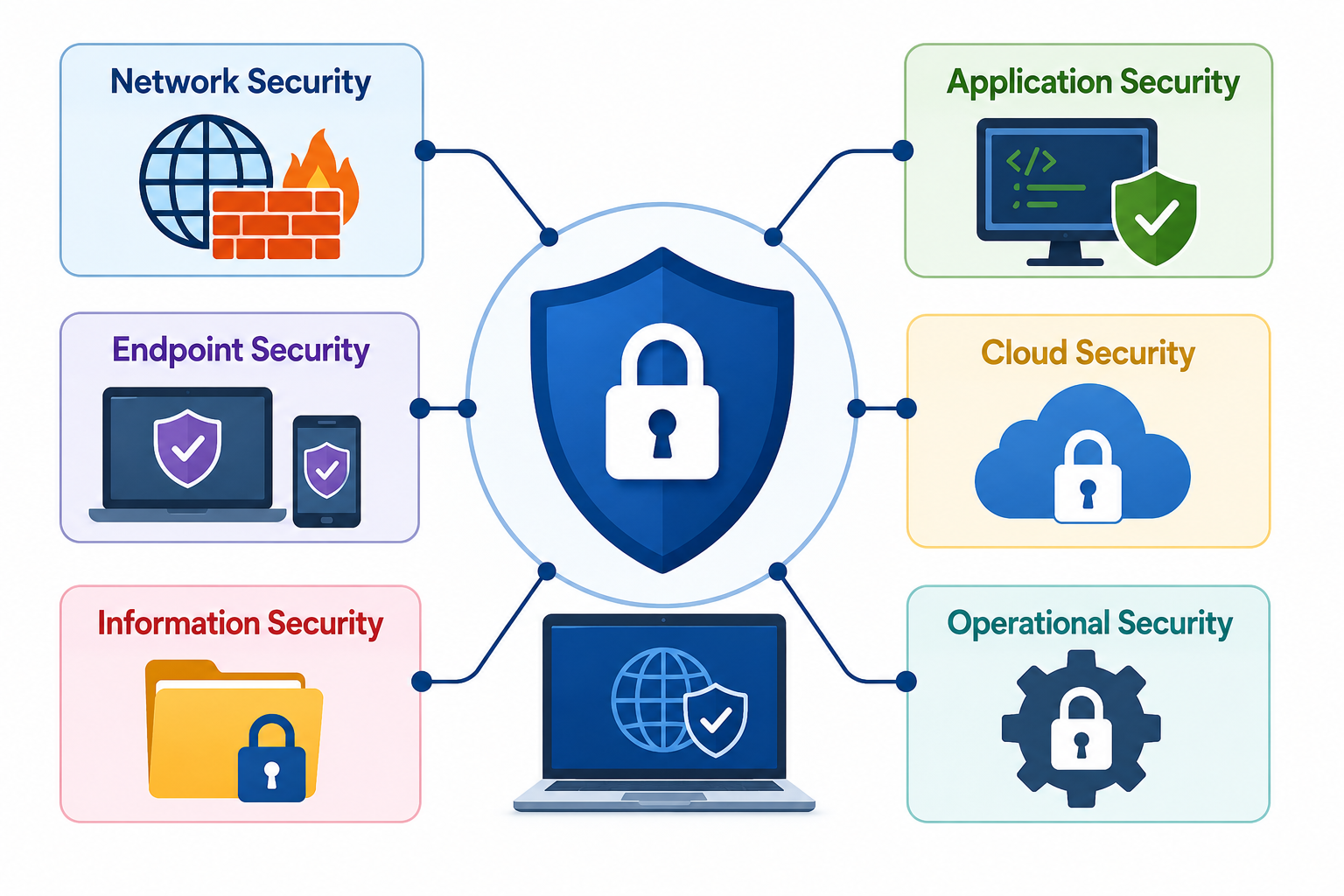
No single lock protects an entire building. You have locks on the front door, security cameras in the hallways, a safe for valuables, and an alarm system that covers everything. Digital security works the same way. Understanding the different types of cybersecurity and how they work together is the foundation of building meaningful protection against the threats that define the modern digital landscape.
In 2026, cyberattacks target every layer of digital infrastructure simultaneously. Criminals probe networks for weak points, scan applications for vulnerabilities, exploit unprotected endpoints, and manipulate people into bypassing even well-designed technical controls. A single security solution cannot address that breadth of threat. What works is a layered approach where each type of cybersecurity addresses a specific attack surface and complements the protection provided by the others.
This guide breaks down every major type of cybersecurity in plain language, explains what each one protects and how, and shows what that protection looks like in the real world.
Quick Answer
The main types of cybersecurity include network security, cloud security, application security, information security, endpoint security, mobile security, IoT security, operational security, identity and access management, and disaster recovery. Each type protects a different layer of digital infrastructure. Together, they create a defense-in-depth strategy that addresses the full range of modern cyber threats.
What Is Cybersecurity?
Cybersecurity is the practice of protecting computers, networks, software, and data from unauthorized access, theft, damage, and disruption. It combines technology, processes, and human behavior to defend digital systems against an expanding range of threats from criminals, foreign adversaries, and malicious insiders.
The field has grown far beyond its origins in network perimeter defense to encompass every layer of the modern technology stack, from the physical devices people carry in their pockets to the vast cloud infrastructure that underpins the global digital economy.
If you are new to this topic and want a comprehensive foundation before diving into the specific types, our detailed guide on What Is Cybersecurity covers the core concepts, how defenses are structured, and why the field matters so deeply in 2026.
Why Are Different Types of Cybersecurity Important?
Growing Cyber Threats
The threat landscape has never been more complex or more dangerous. Ransomware groups operate with business-like sophistication. Nation-state actors conduct long-term espionage campaigns against government and industry targets. AI-powered attack tools automate vulnerability scanning and phishing generation at scales that human attackers could never achieve manually.
Each category of threat targets different parts of the digital infrastructure. Network attacks probe perimeter defenses. Application attacks exploit software vulnerabilities. Social engineering targets people. No single type of security addresses all of these vectors simultaneously.
Digital Transformation
Every industry has moved significant operations into digital environments over the past decade. Healthcare records are electronic. Financial transactions are digital. Supply chains are managed through connected systems. Manufacturing uses networked sensors. The more deeply digital systems are embedded in essential operations, the more damage a successful attack can cause, and the more important it becomes to protect every dimension of that digital environment.
Data Protection
Data is one of the most valuable assets in the modern economy, and it flows continuously through networks, applications, cloud platforms, and endpoints. Protecting it effectively requires security measures at every point in its journey. Network security protects data in transit. Encryption within information security protects data at rest. Endpoint security protects data on the devices where it is processed.
Business Continuity
When cybersecurity fails at any layer, the consequence is often operational disruption. Ransomware that reaches unprotected endpoints halts business. Application vulnerabilities that allow data theft trigger regulatory responses that consume management attention for months. Network outages from DDoS attacks prevent customers from transacting. Different types of cybersecurity protect different dimensions of the operational continuity that businesses depend on.
Privacy
Privacy depends on technical controls that prevent unauthorized access to personal information at every layer where it exists. A person’s medical records might be stored in a cloud database, transmitted across a network, processed by a web application, and accessed from a mobile device. Each of those touchpoints requires appropriate security to maintain the privacy of the information throughout its lifecycle.
Compliance
Regulatory frameworks like GDPR, HIPAA, PCI DSS, and the EU AI Act specify security requirements across multiple domains. Achieving compliance requires implementing appropriate controls at the network, application, data, endpoint, and operational levels. Organizations that rely on only one type of security consistently fail to meet multi-domain regulatory requirements.
Main Types of Cybersecurity
Network Security
Network security is the practice of protecting the infrastructure through which data flows between devices, systems, and services. Every organization has a network, from a small office with a single Wi-Fi router to a global enterprise with thousands of interconnected systems across dozens of locations. Protecting that infrastructure from unauthorized access, eavesdropping, and disruption is the foundational work of network security.
Firewalls are the gatekeepers of network security. They examine incoming and outgoing network traffic and apply rules that determine which connections to allow and which to block. Modern next-generation firewalls go beyond simple rule-based filtering to inspect application-layer content, detect known attack patterns, and integrate threat intelligence feeds that identify malicious sources in real time.
Intrusion Detection Systems (IDS) monitor network traffic for patterns that indicate potential attacks or policy violations. When they identify suspicious activity, they generate alerts that security teams can investigate. IDS operates in a monitoring role, observing and reporting without actively blocking traffic.
Intrusion Prevention Systems (IPS) build on IDS capabilities by adding the ability to actively block detected threats in real time. Rather than simply alerting to suspicious activity, IPS takes automated action to stop it before damage occurs.
VPNs, or Virtual Private Networks, encrypt network connections between remote users or offices and organizational networks, protecting data in transit from interception. In 2026, with remote work normalized across most knowledge-work industries, VPNs remain a critical component of network security for distributed organizations.
Network monitoring tools provide continuous visibility into what is happening across organizational networks. Traffic analysis, flow monitoring, and behavioral anomaly detection help security teams identify threats that evade signature-based detection tools.
A practical example: a financial services company uses firewalls to block traffic from known malicious IP addresses, IPS to stop brute force authentication attempts against its customer portal, a VPN to secure connections from remote employees, and network monitoring to identify the unusual data transfer patterns that might indicate an insider threat or data exfiltration in progress.
Cloud Security
Cloud security addresses the unique challenges of protecting data, applications, and infrastructure hosted in cloud computing environments. As organizations have migrated workloads from private data centers to public cloud platforms like AWS, Microsoft Azure, and Google Cloud, they have gained flexibility and scalability while accepting a new security model that requires fundamentally different approaches.
The shared responsibility model is the foundational concept of cloud security. Cloud providers are responsible for the security of the cloud infrastructure itself, including physical hardware, networking, and hypervisors. Customers are responsible for the security of what they put in the cloud, including their data, applications, access controls, and configurations. Many significant cloud security failures result from organizations misunderstanding their portion of this responsibility and assuming the provider handles more than it does.
Identity management in cloud environments controls who can access cloud resources and what actions they can perform. Cloud Identity and Access Management systems define roles, permissions, and policies that govern access to cloud services, data, and configuration settings.
Encryption of data stored in and transmitted between cloud services ensures that even if cloud storage is compromised, the data itself is unreadable to unauthorized parties. Most cloud providers offer encryption services, but organizations need to understand key management responsibilities to ensure encryption provides meaningful protection.
Cloud Access Security Brokers (CASB) sit between cloud users and cloud services, enforcing security policies, monitoring usage, and protecting data as it moves to and from cloud platforms. They provide visibility into shadow IT, where employees use unauthorized cloud services that bypass organizational security controls.
A practical example: a retail company stores customer payment information in cloud databases, uses IAM to ensure only authorized payment processing systems can access it, encrypts all stored data, and uses a CASB to prevent employees from uploading sensitive business data to personal cloud storage services.
Application Security
Application security focuses on protecting software from vulnerabilities that attackers can exploit to gain unauthorized access, steal data, or disrupt services. Applications are among the most frequently targeted attack surfaces because they are internet-accessible, complex, and often developed under time pressure that leads to security being deprioritized.
Secure coding practices build security into applications from the beginning of development rather than attempting to add it afterward. This includes input validation to prevent injection attacks, proper error handling that does not reveal system information, secure authentication implementation, and following language-specific security guidelines.
Vulnerability testing identifies security weaknesses before attackers do. Static Application Security Testing (SAST) analyzes source code for security flaws. Dynamic Application Security Testing (DAST) probes running applications from the outside, simulating the perspective of an attacker. Penetration testing involves security professionals actively attempting to exploit application vulnerabilities to assess real-world security posture.
Regular software updates and patching address known vulnerabilities in application code and dependencies. Many successful application attacks exploit vulnerabilities for which patches already exist, making timely updates a high-priority security practice.
Web Application Firewalls (WAF) sit in front of web applications and filter HTTP traffic to block common attack patterns including SQL injection, cross-site scripting (XSS), and cross-site request forgery (CSRF). They provide a protective layer even when underlying application code contains vulnerabilities.
A practical example: an e-commerce company uses SAST to scan its checkout application code for SQL injection vulnerabilities, deploys a WAF to block injection attempts against its product search functionality, and runs regular vulnerability scans to identify new weaknesses introduced during development sprints.
Information Security
Information security is the discipline of protecting the data itself, regardless of where it lives, how it moves, or what form it takes. While other types of cybersecurity protect the systems and infrastructure that data passes through, information security focuses specifically on maintaining the properties that make data trustworthy and valuable.
The CIA Triad is the organizing framework of information security, defining three properties that every security control aims to maintain.
| CIA Triad Component | Definition | Example Threat | Example Control |
|---|---|---|---|
| Confidentiality | Only authorized parties can access information | Unauthorized data access | Encryption, access controls |
| Integrity | Information is accurate and has not been altered without authorization | Data tampering, corruption | Digital signatures, checksums |
| Availability | Information is accessible when authorized users need it | DDoS attacks, ransomware | Redundancy, backups, uptime monitoring |
Encryption converts readable data into an unreadable format that can only be decrypted with the correct key. It protects data at rest in storage systems and data in transit across networks. Encryption is the most fundamental technical control for maintaining data confidentiality.
Access control determines who can access specific information and what they can do with it. Role-based access control assigns permissions based on job functions. Attribute-based access control applies more granular policies based on user characteristics, data classification, and context. The principle of least privilege ensures that users have only the minimum access their role genuinely requires.
Data classification categorizes information by sensitivity so that appropriate controls can be applied. Public information requires minimal protection. Internal business information requires reasonable controls. Sensitive personal data, financial records, and trade secrets require the strongest available protections.
A practical example: a healthcare organization classifies patient medical records as highly sensitive, encrypts them both in the database and when transmitted between systems, implements role-based access ensuring only treating clinicians can access specific patient records, and monitors access logs to detect any unusual access patterns.
Endpoint Security
An endpoint is any device that connects to a network: laptops, desktops, smartphones, tablets, servers, printers, and increasingly, the diverse range of IoT devices that exist in modern offices and homes. Endpoint security protects these individual devices from being compromised and used as entry points into broader network environments.
Antivirus and anti-malware software detects and removes known malicious software. Modern solutions go beyond signature-based detection of known threats to use behavioral analysis that identifies malware based on what it does rather than matching it against a database of known signatures. This enables detection of novel threats that have not previously been catalogued.
Endpoint Detection and Response (EDR) represents the current standard of enterprise endpoint security. EDR tools continuously monitor endpoint activity, recording process execution, file changes, network connections, and user actions. When suspicious behavior is detected, EDR provides the investigation tools and automated response capabilities security teams need to understand what happened and contain the threat quickly.
Device management policies control how endpoints are configured and used. This includes enforcing screen lock requirements, mandating encryption of device storage, controlling which applications can be installed, and ensuring operating systems and applications are updated promptly.
Zero trust endpoint access applies the principle that no endpoint should be trusted by default, even on the corporate network. Continuous verification of device security posture ensures that compromised or non-compliant devices cannot access sensitive systems and data.
A practical example: a professional services firm equips every employee laptop with EDR software, enforces full disk encryption through mobile device management, requires screen locks after two minutes of inactivity, and blocks USB storage devices to prevent both data theft and malware introduction through removable media.
Mobile Security
Mobile devices have become the primary computing platform for billions of people and carry extraordinary concentrations of sensitive personal and professional information. Mobile security addresses the specific threats and vulnerabilities associated with smartphones, tablets, and the applications that run on them.
Mobile threats are distinct from traditional computer threats in several important ways. Malicious applications distributed through legitimate and illegitimate app marketplaces are a primary mobile attack vector. Unsecured wireless network connections expose mobile traffic to interception. SMS-based phishing, known as smishing, exploits the higher trust that many people place in text messages compared to email.
Mobile Device Management (MDM) platforms allow organizations to enforce security policies on employee devices, including requiring encryption, mandating passcodes, controlling which applications can be installed, remotely wiping lost or stolen devices, and separating personal and corporate data on devices used for both purposes.
Application security on mobile platforms requires evaluating app permissions carefully. A flashlight app that requests access to contacts, location, microphone, and camera is requesting far more than it needs to function. Limiting permissions to what an app genuinely requires limits the damage if that app is malicious or compromised.
Secure mobile communication involves using encrypted messaging applications for sensitive communications, avoiding unencrypted SMS for anything confidential, and connecting through trusted networks or VPNs rather than public Wi-Fi for any sensitive activity.
A practical example: a legal firm provides employees with company smartphones managed through MDM, restricts installation to approved applications, enforces six-digit PINs, enables remote wipe capability for lost devices, and requires VPN use whenever employees access case management systems from mobile devices.
IoT Security
The Internet of Things encompasses the rapidly expanding universe of internet-connected devices beyond traditional computers and phones. Smart home devices, industrial sensors, medical equipment, connected vehicles, building management systems, and retail point-of-sale systems all fall within the IoT category. By 2026, there are tens of billions of IoT devices deployed globally, and the security of those devices has not kept pace with their proliferation.
IoT devices present unique security challenges. Many are manufactured with minimal built-in security, default credentials that are widely known and rarely changed, limited processing power that constrains the complexity of security software that can run on them, and long operational lifetimes during which security vulnerabilities accumulate without being addressed through updates.
Device authentication ensures that only legitimate, authorized devices can connect to networks and communicate with other systems. Strong authentication mechanisms, unique device credentials, and certificate-based identity verification reduce the risk of fake or compromised devices being accepted as legitimate.
Firmware updates address security vulnerabilities in the software that runs directly on IoT devices. Many device manufacturers now provide automatic firmware updates, but the patching process for IoT at enterprise scale requires management and tracking to ensure all devices receive updates promptly.
Network segmentation for IoT devices places them on separate network segments from more sensitive systems. A compromised smart office thermostat should not be able to communicate with corporate servers. Segmentation limits the blast radius of IoT device compromises by preventing lateral movement to more valuable targets.
IoT security monitoring tracks the behavior of connected devices to detect anomalies that might indicate compromise. A manufacturing sensor that suddenly begins sending large volumes of data to an external IP address is exhibiting behavior inconsistent with its normal function, and that anomaly should trigger investigation.
A practical example: a hospital uses network segmentation to isolate connected medical devices from patient record systems, requires authentication for all device connections, implements an automated firmware update system for all managed IoT devices, and monitors device traffic for behavioral anomalies.
Operational Security (OPSEC)
Operational security, often abbreviated as OPSEC, is both a discipline and a process focused on protecting sensitive information and operations by identifying what needs protection, understanding potential threats, and implementing processes and controls to prevent unauthorized access or disclosure.
While technical security controls protect digital assets through technology, OPSEC protects them through the policies, processes, and behaviors that govern how people interact with sensitive information. It originated in military contexts and has been adopted extensively in both government and private sector security programs.
Access management policies define who is authorized to access specific systems, information, and facilities, and under what circumstances. Regular access reviews ensure that access privileges remain appropriate as roles change, and that the access of departing employees is promptly revoked.
Risk assessment processes systematically identify what information and operations are most sensitive, what threats they face, and what controls are most appropriate and cost-effective. Regular risk assessments ensure that security programs address the actual threat landscape rather than historical assumptions.
Employee security awareness is one of the most important operational security investments an organization can make. Employees who recognize phishing attempts, understand social engineering tactics, know how to handle sensitive information, and report suspicious activity are a powerful security asset. Those who lack that awareness are consistently exploited as the easiest path through technical defenses.
Incident response procedures define how the organization responds when security incidents occur. Clear procedures, practiced through regular tabletop exercises, mean that when an incident happens, the response is coordinated and effective rather than chaotic and improvised.
Identity and Access Management (IAM)
Identity and Access Management is the framework of policies, technologies, and processes that ensure the right people have the right access to the right resources at the right times. As digital environments have become more complex, with cloud services, remote work, mobile access, and partner system integrations all requiring managed access, IAM has become a cornerstone of modern enterprise security.
Authentication verifies that users are who they claim to be. Password-based authentication remains common but increasingly inadequate on its own. Biometric authentication uses physical characteristics like fingerprints and facial recognition. Certificate-based authentication uses cryptographic keys. The strongest approach combines multiple authentication factors.
Multi-Factor Authentication (MFA) requires users to verify their identity using at least two independent factors before access is granted. Combining something you know (a password), something you have (a one-time code from an authenticator app), and something you are (a biometric) creates authentication that remains secure even when individual factors are compromised. MFA is consistently identified as one of the highest-impact security controls available.
Authorization determines what authenticated users are allowed to do. A successfully authenticated user should only be able to access resources and perform actions that their role requires. Fine-grained authorization policies prevent authenticated users from accessing more than they need, limiting the potential damage from compromised accounts.
Single Sign-On (SSO) allows users to authenticate once and gain access to multiple connected systems without re-entering credentials for each one. SSO improves the user experience, reduces password fatigue that leads to weak password choices, and centralizes authentication in a single point that security teams can monitor and control effectively.
Privileged Access Management (PAM) applies additional controls to accounts with elevated permissions, including administrator accounts and service accounts with broad system access. These accounts are high-value targets for attackers, and controlling their use through session recording, time-limited privilege grants, and automated workflow approval reduces the risk of privileged account abuse.
Disaster Recovery and Business Continuity
Disaster recovery and business continuity planning address what happens when security controls fail or when other events, whether cyberattacks, natural disasters, or infrastructure failures, disrupt normal operations. The goal is ensuring that organizations can recover quickly and completely from disruptive events.
Data backups are the foundational element of disaster recovery. The 3-2-1 backup rule provides a proven framework: maintain three copies of important data, store them on two different types of media, and keep one copy off-site or in an isolated cloud environment. Regular backup testing confirms that backups are actually recoverable, not just stored.
Incident response planning defines the processes, roles, and communication protocols that activate when a security incident occurs. A well-tested incident response plan enables organizations to contain threats faster, preserve evidence, and communicate appropriately with affected parties, regulators, and the public.
Recovery Time Objectives (RTO) and Recovery Point Objectives (RPO) define how quickly systems must be restored and how much data loss is acceptable in a recovery scenario. These targets drive technical and operational decisions about redundancy, backup frequency, and recovery infrastructure investment.
Business continuity planning extends beyond technical recovery to address how the organization continues to serve customers and operate through extended disruptions. This includes backup communication methods, alternate work locations, manual process fallbacks for critical functions, and supply chain resilience.
Comparison of Different Types of Cybersecurity
| Type | Primary Purpose | Assets Protected | Common Threats | Key Tools | Priority Level |
|---|---|---|---|---|---|
| Network Security | Protect data in transit, block unauthorized access | Networks, infrastructure | DDoS, intrusion, eavesdropping | Firewalls, IDS/IPS, VPN | Critical |
| Cloud Security | Secure cloud-hosted data and services | Cloud data, apps, infrastructure | Misconfiguration, unauthorized access | CASB, IAM, encryption | Critical |
| Application Security | Protect software from vulnerabilities | Web apps, APIs, software | SQL injection, XSS, CSRF | WAF, SAST, DAST | High |
| Information Security | Protect data confidentiality, integrity, availability | All data types | Unauthorized access, tampering | Encryption, DLP, access control | Critical |
| Endpoint Security | Protect individual devices | Computers, phones, servers | Malware, ransomware, theft | Antivirus, EDR, MDM | High |
| Mobile Security | Secure mobile devices and apps | Smartphones, tablets | Malicious apps, smishing | MDM, VPN, secure apps | High |
| IoT Security | Protect connected devices | Smart devices, sensors | Device compromise, lateral movement | Network segmentation, firmware updates | High |
| Operational Security | Protect processes and information handling | Operations, personnel, information | Insider threats, social engineering | Policies, training, access controls | Critical |
| IAM | Control identity and access | All systems and data | Credential theft, privilege abuse | MFA, SSO, PAM | Critical |
| Disaster Recovery | Ensure recovery from disruptions | All systems and data | Ransomware, natural disasters | Backups, incident response plans | High |
Real-World Examples
Banks and Financial Institutions use network security to monitor for fraud patterns and block unauthorized access to banking systems. They implement IAM with strong MFA to protect both employee and customer account access. Application security testing ensures online banking platforms do not contain exploitable vulnerabilities. Information security controls encrypt all stored financial data and transaction records. EDR protects employee workstations from malware that might otherwise enable data theft or fraudulent transactions.
Hospitals and Healthcare Systems face particularly serious cybersecurity requirements because data breaches expose sensitive medical information and ransomware attacks can directly threaten patient care. Network security segmentation isolates medical devices from administrative systems. Application security protects electronic health record platforms. Information security controls govern who can access patient records and under what circumstances. IoT security manages the enormous number of connected medical devices, from infusion pumps to imaging equipment.
Schools and Universities protect student records and research data through information security controls. Application security keeps learning management systems free of exploitable vulnerabilities. Network security protects campus infrastructure from external intrusion and manages access for the diverse population of students, faculty, and staff. Mobile security extends protection to the devices students and faculty use to access educational resources.
Government Agencies require the most comprehensive implementation of all cybersecurity types. Network security protects the infrastructure connecting government systems. IAM controls access to sensitive government data and systems with strong authentication requirements. Operational security governs how classified and sensitive information is handled. Disaster recovery planning ensures continuity of essential public services through disruptions.
Online Businesses and E-Commerce depend heavily on application security to protect customer-facing systems from the web attacks that target checkout processes and login systems. Cloud security protects the cloud infrastructure on which most modern e-commerce runs. Information security controls protect customer payment data and personal information in compliance with PCI DSS and applicable privacy regulations. Endpoint security protects employee workstations that have access to customer management systems.
Cloud Service Providers implement security across all layers to protect both their own infrastructure and the customer data hosted on it. They provide the infrastructure-level security within the shared responsibility model and offer tools that customers can use to implement their portion of cloud security effectively.
Benefits of Using Multiple Cybersecurity Layers
Multiple cybersecurity layers create a defense-in-depth approach where an attacker who bypasses one control encounters another, significantly increasing the difficulty and cost of a successful attack.
A layered approach ensures that no single point of failure can result in total security compromise. If endpoint security is bypassed, network security may still detect the resulting suspicious traffic.
It provides protection across the full range of attack surfaces that modern organizations present to adversaries, from networks and applications to individual devices and human behaviors.
Multiple layers give security teams multiple sources of alerting and detection data, improving the speed at which attacks are identified and the completeness of understanding when incidents are investigated.
It meets the multi-domain requirements of regulatory frameworks that mandate specific controls at the network, application, data, and operational levels.
Layered security reduces the impact of zero-day vulnerabilities, which are newly discovered weaknesses without available patches. Even when one layer lacks protection against a novel threat, other layers may prevent or limit exploitation.
It creates resilience against increasingly sophisticated multi-stage attacks that are specifically designed to evade single-layer defenses by moving laterally through systems after initial compromise.
Multiple layers support business continuity by providing overlapping protections that maintain operational security even when individual components are under stress or require maintenance.
A defense-in-depth strategy demonstrates the security maturity that enterprise customers, partners, and regulators increasingly require as evidence of responsible security practice.
It enables organizations to prioritize their response to incidents, since multiple detection layers provide richer context about what is happening and how serious the threat actually is.
Layered security supports zero trust principles by ensuring that verification occurs at multiple points rather than relying on a single authentication or perimeter check.
It provides a foundation for security scaling as organizations grow, since adding capacity to specific layers is more efficient than rebuilding a monolithic security approach from scratch.
Challenges of Modern Cybersecurity
AI-powered attacks represent a qualitative change in the threat landscape. AI enables attackers to generate highly convincing phishing content at scale, automate vulnerability discovery across large target populations, adapt malware to evade specific detection tools, and conduct deepfake-based social engineering that defeats even security-aware users.
Insider threats are among the most difficult security challenges because they originate from people who already have legitimate access. Malicious insiders can cause enormous damage precisely because they know where valuable data is and have authorized access to it. Accidental insider actions, including clicking phishing links or misconfiguring systems, cause even more frequent harm.
Cloud complexity has created new categories of security failure. Misconfigured cloud storage buckets exposing sensitive data publicly, overly permissive IAM policies, and inadequate monitoring of cloud resource creation and modification have caused numerous major breaches that would not have been possible in on-premises environments.
Remote work has permanently expanded the attack surface that organizations must defend. Home networks, personal devices, and the absence of physical security controls create an environment significantly different from the controlled corporate office that traditional security architectures assumed.
Skill shortages in cybersecurity remain acute in 2026, with millions of unfilled positions globally. Organizations struggle to find and retain the expertise needed to operate sophisticated security programs, creating gaps that attackers exploit.
Ransomware continues evolving toward double and triple extortion models that combine data encryption with threatened publication of stolen data and DDoS attacks against victim infrastructure. These multi-vector attacks maximize pressure on victims to pay ransoms.
Supply chain attacks compromise security by targeting the software, hardware, or services that organizations trust. When an attacker can insert malicious code into a software update that goes to thousands of organizations, they achieve a scale of compromise impossible through direct attacks against individual targets.
Best Practices for Every Type of Cybersecurity
Implement multi-factor authentication on all accounts and systems, starting with those that have access to the most sensitive data and critical systems.
Apply the principle of least privilege consistently, ensuring that every user, application, and system has only the minimum access required for its legitimate function.
Keep all software, operating systems, firmware, and security tools updated promptly. Enable automatic updates wherever feasible.
Segment networks so that compromised systems in one segment cannot freely communicate with systems in other segments, limiting the lateral movement that amplifies the damage from initial compromises.
Encrypt sensitive data both at rest and in transit. Establish clear key management processes that ensure encryption keys are protected as carefully as the data they protect.
Maintain current, tested backups of all critical data. Verify regularly that backups are complete and that recovery processes work as expected. Store at least one backup copy in a location isolated from the primary environment.
Deploy endpoint detection and response tools on all managed devices and ensure security teams have the capacity to investigate and respond to the alerts those tools generate.
Conduct regular security awareness training for all employees, tailored to the specific threats and scenarios most relevant to their roles. Test awareness through simulated phishing exercises that identify training gaps without punishing individuals.
Perform regular vulnerability assessments and penetration testing across networks, applications, and cloud environments to identify weaknesses before attackers do.
Review IAM configurations regularly to ensure access privileges remain appropriate, that unused accounts are disabled, and that service accounts follow the principle of least privilege.
Implement a Web Application Firewall in front of internet-accessible applications and ensure it is properly configured to address the specific attack patterns most relevant to each application.
Establish a formal incident response plan, assign clear roles and responsibilities, and practice the plan through regular tabletop exercises so that response to real incidents is coordinated rather than improvised.
Monitor network, system, and application logs continuously for anomalies that might indicate attacks in progress. Centralize log collection in a SIEM platform to enable correlation across sources.
Apply security-focused configuration baselines to all systems rather than using default configurations that often prioritize convenience over security.
Evaluate and manage third-party vendor security as part of your overall security program. Supply chain compromises can bypass internal controls, and vendor security posture directly affects organizational risk.
Implement cloud security posture management tools that continuously scan cloud configurations for security gaps and compliance violations.
Establish a formal process for software security testing throughout the development lifecycle rather than treating security as a final pre-launch checklist item.
Use password managers and enforce password policies that require length and complexity while prohibiting reuse across accounts.
Deploy full disk encryption on all laptops and mobile devices used for business purposes.
Create and maintain a comprehensive asset inventory covering all devices, applications, cloud resources, and data stores, because you cannot protect what you cannot see.
Future of Cybersecurity
Artificial Intelligence in Defense
AI-powered defense tools are becoming essential for organizations that need to process the enormous volumes of security data that modern environments generate. Machine learning models identify subtle behavioral anomalies that indicate threats before conventional signatures are available. Automated response capabilities contain threats faster than human-speed response allows. AI will become as fundamental to security operations as firewalls were to network security in an earlier era.
Zero Trust Security
Zero trust continues its transition from emerging concept to operational standard. In 2026, major enterprises are well into zero trust implementation, and the model is being adopted by mid-market organizations as cloud-native zero trust tools become more accessible. The core principle, that no user, device, or system should be trusted by default regardless of network location, provides a resilient foundation for hybrid and cloud-native environments where traditional perimeter models no longer apply.
Extended Detection and Response (XDR)
XDR integrates security detection and response across endpoints, networks, applications, cloud environments, and identity systems into a unified platform. Rather than managing separate tools for each security domain and correlating alerts manually, XDR provides a single platform where security teams can investigate and respond to threats that span multiple layers simultaneously. Adoption of XDR is accelerating as organizations seek to reduce alert fatigue and improve mean time to detection.
Quantum-Resistant Encryption
Post-quantum cryptography standards finalized by NIST are beginning to be implemented across critical systems in preparation for the eventual capability of quantum computers to break current encryption algorithms. Organizations with long-lived sensitive data are prioritizing quantum-resistant encryption for new systems while developing migration plans for existing cryptographic infrastructure.
Cloud-Native Security
Security tools purpose-built for cloud-native architectures, including container security platforms, cloud workload protection tools, and API security solutions, are maturing rapidly. As organizations build more infrastructure using microservices, containers, and serverless computing, security approaches that were designed for traditional server-based architectures require adaptation.
AI-Powered Defense at Scale
The combination of AI analysis, automated threat hunting, and orchestrated response is creating security capabilities that scale in ways human-operated security programs cannot. Organizations with limited security staff increasingly rely on AI-augmented security operations centers and managed detection and response services that apply AI capabilities across their environments.
Frequently Asked Questions
What are the main types of cybersecurity?
The main types of cybersecurity are network security, cloud security, application security, information security, endpoint security, mobile security, IoT security, operational security, identity and access management, and disaster recovery and business continuity. Each type addresses a different layer of the digital environment and works together with the others to create comprehensive protection.
Which type of cybersecurity is most important?
No single type is universally most important because each addresses different threats and attack surfaces. However, information security, IAM, and network security form the foundational layers on which other types build. In practice, the most important type of cybersecurity for any specific organization is the one that addresses its most significant current vulnerability and its highest-value assets.
What is network security?
Network security is the practice of protecting the infrastructure through which data flows between devices and systems. It uses firewalls, intrusion detection and prevention systems, VPNs, and network monitoring tools to control which traffic is allowed into and out of networks, detect suspicious activity, and prevent unauthorized access to networked systems.
What is cloud security?
Cloud security encompasses the policies, technologies, and practices that protect data, applications, and infrastructure hosted in cloud computing environments. It addresses the shared responsibility model between cloud providers and customers, manages access controls, implements encryption, and monitors cloud configurations to prevent the misconfigurations that cause many significant cloud-related breaches.
What is application security?
Application security protects software from vulnerabilities that attackers can exploit. It involves secure coding practices during development, vulnerability testing through SAST and DAST tools, regular patching of known vulnerabilities, and Web Application Firewalls that filter malicious traffic before it reaches application code. Good application security catches vulnerabilities before attackers discover them.
What is endpoint security?
Endpoint security protects individual devices, including laptops, desktops, smartphones, and servers, from being compromised. It uses antivirus and anti-malware software, Endpoint Detection and Response tools, device management policies, and encryption to prevent malware from running on devices and to detect and respond to compromise quickly when it occurs.
What is IoT security?
IoT security addresses the protection of internet-connected devices beyond traditional computers and phones, including smart home devices, industrial sensors, medical equipment, and connected infrastructure. It uses network segmentation, device authentication, firmware updates, and behavioral monitoring to manage the security risks created by devices that often have minimal built-in security capabilities.
What is information security?
Information security is the discipline of protecting data itself through the properties defined by the CIA Triad: Confidentiality, ensuring only authorized parties can access data; Integrity, ensuring data has not been altered without authorization; and Availability, ensuring data is accessible when legitimate users need it. It uses encryption, access controls, and data classification to protect information throughout its lifecycle.
What is operational security?
Operational security focuses on protecting sensitive information and operations through policies, processes, and human behaviors rather than solely through technical controls. It covers access management, risk assessment, employee security awareness, incident response procedures, and the operational disciplines that complement technical security tools.
What is IAM?
Identity and Access Management is the framework of policies and technologies that manage digital identities and control access to systems and data. It includes authentication (verifying who users are), authorization (determining what they can access), multi-factor authentication (requiring multiple verification factors), single sign-on (enabling access to multiple systems through one authentication), and privileged access management (applying additional controls to high-privilege accounts).
How do businesses use cybersecurity?
Businesses use different types of cybersecurity to protect different dimensions of their operations. Network security protects the infrastructure connecting their systems. Application security protects customer-facing software. Information security protects customer and business data. Endpoint security protects employee devices. IAM controls who can access which systems. Disaster recovery planning ensures the business can recover from incidents that bypass other controls.
Can one type of cybersecurity protect everything?
No. Each type of cybersecurity addresses specific threats and attack surfaces. Network security cannot protect against application vulnerabilities. Endpoint security cannot prevent data breaches caused by misconfigured cloud storage. Application security cannot stop social engineering attacks against employees. Effective security requires multiple types working together to address the full range of threats that modern organizations face.
What cybersecurity skills are in demand?
High-demand cybersecurity skills in 2026 include cloud security architecture and engineering, IAM implementation and management, threat hunting and incident response, penetration testing and vulnerability assessment, security operations center analysis, DevSecOps (integrating security into development workflows), and AI-powered security tool operation and interpretation. Soft skills including communication, analytical thinking, and continuous learning remain equally important.
Is cybersecurity a good career?
Yes. Cybersecurity is one of the most in-demand, well-compensated, and intellectually engaging career fields in technology. The persistent global talent shortage means qualified professionals have exceptional job security, strong salary negotiating position, and significant opportunities for advancement. The field also offers meaningful work protecting individuals, organizations, and critical infrastructure from genuine harm.
What is the future of cybersecurity?
The future of cybersecurity involves AI becoming integral to both attack and defense, zero trust architecture replacing perimeter-based security as the enterprise standard, XDR providing unified cross-domain detection and response, post-quantum cryptography protecting against future quantum computing threats, and cloud-native security tools maturing to match the environments they protect. The fundamental challenge of defending against adaptive, motivated adversaries will continue driving innovation across every type of cybersecurity.
People Also Ask
What are the different types of cybersecurity?
The main types are network security, cloud security, application security, information security, endpoint security, mobile security, IoT security, operational security, identity and access management, and disaster recovery. Together they protect every layer of modern digital infrastructure.
Which cybersecurity type is most important?
All types are necessary for comprehensive protection. Information security, IAM, and network security form the foundational layers, but the most critical type for any specific organization depends on where its most significant vulnerabilities and highest-value assets are located.
What is network security?
Network security protects the infrastructure connecting digital systems using firewalls, intrusion detection and prevention systems, VPNs, and monitoring tools that control traffic flow and detect unauthorized access attempts.
What is cloud security?
Cloud security protects data and applications in cloud environments through identity management, encryption, configuration monitoring, and the shared responsibility model that defines what cloud providers and customers each protect.
What is application security?
Application security protects software from exploitable vulnerabilities through secure coding practices, vulnerability testing, regular patching, and Web Application Firewalls that filter malicious traffic.
What is endpoint security?
Endpoint security protects individual devices from malware and compromise using antivirus software, EDR tools, device management policies, and encryption.
What is IoT security?
IoT security protects internet-connected devices through network segmentation, device authentication, firmware updates, and behavioral monitoring that detects anomalies indicating compromise.
Why do businesses need different cybersecurity layers?
Different layers protect different attack surfaces. No single security type addresses all threats. A defense-in-depth approach ensures that attackers who bypass one layer encounter another, significantly increasing the difficulty of successful attacks.
What are the best cybersecurity practices?
The most impactful practices include enabling MFA, applying least privilege access, keeping software updated, encrypting sensitive data, maintaining tested backups, conducting security awareness training, and monitoring systems continuously for anomalies.
Is cybersecurity a good career?
Yes. The global talent shortage, high compensation, job security, intellectual challenge, and meaningful impact of protecting real people and organizations make cybersecurity one of the most rewarding career choices in technology.
References
- CISA. (2026). Cybersecurity and Infrastructure Security Agency. https://www.cisa.gov
- NIST. (2026). NIST Cybersecurity Framework. https://www.nist.gov/cyberframework
- OWASP. (2026). Open Web Application Security Project. https://owasp.org
- Microsoft. (2026). Microsoft Security. https://www.microsoft.com/security
- Cisco. (2026). Cisco Security. https://www.cisco.com/security
- Google. (2026). Google Safety Center. https://safety.google
Author Bio
TechOriginHub Editorial Team
The TechOriginHub Editorial Team is a team of experienced cybersecurity professionals, technology writers, IT security researchers, and digital infrastructure specialists dedicated to publishing trustworthy and easy-to-understand technology content. We specialize in cybersecurity, artificial intelligence, cloud computing, software, programming, and emerging technologies. Every article is thoroughly researched, fact-checked, and reviewed using trusted industry sources to ensure accuracy, clarity, and compliance with Google’s Helpful Content and E-E-A-T guidelines. Our mission is to help individuals, students, professionals, and businesses understand complex technology topics while promoting safer digital practices and informed decision-making.
Disclaimer
This article is for informational and educational purposes only. Cybersecurity technologies, threats, standards, and best practices evolve continuously. While every effort has been made to ensure the accuracy of the information provided, readers should consult official cybersecurity resources and implement security measures appropriate to their specific environment. TechOriginHub is not responsible for any losses resulting from the use of the information in this article.