
 By TechOriginHub Editorial Team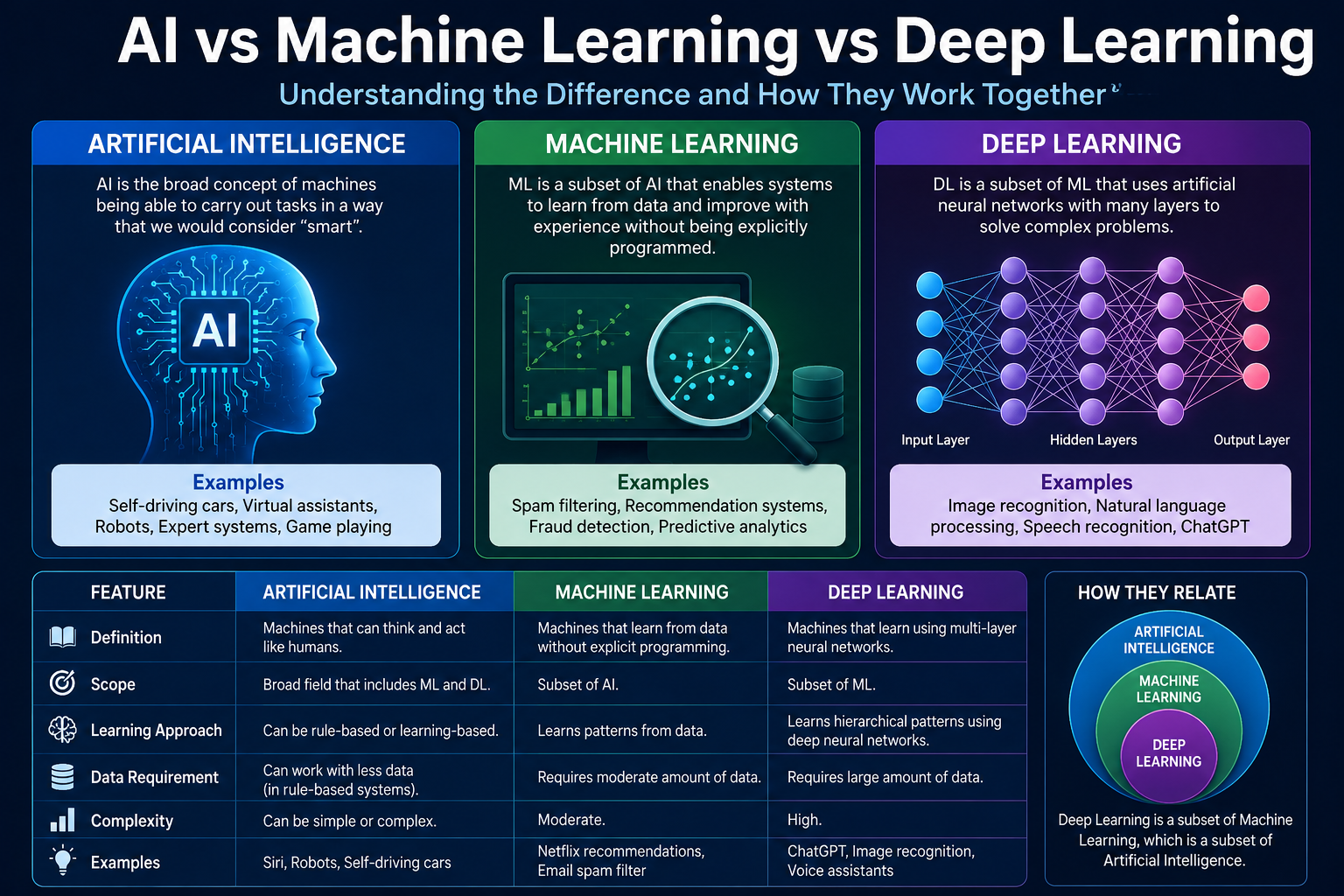
Introduction
If you have spent any time reading about technology over the past few years, you have almost certainly encountered the terms Artificial Intelligence, Machine Learning, and Deep Learning used interchangeably — sometimes in the same sentence. This happens constantly, even in reputable publications, and it creates genuine confusion for anyone trying to understand what these technologies actually are and how they relate to each other.
The confusion is understandable. The three concepts are closely related, and in casual conversation, the distinctions can seem academic. But they are not the same thing, and understanding the differences between Artificial Intelligence vs Machine Learning vs Deep Learning is enormously useful — whether you are a student choosing a career path, a business leader evaluating technology investments, a professional trying to use AI tools more intelligently, or simply a curious person who wants accurate mental models of the technologies reshaping the world.
This guide draws clear, precise boundaries between all three, explains how they relate to each other, and connects every concept to real-world examples you already recognize.
Quick Answer — Featured Snippet
Artificial Intelligence is the broad field of building machines that perform tasks requiring human-like intelligence. Machine Learning is a subset of AI where systems learn from data automatically without explicit programming. Deep Learning is a subset of Machine Learning that uses multi-layered neural networks to process complex data. All three are related: Deep Learning lives inside Machine Learning, which lives inside Artificial Intelligence.
What Is Artificial Intelligence?
Artificial Intelligence is the broadest of the three concepts. It refers to the entire field of computer science dedicated to building systems that can perform tasks requiring human-like intelligence — reasoning, understanding language, recognizing patterns, making decisions, solving problems, and learning from experience.
The goal of AI is not to replicate the human brain in biological terms. It is to build machines and software that achieve intelligent outcomes, regardless of the underlying mechanism. The measure of AI is in the results it produces, not the method it uses to produce them.
AI as a field began formally in 1956 at the Dartmouth Conference, where researchers first proposed that every aspect of human intelligence could in principle be precisely described and simulated by a machine. In the decades that followed, AI developed through several distinct approaches — rule-based systems, expert systems, and eventually the data-driven methods that dominate the field today.
In practical terms, AI today encompasses an enormous range of systems. Siri answering a question on your iPhone is AI. The algorithm that decides which posts appear at the top of your social media feed is AI. The fraud detection system protecting your bank account is AI. The image recognition system that identifies faces in photographs is AI. So is the generative system powering ChatGPT.
What all of these share is a common purpose — performing tasks intelligently — but they achieve that purpose through very different underlying methods.
AI can be built without machine learning, using hand-crafted rules and decision trees designed by human experts. Early AI systems worked this way. Today, however, the most capable and widely deployed AI systems are built on machine learning and, increasingly, deep learning techniques.
For a complete foundation, visit our guide: [What Is Artificial Intelligence? A Beginner’s Guide](internal link).
What Is Machine Learning?
Machine Learning is a specific subset of Artificial Intelligence. Where AI is the broad goal — building intelligent systems — Machine Learning is one powerful method for achieving that goal.
The defining characteristic of Machine Learning is that systems learn from data rather than being explicitly programmed with rules for every situation. A machine learning system improves its own performance by processing examples, identifying patterns in those examples, and updating its internal model based on what it has learned.
The contrast with traditional programming is instructive. In traditional programming, a developer writes rules: if this condition, then that result. The program follows those rules precisely. If a new situation arises that the rules do not cover, the program fails or returns an incorrect result.
In machine learning, you provide data rather than rules. The system analyzes the data, identifies the patterns that distinguish different outcomes, and builds a model that can classify or predict outcomes for new, unseen data. The rules emerge from the data rather than from a human programmer’s explicit instructions.
Types of Machine Learning
Machine learning encompasses several distinct learning paradigms, each suited to different types of problems and data.
Supervised Learning is the most widely used approach. The training data consists of input-output pairs — each example includes both the input and the correct answer. The model learns to map inputs to outputs by minimizing the difference between its predictions and the correct answers. Email spam detection, credit scoring, and medical diagnosis models are typically built using supervised learning.
Unsupervised Learning works with data that has no labels. The model must find patterns and structure in the data on its own, without being told what to look for. Customer segmentation — grouping customers by behavioral similarity without predefined categories — is a classic unsupervised learning application. Anomaly detection in cybersecurity is another.
Reinforcement Learning trains agents through interaction with an environment. The agent takes actions, receives rewards for beneficial actions and penalties for harmful ones, and gradually learns a policy that maximizes cumulative reward over time. This approach powers game-playing AI systems and is used in robotics and certain types of optimization problems.
Semi-Supervised Learning combines a small amount of labeled data with a large amount of unlabeled data, offering a practical middle ground when full labeling is expensive or time-consuming.
Real-world machine learning applications surround you constantly. Recommendation systems on Netflix, Spotify, and Amazon use machine learning to predict preferences. Fraud detection systems use machine learning to identify suspicious transaction patterns. Search engines use machine learning to understand query intent and rank results. Voice assistants use machine learning for speech recognition and intent classification.
What Is Deep Learning?
Deep Learning is a specific subset of Machine Learning. It is the most powerful and computationally intensive branch of machine learning, and it is responsible for the majority of AI’s most dramatic recent advances.
The defining characteristic of deep learning is its use of artificial neural networks with many layers — hence the word “deep.” These multi-layered networks can learn extremely complex representations of data that shallower machine learning models cannot capture.
Neural Networks
To understand deep learning, you need a basic grasp of neural networks. An artificial neural network is a computational system loosely inspired by the structure of the biological brain. It consists of layers of interconnected processing units called neurons, organized into an input layer, one or more hidden layers, and an output layer.
Information flows from the input layer through the hidden layers to the output layer. Each neuron receives input from the previous layer, applies a mathematical transformation to it, and passes the result forward. The connections between neurons carry numerical values called weights, which determine how strongly one neuron influences another.
Training a neural network means adjusting these weights through a process called backpropagation, guided by a mathematical technique called gradient descent, until the network produces accurate outputs consistently.
What makes deep neural networks powerful is their ability to learn hierarchical representations of data automatically. In an image recognition network, early layers detect simple features like edges and colors. Middle layers combine these into textures and shapes. Deeper layers recognize complex objects — faces, vehicles, specific medical conditions — all without a human defining what features to look for.
Deep learning is the technology behind voice recognition systems accurate enough to transcribe speech in real time. It powers facial recognition systems used at border crossings and in smartphone unlock features. It underlies the large language models — GPT, Gemini, Claude — that generate human-quality text. It enables self-driving vehicles to interpret complex road environments. It identifies diseases in medical images with accuracy comparable to specialist clinicians.
The trade-off for this power is substantial: deep learning requires very large datasets and significant computing resources, typically powered by specialized GPUs or TPUs.
Artificial Intelligence vs Machine Learning vs Deep Learning
| Feature | Artificial Intelligence | Machine Learning | Deep Learning |
|---|---|---|---|
| Definition | Broad field of building intelligent machines | AI subset that learns from data automatically | ML subset using multi-layered neural networks |
| Scope | Broadest — encompasses all intelligent systems | Narrower — one method of achieving AI | Narrowest — specific ML technique |
| Learning Method | Rule-based, ML, DL, or hybrid | Statistical pattern recognition from labeled or unlabeled data | Hierarchical feature learning through neural layers |
| Data Requirements | Varies — some approaches need little data | Moderate to large datasets | Very large datasets required |
| Human Involvement | High in rule-based; lower in ML-based AI | Moderate — feature engineering often required | Low — features learned automatically |
| Key Algorithms | Decision trees, expert systems, ML, DL | Linear regression, SVM, random forests, k-NN | CNNs, RNNs, Transformers, GANs |
| Complexity | Varies widely by approach | Moderate | Very high |
| Accuracy | Depends on approach | Good for structured data tasks | State-of-the-art on complex, unstructured data |
| Speed | Fast for rule-based; varies for ML-based | Moderate training and inference speed | Training slow; inference can be fast |
| Computing Power | Low to high depending on method | Moderate | High — requires GPUs or TPUs |
| Interpretability | High for rule-based; low for ML-based | Moderate — depends on algorithm | Low — often a “black box” |
| Examples | Siri, chess programs, expert systems | Spam filters, recommendation engines | ChatGPT, image recognition, AlphaFold |
| Common Applications | Virtual assistants, robotics, planning | Customer segmentation, fraud detection, forecasting | NLP, computer vision, generative AI |
Relationship Between AI, Machine Learning, and Deep Learning
The relationship between the three is one of nested inclusion. Each concept lives inside the one before it. Understanding this hierarchy resolves most of the confusion that surrounds these terms.
Here is how the hierarchy looks in text form:
Artificial Intelligence (the broadest field)
— includes all approaches to building intelligent machines
— encompasses rule-based systems, expert systems, and all learning-based methods
Machine Learning (a subset of AI)
— one powerful method within the broader AI field
— systems that learn from data rather than following hand-coded rules
— includes supervised, unsupervised, and reinforcement learning
Deep Learning (a subset of Machine Learning)
— one specific family of machine learning techniques
— uses artificial neural networks with multiple hidden layers
— learns hierarchical representations from large datasets automatically
This means that every deep learning system is a machine learning system. Every machine learning system is an AI system. But not every AI system uses machine learning, and not every machine learning system uses deep learning.
A useful analogy: think of AI as the category “vehicles.” Machine learning is one type of vehicle — say, cars. Deep learning is one specific type of car — a high-performance sports car. All sports cars are cars, and all cars are vehicles. But not all vehicles are cars, and not all cars are sports cars.
This framing helps clarify why the terms are so often conflated. When people say “AI,” they frequently mean machine learning, because that is how most modern AI systems are built. When they say “machine learning,” they sometimes mean deep learning specifically, because deep learning has produced the most dramatic results. The terms cascade into each other in common usage, which is why precise definitions matter.
How AI, ML, and DL Work Together
In practice, the most powerful and sophisticated AI systems draw on all three levels simultaneously. Understanding how they interact in real products makes the theoretical distinctions much more concrete.
ChatGPT is the clearest contemporary example. At the broadest level, it is an AI system — it performs tasks that require language understanding and generation, clearly within the AI domain. It is built on machine learning — specifically, it was trained on enormous amounts of text data using gradient descent and related optimization techniques. And at the core of its architecture is deep learning — specifically a Transformer neural network with many layers and hundreds of billions of parameters. All three concepts are present simultaneously in the same system.
Google Search operates similarly. AI governs the overall system design and goal: deliver relevant, high-quality results for any query. Machine learning techniques handle query understanding, document relevance scoring, and spam detection. Deep learning models — including BERT and MUM — handle the most challenging aspects of natural language understanding, enabling Google to parse complex, conversational queries accurately.
Netflix uses AI at the system level to pursue the goal of maximizing viewer engagement and satisfaction. Machine learning handles collaborative filtering — finding patterns in viewing behavior across millions of users. Deep learning models process unstructured content data — analyzing video, audio, and metadata — to understand what each piece of content actually contains and who is likely to enjoy it.
Tesla’s autonomous driving systems combine rule-based AI components for safety-critical decision logic, machine learning models for behavioral prediction, and deep learning convolutional neural networks for real-time interpretation of camera and sensor data. The three layers work in concert, each handling the aspects of the problem it is best suited to address.
In healthcare, diagnostic AI systems use deep learning to analyze medical images, machine learning to integrate imaging findings with patient history and laboratory data, and rule-based AI components to ensure compliance with clinical protocols and safety guidelines.
In banking, fraud detection combines machine learning models that score individual transactions against historical baselines, deep learning models that identify complex, non-linear fraud patterns in sequential transaction data, and rule-based AI systems that enforce regulatory compliance requirements.
Real-Life Applications
| Domain | AI Application | ML Technique | DL Technique |
|---|---|---|---|
| Healthcare | Clinical decision support | Risk scoring, patient classification | Medical image analysis, drug discovery |
| Education | Adaptive learning platforms | Student performance prediction | Natural language feedback generation |
| Finance | Fraud detection, trading | Credit scoring, anomaly detection | Pattern recognition in transaction sequences |
| Cybersecurity | Threat monitoring | Behavioral baseline analysis | Malware detection, network intrusion identification |
| Retail | Personalized recommendations | Collaborative filtering, demand forecasting | Visual search, product image recognition |
| Transportation | Route optimization, autonomous driving | Traffic pattern analysis | Computer vision for object detection |
| Agriculture | Precision farming, yield prediction | Soil and weather data modeling | Crop disease detection from drone imagery |
| Manufacturing | Predictive maintenance, quality control | Sensor data analysis, fault prediction | Visual defect detection on production lines |
| Entertainment | Content recommendation, generation | Audience segmentation | AI music and video generation |
In healthcare, the practical implications are life-changing. Deep learning models analyzing mammograms and CT scans detect early-stage cancers that might be missed in routine screening. Machine learning models predict which patients are at elevated risk of hospital readmission, enabling proactive intervention. AI-powered drug discovery platforms have accelerated the identification of candidate compounds for diseases that have resisted treatment for decades.
In education, adaptive learning platforms use machine learning to track individual student performance in real time and adjust the difficulty, pacing, and format of instruction accordingly. Natural language processing — built on deep learning foundations — powers AI tutoring systems that provide detailed, personalized feedback on written work outside of classroom hours.
In finance, algorithmic trading systems execute complex strategies across multiple markets simultaneously, processing data far faster than any human trader. Credit scoring models trained on machine learning techniques assess risk more accurately and with less demographic bias than many traditional approaches, when properly designed and audited.
Advantages of Artificial Intelligence
AI delivers value across an enormous range of applications through several distinct advantages. Its breadth is its primary strength — AI frameworks can be applied to virtually any domain where intelligent decision-making has value.
AI enables automation of tasks that previously required human intelligence, not just human effort. This distinction is significant: earlier automation waves handled physical or simple rule-based tasks, while AI extends automation into domains involving judgment, language, and pattern recognition.
AI systems operating in the field continue to generate data that can improve future iterations. This feedback loop creates a compounding improvement dynamic that is difficult to replicate with non-AI approaches.
At the system level, AI enables organizations to deliver more consistent, personalized, and responsive services at scales that human workforces alone cannot achieve.
Advantages of Machine Learning
Machine Learning’s primary advantage over rule-based AI is its ability to handle problems where the rules are too complex, too numerous, or too variable to define explicitly.
ML models can identify patterns in large datasets that no human analyst would realistically detect by inspection. They adapt to new patterns as data evolves, without requiring complete reconstruction. They improve automatically as more training data becomes available.
Machine learning is also more accessible than deep learning in terms of data and computing requirements. Many powerful machine learning models can be trained on modest hardware with datasets of reasonable size, making the technology accessible to a broader range of organizations.
ML techniques also tend to be more interpretable than deep learning models, particularly in algorithms like decision trees and linear regression. This interpretability is valuable in regulated industries where explaining model decisions to stakeholders or regulators is a practical requirement.
Advantages of Deep Learning
Deep learning’s defining advantage is its ability to learn directly from raw, unstructured data without requiring manual feature engineering. This makes it uniquely suited to the most complex AI tasks — image recognition, speech understanding, language generation, and video analysis.
Deep learning models consistently achieve state-of-the-art performance on benchmark tasks in computer vision, natural language processing, and audio analysis. When large amounts of data and computing power are available, deep learning generally outperforms alternative approaches by a meaningful margin.
The automatic feature learning capability of deep neural networks also makes them more generalizable within their domain. Rather than learning brittle, hand-engineered features that may not transfer well to slightly different data, deep learning models learn robust representations that capture the underlying structure of the problem.
Limitations of Artificial Intelligence
AI at the system level inherits the limitations of whichever underlying techniques it uses. Rule-based AI is brittle — it fails when situations fall outside the scope of its programmed rules. ML-based AI requires data and may be biased by the quality and composition of that data. Deep learning-based AI is computationally expensive and opaque.
At a higher level, all current AI systems are narrow — they operate competently only within their designated domain. No AI system in 2026 can reason flexibly across unrelated domains the way humans do.
AI systems also lack genuine common sense, emotional understanding, and the contextual judgment that humans develop through lived experience. These limitations create real risks in high-stakes deployment contexts where unpredictable edge cases can have serious consequences.
Limitations of Machine Learning
Machine learning requires substantial, high-quality, representative training data. When data is scarce, biased, or unrepresentative of real-world conditions, the resulting model will be unreliable or actively harmful in deployment.
Traditional machine learning algorithms also require human experts to engineer relevant features from raw data — a time-consuming, domain-specific process that requires both technical skill and subject matter expertise. Getting this feature engineering right is often as important as choosing the right algorithm.
Machine learning models can overfit their training data — performing excellently on examples they have seen but failing on new inputs that differ even slightly from their training distribution. Preventing and detecting overfitting requires careful experimental design and ongoing monitoring.
Limitations of Deep Learning
Deep learning’s most significant practical limitation is its data hunger. Training a capable deep learning model typically requires orders of magnitude more labeled data than conventional machine learning approaches. In domains where data is scarce or expensive to label, this can be a decisive constraint.
The computational cost of training large deep learning models is substantial. State-of-the-art model training runs require specialized hardware and generate significant energy consumption, raising both economic and environmental concerns.
Deep learning models are notoriously difficult to interpret. Understanding why a deep neural network produced a specific output is genuinely challenging, even for the researchers who built it. This “black box” characteristic creates real problems in regulated industries and high-stakes applications where explanations for automated decisions are legally or ethically required.
Deep learning models can also be fragile in ways that are difficult to anticipate. Small, carefully crafted perturbations to input data — invisible to human observers — can cause deep learning models to make catastrophically wrong predictions with high confidence.
Which One Should You Learn First?
The answer depends entirely on your background, goals, and how you intend to use these skills.
If you are a complete beginner with no programming experience, start with understanding the conceptual foundations of AI before diving into technical implementations. Build general programming skills — Python is the dominant language in the AI field — and develop a working understanding of statistics and linear algebra. These foundational skills matter regardless of which specific area you eventually specialize in.
If you are a student interested in a career in data science or AI research, a structured progression makes sense: start with fundamental machine learning concepts and algorithms, build proficiency with established libraries like scikit-learn, then advance to deep learning frameworks like PyTorch or TensorFlow as your mathematical foundation solidifies. Follow courses from DeepLearning.AI or take structured programs from Stanford or MIT OpenCourseWare.
If you are a software developer looking to add AI skills, machine learning is the most immediately practical starting point. Understanding supervised and unsupervised learning, working with real datasets, and deploying models via APIs will give you immediately applicable skills for the majority of business AI use cases you will encounter.
If you are a business professional who needs to work with AI teams or make decisions about AI investments, conceptual literacy across all three areas is more valuable than deep technical proficiency in any one. Understanding what problems AI, ML, and DL are suited to — and what their respective limitations are — will make you a much more effective partner to technical teams and a more discerning evaluator of vendor claims.
If you are interested in cutting-edge research or generative AI development specifically, deep learning is where you need to focus. The Transformer architecture that underpins modern large language models, the diffusion models that power image generation, and the reinforcement learning techniques used in advanced AI training are all deep learning territory.
Future of AI, Machine Learning, and Deep Learning
The trajectory of all three fields in 2026 is one of rapid advancement, expanding application, and growing governance attention. Several trends are shaping where each is heading.
Transformer-based large language models continue to grow more capable and more efficient. Research focus has shifted from simply making models larger toward making them more efficient — achieving better performance with less data and computing power, and making them runnable on edge devices rather than relying solely on cloud infrastructure.
Multimodal learning — training models that process multiple types of data simultaneously — is becoming standard. The distinction between “a language model” and “an image recognition model” is blurring as unified architectures handle both and more within a single framework.
Agentic AI — systems that autonomously plan and execute complex, multi-step tasks by calling tools, querying databases, and coordinating with other AI systems — is moving from research demonstrations toward practical deployment. This represents a qualitative shift in how AI systems interact with the world and raises important new questions about oversight and accountability.
Machine learning interpretability and explainability remain active research areas with growing practical urgency. Regulatory requirements — particularly under the EU AI Act — are creating real business and legal pressure to understand and explain model decisions in high-risk applications.
Foundation models — large, pre-trained models that can be fine-tuned for specific tasks with relatively modest additional data — are democratizing access to powerful AI capabilities. Organizations that previously lacked the resources to train sophisticated models from scratch can now fine-tune foundation models for their specific needs.
Reinforcement learning from human feedback, the technique that made ChatGPT dramatically more useful and aligned with user expectations than its predecessors, continues to evolve as a central paradigm for aligning AI system behavior with human values and preferences.
The convergence of all three fields is accelerating. The most powerful AI systems of the next decade will draw on the full depth of AI, machine learning, and deep learning simultaneously, combining their respective strengths in architectures that are more capable, more efficient, and — ideally — more transparent and accountable than those that preceded them.
Frequently Asked Questions
What is the difference between AI and Machine Learning?
Artificial Intelligence is the broad field of building machines that perform tasks requiring human-like intelligence. Machine Learning is one specific method used within that broader field — it enables AI systems to learn from data automatically rather than following hand-coded rules. All machine learning is AI, but not all AI uses machine learning. Rule-based expert systems, for example, are AI without machine learning.
Is Deep Learning part of Machine Learning?
Yes. Deep Learning is a subset of Machine Learning that uses artificial neural networks with multiple hidden layers to learn complex representations from data. Every deep learning system is a machine learning system, but most machine learning systems do not use deep learning. Deep learning is distinguished by its use of multi-layered neural architectures and its ability to learn features automatically from raw, unstructured data.
Is ChatGPT AI or Machine Learning?
ChatGPT is all three simultaneously. At the highest level, it is an Artificial Intelligence system — it performs language-based tasks that require human-like intelligence. It is built using machine learning — trained on vast amounts of text data using optimization algorithms. And its core architecture is a deep learning model — specifically a multi-layered Transformer neural network. The three categories are nested, not mutually exclusive.
Which is better, AI or Machine Learning?
This question involves a category error — AI is not comparable to machine learning because machine learning is a subset of AI. A more useful question is which approach — rule-based AI, machine learning, or deep learning — is best suited to a specific problem. Rule-based systems work well for well-defined problems with clear, stable rules. Machine learning works better when the rules are complex or variable. Deep learning works best for unstructured data tasks when large datasets and computing resources are available.
What are Neural Networks?
Neural networks are computational systems organized into layers of interconnected processing units called neurons. Information flows from an input layer through one or more hidden layers to an output layer, with each neuron applying a mathematical transformation to its inputs. Training a neural network means adjusting the strength of the connections between neurons — called weights — through backpropagation until the network produces accurate outputs. They are the foundational architecture of all deep learning systems.
Can Machine Learning exist without AI?
No. Machine learning is a subset of AI by definition — it is one approach to achieving artificial intelligence. Every machine learning system is an AI system. The reverse is not true: AI can exist without machine learning, using rule-based or expert system approaches. But machine learning cannot exist independently of AI because it is a component within the AI field, not a separate discipline.
Which is harder to learn?
Deep learning is generally the most technically demanding of the three, requiring a solid foundation in linear algebra, calculus, probability, and statistics, plus proficiency with deep learning frameworks like PyTorch or TensorFlow. Machine learning sits at an intermediate level of difficulty. Conceptual AI literacy requires the least technical background. The appropriate starting point depends on your existing skills and how technically deep you need to go for your purposes.
Where is Deep Learning used?
Deep learning is used wherever complex, unstructured data needs to be processed at scale. Primary application areas include computer vision (image and video recognition, medical imaging, autonomous driving), natural language processing (language models, translation, sentiment analysis), speech recognition and synthesis, generative AI (text, image, music, and video generation), drug discovery, weather forecasting, and scientific research including protein structure prediction.
Which technology powers self-driving cars?
Self-driving vehicles use all three technologies in combination. Deep learning — specifically convolutional neural networks — processes camera and sensor data to detect objects, read signs, and interpret the driving environment in real time. Machine learning models predict the behavior of other road users. Rule-based AI components handle safety-critical decision logic and ensure compliance with traffic regulations. The integration of all three is what makes autonomous driving systems functional.
What should beginners learn first?
Beginners should start with foundational programming skills in Python and a conceptual understanding of how AI, machine learning, and deep learning relate to each other. From there, fundamental machine learning concepts — supervised learning, model evaluation, feature engineering — provide the most practical and immediately applicable skills. Deep learning is best approached after developing a solid machine learning foundation and the necessary mathematical background in linear algebra and calculus.
Final Thoughts
The relationship between Artificial Intelligence vs Machine Learning vs Deep Learning is not a competition between alternatives — it is a hierarchy of nested concepts where each level builds on the one above it. AI is the goal. Machine learning is one powerful method for achieving it. Deep learning is one specific, extraordinarily capable family of machine learning techniques.
Understanding these distinctions matters because it cuts through the hype and gives you a genuinely useful framework for evaluating what AI tools can do, what their limitations are, and where different approaches make sense. Every time you read a headline about an AI breakthrough, understanding whether the underlying technology is a rule-based system, a machine learning model, or a deep neural network changes how you interpret it.
The field is advancing rapidly. The tools are becoming more capable, more accessible, and more deeply integrated into the systems that run modern life. The people who engage with this technology with clarity and understanding — rather than confusion and buzzword familiarity — will be far better positioned to benefit from what it offers and think critically about its risks.
References
- OpenAI Documentation — Technical documentation for GPT models, Transformer architecture, and AI development resources.
https://platform.openai.com/docs - Google AI — Official Google AI research hub covering Gemini, Transformer models, and machine learning research.
https://ai.google - Microsoft AI — Microsoft’s official AI platform covering Copilot, Azure Machine Learning, and deep learning tools.
https://www.microsoft.com/ai - IBM Think — Artificial Intelligence — Foundational explanations of AI, machine learning, and deep learning concepts for practitioners.
https://www.ibm.com/think/topics/artificial-intelligence - AWS — What Is Artificial Intelligence? — Amazon Web Services explanations of AI, ML, and DL capabilities and cloud deployment.
https://aws.amazon.com/what-is/artificial-intelligence/ - NVIDIA AI and Data Science — GPU computing resources, deep learning infrastructure, and neural network training documentation.
https://www.nvidia.com/en-us/ai-data-science/ - DeepLearning.AI — Comprehensive educational resources on machine learning, deep learning, and AI fundamentals from Andrew Ng.
https://www.deeplearning.ai - Stanford HAI — Human-Centered Artificial Intelligence — AI research, policy analysis, and the annual AI Index Report.
https://hai.stanford.edu - MIT CSAIL — Computer Science and Artificial Intelligence Laboratory — Academic research publications on AI, ML, and deep learning.
https://www.csail.mit.edu - NIST Artificial Intelligence — National Institute of Standards and Technology AI standards, risk management framework, and technical guidelines.
https://www.nist.gov/artificial-intelligence
Author Bio
TechOriginHub Editorial Team
The TechOriginHub Editorial Team consists of experienced technology journalists, AI researchers, and SEO content strategists committed to producing accurate, accessible, and genuinely useful content about emerging technologies. With expertise spanning artificial intelligence, machine learning, deep learning, cybersecurity, and digital innovation, the team applies rigorous research standards and thorough editorial review to every article published on TechOriginHub. Our mission is to make complex technology topics understandable and practically valuable for readers at every level of technical background.
Disclaimer
Disclaimer: This article is for educational and informational purposes only. Artificial Intelligence, Machine Learning, and Deep Learning technologies evolve rapidly. Always verify technical specifications, research findings, and product information through official documentation and trusted sources before making decisions.
 saman zahra