
 By TechOriginHub Editorial Team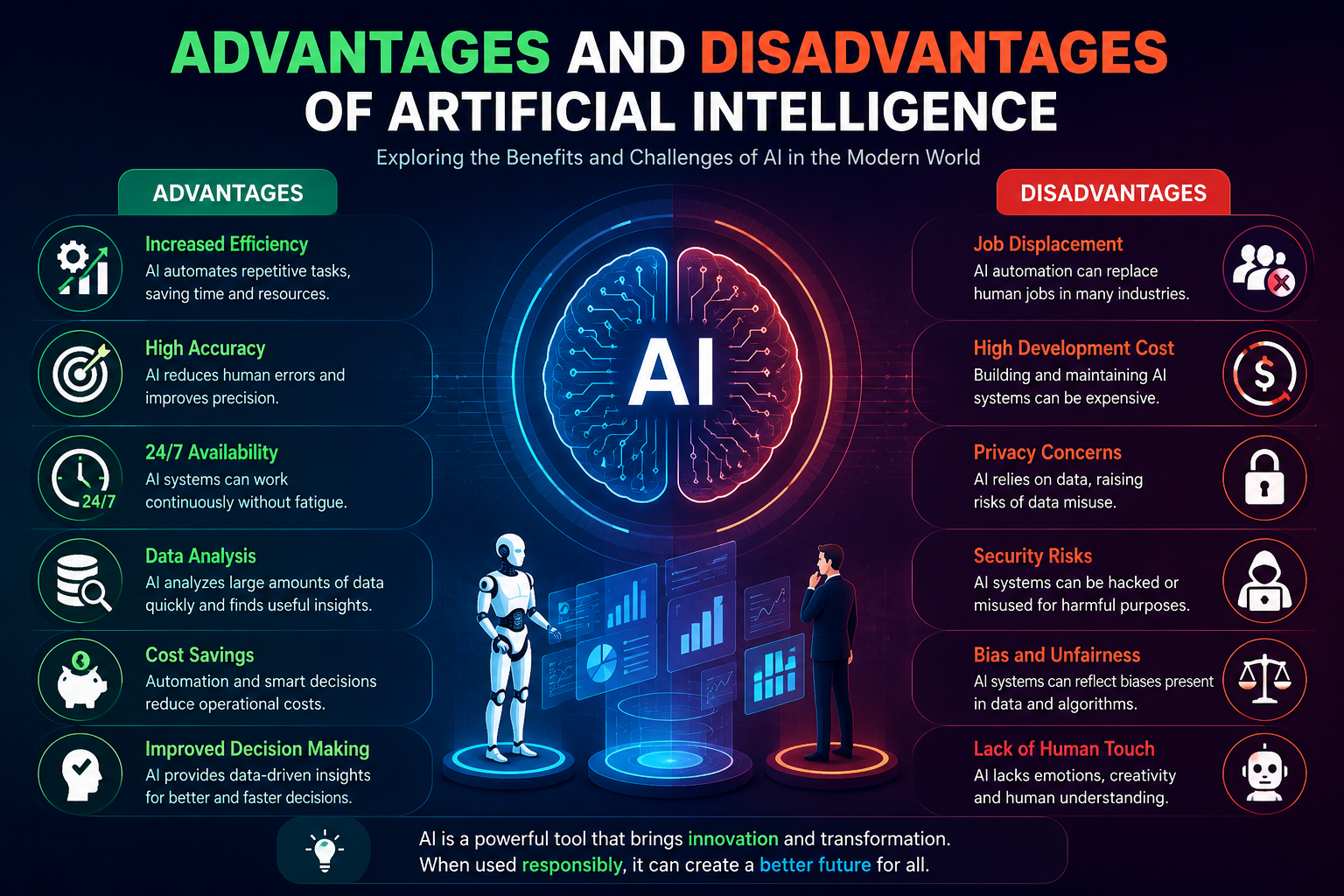
Introduction
Artificial Intelligence is no longer a technology of the future. It is here, it is expanding rapidly, and it is reshaping nearly every aspect of how we work, communicate, learn, and make decisions. From the recommendations you see on streaming platforms to the fraud alerts your bank sends in real time, AI is deeply embedded in the fabric of modern life.
But with that presence comes a genuine and important conversation. Understanding the advantages and disadvantages of Artificial Intelligence is not just an academic exercise — it is essential knowledge for anyone who uses digital tools, runs a business, works in a regulated industry, or simply wants to make informed choices about the technology they interact with every day.
This guide covers both sides of the AI story honestly and in full detail. No hype, no fear-mongering — just a clear, balanced, and practically useful examination of what AI does well, where it falls short, and what that means for all of us.
Quick Answer — Featured Snippet
The main advantages of Artificial Intelligence include improved efficiency, faster decision-making, 24/7 availability, personalized experiences, and breakthroughs in healthcare and scientific research. The key disadvantages include high development costs, job displacement, privacy concerns, algorithmic bias, security risks, and the spread of misinformation through AI-generated content. Responsible development and clear regulation are essential to maximizing benefits while managing risks.
What Is Artificial Intelligence?
Artificial Intelligence refers to the development of computer systems capable of performing tasks that would normally require human intelligence. These tasks include understanding language, recognizing patterns in data, making decisions, generating content, and learning from experience.
Modern AI systems are built on machine learning and deep learning techniques that allow them to improve their performance by processing large amounts of data rather than following rigid, manually written rules. The result is technology that can adapt, generalize within its domain, and produce outputs that are often indistinguishable from human work.
AI today spans an enormous range of applications — from voice assistants and spam filters at one end of the complexity spectrum, to sophisticated medical diagnostic tools and generative AI systems like ChatGPT and Google Gemini at the other.
For a complete foundation before reading further, visit our guide: [What Is Artificial Intelligence? A Beginner’s Guide](internal link).
Why Artificial Intelligence Is Growing So Fast
AI has existed as a field of research since the 1950s, but the pace of progress accelerated dramatically over the past decade. Several converging forces explain why AI has grown so rapidly and why its adoption continues to expand across every sector.
Big Data
The explosion of digital data created the raw material that AI systems need to learn effectively. Every search query, every online purchase, every medical scan, every social media post generates data. Modern AI systems thrive on this abundance, using it to identify patterns that were previously invisible to human analysts.
The volume of data generated globally grows every year, and with it, the opportunity to build more capable, more accurate, and more specialized AI systems.
Machine Learning
Machine learning gave AI developers a way to build systems that improve automatically through experience rather than requiring manual updates to their programming. This breakthrough made it practical to build AI systems for complex, real-world tasks where writing explicit rules for every possible scenario would be impossible.
As machine learning techniques matured, researchers developed increasingly powerful algorithms capable of handling more complex data and producing more reliable results.
Cloud Computing
Cloud platforms from Amazon, Google, and Microsoft gave organizations access to the computing power needed to train and deploy AI systems without building expensive on-premise infrastructure. A startup with a strong idea can now access the same computing resources that were once available only to the largest technology companies.
Cloud computing also made AI deployment faster and more scalable, allowing organizations to expand AI-powered services to millions of users without rebuilding their infrastructure from scratch.
Faster Hardware
Specialized processors — particularly graphics processing units (GPUs) and tensor processing units (TPUs) — made it possible to train large, complex AI models in hours or days rather than months or years. NVIDIA’s GPU technology, for example, became foundational to the modern deep learning revolution.
Continued advances in chip design are enabling AI models to run directly on consumer devices — phones, watches, and laptops — making AI faster, more private, and available without a constant internet connection.
Generative AI
The emergence of generative AI — systems capable of creating text, images, music, video, and code — transformed public perception of what AI could do and dramatically accelerated business investment. The release of ChatGPT in 2022 introduced hundreds of millions of people to conversational AI, triggering a wave of product development, investment, and regulatory attention that continues to define the AI landscape in 2026.
Top Advantages of Artificial Intelligence
Reduces Human Errors
Human beings make mistakes — through fatigue, distraction, cognitive biases, or simple oversight. AI systems, when properly trained and tested, apply the same process to every input with consistent precision.
In healthcare, AI-assisted diagnostic tools analyze medical images with a level of consistency that individual radiologists working long shifts cannot always maintain. In manufacturing, AI quality control systems detect product defects that human inspectors on a busy production line might miss.
This does not mean AI is infallible — it makes its own types of errors. But in high-volume, repetitive tasks where consistency matters enormously, AI reduces error rates in ways that have measurable real-world impact.
Works 24/7 Without Fatigue
Unlike human workers who need rest, AI systems operate continuously without degradation in performance. This persistent availability is enormously valuable in contexts where interruptions carry significant costs.
Customer support chatbots handle inquiries around the clock. Fraud detection systems monitor every transaction at every hour of every day. Network security systems scan for threats continuously without shift changes or lunch breaks.
This 24/7 capability allows organizations to provide services and maintain oversight at a scale and consistency that human teams simply cannot match.
Automates Repetitive Tasks
A significant portion of work in virtually every industry involves repetitive, rule-based tasks — data entry, invoice processing, report generation, scheduling, and routine correspondence. These tasks consume time, drain human energy, and rarely require the judgment or creativity that makes human workers most valuable.
AI automation handles these tasks reliably and efficiently, freeing human employees to focus on complex problem-solving, relationship building, and creative work where human judgment genuinely adds value.
In finance, AI automates transaction categorization and reconciliation. In legal services, it reviews documents for standard compliance requirements. In human resources, it screens applications based on specified criteria before human review begins.
Faster Decision Making
AI processes data and generates recommendations far faster than any human decision-making process. In environments where timing is critical — financial trading, emergency response routing, real-time supply chain management — this speed advantage translates directly into better outcomes.
Algorithmic trading systems execute thousands of transactions per second based on real-time market analysis. Logistics AI reroutes deliveries in response to traffic conditions, weather events, and demand fluctuations in real time. Emergency services AI prioritizes response resources based on incident severity and proximity simultaneously.
Improves Healthcare
AI’s impact on healthcare is one of the clearest, most consequential examples of the technology’s benefits. Medical AI systems analyze imaging data to detect cancers, tumors, and other conditions at earlier stages than traditional screening methods.
AI tools assist in genomic analysis, helping researchers identify disease risk factors and design targeted therapies. Drug discovery platforms use AI to predict how candidate molecules will interact with biological targets, dramatically reducing the time and cost of early-stage pharmaceutical research.
AI-powered monitoring systems track patient vital signs continuously, alerting clinical staff to changes that might indicate deterioration before a crisis develops. The cumulative effect is healthcare that is faster, more precise, and more personalized.
Better Customer Support
Modern customer support powered by AI handles routine inquiries instantly, at any hour, across multiple languages simultaneously. AI chatbots resolve common questions — order tracking, policy explanations, account management — without requiring a human agent and without placing customers in a queue.
When complex issues arise that require human judgment, AI systems route customers to the most appropriate agent and provide that agent with relevant context, reducing resolution time and improving customer satisfaction.
The result is support that is more responsive, more consistent, and more cost-effective than purely human-staffed alternatives, particularly at scale.
Personalized Recommendations
AI enables personalization at a scale that was previously impossible. Systems that analyze individual behavior, preferences, and history can tailor content, products, and experiences for millions of users simultaneously — each receiving something meaningfully different from everyone else.
Netflix recommends content based on your specific viewing history. Spotify generates playlists calibrated to your musical taste. Amazon surfaces products aligned with your purchase patterns. Educational platforms adapt the difficulty and pace of lessons to each student’s performance in real time.
This personalization creates genuine value for users and measurable business benefits for the organizations that deploy it.
Increased Productivity
Across industries, AI tools are making individual workers and teams significantly more productive. Professionals who use AI writing assistants, data analysis tools, and code generation platforms consistently report completing work faster and at higher quality than without AI support.
Microsoft’s research on Copilot usage found that professionals using AI assistance completed certain tasks significantly faster than control groups working without it. Similar productivity gains have been documented in software development, content creation, legal research, and financial analysis.
These productivity improvements compound at the organizational level, enabling companies to accomplish more with the same headcount or maintain output levels while redirecting human talent to higher-value activities.
Better Cybersecurity
The cybersecurity threat landscape has grown more complex and more aggressive. AI-powered security systems respond to this challenge by monitoring network traffic at a scale and speed that human security teams cannot match.
Behavioral AI systems establish baselines of normal activity for users and systems, then flag deviations that might indicate a compromised account or an active intrusion. Malware detection AI identifies new threats based on behavioral characteristics rather than waiting for specific signatures to be added to a database.
Threat intelligence platforms use AI to correlate information from thousands of sources simultaneously, identifying emerging attack patterns and enabling proactive defense rather than reactive response.
Smarter Business Decisions
AI-powered analytics transform large, complex datasets into actionable insights that inform better business decisions. Rather than relying on periodic reports generated from a fraction of available data, executives can access real-time dashboards that synthesize information from across the organization.
Demand forecasting AI helps retailers optimize inventory, reducing both stockouts and excess. Market analysis AI helps financial analysts identify trends in data that human analysts reviewing the same information might miss. Operational AI identifies inefficiencies in business processes and recommends targeted improvements.
The cumulative effect is decision-making that is faster, better-informed, and more likely to produce the outcomes organizations are seeking.
Improves Education
AI is making education more accessible and more effective for students at every level. Adaptive learning platforms adjust the difficulty, pace, and format of instruction based on each student’s performance, ensuring that content remains appropriately challenging without becoming overwhelming.
AI tutoring systems provide immediate, personalized feedback on student work outside classroom hours, extending learning support without requiring additional teacher time. Language learning platforms like Duolingo use AI to optimize lesson sequences for each learner’s specific strengths and weaknesses.
For educators, AI tools reduce time spent on administrative tasks — grading routine assignments, generating lesson materials, tracking student progress — freeing more time for meaningful instruction and student interaction.
Helps Scientific Research
AI is accelerating the pace of scientific discovery across multiple disciplines. In biology, DeepMind’s AlphaFold predicted the three-dimensional structure of virtually every known protein, solving a problem that had challenged researchers for decades.
In astronomy, AI systems analyze telescope data to identify patterns that would take human researchers years to find manually. In materials science, AI predicts the properties of novel compounds before they are synthesized in the laboratory, guiding researchers toward more promising candidates faster.
Climate scientists use AI to build more accurate models of complex Earth systems, improving the precision of projections that inform environmental policy. In every case, AI enables researchers to extract more value from existing data and design more targeted experiments.
Top Disadvantages of Artificial Intelligence
High Development Cost
Building capable AI systems requires significant investment in multiple dimensions — computing infrastructure, specialized talent, data acquisition and preparation, and ongoing maintenance. Training a large-scale AI model can cost millions of dollars in computing resources alone, before accounting for the engineering teams required to design, build, and refine it.
These costs create a significant barrier to entry. Small organizations and developing nations risk being locked out of the most powerful AI capabilities, concentrating the technology’s benefits among already well-resourced players and widening existing inequalities.
Even for organizations that can afford initial development, the ongoing costs of maintaining, updating, and monitoring deployed AI systems are substantial.
Job Displacement
Automation has always changed the nature of work, but AI is accelerating that change at an unprecedented pace and across a broader range of occupations than previous technological waves.
Roles centered on routine, predictable tasks — data entry, basic customer service, document processing, quality inspection — are most immediately at risk. But AI’s expanding capabilities in language, reasoning, and creative tasks are also beginning to affect knowledge workers in legal, financial, and creative fields.
The concern is not simply that jobs will disappear — it is that the transition may happen faster than labor markets and education systems can adapt, creating real hardship for workers whose skills become less economically valuable before new opportunities are accessible.
Lack of Human Creativity
AI systems can generate impressive outputs in creative domains — writing, music composition, image creation, design — but they do so by recombining patterns learned from existing human-created work. They do not generate original ideas driven by curiosity, lived experience, emotional depth, or genuine artistic vision.
An AI system can produce a competent and even beautiful piece of music, but it cannot be moved by loss, inspired by wonder, or motivated by a desire to communicate something true about the human condition. This distinction matters in creative fields, and it matters in any context where genuine originality and authentic human expression are the point.
Privacy Concerns
AI systems are hungry for data, and the data they learn from is often deeply personal — medical records, financial histories, communications, location data, behavioral patterns. The collection, storage, and use of this data raises serious privacy questions that regulatory frameworks are still working to address.
Surveillance applications of AI — facial recognition systems, behavioral monitoring tools, predictive policing algorithms — represent the sharpest end of these concerns. When AI enables governments or corporations to monitor individuals at scale, the implications for civil liberties and democratic accountability are profound.
Security Risks
AI introduces new attack surfaces and new forms of vulnerability. Adversarial attacks — carefully crafted inputs designed to fool AI systems into making wrong predictions — have been demonstrated across image recognition, speech recognition, and natural language processing systems.
Perhaps more immediately concerning is the weaponization of AI by malicious actors. AI tools lower the technical barrier to creating sophisticated phishing campaigns, generating convincing fake identities, automating cyberattacks, and producing malware that adapts to defensive measures. The same technology that improves security defenses also empowers attackers.
AI Bias
AI systems learn from historical data, and historical data reflects historical human decisions — which often contain systematic biases based on race, gender, socioeconomic status, geography, and other characteristics.
When biased data trains an AI model, the model learns to replicate and in some cases amplify those biases. AI systems have been shown to disadvantage minority applicants in hiring algorithms, assign higher credit risk scores to certain demographic groups, and produce less accurate results for faces that are underrepresented in training datasets.
Addressing AI bias requires deliberate effort at every stage of development — diverse training data, bias audits, diverse development teams, and ongoing monitoring of deployed systems for discriminatory outcomes.
Ethical Issues
AI deployment raises ethical questions that technology alone cannot resolve. When an AI system makes a consequential decision — whether to approve a loan, flag a social media post for removal, or recommend a medical treatment — questions of accountability arise.
Who is responsible when an AI system causes harm? How transparent should AI decision-making be to the people it affects? Should certain decisions — criminal sentencing, medical treatment choices, child welfare determinations — be delegable to AI systems at all? These questions require ongoing dialogue between technologists, ethicists, policymakers, and the public.
Overdependence on AI
As AI tools become more capable and more convenient, there is a genuine risk that individuals and organizations become overly dependent on AI outputs without maintaining the critical judgment needed to recognize when those outputs are wrong.
Professionals who rely on AI for analysis, writing, or decision support may gradually lose the skills needed to perform those functions independently. Organizations that automate critical processes without maintaining human oversight capabilities may find themselves dangerously exposed when AI systems fail or produce unexpected results.
Healthy AI integration requires deliberate effort to maintain human competence and judgment alongside AI assistance.
Lack of Emotions
AI systems have no emotional intelligence in any genuine sense. They can recognize emotional patterns in language and images, and they can generate text that sounds empathetic, but they do not feel, care, or experience anything.
This limitation matters in contexts where authentic human connection is essential — mental health support, patient care, conflict resolution, leadership, and education. An AI that simulates empathy without possessing it can be useful in limited contexts, but it cannot replace the genuine human understanding that certain situations fundamentally require.
Misinformation and Deepfakes
Generative AI has dramatically lowered the cost and skill required to produce convincing misinformation. AI systems can generate realistic-sounding news articles, authentic-looking photographs of events that never happened, and video footage of real people saying things they never said.
The consequences for public discourse, democratic processes, and individual reputations are serious. In 2026, AI-generated misinformation is a documented threat to electoral integrity, public health communication, and institutional trust. Distinguishing AI-generated content from authentic human-created content is becoming increasingly difficult even for technically sophisticated observers.
Environmental Impact
Training large AI models consumes substantial amounts of electricity. A single training run for a state-of-the-art large language model can produce carbon emissions comparable to those of multiple international flights, depending on the energy mix of the data centers involved.
As AI adoption expands and models grow larger, the cumulative environmental cost is becoming a serious concern for researchers, policymakers, and technology companies working toward sustainability commitments. More efficient training methods and the use of renewable energy in data centers are active areas of focus, but the environmental footprint of AI remains significant.
Limited Common Sense
Despite their impressive capabilities, AI systems lack the common sense understanding that humans develop through lived experience. They can fail in surprising and sometimes embarrassing ways when presented with situations that fall slightly outside their training distribution.
An AI navigation system might route a driver through a technically legal but clearly impractical path. A language model might generate factually incorrect information with complete confidence. A medical AI trained on one population might perform poorly on patients with different demographic characteristics.
These failures reflect a fundamental limitation: AI systems learn statistical patterns from data, but they do not build a genuine model of how the world works the way humans do.
Advantages vs Disadvantages of AI — Comparison Table
| Category | Advantages | Disadvantages |
|---|---|---|
| Productivity | Automates repetitive tasks, increases output | Risk of overdependence, skill erosion |
| Accuracy | Reduces human error in defined tasks | Bias from training data, hallucinations |
| Availability | Operates 24/7 without fatigue | High infrastructure and maintenance costs |
| Decision Making | Faster, data-driven insights | Lack of common sense, accountability gaps |
| Healthcare | Earlier diagnosis, drug discovery | Privacy concerns with medical data |
| Employment | Creates new AI-related roles | Displaces workers in routine roles |
| Security | Improved threat detection | Enables more sophisticated cyberattacks |
| Creativity | Generates content at scale | No genuine originality or creative intent |
| Personalization | Tailored experiences at scale | Requires extensive personal data collection |
| Research | Accelerates scientific discovery | Energy-intensive training processes |
| Communication | Real-time translation, accessibility tools | Generates convincing misinformation |
| Ethics | Enables consistent rule application | Ethical accountability remains unclear |
Real-Life Examples of AI
Understanding AI’s advantages and disadvantages becomes much clearer when you connect them to systems you already recognize.
ChatGPT, developed by OpenAI, demonstrates AI’s advantage in productivity and communication clearly — it drafts documents, answers questions, and generates code in seconds. At the same time, it illustrates the disadvantage of hallucination, occasionally generating plausible-sounding but factually incorrect information.
Google Gemini integrates AI assistance across Google’s product ecosystem, improving productivity in Search, Gmail, and Google Docs. Its multimodal capabilities allow it to process images and text together, showcasing AI’s expanding practical utility in everyday workflows.
Microsoft Copilot embedded within Microsoft 365 demonstrates measurable productivity advantages for enterprise users — automating document drafting, data analysis, and email summarization. It also illustrates the overdependence risk when professionals begin to skip critical review of AI-generated outputs.
Tesla’s Autopilot and Full Self-Driving systems demonstrate AI’s ability to process sensor data and make driving decisions faster than human reaction times allow, improving safety in many highway conditions. They also illustrate the challenge of edge cases — situations outside the training distribution where the system’s behavior becomes less predictable.
Netflix and Amazon recommendation engines showcase AI personalization at massive scale, delivering genuine value to users while simultaneously raising legitimate questions about filter bubbles and the privacy cost of the behavioral data that powers these recommendations.
In healthcare, AI imaging analysis tools used in radiology departments are detecting early-stage cancers at rates that match or exceed specialist performance, demonstrating one of AI’s most consequential and clearly beneficial real-world applications.
In banking, real-time fraud detection AI protects consumers from unauthorized transactions while also raising questions about false positives — legitimate transactions flagged as suspicious — that can inconvenience customers and create access problems for people whose spending patterns differ from the statistical norm.
In education, platforms like Khan Academy’s AI tutor and Duolingo’s adaptive learning engine demonstrate how AI can extend high-quality educational support to students regardless of their geographic location or access to qualified teachers.
In manufacturing, predictive maintenance AI analyzes sensor data from equipment to identify failure patterns before breakdowns occur, reducing downtime and maintenance costs while also displacing some of the routine monitoring roles previously performed by human technicians.
Industries That Benefit Most From AI
| Industry | Key AI Applications | Primary Benefits |
|---|---|---|
| Healthcare | Diagnostic imaging, drug discovery, patient monitoring | Earlier detection, faster research, personalized treatment |
| Finance | Fraud detection, algorithmic trading, credit scoring | Security, speed, risk management |
| Education | Adaptive learning, AI tutoring, automated grading | Personalization, accessibility, efficiency |
| Retail | Recommendation engines, inventory management, visual search | Customer experience, cost reduction, demand accuracy |
| Transportation | Autonomous vehicles, route optimization, predictive maintenance | Safety, efficiency, cost reduction |
| Agriculture | Crop monitoring, yield prediction, precision irrigation | Sustainability, efficiency, food security |
| Cybersecurity | Threat detection, behavioral analysis, incident response | Speed, scale, proactive defense |
| Marketing | Audience segmentation, content personalization, campaign optimization | ROI improvement, relevance, scalability |
| Manufacturing | Predictive maintenance, quality control, robotic automation | Uptime, consistency, cost reduction |
| Entertainment | Content recommendation, AI generation tools, game AI | Engagement, personalization, production efficiency |
Risks of Artificial Intelligence
Beyond the individual disadvantages, AI presents systemic risks that deserve dedicated attention because their scale and complexity extend beyond any single use case.
AI misuse represents one of the most immediate risks. The same general-purpose AI capabilities that enable legitimate productivity applications can be repurposed for harmful ends. Automated social media manipulation, AI-generated propaganda, and AI-assisted scam operations are already documented problems in 2026.
Cyberattacks powered by AI are becoming more sophisticated and more scalable. AI enables attackers to craft highly personalized phishing messages at volume, identify vulnerabilities in target systems automatically, and develop malware that adapts to defensive responses. Organizations that rely heavily on AI-powered defenses face adversaries who are increasingly using AI offensively.
AI-generated fake content — whether text, images, audio, or video — represents a fundamental challenge to information integrity. When realistic fabrications can be produced quickly and cheaply, the ability of individuals and institutions to verify what is real becomes genuinely strained. The downstream effects on public trust, democratic processes, and personal relationships are significant and not yet fully understood.
The ethical concerns surrounding AI — bias, accountability, transparency, consent — are not purely philosophical. They have practical consequences for real people who are affected by AI decisions in consequential contexts like employment, healthcare, housing, and criminal justice. Addressing these concerns requires deliberate technical work, institutional commitment, and appropriate regulation.
How to Use AI Responsibly
Responsible AI use is not about avoiding the technology — it is about engaging with it thoughtfully, maintaining appropriate human oversight, and making deliberate choices about where and how AI assistance adds genuine value.
For individuals, responsible AI use starts with maintaining critical judgment. AI outputs — whether text, analysis, or recommendations — should be treated as starting points for human review rather than authoritative final answers. Verify factual claims made by AI systems against reliable sources, particularly in consequential contexts.
Be deliberate about the personal data you share with AI tools. Review privacy policies, understand how your data is used and stored, and choose tools from providers with clear, trustworthy data governance practices.
Maintain and develop your own skills alongside AI tools. Use AI assistance to enhance your work, not to replace the thinking and judgment that make your contribution valuable.
For businesses, responsible AI deployment requires investing in bias testing before deploying AI systems in contexts that affect people’s lives and livelihoods. Maintain meaningful human oversight of AI-assisted decisions, particularly in high-stakes domains. Be transparent with customers and employees about how AI is used in your organization and what data it relies on.
Establish clear accountability structures so that when AI systems produce harmful outputs, it is clear who is responsible and what the process for remedy is. Invest in the ongoing monitoring of deployed AI systems — a model that performs well at launch may drift or develop unexpected behaviors as conditions change.
Engage with regulatory developments in your jurisdiction and treat compliance as a floor rather than a ceiling for responsible AI practice.
Future of Artificial Intelligence
The AI landscape in 2026 is defined by capability and controversy in equal measure. The technology is advancing rapidly, its applications are expanding across every sector, and the policy frameworks needed to govern it are developing — albeit more slowly than the technology itself.
Several developments will shape AI’s trajectory in the years immediately ahead. Agentic AI — systems that autonomously plan and execute multi-step tasks with minimal human intervention — is moving from research demonstrations to practical deployment. This shift will amplify both the productivity benefits of AI and the oversight challenges it presents.
Multimodal AI that seamlessly integrates text, image, audio, and video processing will become standard rather than exceptional. The distinction between specialized AI tools for different content types will blur as unified systems handle all of them fluently.
AI regulation will become more comprehensive and more consistent. The EU AI Act provides a template that other jurisdictions are studying and adapting. Expect clearer rules around high-risk AI applications, transparency requirements, and accountability mechanisms in most major economies over the next several years.
The environmental footprint of AI training will receive increasing scrutiny and drive investment in more efficient model architectures, hardware, and energy sources. The industry’s ability to demonstrate credible progress on sustainability will become an increasingly important factor in public and regulatory trust.
Perhaps most importantly, the conversation about what AI should and should not do — in healthcare, criminal justice, financial services, education, and public discourse — will mature from general principles to specific, enforceable standards. How that conversation unfolds, and who has a voice in it, will determine whether the balance of AI’s advantages and disadvantages tips in a direction that is genuinely beneficial for the broadest possible range of people.
For a deeper look at where AI is heading, read our article: [Types of Artificial Intelligence: Narrow AI, AGI and Super AI](internal link).
Frequently Asked Questions
What are the advantages of Artificial Intelligence?
The key advantages of AI include reduced human error in repetitive tasks, 24/7 availability without fatigue, automation of routine work, faster and better-informed decision-making, improvements in healthcare diagnostics and drug discovery, personalized user experiences, enhanced cybersecurity, and acceleration of scientific research. These benefits are already measurable and expanding across virtually every industry.
What are the disadvantages of Artificial Intelligence?
The main disadvantages include high development and maintenance costs, job displacement in routine roles, the absence of genuine creativity or emotional intelligence, serious privacy concerns, AI bias from flawed training data, security risks from AI-powered attacks, ethical accountability gaps, overdependence risks, the spread of AI-generated misinformation, significant environmental costs, and limited common sense reasoning.
Is AI good or bad?
AI is neither inherently good nor bad — its impact depends entirely on how it is developed, deployed, and governed. When built with care, tested rigorously, and deployed in appropriate contexts with meaningful human oversight, AI delivers genuine benefits. When developed carelessly, deployed without accountability, or misused deliberately, it causes real harm. The outcome is determined by human choices, not by the technology itself.
Can AI replace humans?
AI can replace humans for specific, well-defined, repetitive tasks. It cannot replace the full range of human capabilities — creativity, emotional intelligence, ethical judgment, social understanding, and the ability to navigate genuinely novel situations. The most realistic outcome in most fields is collaboration between human and AI capabilities, with the balance shifting as AI systems become more capable in specific domains.
What are the biggest risks of AI?
The most significant risks include the spread of AI-generated misinformation and deepfakes undermining information integrity, AI-powered cyberattacks becoming more sophisticated, algorithmic bias producing discriminatory outcomes in consequential decisions, the concentration of advanced AI capabilities creating dangerous power imbalances, misaligned AI systems pursuing objectives in harmful ways, and the displacement of workers faster than labor markets can adapt.
What industries use AI the most?
Healthcare, finance, retail, transportation, manufacturing, and technology are currently the heaviest users of AI. Agriculture, education, cybersecurity, marketing, and entertainment are rapidly expanding their AI deployments. By 2026, it is accurate to say that no major industry is untouched by AI applications at some level of its operations.
Is AI safe?
AI safety depends on how systems are designed, tested, and deployed. Many AI applications are well-tested and reliably beneficial. Others carry meaningful risks, particularly in high-stakes domains where biased outputs or system failures can cause serious harm. Robust testing, diverse training data, meaningful human oversight, and appropriate regulation are all necessary components of responsible, safe AI deployment.
Why is AI important?
AI is important because it enables organizations and individuals to process information, identify patterns, and make decisions at a speed and scale that human cognition alone cannot match. In healthcare, it saves lives through earlier diagnosis. In science, it accelerates discovery. In business, it drives efficiency and competitive advantage. Its importance will only grow as its capabilities expand and its integration into critical systems deepens.
How does AI help businesses?
AI helps businesses by automating repetitive tasks and reducing operational costs, providing faster and more data-driven decision support, enabling personalized customer experiences at scale, improving security against fraud and cyberattacks, accelerating product development and research, and generating insights from data that inform better strategic choices. Businesses that integrate AI effectively consistently report meaningful productivity and efficiency gains.
What is the future of AI?
The near-term future of AI includes more capable and autonomous AI agents, deeper multimodal integration, more sophisticated generative AI tools, and expanding regulatory frameworks. The longer-term future depends on research breakthroughs in areas like reasoning, alignment, and generalization. What is certain is that AI will remain one of the defining forces shaping economies, societies, and individual lives for the foreseeable future. Responsible governance of that force is one of the most important challenges of our time.
Final Thoughts
The advantages and disadvantages of Artificial Intelligence are both real and significant. This is not a technology that can be reduced to simple cheerleading or simple alarm — it demands nuanced understanding, honest evaluation, and ongoing critical engagement.
The benefits are substantial and already proven. AI is saving lives in healthcare, accelerating science, improving productivity, and making services more accessible to more people. These are not hypothetical future possibilities — they are documented, present-day realities.
The disadvantages and risks are equally real. Bias, privacy erosion, job displacement, misinformation, and the profound ethical questions surrounding AI accountability are not concerns to be dismissed as anti-technology sentiment. They are legitimate challenges that require deliberate technical work, responsible business practices, and effective governance.
The most productive relationship with AI is one built on informed engagement rather than either uncritical adoption or reflexive resistance. Understanding what AI does well, where it falls short, and what responsible use looks like puts you in a far stronger position — as a professional, a business leader, a policymaker, or simply a citizen trying to navigate a world that AI is reshaping in real time.
References
- OpenAI Documentation — Technical documentation for GPT models and AI capabilities.
https://platform.openai.com/docs - Google AI — Official Google AI research hub covering AI development and applications.
https://ai.google - Microsoft AI — Microsoft’s official AI platform covering Copilot, Azure AI, and enterprise use cases.
https://www.microsoft.com/ai - IBM Think — Artificial Intelligence — Foundational AI explanations, industry applications, and business AI resources.
https://www.ibm.com/think/topics/artificial-intelligence - AWS — What Is Artificial Intelligence? — Amazon Web Services overview of AI capabilities and cloud deployment.
https://aws.amazon.com/what-is/artificial-intelligence/ - NVIDIA AI and Data Science — GPU computing resources and deep learning infrastructure documentation.
https://www.nvidia.com/en-us/ai-data-science/ - Stanford HAI — Human-Centered Artificial Intelligence — AI research, ethics, policy analysis, and the annual AI Index Report.
https://hai.stanford.edu - DeepLearning.AI — Educational resources on machine learning, deep learning, and practical AI skills.
https://www.deeplearning.ai - MIT CSAIL — Computer Science and Artificial Intelligence Laboratory — Academic AI research and technical publications.
https://www.csail.mit.edu - NIST Artificial Intelligence — National Institute of Standards and Technology AI Risk Management Framework and standards.
https://www.nist.gov/artificial-intelligence
Author Bio
TechOriginHub Editorial Team
The TechOriginHub Editorial Team brings together experienced technology journalists, AI researchers, and SEO content strategists dedicated to producing accurate, balanced, and genuinely useful content about emerging technologies. With expertise spanning artificial intelligence, machine learning, cybersecurity, digital policy, and technology ethics, the team applies rigorous research standards and thorough editorial review to every article published on TechOriginHub. Our mission is to make complex technology topics accessible and practically valuable for readers at every level of technical familiarity.
Disclaimer
This article is for informational and educational purposes only. Artificial Intelligence technologies continue to evolve, and capabilities, regulations, and best practices may change over time. Always verify the latest information through official documentation and trusted industry sources before making decisions based on AI tools or services.