 By TechOriginHub Editorial Team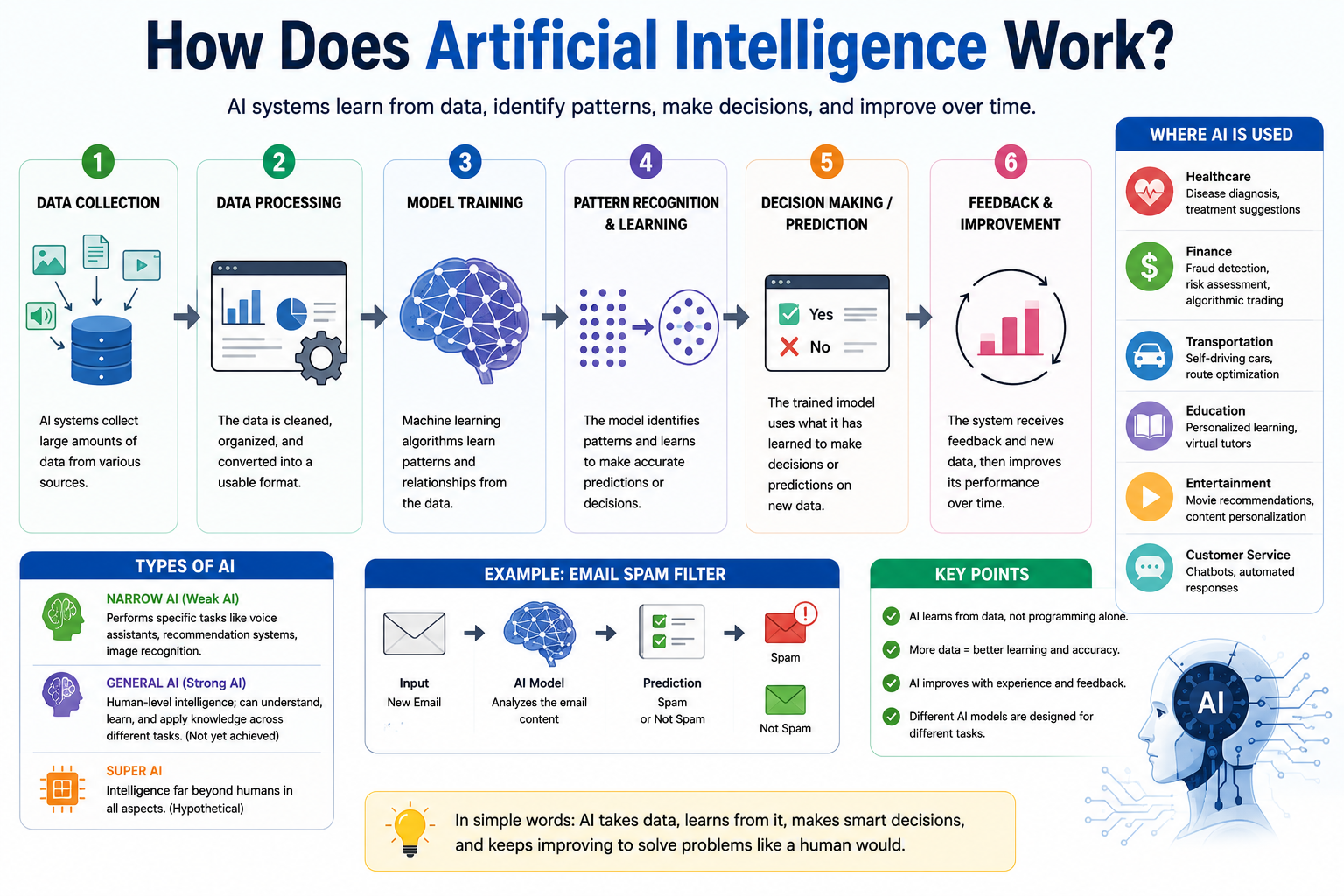
Introduction
Every time you ask your phone a question, get a movie recommendation, or receive a fraud alert from your bank, Artificial Intelligence is working quietly behind the scenes. Most people use AI dozens of times a day without ever stopping to wonder what is actually happening inside these systems.
Understanding how does Artificial Intelligence work is no longer just a topic for computer scientists and researchers. As AI reshapes careers, industries, and daily routines, having at least a basic grasp of its mechanics puts you in a far stronger position — whether you are a student, a business professional, or simply a curious person trying to make sense of the modern world.
This guide breaks down the entire AI process from beginning to end, using plain language, real examples, and a logical step-by-step structure. No prior technical knowledge required.
Quick Answer — Featured Snippet
How does Artificial Intelligence work?
Artificial Intelligence works by collecting large amounts of data, processing it through mathematical algorithms, and training computer models to recognize patterns. Once trained, these models use what they have learned to make predictions, generate content, or make decisions when given new inputs — without being explicitly programmed for every situation.
What Is Artificial Intelligence?
Artificial Intelligence is the field of computer science focused on building machines and software systems that can perform tasks requiring human-like intelligence. These tasks include understanding language, recognizing images, solving problems, making decisions, and learning from experience.
Unlike traditional software, which follows a fixed set of rules programmed by developers, AI systems learn from data. They improve their own performance over time without a human manually rewriting their instructions after every new situation.
Think of traditional software as a recipe — it follows precise steps in a fixed order. AI, on the other hand, is more like an experienced chef who has tasted thousands of dishes and can now create something new based on everything they have learned.
If you want a deeper overview before diving into the mechanics, check out our full guide: [What Is Artificial Intelligence? A Beginner’s Guide](internal link).
How Does Artificial Intelligence Work?
The process behind AI is more logical than most people expect. It follows a clear, repeatable workflow that transforms raw data into intelligent outputs. Here is how it works, step by step.
Step 1 — Data Collection
Everything in AI begins with data. Without data, an AI system has nothing to learn from. This is the single most important ingredient in the entire process.
Data comes in two main forms:
Structured Data is organized and easy for computers to read — think spreadsheets, databases, and numerical records. A bank’s transaction history is a classic example of structured data.
Unstructured Data has no fixed format. Text documents, social media posts, emails, images, audio recordings, and videos are all unstructured. Most of the data in the real world falls into this category.
AI systems need enormous volumes of data to learn effectively. A facial recognition system might be trained on millions of photographs. A language model like ChatGPT was trained on hundreds of billions of words from across the internet, books, and other text sources.
Data quality matters just as much as quantity. If the training data is inaccurate, biased, or incomplete, the AI model will reflect those flaws in everything it produces. Researchers call this problem “garbage in, garbage out.”
Step 2 — Data Preparation
Raw data is almost never ready to use directly. Before it can train an AI model, it needs to go through a careful preparation process. This stage often takes more time than the actual training.
Data Cleaning involves removing duplicates, correcting errors, handling missing values, and filtering out irrelevant information. A dataset full of typos, duplicated entries, or blank fields will confuse the model during training.
Data Labeling is the process of adding meaningful tags to data so the model knows what it is looking at. If you want to train an AI to recognize dogs in photos, a human must first go through thousands of images and label each one as “dog” or “not dog.” This labeled data is what the model learns from.
Organizing Datasets means splitting the prepared data into separate groups — typically a training set (used to teach the model), a validation set (used to fine-tune it), and a test set (used to evaluate final performance). A typical split might be 70% training, 15% validation, and 15% testing.
Step 3 — Choosing an AI Algorithm
An algorithm is the mathematical engine that powers an AI model. Choosing the right algorithm depends on the task at hand. Different problems require different approaches.
Decision Trees are one of the simplest AI algorithms. They work by asking a series of yes/no questions about the data and branching toward a conclusion based on the answers. They are easy to interpret and work well for classification problems, like deciding whether an email is spam or legitimate.
Machine Learning Algorithms include a broad family of techniques such as linear regression, support vector machines, random forests, and k-nearest neighbors. Each has specific strengths depending on the type and structure of the data.
Neural Networks are designed to mimic the way biological brains process information through layers of connected nodes. They excel at complex tasks like image recognition, speech understanding, and language generation.
Deep Learning Models are large, multi-layered neural networks capable of learning extremely complex patterns. They require massive datasets and significant computing power, but they consistently achieve state-of-the-art results on difficult tasks.
Step 4 — Model Training
This is where the actual learning happens. Training is the process of feeding prepared data through the chosen algorithm and allowing the model to adjust itself until it gets better at the task.
Here is how it works in practice. The model receives an input — say, an image of a cat. It makes an initial prediction (which is likely wrong early in training). The system then calculates how far off that prediction was from the correct answer. This measurement is called the loss or error.
The model then adjusts its internal parameters — called weights — slightly, in a direction that reduces the error. This adjustment process is called backpropagation, and it relies on a mathematical technique called gradient descent.
This cycle repeats millions of times. Each complete pass through the entire training dataset is called an epoch. Training a large model might require dozens or hundreds of epochs.
Over time, through thousands or millions of these tiny adjustments, the model becomes increasingly accurate at recognizing patterns and making correct predictions. It is not memorizing answers — it is learning the underlying relationships within the data.
Step 5 — Testing and Validation
Once training is complete, the model needs to prove it can perform on data it has never seen before. This is a critical distinction. A model that only performs well on its training data but fails on new data has a problem called overfitting — it has essentially memorized the training examples rather than learning generalizable patterns.
The validation dataset, which was set aside during preparation, is used during training to monitor the model’s generalization ability and prevent overfitting.
The test dataset is used only after training is fully complete to get an unbiased measure of real-world performance. Engineers analyze key metrics — accuracy, precision, recall, and F1 score — to determine whether the model is ready for deployment.
If performance is not satisfactory, engineers go back and adjust the algorithm, the training process, the data, or the model architecture. This iterative refinement is a normal and expected part of AI development.
Step 6 — Prediction and Decision Making
Once a model passes testing, it is deployed into the real world. Now it performs its core function: taking new inputs and generating outputs.
A spam filter receives a new email and decides within milliseconds whether it is spam. A medical imaging AI analyzes a scan and highlights areas of concern. A recommendation engine receives your viewing history and generates a ranked list of shows you are likely to enjoy.
The model does not apply a fixed rule for every situation. Instead, it applies everything it learned during training to the specific characteristics of the new input. This is what makes AI systems so flexible and powerful — they can handle situations they were not explicitly programmed for, as long as those situations resemble patterns present in their training data.
Machine Learning Explained
Machine Learning is the branch of AI that enables systems to learn from data without being explicitly programmed for every outcome. It is the core technology behind most AI applications you encounter today.
Traditional programming works like this: a developer writes specific rules, and the computer follows them precisely. If a new situation arises that the rules do not cover, the program fails or produces the wrong result.
Machine learning flips this model entirely. Instead of writing rules, you feed the system large amounts of data and let it figure out the rules on its own. The result is a model that can handle new situations it has never explicitly encountered, as long as they share patterns with its training data.
There are three primary types of machine learning:
- Supervised Learning: The model learns from labeled data — each training example comes with the correct answer. Most practical AI applications use this approach.
- Unsupervised Learning: The model receives unlabeled data and must find patterns and structure on its own. It is useful for clustering similar customers or detecting anomalies.
- Reinforcement Learning: The model learns by trial and error, receiving rewards for good decisions and penalties for bad ones. This technique powers game-playing AI systems and robotics.
For a deeper dive, see our article: [Types of Artificial Intelligence Explained](internal link).
Deep Learning Explained
Deep Learning is a specialized subset of machine learning that uses large, multi-layered neural networks to process complex data. The word “deep” refers to the many layers within these networks — some modern models have hundreds or even thousands of layers.
Deep learning is the technology responsible for the most impressive recent advances in AI. Image recognition, voice assistants, real-time translation, autonomous driving, and generative AI are all built on deep learning foundations.
What makes deep learning so powerful is its ability to learn hierarchical representations of data. In an image recognition model, early layers might detect simple edges and colors. Middle layers combine those features into shapes. Deeper layers recognize complex objects like faces, cars, or specific breeds of dogs — all without a human telling it what features to look for.
The trade-off is that deep learning requires enormous amounts of data and substantial computing resources, typically powered by specialized graphics processing units (GPUs) or tensor processing units (TPUs).
What Are Neural Networks?
A neural network is a computational system loosely inspired by the structure of the human brain. It consists of layers of interconnected nodes, called neurons, that process and transmit information.
Every neural network has at least three types of layers:
Input Layer: Receives raw data — pixel values from an image, word tokens from a sentence, or numerical features from a dataset.
Hidden Layers: Where the actual computation happens. Each neuron in a hidden layer receives inputs from the previous layer, applies a mathematical function, and passes its output to the next layer. The more hidden layers a network has, the more complex patterns it can learn.
Output Layer: Produces the final result — a classification, a number, a word, or any other type of prediction.
The connections between neurons carry numerical values called weights, which determine how strongly one neuron influences another. Training a neural network means adjusting these weights through backpropagation until the network produces accurate outputs consistently.
A useful analogy: think of a neural network as a series of filters. Each filter layer extracts increasingly refined information from the raw input until a meaningful, usable output emerges at the end.
How Large Language Models (LLMs) Work
Large Language Models represent one of the most significant developments in the history of AI. These are deep learning models trained on vast amounts of text data to understand and generate human language with remarkable fluency and coherence.
The foundational architecture behind modern LLMs is called the Transformer, introduced by Google researchers in a 2017 paper titled “Attention Is All You Need.” Transformers process entire sequences of text simultaneously rather than word by word, which makes them dramatically faster and more effective at understanding context.
The key innovation within Transformers is a mechanism called self-attention. This allows the model to consider the relationships between every word in a sentence simultaneously, understanding context that spans long distances within a text.
Here is how the most prominent LLMs work:
ChatGPT (OpenAI): ChatGPT is built on OpenAI’s GPT series of models (Generative Pre-trained Transformer). It was pre-trained on hundreds of billions of words from the internet, books, and other sources. It was then fine-tuned using a technique called Reinforcement Learning from Human Feedback (RLHF), where human trainers rated the model’s responses and those ratings were used to guide further training. The result is a model that generates helpful, coherent, contextually appropriate responses.
Google Gemini: Gemini is Google’s flagship multimodal AI model, designed to process and reason across text, images, audio, and video simultaneously. It powers Google Search AI features, Google Workspace tools, and the Gemini chatbot platform. Gemini was trained on Google’s proprietary infrastructure and benefits from integration with Google’s vast knowledge systems.
Claude (Anthropic): Claude is built by Anthropic with a strong emphasis on AI safety and constitutional AI principles. Rather than simply optimizing for helpfulness, Claude is trained with a set of guiding principles designed to make it honest, harmless, and helpful. It excels at handling long, complex documents and nuanced instructions.
See our dedicated guide: [ChatGPT Explained: How It Works and What It Can Do](internal link).
How Generative AI Works
Generative AI refers to AI systems that create new content — text, images, music, video, code — rather than simply analyzing or classifying existing content. It is the category of AI that captured global attention with the rise of ChatGPT and tools like Midjourney and Runway.
At its core, generative AI works by learning the statistical patterns within a training dataset well enough to produce new examples that resemble the original data but are not simple copies.
For text generation: Models like GPT-4 and Claude predict the most probable next word (technically, the next “token”) given everything that came before it. By sampling from these probability distributions intelligently, the model generates coherent, contextually appropriate text one piece at a time.
For image generation: Models like Midjourney and Stable Diffusion use a technique called diffusion. They are trained by adding random noise to real images and learning to reverse that process — essentially recovering the original image from noise. At generation time, they start with pure noise and progressively refine it, guided by a text description, until a coherent image emerges.
For video generation: Tools like Runway extend diffusion models into the temporal dimension, learning patterns of motion and visual continuity across frames to generate realistic video sequences from text prompts.
Generative AI has genuine creative capability within its training distribution. However, it has no consciousness, intent, or understanding — it is an extraordinarily sophisticated pattern completion system operating at massive scale.
Artificial Intelligence Workflow
Here is the complete AI workflow presented in a simple, easy-to-follow table:
| Stage | What Happens | Example |
|---|---|---|
| Input | Raw data enters the system | Thousands of medical images |
| Data Collection | Relevant data is gathered from multiple sources | Patient scans from hospitals |
| Data Preparation | Data is cleaned, labeled, and organized | Images tagged as “tumor” or “normal” |
| Algorithm Selection | The right AI model type is chosen | Convolutional Neural Network |
| Model Training | The model learns patterns from the data | Learns visual features of tumors |
| Validation | Model is tested on unseen data | Checks accuracy on new patient images |
| Testing | Final performance evaluation | Achieves 94% accuracy on test set |
| Prediction | Model makes decisions on new inputs | Flags suspicious areas in a new scan |
| Output | Result is delivered to the user | Doctor receives highlighted scan report |
| Feedback Loop | Results improve future training | New labeled images feed next training cycle |
Real-Life Examples of AI
Understanding AI becomes much easier when you connect it to things you already use every day.
Smartphones: Your phone uses AI for voice assistants (Siri, Google Assistant), predictive text, camera autofocus and portrait mode, face unlock, and spam call detection. These are all separate AI models working in coordination.
Netflix: Netflix’s recommendation engine analyzes what you watch, when you pause, what you rewatch, and what similar users enjoy — then generates a personalized content feed. The company credits AI recommendations with saving over one billion dollars annually in reduced subscriber churn.
YouTube: YouTube’s algorithm uses AI to decide which video plays next, which videos appear on your homepage, and how to rank search results. It optimizes for watch time and engagement using reinforcement learning principles.
Google Search: Google uses multiple AI systems simultaneously — one to understand the meaning of your query, one to match it to relevant content, and one to rank results. RankBrain and MUM are two of its most significant AI components.
Amazon: From product recommendations (“customers who bought this also bought”) to Alexa voice commands, dynamic pricing adjustments, and warehouse robot coordination — Amazon’s entire operation is powered by AI.
Tesla: Tesla vehicles use a combination of cameras, sensors, and deep learning models to enable Autopilot and Full Self-Driving features. Every Tesla on the road contributes anonymized driving data that improves the shared model.
Healthcare: AI assists radiologists in detecting early-stage cancers in mammograms and CT scans. AI tools help pathologists analyze tissue samples. Drug discovery platforms use AI to predict how molecules will behave before expensive laboratory testing begins.
Banking: Real-time fraud detection AI analyzes hundreds of data points per transaction — location, amount, merchant type, spending history — in milliseconds. Unusual patterns trigger immediate alerts or automatic card freezes.
Online Shopping: Chatbots handle customer inquiries. Visual search allows shoppers to photograph a product and find it instantly online. AI-driven dynamic pricing adjusts product prices based on demand, competition, and inventory levels.
Customer Support: AI-powered virtual agents handle routine customer inquiries at scale — tracking orders, processing returns, answering policy questions — and escalate to human agents only when necessary.
AI vs Machine Learning vs Deep Learning
| Feature | Artificial Intelligence | Machine Learning | Deep Learning |
|---|---|---|---|
| Definition | Machines simulating human intelligence | AI that learns from data automatically | ML using multi-layered neural networks |
| Relationship | Broadest category | Subset of AI | Subset of Machine Learning |
| Data Requirement | Varies | Moderate to large | Very large datasets required |
| Computing Power | Varies | Moderate | High — requires GPUs/TPUs |
| Human Intervention | Depends on type | Some required | Minimal after training |
| Interpretability | Varies | Moderate | Low — often “black box” |
| Key Examples | Siri, self-driving cars, robots | Spam filters, credit scoring | ChatGPT, image recognition, AlphaFold |
| Emerged | 1950s | 1980s–1990s | 2010s |
| Complexity | Varies | Moderate | Very high |
Benefits of AI
1. Speed and Efficiency: AI processes information and performs tasks at speeds no human team could match. A fraud detection system evaluates millions of transactions per second.
2. Consistency: AI does not have bad days, get distracted, or make errors due to fatigue. For repetitive, high-volume tasks, this consistency is enormously valuable.
3. Scalability: A single AI system can serve millions of users simultaneously. One recommendation engine serves every Netflix subscriber on the planet at once.
4. Pattern Recognition: AI excels at detecting subtle patterns in complex data that humans would likely miss — from early disease markers in medical scans to equipment failure signals in manufacturing sensor data.
5. Personalization: AI enables truly personalized experiences at scale — tailored product recommendations, customized learning paths, and individualized health insights for every user.
6. Cost Reduction: Automating routine tasks reduces operational costs significantly, allowing organizations to redirect human talent toward higher-value work.
7. Accessibility: AI-powered tools — real-time captioning, language translation, screen readers, and navigation assistance — make technology more accessible to people with disabilities.
8. Scientific Discovery: AI is dramatically accelerating research timelines. DeepMind’s AlphaFold predicted the structure of virtually every known protein, a breakthrough that would have taken conventional methods many additional decades.
9. Risk Reduction: In dangerous environments — deep-sea inspection, nuclear facility monitoring, hazardous material handling — AI-powered robots and drones reduce human exposure to risk.
10. 24/7 Operation: AI systems never need rest. Customer support bots, security monitoring systems, and automated trading platforms operate continuously without interruption.
Limitations of AI
Despite its impressive capabilities, AI has real and important limitations that deserve honest acknowledgment.
Hallucination: Language models sometimes generate plausible-sounding but factually incorrect information with complete confidence. This remains one of the most significant challenges in deployed AI systems.
Data Dependency: AI is only as good as the data it trains on. Biased, incomplete, or low-quality data produces unreliable and potentially harmful outputs.
Lack of Common Sense: AI systems struggle with the kind of basic common-sense reasoning that young children master effortlessly. They can fail in surprising ways when encountering situations slightly outside their training distribution.
No True Understanding: Despite producing human-like text and solving complex problems, AI systems do not understand meaning the way humans do. They are sophisticated pattern matchers, not genuine thinkers.
Black Box Problem: Many deep learning models — especially large neural networks — cannot easily explain how they reached a particular decision. This lack of transparency is a serious concern in high-stakes applications like healthcare and criminal justice.
High Resource Requirements: Training large AI models consumes vast amounts of electricity and requires expensive specialized hardware. The environmental and economic costs are substantial.
Security Vulnerabilities: AI systems can be manipulated through techniques like adversarial attacks — carefully crafted inputs designed to fool the model into making a wrong prediction.
Job Displacement: Automation powered by AI is already displacing workers in certain sectors. The transition creates real hardship for affected individuals and communities, even if new jobs eventually emerge.
Common Myths About AI
Myth: AI understands everything it produces. AI language models generate text by predicting likely sequences based on patterns. They have no comprehension, awareness, or genuine understanding of the content they produce.
Myth: AI learns continuously on its own. Most deployed AI models are static after training. They do not automatically learn from new inputs unless specifically designed and updated to do so.
Myth: AI is always objective. AI inherits the biases present in its training data. A hiring algorithm trained on historically biased recruitment decisions will perpetuate that bias unless actively corrected.
Myth: More data always makes AI better. Data quality matters more than quantity. Enormous amounts of poor-quality or irrelevant data can actually degrade model performance.
Myth: AI will become conscious soon. Current AI systems, regardless of their sophistication, show no evidence of consciousness, self-awareness, or subjective experience. These remain deeply theoretical discussions without near-term practical implications.
Myth: AI works the same way the human brain does. Neural networks are loosely inspired by biological brains, but they operate very differently. The analogy is useful for intuition but misleading as a technical description.
Future of Artificial Intelligence
The trajectory of AI in 2026 and beyond points toward several clear and transformative directions.
Agentic AI is perhaps the most significant near-term shift. Rather than answering individual questions, AI agents will autonomously plan and execute complex, multi-step tasks — conducting research, writing reports, booking travel, managing projects, and coordinating with other AI agents — with minimal human intervention.
Multimodal AI will become the standard rather than the exception. Future systems will seamlessly process and generate combinations of text, images, audio, video, and structured data within a single unified model.
AI in Science will continue to accelerate discovery at a pace that was previously impossible. From drug development to materials science to climate modeling, AI is becoming an indispensable research tool.
Edge AI — running AI models directly on devices rather than cloud servers — will make AI faster, more private, and accessible in low-connectivity environments. Your phone, watch, and car will increasingly run powerful AI models locally.
Regulation and Governance will mature significantly. The EU AI Act is already reshaping how AI systems are developed and deployed in Europe, and other major economies are rapidly developing their own frameworks.
AI Safety and Alignment will become increasingly central concerns as models become more capable. Ensuring that AI systems behave reliably, honestly, and in alignment with human values is one of the defining technical and ethical challenges of this decade.
The pace of AI development shows no signs of slowing. Understanding the fundamentals — how these systems actually work — gives you the foundation to engage with every new development from an informed perspective.
Frequently Asked Questions
1. How does Artificial Intelligence work?
AI works by collecting large amounts of data, preparing and labeling that data, and feeding it through mathematical algorithms during a training process. The model learns to recognize patterns and relationships within the data, then applies that learning to new inputs to generate predictions, decisions, or content.
2. How does ChatGPT work?
ChatGPT is built on a large language model trained on hundreds of billions of words from text across the internet and books. It uses a Transformer architecture with a self-attention mechanism to understand context. After pre-training, it was fine-tuned using Reinforcement Learning from Human Feedback (RLHF), where human raters guided the model toward more helpful, accurate, and appropriate responses.
3. What is Machine Learning?
Machine Learning is a branch of AI where systems learn from data without being explicitly programmed for every outcome. Instead of following rigid rules, ML models identify patterns in training data and use those patterns to make predictions on new, unseen inputs. Supervised learning, unsupervised learning, and reinforcement learning are its three primary types.
4. What is Deep Learning?
Deep Learning is a subset of Machine Learning that uses large, multi-layered neural networks to learn from complex data. The “deep” refers to the many hidden layers within the network. Deep learning powers image recognition, speech processing, language models, and generative AI — and is responsible for most of the major AI breakthroughs of the past decade.
5. What are Neural Networks?
Neural networks are computational systems modeled loosely on the structure of biological brains. They consist of layers of interconnected nodes (neurons) that process information and pass signals forward. Input layers receive data, hidden layers extract patterns, and output layers produce results. Training adjusts the strength of connections between neurons until the network produces accurate outputs.
6. How is AI trained?
AI is trained by feeding large amounts of prepared, labeled data through an algorithm repeatedly. During each pass, the model makes predictions, compares them to correct answers, calculates the error, and adjusts its internal parameters (weights) to reduce that error. This cycle repeats across many epochs until the model achieves satisfactory accuracy on both training and validation data.
7. Can AI think like humans?
No. Current AI systems process inputs and generate outputs based on learned statistical patterns. They do not think, reason, feel, or understand in any way comparable to human cognition. AI can produce outputs that appear thoughtful or creative, but this is the result of sophisticated pattern matching on vast training data — not genuine thought.
8. What data does AI use?
AI uses virtually any type of data depending on the task: text from websites, books, and articles; images and videos from cameras and databases; numerical data from sensors and financial records; audio recordings; medical scans; and much more. Data quality, quantity, and diversity all significantly impact how well the resulting AI model performs.
9. Is AI safe?
AI safety depends heavily on how systems are designed, trained, tested, and deployed. Many AI applications — medical diagnostics, fraud detection, navigation — are highly safe and beneficial. However, AI also carries real risks including bias, privacy violations, misuse for surveillance or misinformation, and unpredictable behavior in edge cases. Responsible development, robust testing, and clear regulatory frameworks are essential safeguards.
10. What is Generative AI?
Generative AI refers to AI systems capable of creating new content — text, images, music, video, and code — rather than simply analyzing existing data. Models like ChatGPT, Google Gemini, and Midjourney are prominent examples. They work by learning the patterns within training data deeply enough to generate new examples that are original, coherent, and contextually appropriate.
Final Thoughts
Understanding how does Artificial Intelligence work is no longer an abstract intellectual exercise. It is practical knowledge that helps you use AI tools more effectively, evaluate AI-generated content more critically, and engage with the ethical and societal questions these technologies raise more confidently.
At its foundation, AI is a remarkably logical process: collect data, prepare it carefully, choose the right algorithm, train a model through iterative refinement, test its performance rigorously, and deploy it to solve real problems. The complexity lives in the details — the mathematics of neural networks, the scale of training data, the engineering of modern GPU clusters — but the underlying logic is accessible to anyone willing to engage with it.
AI will continue to evolve rapidly. The tools will become more capable, more integrated, and more autonomous. The decisions we make now — about how to build, regulate, and deploy these systems — will shape the trajectory of the technology for decades to come.
The best thing you can do in this environment is stay informed, stay curious, and keep asking good questions. That is exactly what you are already doing.
Image Suggestions
- Featured Image: A clean digital illustration showing a flowchart of data flowing through a computer brain — representing the full AI process from input to output. ALT: How Does Artificial Intelligence Work – Step-by-Step Guide 2026
- AI Workflow Diagram: A horizontal flowchart showing: Raw Data → Collection → Preparation → Algorithm → Training → Testing → Prediction → Output, with icons at each stage.
- Neural Network Illustration: A layered diagram showing Input Layer → Hidden Layers → Output Layer with connecting arrows between nodes, labeled with simple descriptions of what each layer does.
- Machine Learning Process Infographic: A circular diagram showing the iterative ML cycle: Data → Training → Evaluation → Improvement → Deployment → Feedback → Data.
- AI Decision-Making Flowchart: A branching decision tree diagram showing how an AI system processes an input and arrives at a classification or prediction through a series of logical branches.
References
- OpenAI Documentation — Platform documentation for GPT models, RLHF, and API reference.
https://platform.openai.com/docs - Google AI — Official Google AI research hub covering Gemini, Transformer architecture, and AI developments.
https://ai.google - Google AI Blog — In-depth technical articles and research updates from Google’s AI teams.
https://blog.google/technology/ai/ - Microsoft AI — Microsoft’s official AI platform covering Copilot, Azure AI, and enterprise applications.
https://www.microsoft.com/ai - Microsoft Learn — AI Documentation — Technical learning resources for AI and machine learning on Microsoft platforms.
https://learn.microsoft.com/ai/ - IBM Think — Artificial Intelligence — Foundational explanations of AI concepts, machine learning, and enterprise AI.
https://www.ibm.com/think/topics/artificial-intelligence - AWS — What Is Artificial Intelligence? — Amazon Web Services explanation of AI fundamentals and cloud AI services.
https://aws.amazon.com/what-is/artificial-intelligence/ - NVIDIA AI and Data Science — Resources on GPU computing, deep learning infrastructure, and AI model development.
https://www.nvidia.com/en-us/ai-data-science/ - DeepLearning.AI — Educational platform founded by Andrew Ng covering machine learning and deep learning fundamentals.
https://www.deeplearning.ai - Stanford HAI — Human-Centered Artificial Intelligence — AI research, policy, ethics, and the annual AI Index Report.
https://hai.stanford.edu - MIT CSAIL — Computer Science and Artificial Intelligence Laboratory — Academic AI research and technical publications.
https://www.csail.mit.edu - NIST — Artificial Intelligence — National Institute of Standards and Technology AI Risk Management Framework and standards.
https://www.nist.gov/artificial-intelligence
Author Bio
TechOriginHub Editorial Team
The TechOriginHub Editorial Team is composed of experienced technology journalists, AI researchers, and digital content strategists dedicated to making complex technology topics accessible to everyone. With backgrounds spanning computer science, data science, digital media, and technical communications, the team covers Artificial Intelligence, machine learning, emerging technologies, and the digital economy. Every article published by TechOriginHub undergoes rigorous fact-checking, editorial review, and SEO optimization to ensure accuracy, clarity, and genuine value for our readers. Our mission is to be the most trusted, beginner-friendly technology resource on the web.
Disclaimer
This article is for informational and educational purposes only. Artificial Intelligence technologies evolve rapidly, and features, pricing, and capabilities may change over time. Always verify the latest information through the official documentation and websites of the respective companies before making decisions based on AI tools or services. TechOriginHub does not endorse any specific AI product or company mentioned in this article.